
Các phụ kiện hàng ngày nhỏ gọn đã trở thành một trong những danh mục phát triển nhanh nhất trong lĩnh vực thời trang và sản phẩm khuyến mãi. Trong số đó, túi đeo tay đôi nổi bật với thiết kế thực tiễn, kết hợp hai ngăn có khóa kéo cùng với dây đeo tay có thể tháo rời. Sản phẩm này đã được nhiều thương hiệu phong cách sống nổi tiếng như Lululemon, sản phẩm này đã truyền cảm hứng cho nhiều nhà bán lẻ, công ty khuyến mãi, và các thương hiệu tư nhân phát triển phiên bản riêng của họ. Đối với người mua, việc hiểu về cấu trúc, tùy chọn tùy chỉnh và quy trình sản xuất là bước đầu tiên hướng tới việc tạo ra một dòng sản phẩm thành công.
What Is a Túi đeo cổ tay đôi?
Túi đeo tay đôi là một phụ kiện nhỏ gọn được xây dựng xung quanh hai túi có khóa kéo độc lập kết nối với nhau bằng phần cứng kim loại và dây đeo tay chung. Khác với túi đeo tay có một ngăn hoặc ví tiêu chuẩn, cấu trúc mô-đun của nó giữ các loại mặt hàng khác nhau tách biệt và có thể truy cập mà không có khối lượng của một chiếc túi.
Các thành phần chính xác định thiết kế:
- Hai túi có khóa kéo độc lập — thường là một túi chính hình chữ nhật để đựng thẻ và tiền mặt, và một túi phụ nhỏ hơn hình bán nguyệt hoặc vuông để đựng chìa khóa, tiền xu, hoặc các phụ kiện nhỏ
- Dây đeo cổ tay chia sẻ — một vòng thun hoặc vòng dây cho phép mang theo rảnh tay quanh cổ tay
- Móc xoay và kết nối O-ring — phần cứng kim loại liên kết hai túi và cho phép mỗi túi có thể được tháo rời độc lập
- Phần cứng có thể tháo rời — cả hai túi có thể được tách ra và sử dụng riêng biệt hoặc kẹp vào một chiếc túi lớn hơn
- Lightweight construction — thường dưới 100g, được thiết kế cho tính di động hàng ngày
Mặc dù người tiêu dùng coi đây là một phụ kiện thời trang, nhưng các nhà sản xuất xem đây là một sản phẩm mô-đun gồm nhiều thành phần tùy chỉnh — mỗi thành phần có thể được chỉ định, thương hiệu và tối ưu hóa chi phí độc lập.
Tại sao túi đeo tay đôi lại trở nên phổ biến đến vậy?
Sự gia tăng của sản phẩm này phản ánh ba xu hướng đang hội tụ có liên quan trực tiếp đến quyết định nguồn cung của thương hiệu.
Xu hướng mang theo hàng ngày
Chủ nghĩa tối giản trong việc mang theo cá nhân đã gia tăng kể từ đầu những năm 2020. Nhiều người tiêu dùng chọn để lại những chiếc túi lớn để chỉ mang theo những gì họ cần: một thẻ, một chiếc chìa khóa, tai nghe và một thỏi son. Chiếc ví đeo tay với hai túi phù hợp chính xác với sự thay đổi hành vi này — nó giữ chính xác danh sách đồ dùng hàng ngày hiện đại mà không làm tăng trọng lượng hoặc kích thước không cần thiết. Đối với các thương hiệu nhắm đến người tiêu dùng năng động, sống ở thành phố, hoặc chú trọng đến lối sống, điều này tạo ra một danh mục sản phẩm có tính liên quan cao.
Sự tiếp xúc trên mạng xã hội
Định dạng ví đeo tay hai túi bản chất là rất dễ chụp hình. Hình dáng gọn nhẹ, đường nét sạch sẽ và khả năng tùy chỉnh màu sắc đã giúp nó phù hợp tự nhiên với nội dung “những gì trong túi của tôi” trên TikTok, bố cục flat-lay OOTD trên Instagram, và các bảng mang theo hàng ngày trên Pinterest. Việc tạo nội dung tự nhiên từ người dùng thực tế đã thúc đẩy sự tăng trưởng khối lượng tìm kiếm bền vững ở nhiều thị trường, khiến sản phẩm này tự bán mình qua bằng chứng xã hội — điều này đặc biệt có giá trị cho các thương hiệu mới gia nhập danh mục này.
Cách mà Lululemon phổ biến túi đeo tay đôi
Các túi hai ngăn đã tồn tại trong nhiều năm trong các danh mục sản phẩm bao gồm túi chìa khóa, ví tiền xu, tổ chức du lịch, và ví đeo tay. Khái niệm cấu trúc — hai ngăn kéo khóa được liên kết bằng phần cứng — không phải là mới trong ngành sản xuất túi.
Điều thay đổi là vai trò của Lululemon trong việc mang cấu trúc này đến nhận thức của người tiêu dùng chính thống. Ví đeo tay hai túi của Lululemon đã giới thiệu một định dạng hai túi tiêu chuẩn, có thể tháo rời với thẩm mỹ athleisure sạch sẽ, chất liệu nylon chống thấm nước, và tỷ lệ kích thước đồng nhất giữa hai ngăn. Thông qua các kênh phân phối thương hiệu và sự hiện diện mạnh mẽ trên mạng xã hội, sản phẩm này đã trở nên nổi tiếng — và được tìm kiếm nhiều.
Tác động thị trường là đáng kể đối với ngành công nghiệp rộng lớn hơn: khi phiên bản Lululemon liên tục bán hết, người mua bắt đầu tìm kiếm các thiết kế hai túi tương tự từ các thương hiệu khác. Nhu cầu tràn ra này đã tạo ra một cơ hội nguồn cung thực sự mà vẫn tiếp tục phát triển. Thay vì phát minh ra khái niệm, Lululemon đã đóng vai trò quan trọng trong việc đặt tên, tiêu chuẩn hóa, và phổ biến một định dạng sản phẩm mà các nhà sản xuất OEM và các thương hiệu nhãn hiệu riêng hiện đang sẵn sàng cung cấp.
Cấu trúc của một túi đeo tay đôi
Hiểu rõ sự phân loại các thành phần là rất quan trọng cho việc báo giá chính xác, quyết định công cụ, và kế hoạch tùy chỉnh.
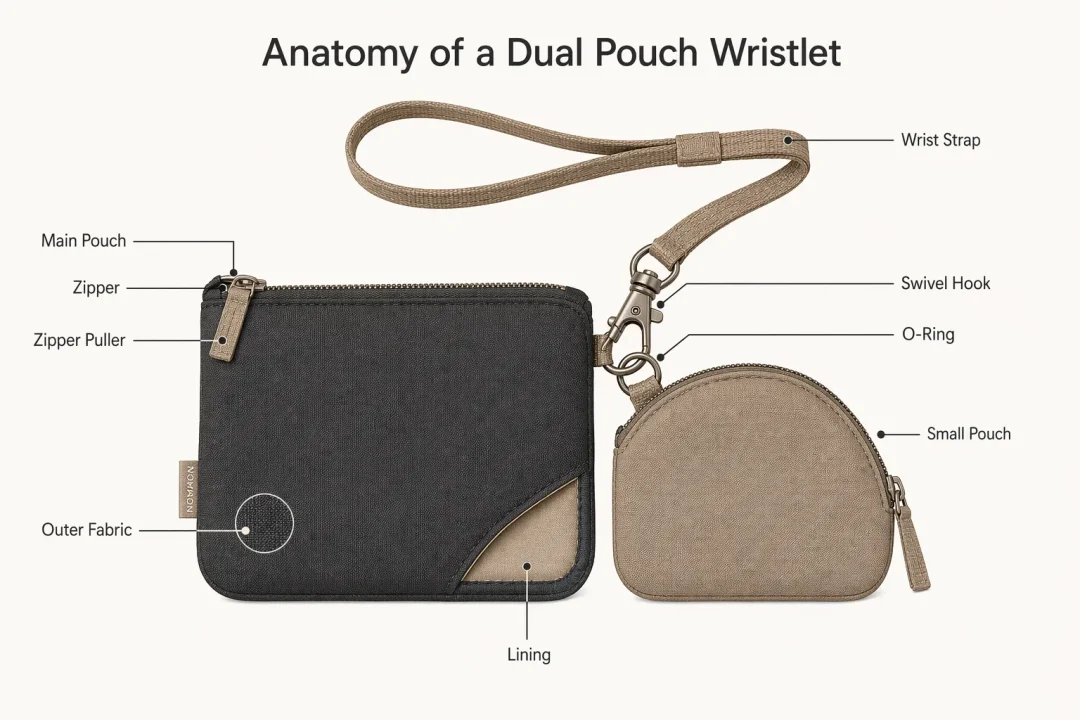
Each of these nine components represents an independent decision point in the product development process — and each has direct cost implications.
Vật liệu thông dụng được sử dụng
Material selection is one of the most consequential decisions in dual pouch wristlet development. It affects unit cost, MOQ, printing compatibility, durability, and target market positioning.
Material choice also determines:
- Unit cost — nylon and canvas are typically the most cost-efficient; PU leather and neoprene carry a premium
- MOQ requirements — specialty materials often require higher minimums
- Printing method compatibility — not all fabrics accept all print techniques
- Durability and market positioning — sports-facing SKUs typically prioritize nylon or neoprene; fashion-facing SKUs may use quilted fabric or PU leather
Các thương hiệu có thể tùy chỉnh gì?
The dual pouch wristlet is one of the most customizable compact accessories in the bag category. Below is a complete customization checklist for brand buyers.
Danh sách kiểm tra tùy chỉnh đầy đủ
Fabric & Structure
- ✅ Outer fabric type and color
- ✅ Lining color and material
- ✅ Pouch size ratio (main vs secondary)
- ✅ Pouch shape (semi-circle, square, rectangular)
- ✅ Both pouches in different fabrics or colors
Logo & Thương hiệu
- ✅ Screen print (on fabric surface)
- ✅ Heat transfer (for complex graphics)
- ✅ Embroidery (for premium texture)
- ✅ Silicone patch (raised logo effect)
- ✅ Woven label (sewn inside or outside)
- ✅ Deboss / laser engraving (on hardware or PU panels)
Hardware
- ✅ Swivel hook finish (gold / silver / gunmetal / black)
- ✅ Swivel hook size
- ✅ O-ring size and finish
- ✅ Zipper brand (YKK, SBS, or standard)
- ✅ Zipper color
- ✅ Zipper puller shape and material
- ✅ Custom zipper puller with logo
Wrist Strap
- ✅ Strap width
- ✅ Strap length
- ✅ Strap material (elastic, flat webbing, round cord)
- ✅ Logo print or woven label on strap
Đóng gói
- ✅ Hangtag (design, string color, hole placement)
- ✅ Polybag (plain or printed)
- ✅ Branded gift box
- ✅ Retail-ready packaging with barcode and pricing
Các yếu tố ảnh hưởng đến giá đơn vị?
This is typically the first question from brand buyers. Unit cost for a dual pouch wristlet is not fixed — it varies significantly based on the following factors:
Understanding these drivers allows buyers to make informed trade-offs — for example, choosing screen print over embroidery at lower volumes, or selecting a standard zipper for entry-level SKUs while reserving YKK specification for premium lines.
Túi đeo tay đôi được sản xuất như thế nào?
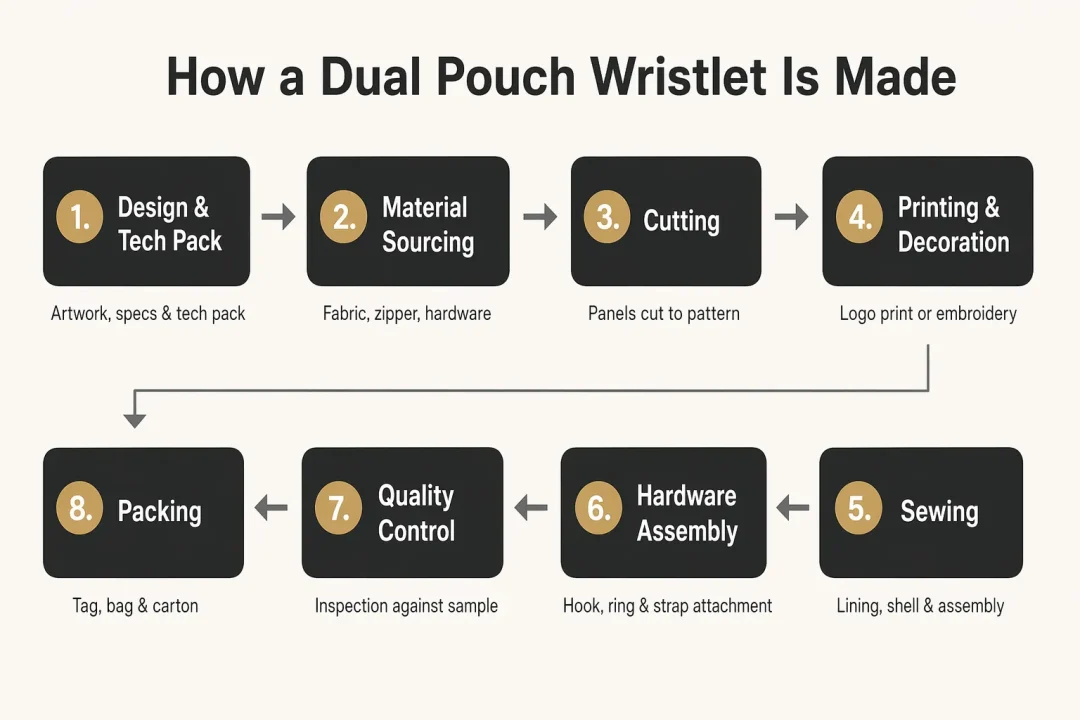
The production process for a dual pouch wristlet follows a standard soft goods manufacturing workflow, with several key stages that directly affect lead time and quality outcomes.
1. Design & Tech Pack Brand submits artwork, material specs, hardware references, and size requirements. Factory produces a tech pack with construction details, stitch counts, and tolerance ranges.
2. Material Sourcing Fabric, lining, zipper, hardware, and strap are sourced according to specification. Certified materials (RPET, OEKO-TEX) require supplier documentation at this stage.
3. Cutting Fabric panels are cut to pattern specifications. Precision at this stage affects seam alignment and finished dimensions.
4. Printing & Decoration Logo application (screen print, heat transfer, embroidery, or silicone patch) is applied to fabric panels before sewing where possible, ensuring clean edges and consistent placement.
5. Sewing Panels are sewn in sequence — lining first, then outer shell, then assembly of both pouches. Stitch type, stitch count per inch, and reinforcement at stress points (strap attachment, zipper base) are critical quality indicators.
6. Hardware Assembly Swivel hook, O-ring, zipper pullers, and wrist strap are attached. Hardware torque and fit are checked at this stage.
7. Quality Control Finished units are inspected against the approved sample. Typical checks include: zipper function, seam integrity, hardware security, logo placement accuracy, and dimensional compliance.
8. Packing Units are folded, bagged, tagged, and packed to carton specification. Export documentation (packing list, COA, test reports) is prepared.
Typical production lead time from approved sample to shipment: 30–45 days depending on order volume and material availability.
Ứng dụng điển hình
The dual pouch wristlet serves a wide range of B2B buyer categories, each with distinct product requirements:
OEM so với ODM túi đeo tay đôi
Understanding the difference between these sourcing models helps buyers choose the right approach for their product development stage.
When ODM makes sense: If you are entering the category for the first time, testing market demand, or working with a limited development budget, selecting from an existing ODM range allows you to launch quickly with lower risk. ODM samples are typically available within 7–10 days.
When OEM makes sense: If you have a defined brand aesthetic, existing product line consistency requirements, or proprietary structural features (e.g., RFID lining, custom hardware shape), OEM gives you full control over the final product. OEM development typically requires 2–4 weeks for sampling and approval before production begins.
Ma trận tùy chỉnh
A complete reference for brand buyers assessing what can be specified at the component level:
Cách chọn một nhà sản xuất túi đeo tay đáng tin cậy
Selecting the right manufacturing partner for a dual pouch wristlet is not simply a matter of price. The following criteria reflect what experienced buyers evaluate:
1. Relevant product experience Ask whether the factory has produced dual-pouch or multi-compartment wristlets before. Request photos of past production runs, not just catalog images. A supplier familiar with the specific hardware assembly (swivel hook + O-ring + dual zipper coordination) will produce more consistent results and require less sampling iteration.
2. Custom hardware capability Standard hardware is widely available, but brands often require a specific finish, size, or engraved detail. Confirm whether the factory can source or tool custom hardware, and what the associated tooling cost and lead time are.
3. Mold and tooling development For custom zipper pullers, swivel hooks, or silicone patches with brand logos, mold tooling is required. A capable factory will have experience managing this process and can provide tooling samples for approval before production.
4. QC process and documentation Request the factory’s standard QC checklist for wristlet production. Key indicators include: seam pull-force testing, zipper cycle testing, hardware corrosion resistance, and dimensional inspection against approved sample.
5. Export market experience Brands targeting the US or European market need suppliers familiar with applicable regulations: REACH compliance, California Proposition 65, CPSC requirements for consumer products, and OEKO-TEX or GRS certification for sustainable claims. Confirm whether the factory has supplied these markets before and can provide relevant documentation.
6. Sampling responsiveness Sampling speed is often a proxy for factory organization. A well-run factory should be able to deliver a first ODM sample within 7–10 days and an OEM sample within 14–21 days of receiving approved materials and tech pack.
5 câu hỏi cần hỏi trước khi đặt hàng túi đeo tay đôi tùy chỉnh
These questions go beyond standard supplier evaluation and reflect real sourcing concerns for brand buyers working in the accessories category:
1. Will the metal hardware pass salt spray or corrosion testing? Hardware is a common failure point in wristlet products, particularly for brands selling into markets with humidity or coastal environments. Ask for the factory’s standard hardware testing protocol and whether they can provide salt spray test reports.
2. Can the zipper brand be specified — for example, YKK or SBS? Zipper quality directly affects consumer perception and product longevity. If your brand has a zipper specification, confirm upfront whether the factory can source and use that brand. Standard zippers are significantly cheaper, but may not meet the durability expectations of premium retail SKUs.
3. Is recycled or certified material available? If your brand makes sustainability claims, the material supply chain needs to be documented. Ask whether the factory can supply RPET fabric with GRS (Global Recycled Standard) certification, and whether they can provide chain-of-custody documentation for your compliance needs.
4. Can both pouches use different fabrics or colors? This is a common design question that not all factories handle efficiently. Mixed-material or mixed-color dual-pouch construction requires careful pattern management and may affect per-unit cost. Confirm this capability before committing to a design.
5. Does the supplier have experience producing for lifestyle or sports brands? Category experience matters. Factories that have produced for athleisure, outdoor, or premium lifestyle brands understand the finishing standards, color consistency requirements, and packaging expectations of those markets. Ask for brand references or production photos in the relevant category.
Câu Hỏi Thường Gặp
What size is a dual pouch wristlet? Standard sizes vary by manufacturer, but a typical dual pouch wristlet features a main pouch of approximately 4.5″ × 2.8″ (11.5cm × 7cm) and a secondary pouch slightly smaller. Custom sizing is available through OEM production, and buyers can specify dimensions to match their intended use case.
What materials are most durable for everyday use? Water-repellent nylon is widely considered the most practical material for everyday carry — it is lightweight, easy to clean, and resistant to light moisture. Canvas is more structured and suitable for casual or retail applications. For outdoor or active-use products, neoprene offers additional stretch and water resistance.
Can I customize the wrist strap? Yes. Strap width, length, and material can all be specified in OEM production. Brands can also add a logo to the strap via woven label, screen print, or heat transfer. Strap attachment method (sewn vs hardware-connected) can also be adjusted depending on the desired aesthetic.
What is the typical MOQ for custom dual pouch wristlets? MOQ varies depending on materials, hardware specifications, and printing requirements. Factories generally have lower MOQs for ODM styles using existing materials and higher MOQs for fully custom OEM production. Contact your supplier directly to discuss MOQ based on your specific product brief.
Can both pouches have different colors or fabrics? Yes — mixed-color and mixed-material dual-pouch construction is technically feasible and fairly common in retail collections. Each pouch is cut and sewn independently before hardware assembly, which allows independent specification. This may affect per-unit cost slightly due to the additional material management involved.
Can the wristlet be made from recycled materials? Yes. RPET (recycled polyester from post-consumer plastic bottles) is a widely available option for wristlet production. GRS-certified RPET is available through most experienced OEM suppliers and supports brand sustainability claims. Lining can also be specified in recycled material if needed.
Can different pouch sizes be combined? Yes. The ratio between the main pouch and the secondary pouch is a design variable. Some brands prefer nearly equal-sized pouches; others prefer a significantly larger main pouch with a small coin-sized secondary. Custom proportions can be developed during the sampling stage.
Final Thoughts
As demand for compact everyday accessories continues to grow, the dual pouch wristlet has become more than just a fashion item — it is now a versatile product category for retailers, promotional companies, and private-label brands. Understanding its construction, materials, and customization options helps buyers make better sourcing decisions. Whether you’re developing a minimalist lifestyle collection or expanding an existing accessories line, working with an experienced OEM manufacturer can streamline product development from concept to production.

 Vietnamese
 English
 French
 German
 Japanese
 Arabic
 Thai
 Russian
 Spanish
 Portuguese