
Kompakte Alltagsaccessoires haben sich zu einer der am schnellsten wachsenden Kategorien in der Mode und bei Werbeartikeln entwickelt. Unter ihnen sticht das duale Beutelarmband durch sein praktisches Design hervor, das zwei Reißverschlussfächer mit einem abnehmbaren Handgelenkband kombiniert. Popularisiert von bekannten Lifestyle-Marken wie Lululemon, hat dieses Produkt viele Einzelhändler, Werbefirmen und Marken mit eigenem Label inspiriert, ihre eigenen Versionen zu entwickeln. Für Käufer ist das Verständnis der Konstruktion, der Anpassungsoptionen und des Herstellungsprozesses der erste Schritt zur Schaffung einer erfolgreichen Produktlinie.
Was ist ein Dual Pouch Wristlet?
Ein duales Beutelarmband ist ein kompaktes Tragaccessoire, das um zwei unabhängige Reißverschlusstaschen herum gebaut ist, die durch Metallbeschläge und ein gemeinsames Handgelenkband miteinander verbunden sind. Im Gegensatz zu einem Einzelfach-Armband oder einer Standard-Brieftasche hält seine modulare Struktur verschiedene Kategorien von Gegenständen getrennt und zugänglich, ohne die Masse einer Tasche.
Die wichtigsten Komponenten, die das Design definieren:
- Zwei unabhängige Reißverschlussfächer — typischerweise ein rechteckiges Hauptfach für Karten und Bargeld und ein kleineres halbkreisförmiges oder quadratisches secundäres Fach für Schlüssel, Münzen oder kleine Accessoires
- Geteiltes Handgelenkband — eine elastische oder gewebte Schlaufe, die das Tragen um das Handgelenk freihändig ermöglicht
- Drehhaken und O-Ring-Verbindung — die Metallhardware, die die beiden Taschen verbindet und es ermöglicht, jede unabhängig zu trennen
- Abnehmbare Hardware — beide Taschen können getrennt und einzeln oder an einer größeren Tasche befestigt werden
- Lightweight construction — typischerweise unter 100 g, entworfen für die tragbare Nutzung im Alltag
Obwohl Verbraucher es als Modeaccessoire ansehen, betrachten Hersteller es als ein modulares Produkt, das aus mehreren anpassbaren Komponenten besteht — von denen jede unabhängig spezifiziert, gebrandet und kostenoptimiert werden kann.
Warum ist das duale Beutelarmband so beliebt geworden?
Der Aufstieg des Produkts spiegelt drei sich kreuzende Trends wider, die direkt relevant für Entscheidungen zur Beschaffung von Marken sind.
Trends bei Alltagsgegenständen
Minimalismus im persönlichen Gepäck hat seit den frühen 2020er Jahren zugenommen. Immer mehr Verbraucher entscheiden sich dafür, große Handtaschen zurückzulassen und nur das zu tragen, was sie benötigen: eine Karte, einen Schlüssel, Ohrhörer und einen Lippenbalsam. Die doppelte Taschen-Handgelenktasche passt genau zu diesem Verhaltenswandel — sie hält genau die moderne Liste für das tägliche Tragen, ohne unnötiges Gewicht oder Volumen hinzuzufügen. Für Marken, die aktive, städtische oder lebensstilbewusste Verbraucher ansprechen, macht dies es zu einer hochrelevanten Produktkategorie.
Präsenz in sozialen Medien
Das Format der doppelten Taschen-Handgelenktasche ist von Natur aus fotogen. Ihre kompakte Silhouette, klaren Linien und die Möglichkeit zur Farbanpassung machten sie zu einer natürlichen Ergänzung für TikTok “Was ist in meiner Tasche” Inhalte, Instagram OOTD-Flachansichten und Pinterest-Boards für das tägliche Tragen. Die organische Inhaltserstellung durch echte Nutzer führte zu einem nachhaltigen Anstieg des Suchvolumens in mehreren Märkten, was dieses Produkt zu einem macht, das sich durch sozialer Beweis selbst verkauft — was besonders wertvoll für neue Marken ist, die in die Kategorie eintreten.
Wie Lululemon das duale Beutelarmband popularisierte
Doppelte Fachtaschen gibt es seit Jahren in Produktkategorien wie Schlüsseltaschen, Geldbörsen, Reiseorganisatoren und Handgelenk-Wallets. Das strukturelle Konzept — zwei mit Hardware verbundene Reißverschlussfächer — ist der Taschenherstellungsindustrie nicht neu.
Was sich geändert hat, ist die Rolle von Lululemon bei der Einführung dieser Struktur in das allgemeine Bewusstsein der Verbraucher. Die Dual Pouch Wristlet von Lululemon führte ein standardisiertes, abnehmbares Format mit zwei Taschen ein, das eine saubere athleisure Ästhetik, wasserabweisende Nylonkonstruktion und ein konsistentes Größenverhältnis zwischen den beiden Fächern aufweist. Durch seine Vertriebswege und die starke Präsenz in sozialen Medien wurde das Produkt weithin anerkannt — und häufig gesucht.
Die Markteinwirkung war für die breitere Branche erheblich: Als die Lululemon-Version wiederholt ausverkauft war, begannen Käufer nach ähnlichen Designs mit doppelten Taschen anderer Marken zu suchen. Diese Spillover-Nachfrage schuf eine echte Beschaffungsmöglichkeit, die weiter wächst. Anstatt das Konzept zu erfinden, spielte Lululemon eine Schlüsselrolle bei der Benennung, Standardisierung und Popularisierung eines Produktformats, das OEM-Hersteller und Eigenmarken jetzt gut versorgt können.
Anatomie eines dualen Beutelarmbands
Das Verständnis der Komponentenaufteilung ist wichtig für präzise Angebote, Werkzeugentscheidungen und Anpassungsplanung.
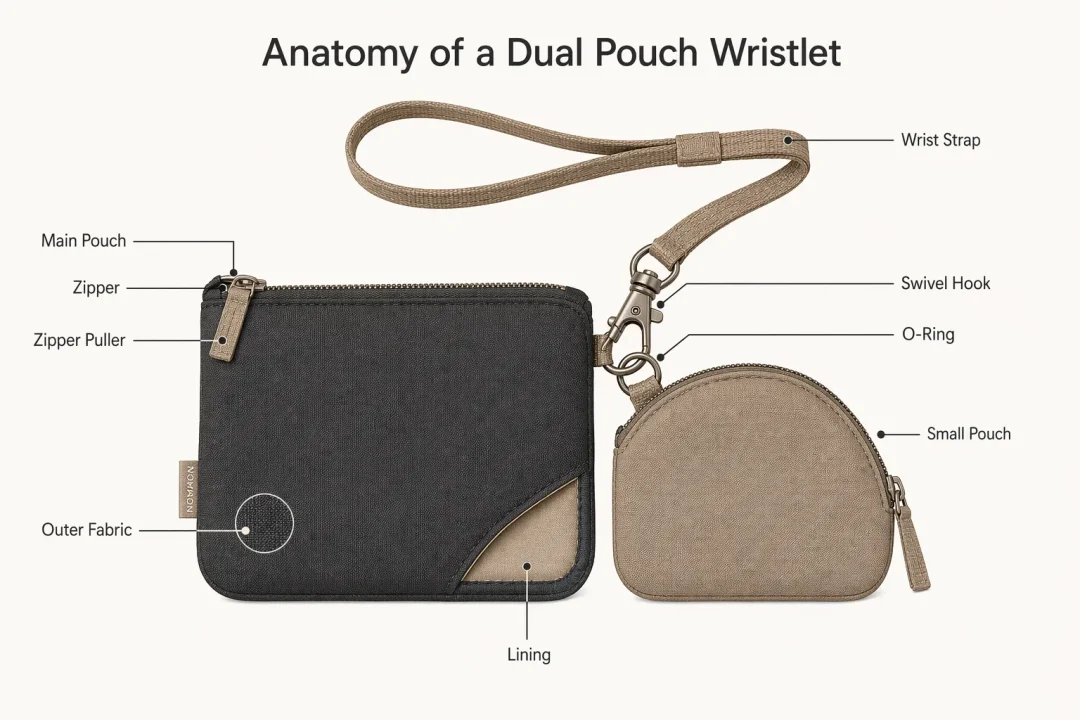
Jedes dieser neun Komponenten stellt einen unabhängigen Entscheidungsprozess im Produktentwicklungsprozess dar – und jede hat direkte Kostenimplikationen.
Häufig verwendete Materialien
Die Materialauswahl ist eine der folgenreichsten Entscheidungen bei der Entwicklung von dualen Pouch-Wristlets. Sie beeinflusst die Stückkosten, MOQ, Druckkompatibilität, Haltbarkeit und die Positionierung im Zielmarkt.
Die Materialwahl bestimmt ebenfalls:
- Unit cost — Nylon und Canvas sind in der Regel die kosteneffizientesten; PU-Leder und Neopren haben einen höheren Preis
- Mindestbestellmengen (MOQ) — Spezialmaterialien erfordern oft höhere Mindestmengen
- Kompatibilität der Druckmethoden — nicht alle Stoffe akzeptieren alle Drucktechniken
- Haltbarkeit und Marktpositionierung — Sportartikel legen typischerweise Wert auf Nylon oder Neopren; Modeartikel verwenden möglicherweise gesteppte Stoffe oder PU-Leder
Was können Marken anpassen?
Der doppelte Taschen-Wristlet ist eines der anpassbarsten kompakten Accessoires in der Taschenkategorie. Unten finden Sie eine vollständige Anpassungscheckliste für Markenkäufer.
Checkliste zur vollständigen Anpassung
Stoff & Struktur
- ✅ Außenstofftyp und Farbe
- ✅ Futterfarbe und -material
- ✅ Beutelgrößenverhältnis (haupt vs. sekundär)
- ✅ Beutelform (Halbkreis, quadratisch, rechteckig)
- ✅ Beide Beutel in verschiedenen Stoffen oder Farben
Logo & Branding
- ✅ Siebdruck (auf Stoffoberfläche)
- ✅ Wärmeübertragung (für komplexe Grafiken)
- ✅ Stickerei (für hochwertige Textur)
- ✅ Silikonaufnäher (erhabene Logo-Effekt)
- ✅ Gewebtes Etikett (innen oder außen genäht)
- ✅ Prägung / Lasermarkierung (auf Hardware oder PU-Platten)
Hardware
- ✅ Swivel hook finish (gold / silver / gunmetal / black)
- ✅ Swivel hook size
- ✅ O-ring size and finish
- ✅ Zipper brand (YKK, SBS, or standard)
- ✅ Zipper color
- ✅ Zipper puller shape and material
- ✅ Custom zipper puller with logo
Wrist Strap
- ✅ Strap width
- ✅ Strap length
- ✅ Strap material (elastic, flat webbing, round cord)
- ✅ Logo print or woven label on strap
Verpackung
- ✅ Hangtag (design, string color, hole placement)
- ✅ Polybag (plain or printed)
- ✅ Branded gift box
- ✅ Retail-ready packaging with barcode and pricing
Kostenfaktoren: Was beeinflusst den Stückpreis?
This is typically the first question from brand buyers. Unit cost for a dual pouch wristlet is not fixed — it varies significantly based on the following factors:
Understanding these drivers allows buyers to make informed trade-offs — for example, choosing screen print over embroidery at lower volumes, or selecting a standard zipper for entry-level SKUs while reserving YKK specification for premium lines.
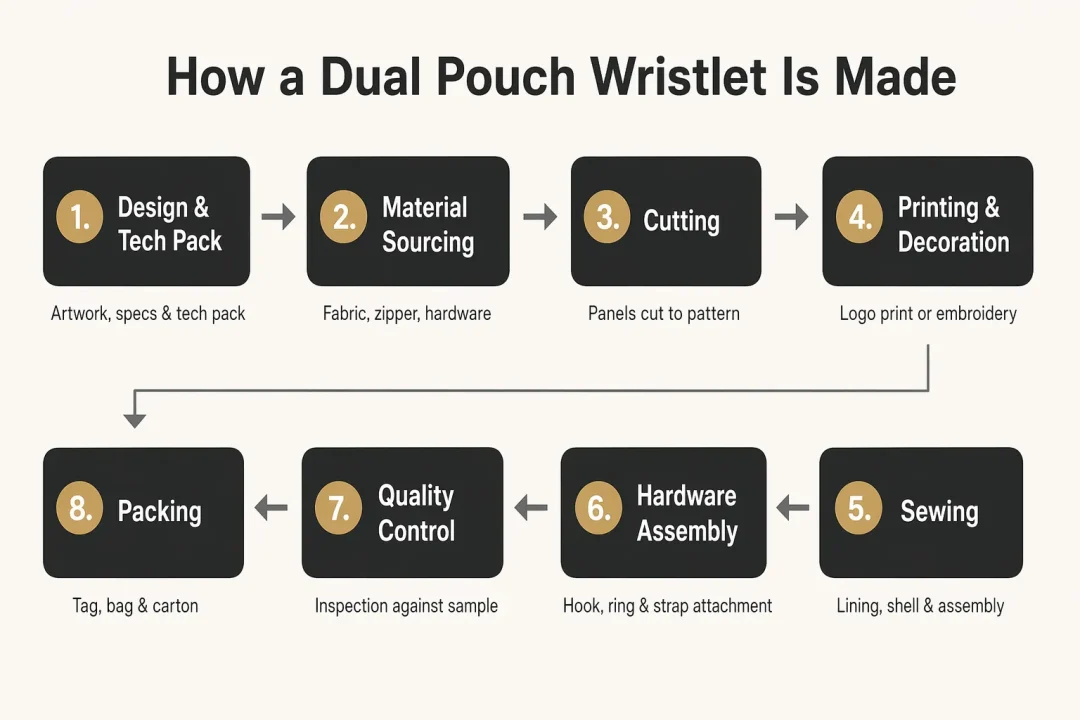
Wie wird ein duales Beutelarmband hergestellt?
The production process for a dual pouch wristlet follows a standard soft goods manufacturing workflow, with several key stages that directly affect lead time and quality outcomes.
1. Design & Tech Pack Brand submits artwork, material specs, hardware references, and size requirements. Factory produces a tech pack with construction details, stitch counts, and tolerance ranges.
2. Material Sourcing Fabric, lining, zipper, hardware, and strap are sourced according to specification. Certified materials (RPET, OEKO-TEX) require supplier documentation at this stage.
3. Cutting Fabric panels are cut to pattern specifications. Precision at this stage affects seam alignment and finished dimensions.
4. Printing & Decoration Logo application (screen print, heat transfer, embroidery, or silicone patch) is applied to fabric panels before sewing where possible, ensuring clean edges and consistent placement.
5. Sewing Panels are sewn in sequence — lining first, then outer shell, then assembly of both pouches. Stitch type, stitch count per inch, and reinforcement at stress points (strap attachment, zipper base) are critical quality indicators.
6. Hardware Assembly Swivel hook, O-ring, zipper pullers, and wrist strap are attached. Hardware torque and fit are checked at this stage.
7. Quality Control Finished units are inspected against the approved sample. Typical checks include: zipper function, seam integrity, hardware security, logo placement accuracy, and dimensional compliance.
8. Packing Units are folded, bagged, tagged, and packed to carton specification. Export documentation (packing list, COA, test reports) is prepared.
Typical production lead time from approved sample to shipment: 30–45 days depending on order volume and material availability.
Typische Anwendungen
The dual pouch wristlet serves a wide range of B2B buyer categories, each with distinct product requirements:
OEM vs ODM duale Beutelarmbänder
Understanding the difference between these sourcing models helps buyers choose the right approach for their product development stage.
When ODM makes sense: If you are entering the category for the first time, testing market demand, or working with a limited development budget, selecting from an existing ODM range allows you to launch quickly with lower risk. ODM samples are typically available within 7–10 days.
When OEM makes sense: If you have a defined brand aesthetic, existing product line consistency requirements, or proprietary structural features (e.g., RFID lining, custom hardware shape), OEM gives you full control over the final product. OEM development typically requires 2–4 weeks for sampling and approval before production begins.
Anpassungsmatrix
A complete reference for brand buyers assessing what can be specified at the component level:
Wie wählt man einen zuverlässigen Armbandhersteller aus?
Selecting the right manufacturing partner for a dual pouch wristlet is not simply a matter of price. The following criteria reflect what experienced buyers evaluate:
1. Relevant product experience Ask whether the factory has produced dual-pouch or multi-compartment wristlets before. Request photos of past production runs, not just catalog images. A supplier familiar with the specific hardware assembly (swivel hook + O-ring + dual zipper coordination) will produce more consistent results and require less sampling iteration.
2. Custom hardware capability Standard hardware is widely available, but brands often require a specific finish, size, or engraved detail. Confirm whether the factory can source or tool custom hardware, and what the associated tooling cost and lead time are.
3. Mold and tooling development For custom zipper pullers, swivel hooks, or silicone patches with brand logos, mold tooling is required. A capable factory will have experience managing this process and can provide tooling samples for approval before production.
4. QC process and documentation Request the factory’s standard QC checklist for wristlet production. Key indicators include: seam pull-force testing, zipper cycle testing, hardware corrosion resistance, and dimensional inspection against approved sample.
5. Export market experience Brands targeting the US or European market need suppliers familiar with applicable regulations: REACH compliance, California Proposition 65, CPSC requirements for consumer products, and OEKO-TEX or GRS certification for sustainable claims. Confirm whether the factory has supplied these markets before and can provide relevant documentation.
6. Sampling responsiveness Sampling speed is often a proxy for factory organization. A well-run factory should be able to deliver a first ODM sample within 7–10 days and an OEM sample within 14–21 days of receiving approved materials and tech pack.
5 Fragen, die Sie vor der Bestellung von individuellen dualen Beutelarmbändern stellen sollten
These questions go beyond standard supplier evaluation and reflect real sourcing concerns for brand buyers working in the accessories category:
1. Will the metal hardware pass salt spray or corrosion testing? Hardware is a common failure point in wristlet products, particularly for brands selling into markets with humidity or coastal environments. Ask for the factory’s standard hardware testing protocol and whether they can provide salt spray test reports.
2. Can the zipper brand be specified — for example, YKK or SBS? Zipper quality directly affects consumer perception and product longevity. If your brand has a zipper specification, confirm upfront whether the factory can source and use that brand. Standard zippers are significantly cheaper, but may not meet the durability expectations of premium retail SKUs.
3. Is recycled or certified material available? If your brand makes sustainability claims, the material supply chain needs to be documented. Ask whether the factory can supply RPET fabric with GRS (Global Recycled Standard) certification, and whether they can provide chain-of-custody documentation for your compliance needs.
4. Can both pouches use different fabrics or colors? This is a common design question that not all factories handle efficiently. Mixed-material or mixed-color dual-pouch construction requires careful pattern management and may affect per-unit cost. Confirm this capability before committing to a design.
5. Does the supplier have experience producing for lifestyle or sports brands? Category experience matters. Factories that have produced for athleisure, outdoor, or premium lifestyle brands understand the finishing standards, color consistency requirements, and packaging expectations of those markets. Ask for brand references or production photos in the relevant category.
Häufig gestellte Fragen
What size is a dual pouch wristlet? Standard sizes vary by manufacturer, but a typical dual pouch wristlet features a main pouch of approximately 4.5″ × 2.8″ (11.5cm × 7cm) and a secondary pouch slightly smaller. Custom sizing is available through OEM production, and buyers can specify dimensions to match their intended use case.
What materials are most durable for everyday use? Water-repellent nylon is widely considered the most practical material for everyday carry — it is lightweight, easy to clean, and resistant to light moisture. Canvas is more structured and suitable for casual or retail applications. For outdoor or active-use products, neoprene offers additional stretch and water resistance.
Can I customize the wrist strap? Yes. Strap width, length, and material can all be specified in OEM production. Brands can also add a logo to the strap via woven label, screen print, or heat transfer. Strap attachment method (sewn vs hardware-connected) can also be adjusted depending on the desired aesthetic.
What is the typical MOQ for custom dual pouch wristlets? MOQ varies depending on materials, hardware specifications, and printing requirements. Factories generally have lower MOQs for ODM styles using existing materials and higher MOQs for fully custom OEM production. Contact your supplier directly to discuss MOQ based on your specific product brief.
Can both pouches have different colors or fabrics? Yes — mixed-color and mixed-material dual-pouch construction is technically feasible and fairly common in retail collections. Each pouch is cut and sewn independently before hardware assembly, which allows independent specification. This may affect per-unit cost slightly due to the additional material management involved.
Can the wristlet be made from recycled materials? Yes. RPET (recycled polyester from post-consumer plastic bottles) is a widely available option for wristlet production. GRS-certified RPET is available through most experienced OEM suppliers and supports brand sustainability claims. Lining can also be specified in recycled material if needed.
Can different pouch sizes be combined? Yes. The ratio between the main pouch and the secondary pouch is a design variable. Some brands prefer nearly equal-sized pouches; others prefer a significantly larger main pouch with a small coin-sized secondary. Custom proportions can be developed during the sampling stage.
Fazit
As demand for compact everyday accessories continues to grow, the dual pouch wristlet has become more than just a fashion item — it is now a versatile product category for retailers, promotional companies, and private-label brands. Understanding its construction, materials, and customization options helps buyers make better sourcing decisions. Whether you’re developing a minimalist lifestyle collection or expanding an existing accessories line, working with an experienced OEM manufacturer can streamline product development from concept to production.
 German
 English
 French
 Japanese
 Arabic
 Thai
 Vietnamese
 Russian
 Spanish
 Portuguese