
Compact everyday accessories have become one of the fastest-growing categories in fashion and promotional products. Among them, the dual pouch wristlet stands out for its practical design, combining two zippered compartments with a detachable wrist strap. Popularized by well-known lifestyle brands such as Lululemon, this product has inspired many retailers, promotional companies, and private-label brands to develop their own versions. For buyers, understanding its construction, customization options, and manufacturing process is the first step toward creating a successful product line.
What Is a Dual Pouch Wristlet?
A dual pouch wristlet is a compact carry accessory built around two independent zippered pouches connected by metal hardware and a shared wrist strap. Unlike a single-compartment wristlet or a standard wallet, its modular structure keeps different categories of items separated and accessible without the bulk of a bag.
The key components that define the design:
- Two independent zippered pouches — typically one rectangular main pouch for cards and cash, and one smaller semi-circle or square secondary pouch for keys, coins, or small accessories
- Shared wrist strap — an elastic or webbing loop that allows hands-free carrying around the wrist
- Swivel hook and O-ring connector — the metal hardware that links the two pouches and allows each to be detached independently
- Detachable hardware — both pouches can be separated and used individually or clipped onto a larger bag
- Lightweight construction — typically under 100g, designed for everyday portability
Although consumers see it as a fashion accessory, manufacturers view it as a modular product consisting of multiple customizable components — each of which can be independently specified, branded, and optimized for cost.
Why Has the Dual Pouch Wristlet Become So Popular?
The product’s rise reflects three converging trends that are directly relevant to brand sourcing decisions.
Everyday Carry Trend
Minimalism in personal carry has been accelerating since the early 2020s. More consumers are choosing to leave large handbags behind in favor of carrying only what they need: a card, a key, earbuds, and a lip balm. The dual pouch wristlet fits this behavioral shift precisely — it holds exactly the modern everyday carry list without adding unnecessary weight or bulk. For brands targeting active, urban, or lifestyle-conscious consumers, this makes it a high-relevance product category.
Social Media Exposure
The dual pouch wristlet format is inherently photogenic. Its compact silhouette, clean lines, and color customizability made it a natural fit for TikTok “what’s in my bag” content, Instagram OOTD flat-lays, and Pinterest everyday carry boards. Organic content creation by real users drove sustained search volume growth across multiple markets, making this a product that sells itself through social proof — which is particularly valuable for new brands entering the category.
How Lululemon Popularized the Dual Pouch Wristlet
Dual-compartment pouches have existed for years across product categories including key pouches, coin purses, travel organizers, and wristlet wallets. The structural concept — two zippered compartments connected by hardware — is not new to the bag manufacturing industry.
What changed was Lululemon’s role in bringing this structure to mainstream consumer awareness. Lululemon’s Dual Pouch Wristlet introduced a standardized, detachable two-pouch format with a clean athleisure aesthetic, water-repellent nylon construction, and a consistent size ratio between the two compartments. Through its brand distribution channels and strong social media presence, the product became widely recognized — and widely searched.
The market impact was significant for the broader industry: as the Lululemon version sold out repeatedly, buyers began searching for similar dual-pouch designs from other brands. This spillover demand created a genuine sourcing opportunity that continues to grow. Rather than inventing the concept, Lululemon played a key role in naming, standardizing, and popularizing a product format that OEM manufacturers and private-label brands are now well-positioned to supply.
Anatomy of a Dual Pouch Wristlet
Understanding the component breakdown is essential for accurate quoting, tooling decisions, and customization planning.
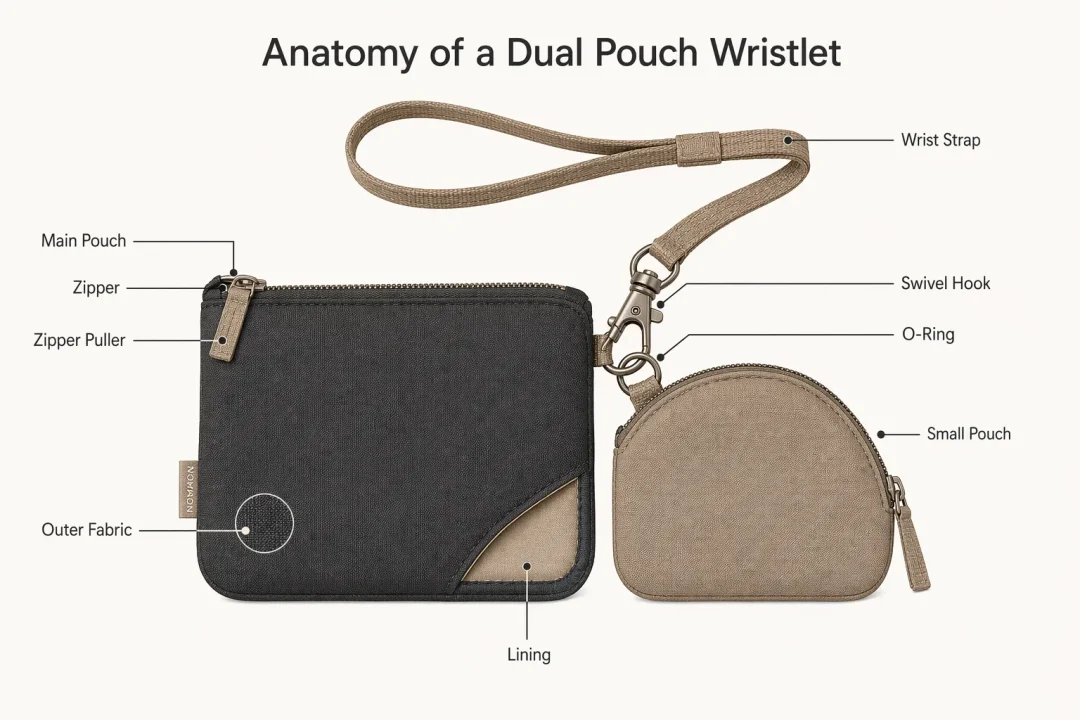
Each of these nine components represents an independent decision point in the product development process — and each has direct cost implications.
Common Materials Used
Material selection is one of the most consequential decisions in dual pouch wristlet development. It affects unit cost, MOQ, printing compatibility, durability, and target market positioning.
Material choice also determines:
- Unit cost — nylon and canvas are typically the most cost-efficient; PU leather and neoprene carry a premium
- MOQ requirements — specialty materials often require higher minimums
- Printing method compatibility — not all fabrics accept all print techniques
- Durability and market positioning — sports-facing SKUs typically prioritize nylon or neoprene; fashion-facing SKUs may use quilted fabric or PU leather
What Can Brands Customize?
The dual pouch wristlet is one of the most customizable compact accessories in the bag category. Below is a complete customization checklist for brand buyers.
Full Customization Checklist
Fabric & Structure
- ✅ Outer fabric type and color
- ✅ Lining color and material
- ✅ Pouch size ratio (main vs secondary)
- ✅ Pouch shape (semi-circle, square, rectangular)
- ✅ Both pouches in different fabrics or colors
Logo & Branding
- ✅ Screen print (on fabric surface)
- ✅ Heat transfer (for complex graphics)
- ✅ Embroidery (for premium texture)
- ✅ Silicone patch (raised logo effect)
- ✅ Woven label (sewn inside or outside)
- ✅ Deboss / laser engraving (on hardware or PU panels)
Hardware
- ✅ Swivel hook finish (gold / silver / gunmetal / black)
- ✅ Swivel hook size
- ✅ O-ring size and finish
- ✅ Zipper brand (YKK, SBS, or standard)
- ✅ Zipper color
- ✅ Zipper puller shape and material
- ✅ Custom zipper puller with logo
Wrist Strap
- ✅ Strap width
- ✅ Strap length
- ✅ Strap material (elastic, flat webbing, round cord)
- ✅ Logo print or woven label on strap
Packaging
- ✅ Hangtag (design, string color, hole placement)
- ✅ Polybag (plain or printed)
- ✅ Branded gift box
- ✅ Retail-ready packaging with barcode and pricing
Cost Drivers: What Affects the Unit Price?
This is typically the first question from brand buyers. Unit cost for a dual pouch wristlet is not fixed — it varies significantly based on the following factors:
Understanding these drivers allows buyers to make informed trade-offs — for example, choosing screen print over embroidery at lower volumes, or selecting a standard zipper for entry-level SKUs while reserving YKK specification for premium lines.
How Is a Dual Pouch Wristlet Manufactured?
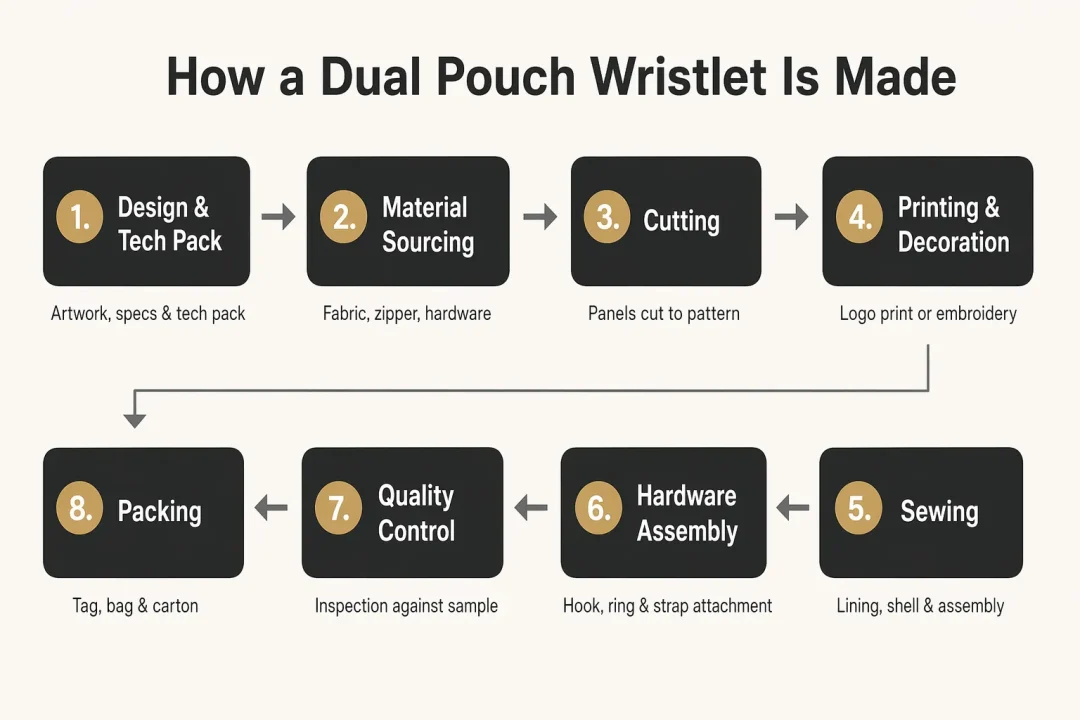
The production process for a dual pouch wristlet follows a standard soft goods manufacturing workflow, with several key stages that directly affect lead time and quality outcomes.
1. Design & Tech Pack Brand submits artwork, material specs, hardware references, and size requirements. Factory produces a tech pack with construction details, stitch counts, and tolerance ranges.
2. Material Sourcing Fabric, lining, zipper, hardware, and strap are sourced according to specification. Certified materials (RPET, OEKO-TEX) require supplier documentation at this stage.
3. Cutting Fabric panels are cut to pattern specifications. Precision at this stage affects seam alignment and finished dimensions.
4. Printing & Decoration Logo application (screen print, heat transfer, embroidery, or silicone patch) is applied to fabric panels before sewing where possible, ensuring clean edges and consistent placement.
5. Sewing Panels are sewn in sequence — lining first, then outer shell, then assembly of both pouches. Stitch type, stitch count per inch, and reinforcement at stress points (strap attachment, zipper base) are critical quality indicators.
6. Hardware Assembly Swivel hook, O-ring, zipper pullers, and wrist strap are attached. Hardware torque and fit are checked at this stage.
7. Quality Control Finished units are inspected against the approved sample. Typical checks include: zipper function, seam integrity, hardware security, logo placement accuracy, and dimensional compliance.
8. Packing Units are folded, bagged, tagged, and packed to carton specification. Export documentation (packing list, COA, test reports) is prepared.
Typical production lead time from approved sample to shipment: 30–45 days depending on order volume and material availability.
Typical Applications
The dual pouch wristlet serves a wide range of B2B buyer categories, each with distinct product requirements:
OEM vs ODM Dual Pouch Wristlets
Understanding the difference between these sourcing models helps buyers choose the right approach for their product development stage.
When ODM makes sense: If you are entering the category for the first time, testing market demand, or working with a limited development budget, selecting from an existing ODM range allows you to launch quickly with lower risk. ODM samples are typically available within 7–10 days.
When OEM makes sense: If you have a defined brand aesthetic, existing product line consistency requirements, or proprietary structural features (e.g., RFID lining, custom hardware shape), OEM gives you full control over the final product. OEM development typically requires 2–4 weeks for sampling and approval before production begins.
Customization Matrix
A complete reference for brand buyers assessing what can be specified at the component level:
How to Choose a Reliable Wristlet Manufacturer
Selecting the right manufacturing partner for a dual pouch wristlet is not simply a matter of price. The following criteria reflect what experienced buyers evaluate:
1. Relevant product experience Ask whether the factory has produced dual-pouch or multi-compartment wristlets before. Request photos of past production runs, not just catalog images. A supplier familiar with the specific hardware assembly (swivel hook + O-ring + dual zipper coordination) will produce more consistent results and require less sampling iteration.
2. Custom hardware capability Standard hardware is widely available, but brands often require a specific finish, size, or engraved detail. Confirm whether the factory can source or tool custom hardware, and what the associated tooling cost and lead time are.
3. Mold and tooling development For custom zipper pullers, swivel hooks, or silicone patches with brand logos, mold tooling is required. A capable factory will have experience managing this process and can provide tooling samples for approval before production.
4. QC process and documentation Request the factory’s standard QC checklist for wristlet production. Key indicators include: seam pull-force testing, zipper cycle testing, hardware corrosion resistance, and dimensional inspection against approved sample.
5. Export market experience Brands targeting the US or European market need suppliers familiar with applicable regulations: REACH compliance, California Proposition 65, CPSC requirements for consumer products, and OEKO-TEX or GRS certification for sustainable claims. Confirm whether the factory has supplied these markets before and can provide relevant documentation.
6. Sampling responsiveness Sampling speed is often a proxy for factory organization. A well-run factory should be able to deliver a first ODM sample within 7–10 days and an OEM sample within 14–21 days of receiving approved materials and tech pack.
5 Questions to Ask Before Ordering Custom Dual Pouch Wristlets
These questions go beyond standard supplier evaluation and reflect real sourcing concerns for brand buyers working in the accessories category:
1. Will the metal hardware pass salt spray or corrosion testing? Hardware is a common failure point in wristlet products, particularly for brands selling into markets with humidity or coastal environments. Ask for the factory’s standard hardware testing protocol and whether they can provide salt spray test reports.
2. Can the zipper brand be specified — for example, YKK or SBS? Zipper quality directly affects consumer perception and product longevity. If your brand has a zipper specification, confirm upfront whether the factory can source and use that brand. Standard zippers are significantly cheaper, but may not meet the durability expectations of premium retail SKUs.
3. Is recycled or certified material available? If your brand makes sustainability claims, the material supply chain needs to be documented. Ask whether the factory can supply RPET fabric with GRS (Global Recycled Standard) certification, and whether they can provide chain-of-custody documentation for your compliance needs.
4. Can both pouches use different fabrics or colors? This is a common design question that not all factories handle efficiently. Mixed-material or mixed-color dual-pouch construction requires careful pattern management and may affect per-unit cost. Confirm this capability before committing to a design.
5. Does the supplier have experience producing for lifestyle or sports brands? Category experience matters. Factories that have produced for athleisure, outdoor, or premium lifestyle brands understand the finishing standards, color consistency requirements, and packaging expectations of those markets. Ask for brand references or production photos in the relevant category.
Frequently Asked Questions
What size is a dual pouch wristlet? Standard sizes vary by manufacturer, but a typical dual pouch wristlet features a main pouch of approximately 4.5″ × 2.8″ (11.5cm × 7cm) and a secondary pouch slightly smaller. Custom sizing is available through OEM production, and buyers can specify dimensions to match their intended use case.
What materials are most durable for everyday use? Water-repellent nylon is widely considered the most practical material for everyday carry — it is lightweight, easy to clean, and resistant to light moisture. Canvas is more structured and suitable for casual or retail applications. For outdoor or active-use products, neoprene offers additional stretch and water resistance.
Can I customize the wrist strap? Yes. Strap width, length, and material can all be specified in OEM production. Brands can also add a logo to the strap via woven label, screen print, or heat transfer. Strap attachment method (sewn vs hardware-connected) can also be adjusted depending on the desired aesthetic.
What is the typical MOQ for custom dual pouch wristlets? MOQ varies depending on materials, hardware specifications, and printing requirements. Factories generally have lower MOQs for ODM styles using existing materials and higher MOQs for fully custom OEM production. Contact your supplier directly to discuss MOQ based on your specific product brief.
Can both pouches have different colors or fabrics? Yes — mixed-color and mixed-material dual-pouch construction is technically feasible and fairly common in retail collections. Each pouch is cut and sewn independently before hardware assembly, which allows independent specification. This may affect per-unit cost slightly due to the additional material management involved.
Can the wristlet be made from recycled materials? Yes. RPET (recycled polyester from post-consumer plastic bottles) is a widely available option for wristlet production. GRS-certified RPET is available through most experienced OEM suppliers and supports brand sustainability claims. Lining can also be specified in recycled material if needed.
Can different pouch sizes be combined? Yes. The ratio between the main pouch and the secondary pouch is a design variable. Some brands prefer nearly equal-sized pouches; others prefer a significantly larger main pouch with a small coin-sized secondary. Custom proportions can be developed during the sampling stage.
Final Thoughts
As demand for compact everyday accessories continues to grow, the dual pouch wristlet has become more than just a fashion item — it is now a versatile product category for retailers, promotional companies, and private-label brands. Understanding its construction, materials, and customization options helps buyers make better sourcing decisions. Whether you’re developing a minimalist lifestyle collection or expanding an existing accessories line, working with an experienced OEM manufacturer can streamline product development from concept to production.

 English
 French
 German
 Japanese
 Arabic
 Thai
 Vietnamese
 Russian
 Spanish
 Portuguese