
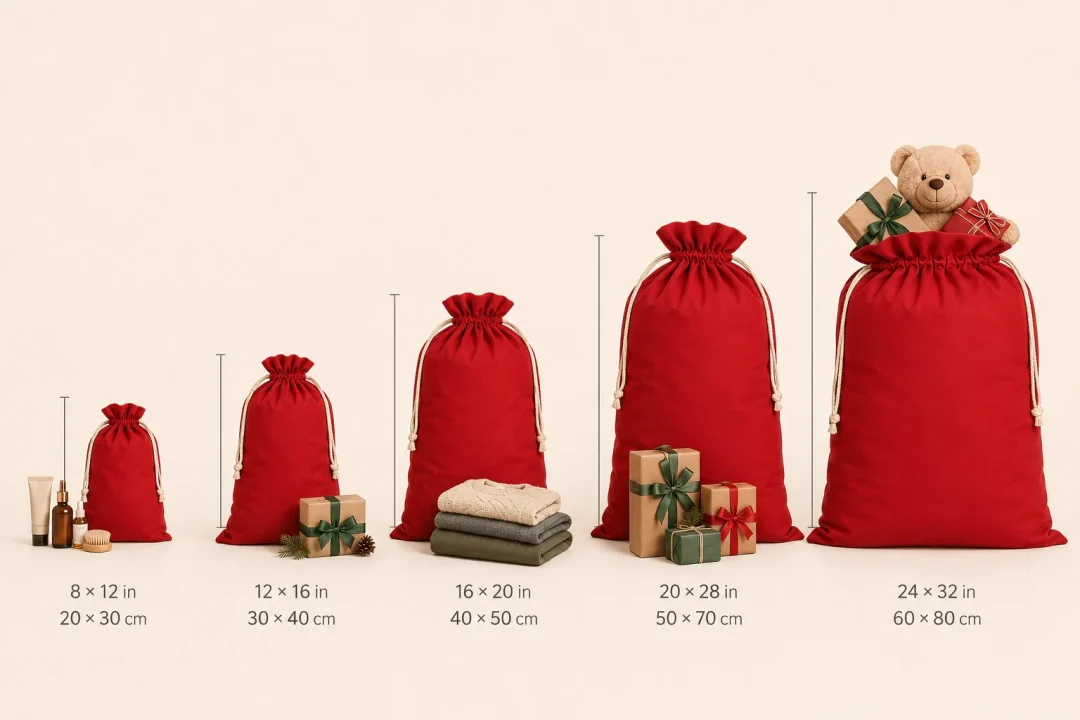
Đối với hầu hết các ứng dụng quà tặng gia đình, một túi Santa có kích thước khoảng 20 × 28 inch (50 × 70 cm) là một điểm khởi đầu thực tế. Các bộ quà tặng bán lẻ hoặc doanh nghiệp nhỏ hơn thường phù hợp hơn với 12 × 16 inch (30 × 40 cm) hoặc 16 × 20 inch (40 × 50 cm) các túi, trong khi các đồ chơi cồng kềnh và đạo cụ trưng bày có thể cần 24 × 32 inch (60 × 80 cm) or more.
Tuy nhiên, không có kích thước túi Santa tiêu chuẩn chung.
Dựa trên các yêu cầu theo mùa và các dự án túi tùy chỉnh mà chúng tôi đã xử lý, kích thước phù hợp thường phụ thuộc vào bốn yếu tố:
- Kích thước của sản phẩm sau khi đóng gói bán lẻ hoặc quà tặng
- Số lượng và cách sắp xếp các món đồ bên trong mỗi túi
- Không gian đóng lại cần thiết phía trên các sản phẩm
- Tổng trọng lượng và phương thức dự kiến để mang túi
Một túi được mô tả là “lớn” bởi một nhà cung cấp có thể được coi là “vô cùng lớn” bởi một nhà cung cấp khác. Vì vậy, đối với sản xuất tùy chỉnh, tên gọi kích thước chỉ là một điểm khởi đầu. Thông số cuối cùng luôn nên được viết dưới dạng chiều rộng hoàn thiện × chiều cao hoàn thiện, kèm theo kích thước mí khi có thể.
Nhanh chóng Túi Santa Biểu đồ kích thước
Các kích thước sau đây cung cấp các điểm khởi đầu thực tế để chọn hoặc phát triển một túi Santa.
| Kích thước khởi đầu | Kích thước mét | Nội dung phù hợp | Ứng dụng phổ biến |
|---|---|---|---|
| 8 × 12 in | 20 × 30 cm | Kẹo, trang sức, mỹ phẩm nhỏ và đồ quảng cáo | Quà tặng bán lẻ, tiện ích khách sạn và tiệc lễ hội |
| 12 × 16 in | 30 × 40 cm | Bộ chăm sóc da, văn phòng phẩm, phụ kiện và đồ chơi nhỏ | Bộ quà tặng làm đẹp, quà tặng cho nhân viên và khuyến mãi |
| 16 × 20 in | 40 × 50 cm | Sách, pyjama, bộ đồ chơi và hộp quà nhỏ | Quà tặng cho trẻ em và gói quà lễ hội có thương hiệu |
| 20 × 28 in | 50 × 70 cm | Hộp giày, vài món quà đã được gói và đồ chơi nhồi bông trung bình | Sử dụng gia đình, bộ sưu tập bán lẻ và bộ quà tặng lớn hơn |
| 24 × 32 in | 60 × 80 cm | Đồ chơi lớn, nhiều hộp và đồ chơi nhồi bông cồng kềnh | Quà tặng cho trẻ em, sự kiện và trưng bày theo mùa |
| 30 × 40 in hoặc lớn hơn | 75 × 100 cm hoặc lớn hơn | Đồ chơi quá cỡ, quà tặng nhẹ và đạo cụ trưng bày | Trung tâm thương mại, chụp ảnh và sự kiện Santa |
Đây là các khoảng đánh giá được khuyến nghị hơn là tiêu chuẩn ngành bắt buộc.
Một hộp chữ nhật cứng có thể yêu cầu chiều rộng hoặc một nếp gấp nhiều hơn so với một sản phẩm mềm có cùng thể tích. Một bao lớn dành cho đồ chơi nhồi bông có thể không cần vải nặng, trong khi một bao nhỏ chứa sách, chai hoặc cốc sứ có thể yêu cầu cấu trúc mạnh mẽ hơn.
Đối với các đơn hàng tùy chỉnh số lượng lớn, một bài kiểm tra đóng gói thực tế nên được thực hiện trước khi các kích thước cuối cùng được phê duyệt.
Cách chúng tôi phù hợp kích thước túi Santa với các tình huống tùy chỉnh khác nhau
Các yêu cầu về túi Santa mà một nhà máy nhận được không chỉ giới hạn trong các món quà Giáng sinh cho gia đình. Người mua sử dụng những túi này cho các bộ sưu tập bán lẻ, chương trình quà tặng doanh nghiệp, tiện nghi khách sạn, sự kiện quảng cáo, đóng gói đồ chơi và trưng bày theo mùa.
Mỗi loại dự án tạo ra một ưu tiên kích thước khác nhau. Các khoảng sau đây phản ánh các điểm khởi đầu hữu ích được rút ra từ những ứng dụng lặp đi lặp lại đó.
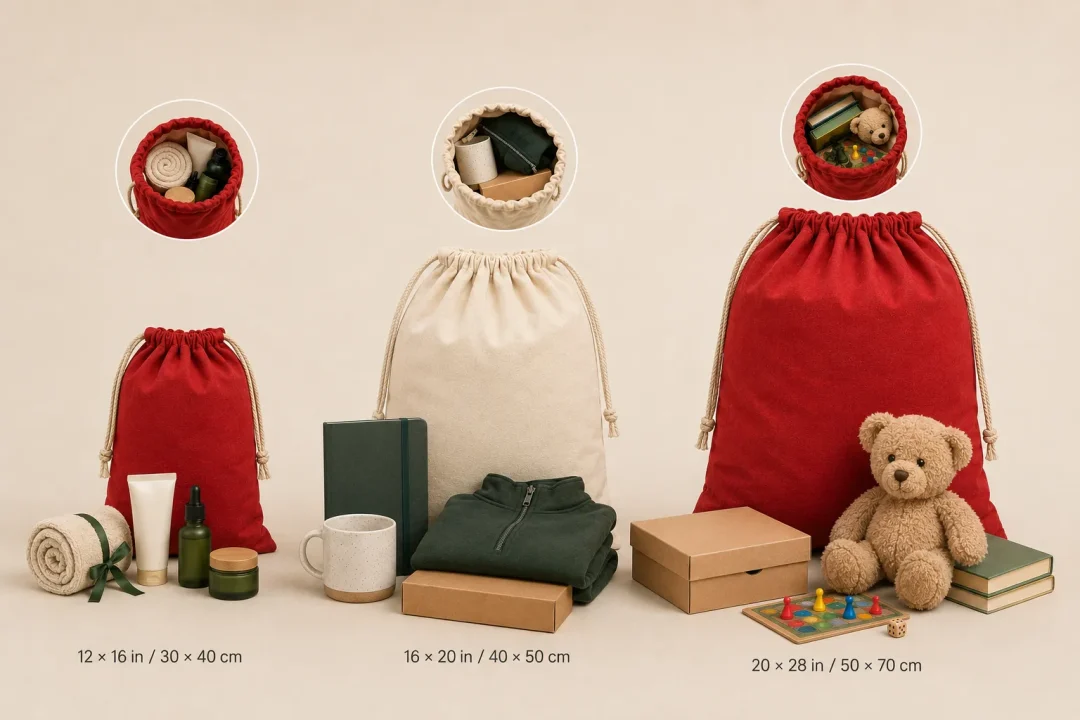
Bộ quà tặng làm đẹp và chăm sóc cá nhân
Người mua mỹ phẩm và chăm sóc cá nhân thường cần túi Santa để chứa các chai, lọ, tuýp, sản phẩm chăm sóc da đóng hộp và phụ kiện.
Một 8 × 12 inch túi có thể đủ cho một vài sản phẩm mỹ phẩm nhỏ hoặc mẫu. Một bộ sản phẩm chăm sóc da hoặc spa hoàn chỉnh thường bắt đầu từ 12 × 16 inch.
Làm cho túi quá lớn có thể làm suy yếu sự trình bày. Những chai nhỏ có thể rơi ngẫu nhiên ở đáy, để phần trên của túi trống và làm cho bộ quà tặng trông kém phần chắc chắn. Đối với những dự án này, chúng tôi thường đánh giá kích thước nhỏ nhất mà giữ trọn bộ một cách thoải mái trong khi vẫn còn đủ không gian để dây rút đóng.
Trọng lượng sản phẩm cũng cần được chú ý. Mỹ phẩm có thể chiếm ít không gian nhưng trở nên khá nặng khi nhiều chai hoặc lọ thủy tinh được đóng gói cùng nhau. Do đó, nhà máy nên kiểm tra:
- Hộp bán lẻ hoàn chỉnh thay vì chai chưa đóng gói
- Liệu các chai có đứng thẳng hay nằm phẳng
- Trọng lượng kết hợp của toàn bộ bộ
- Liệu có cần một túi lót trong, lót hoặc gia cố đáy
- Liệu túi có được mang theo hay chỉ để bên trong một gói khác
Các ứng dụng điển hình bao gồm bộ sản phẩm làm đẹp có thương hiệu, gói spa, tiện nghi Giáng sinh khách sạn và bộ quà tặng từ người có ảnh hưởng.
Chương trình quà tặng bán lẻ và khuyến mãi
Các dự án bán lẻ và quảng cáo thường ưu tiên tính nhất quán, hiệu quả đóng gói và chi phí đơn vị.
Một người mua có thể cần mỗi túi chứa một bộ cố định các mặt hàng sẽ được phân phát qua nhiều cửa hàng hoặc địa điểm sự kiện. Trong tình huống này, không gian thừa làm tăng sử dụng vật liệu, thể tích vận chuyển và thời gian cần thiết để sắp xếp nội dung.
Kích thước khởi động phổ biến bao gồm:
- 8 × 12 inch cho kẹo, phiếu giảm giá, phụ kiện hoặc các món đồ quảng cáo nhỏ
- 12 × 16 inch cho văn phòng phẩm, phụ kiện đồ uống và bộ hàng hóa gọn nhẹ
- 16 × 20 inch cho trang phục, sổ tay, đồ chơi nhỏ và quà tặng quảng cáo hỗn hợp
- 20 × 28 inch cho các gói quà kỳ nghỉ đa dạng lớn hơn
Đối với một chương trình quảng cáo quy mô lớn, tùy chọn thực tế nhất thường là kích thước nhỏ nhất cho phép toàn bộ bộ được đưa vào và đóng lại một cách nhất quán. Không nên quá chặt để nhân viên gặp khó khăn trong quá trình đóng gói số lượng lớn, nhưng cũng nên tránh để lại không gian trống không cần thiết.
Vị trí của logo phải được kiểm tra sau khi túi đã được lấp đầy. Nếu các nội dung đẩy phần in vào nếp gấp, góc cạnh hoặc khu vực cong, thương hiệu có thể không còn xuất hiện như mong muốn.
Bộ quà tặng doanh nghiệp trong dịp lễ
Túi quà tặng doanh nghiệp có thể chứa sổ tay, ly giữ nhiệt, cốc, quần áo, thực phẩm, phụ kiện điện tử hoặc hộp quà đã lắp ráp sẵn. Một khoảng khởi đầu hữu ích thường là 12 × 16 đến 20 × 28 inch, nhưng kích thước hộp quà bên ngoài thường quan trọng hơn so với các sản phẩm riêng lẻ.
Nếu bộ sản phẩm phải ở trong một sắp xếp cố định, một túi phẳng có thể không cung cấp được sự trình bày cần thiết. Một góc dưới, góc bên hoặc đáy hộp có thể tạo ra một nền tảng ổn định hơn và ngăn chặn sản phẩm bị tích tụ thành một đống lộn xộn.
Trọng lượng cũng là một yếu tố quan trọng khác. Một bộ gồm một sổ tay và áo phông tạo ra một tải trọng rất khác so với một bộ bao gồm cốc gốm, chai rượu hoặc nhiều hũ thực phẩm, ngay cả khi các kích thước bên ngoài của chúng tương tự.
Đối với các dự án doanh nghiệp, chúng tôi thường đánh giá:
- Kích thước cuối cùng của bộ quà tặng đã lắp ráp
- Cách sắp xếp các sản phẩm
- Liệu túi cần đứng để trình bày
- Liệu người nhận sẽ xách nó bằng dây rút
- Liệu có nên thêm tay cầm riêng biệt không
- Nơi logo nên xuất hiện khi túi đầy
Một túi phẳng lớn hơn không tự động là lựa chọn tốt nhất. Việc thêm chiều sâu thông qua góc cạnh thường có thể tạo ra một gói trông đẹp hơn và hiệu quả tài liệu hơn.
Quà tặng cho trẻ em và bộ sưu tập đồ chơi
Kích thước đồ chơi rất khác nhau, vì vậy độ tuổi của trẻ em không phải là cơ sở đáng tin cậy để chọn một túi Santa.
Một món đồ chơi nhồi bông lớn của trẻ sơ sinh có thể cần nhiều không gian hơn so với một bộ sách dành cho trẻ lớn hơn. Kích thước chính xác nên dựa trên món đồ đóng gói lớn nhất và cách sắp xếp tất cả các món đồ bên trong.
Một số điểm khởi đầu thực tế bao gồm:
- 16 × 20 inch cho sách, trò chơi ghép hình, đồ ngủ và các bộ đồ chơi nhỏ hơn
- 20 × 28 inch cho hộp giày, trò chơi bảng và một số món quà được bọc lại
- 24 × 32 inch cho các món đồ chơi nhồi bông lớn và quà tặng trẻ em cồng kềnh
- 30 × 40 inch hoặc lớn hơn cho đồ chơi quá cỡ hoặc các ứng dụng tập trung vào trưng bày
Đồ chơi nhồi bông thường cồng kềnh nhưng tương đối nhẹ. Sách, trò chơi ghép hình và trò chơi đóng hộp có thể chiếm ít không gian hơn nhưng lại đặt nhiều áp lực hơn lên các đường may ở đáy. Đó là lý do tại sao kích thước và khả năng tải trọng phải được đánh giá độc lập.
Hộp đồ chơi rộng nhất cũng phải qua được lối vào. Có thể thể tích lý thuyết của một chiếc bao là đủ trong khi lối vào thực tế của chiếc bao vẫn quá hẹp cho hộp.
Dự án Thực phẩm, Đồ uống và Khách sạn
Food, beverage and hospitality buyers have different structural requirements from buyers packing clothing or plush toys.
Wine bottles, glass jars and ceramic containers may fit inside a relatively small bag, but their concentrated weight can strain the bottom and side seams. Food hampers may need more base depth so that the products remain upright and presentable.
Typical starting points include:
- 12 × 16 inch for small snack or hotel amenity sets
- 16 × 20 inch for several packaged food items
- 20 × 28 inch for larger food and beverage combinations
- A fully customized size for fixed hampers, rigid gift boxes or multiple bottles
Depending on the products, a traditional drawstring sack may not always be the most suitable construction. A gusseted sack with separate carrying handles, a reinforced base or internal dividers may offer better protection and easier handling.
For glass products, size selection should also leave room for any protective inserts or dividers. The bag should not be used as a substitute for the protective packaging required to prevent impact damage.
Sự kiện, Trưng bày và Đồ trang trí cỡ lớn
Event companies, shopping malls, photography studios and seasonal display teams often need Santa sacks for visual effect rather than ordinary gift packaging.
Sizes may begin at 24 × 32 inch and extend beyond 30 × 40 inches, depending on the display.
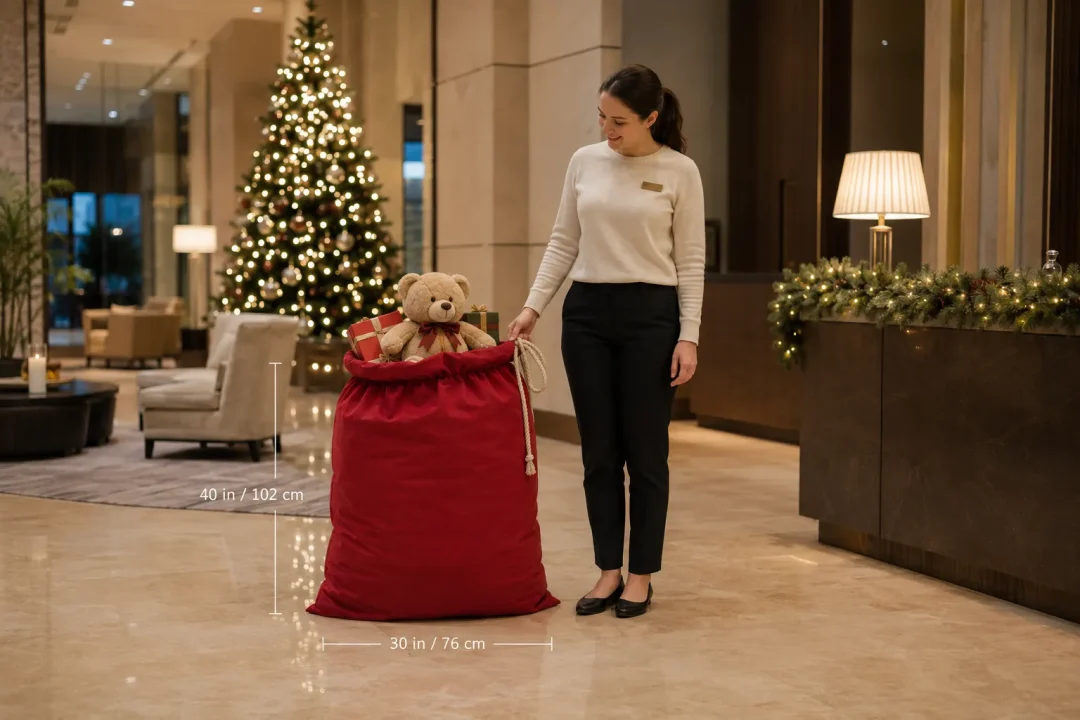
Important questions include:
- Will the sack be filled with real gifts or lightweight props?
- Does it need to be carried after filling?
- Should it stand upright or retain a rounded shape?
- Will the drawstring be operated frequently?
- Does the artwork need to remain visible from a distance?
- How small must the sack fold for shipping and storage?
An oversized sack made for static display can use a different structure from one carried by a Santa performer. If it will be moved while full, the factory must evaluate seams, handles, fabric and load distribution rather than simply increasing the dimensions.
Tại sao những món quà giống nhau có thể cần kích thước túi khác nhau
Two buyers packing similar products may still require different Santa sack dimensions. Packaging, presentation and distribution methods can all change the amount of usable space required.
Đo sản phẩm sau khi đóng gói
Product dimensions should be measured in the final condition in which the items will enter the sack.
This may include:
- Retail boxes
- Gift wrapping
- Ribbons and bows
- Protective inserts
- Inner cartons
- Tissue paper or other fillers
- A larger box combining several products
A common sizing problem occurs when the dimensions of the bare product are supplied, but the final gift box is significantly wider or thicker. The product may fit the bag body while its package cannot pass through the opening.
For a multi-item set, the planned arrangement should also be measured. Products placed side by side require different dimensions from the same products stacked vertically.
Fit gọn, tiêu chuẩn hoặc thoải mái
The desired appearance influences the final size.
| Fit preference | Appearance and result | Common use |
| Compact fit | Full appearance with limited unused space | Promotions and high-volume distribution |
| Standard fit | Natural bag shape with sufficient closing space | Family gifts and general retail |
| Relaxed fit | More open space and a softer presentation | Premium gifts and reusable packaging |
A compact fit reduces excess material but allows less tolerance for packing variations. A relaxed fit is easier to pack and may create a more premium presentation, but a sack that is excessively large can make the contents look sparse.
Before sampling, the buyer and manufacturer should agree on how full the finished sack is expected to look.
Cách cấu trúc túi thay đổi kích thước bạn cần
Flat dimensions do not tell the complete story. Two sacks with the same stated width and height can provide different usable capacities if their bottom, sides, lining or closure structures are different.
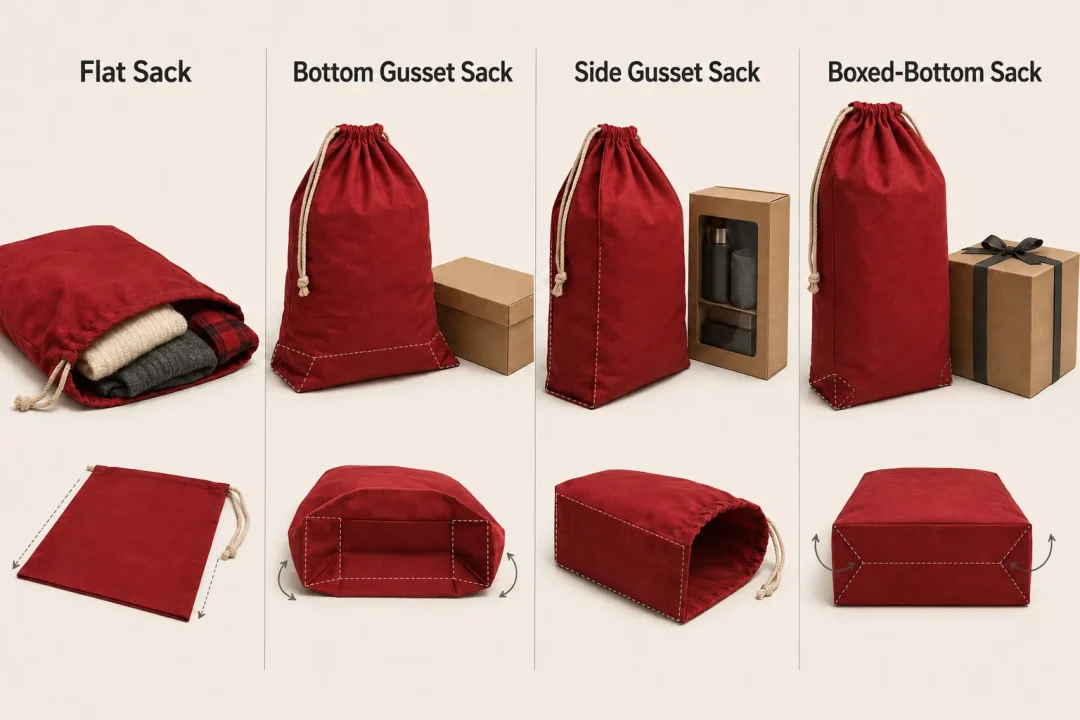
Túi Santa phẳng
A flat sack is made from two panels or a folded piece of fabric without a separate depth measurement.
Nó phù hợp cho:
- Clothing
- Pajamas
- Plush toys
- Blankets
- Other flexible gifts
Flat sacks are easy to fold, pack and store. However, when a thick box is inserted, part of the flat width is used to wrap around the sides of the box. The remaining front width becomes smaller, and the bag may feel tighter than expected.
A flat sack is therefore less efficient for rigid, deep products even if its flat measurements appear generous.
Túi Santa đáy bẻ
A bottom gusset unfolds as products are inserted, creating additional depth at the base.
This structure is useful for:
- Hộp giày
- Food packages
- Corporate gift boxes
- Several smaller items
- Products that need a broader base
A bottom gusset can improve capacity without increasing the entire width of the sack. It also helps the contents sit more naturally at the bottom.
However, a gusset does not automatically make the bag stronger. Its seams and corners must still be designed for the expected load.
Túi Santa bề ngang bẻ
Side gussets create depth along the vertical sides of the bag. They are useful when the contents are thick, numerous or arranged in a block-like formation.
Common applications include:
- Multi-product retail sets
- Large rectangular boxes
- Food packages
- Bulky promotional kits
The artwork must be positioned carefully. A design printed too close to a side gusset may wrap around the fold or appear distorted after filling.
Cấu trúc đáy hộp
A boxed bottom creates a more defined base by forming corners at the bottom of the bag. It can give the sack a more structured appearance when filled.
This construction is often selected for:
- Premium corporate gifts
- Structured retail sets
- Products intended for display
- Gifts that need to remain upright
Compared with an ordinary flat sack, a boxed bottom can produce a neater presentation. It involves additional construction considerations, so the finished depth and intended loading arrangement should be confirmed during sampling.
Túi Santa lót
A lining may be added for appearance, protection or additional structure. It is often used with velvet, premium cotton or decorative seasonal fabrics.
Because the lining and outer shell occupy space, a lined sack may have slightly less internal room than an unlined sack with the same external dimensions. The additional thickness can also affect how tightly the opening gathers.
When a lining is required, the capacity and closure should be tested on the completed construction rather than estimated from the outer shell alone.
Khi tăng kích thước phẳng không phải là giải pháp tốt nhất
When a thick gift box does not fit a flat sack, the immediate response is often to increase the overall bag width. This can create an unnecessarily large front panel, increase material consumption and leave excess fabric around the product.
Adding a bottom or side gusset may be a more effective solution. It creates depth where it is needed and can improve the appearance of the filled sack.
The most suitable option depends on the product shape, desired presentation, manufacturing budget and whether the sack must fold flat for distribution.
Kích thước phẳng không giống như không gian sử dụng
The stated dimensions of a Santa sack usually describe the finished external width and height when laid flat. They do not necessarily represent the entire usable storage area.
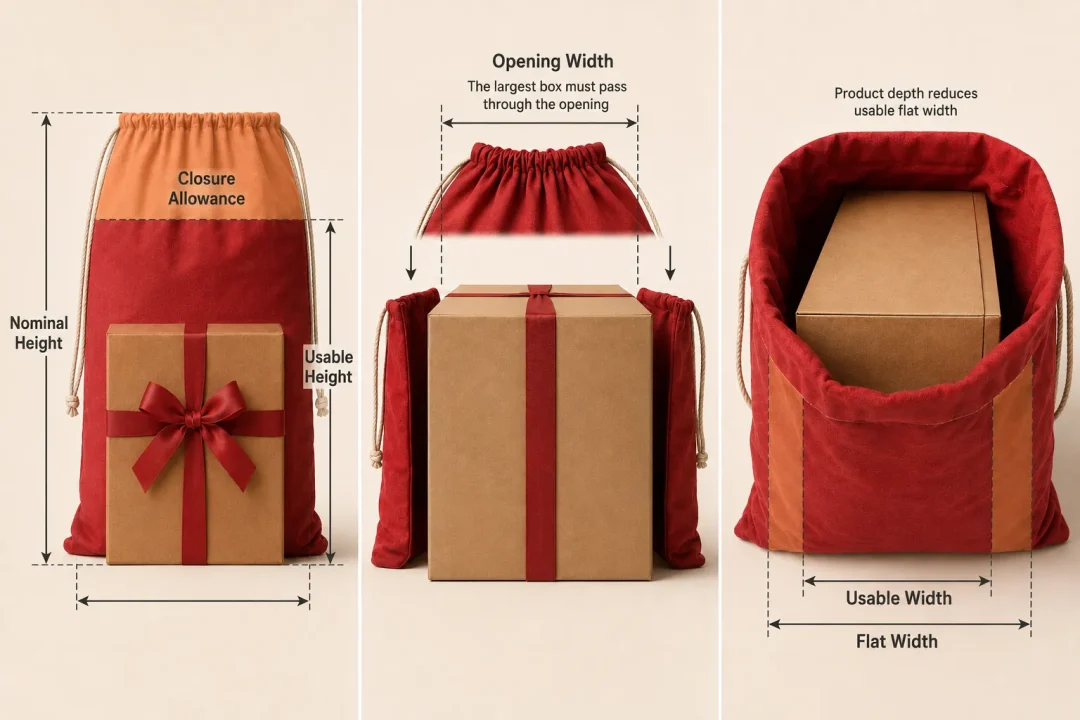
Kênh dây kéo sử dụng một phần chiều cao
The drawstring channel, top hem and gathering area occupy space at the upper part of the sack. Gifts should remain below this area so the opening can gather and close.
A 28-inch-tall sack does not provide 28 inches of usable vertical packing space. The exact reduction depends on:
- The width of the drawstring channel
- The position of the drawstring
- The amount of fabric required for gathering
- Whether the sack uses one or two drawstrings
- The thickness and stiffness of the material
Bulky items packed too close to the drawstring may prevent full closure even though they remain within the external height.
Lỗ mở có thể nhỏ hơn thân túi
The largest product must pass through the finished opening.
The opening can become more restrictive when the sack uses:
- Vải bạt dày
- A wide folded hem
- A lining
- Double drawstring channels
- Reinforced top stitching
- Thick cords or internal cord structures
For rigid boxes, the opening width should be tested directly. A box that fits inside the lower body may still be difficult or impossible to insert.
Độ sâu sản phẩm sử dụng một phần chiều rộng phẳng
For a flat sack, product depth consumes part of the available width as the fabric wraps around both sides of the object.
As an initial estimate for a simple flat sack, buyers sometimes consider:
Required flat width ≈ product width + product depth + fitting allowance
This is only a preliminary guide. Fabric flexibility, seam construction, loading direction and the shape of the product can all affect the final result.
A rigid box usually needs more controlled allowance than soft clothing because it cannot compress or adapt to the bag shape.
Kích thước và trọng lượng phải được đánh giá riêng biệt
A large Santa sack is not automatically heavy-duty, and a smaller sack is not automatically suitable for dense products.
Capacity describes whether the products fit inside. Load capacity describes whether the material, seams and carrying structure can safely support the products during intended use.
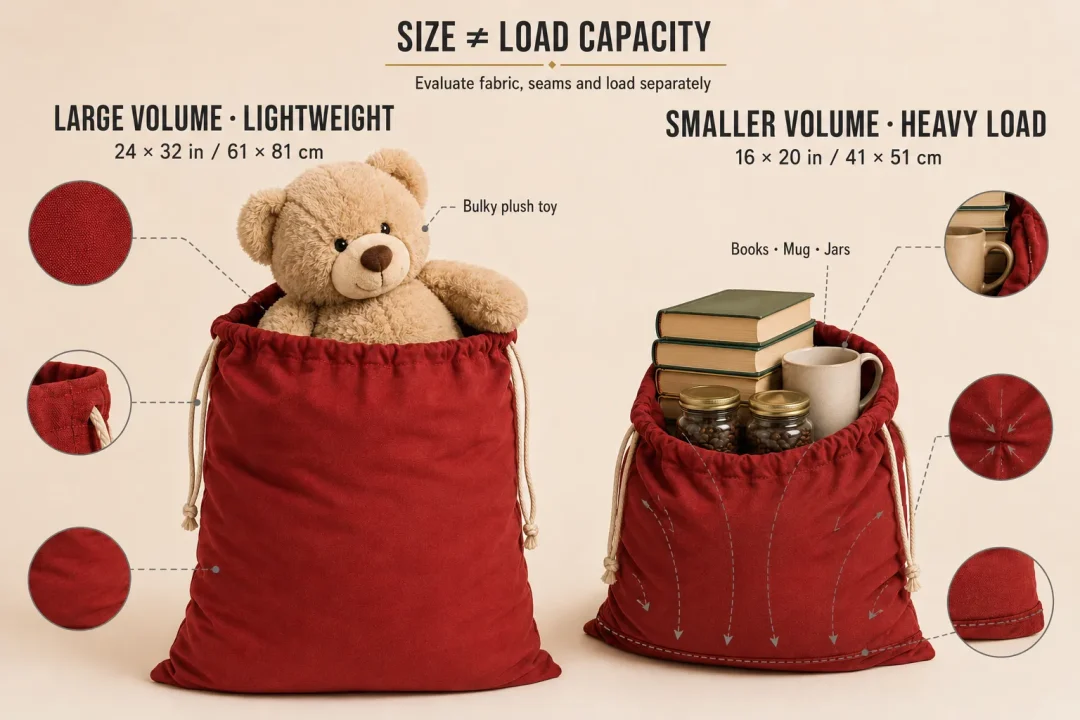
Nội dung lớn nhưng nhẹ
A 24 × 32-inch sack filled with a large plush toy may have substantial volume but relatively little weight.
The main concerns are likely to be:
- Whether the toy passes through the opening
- Whether the sack can close properly
- Whether the filled shape looks balanced
- Whether the fabric is opaque enough
- Whether the print remains visible when the bag expands
A moderate-weight cotton or polyester fabric may be sufficient if the sack is only carried a short distance and the structure is properly sewn.
Using an excessively heavy canvas could make the drawstring difficult to gather without adding meaningful value to this application.
Nội dung gọn nhưng nặng
A 16 × 20-inch sack containing books, ceramic mugs, glass jars or bottles may be much smaller but create significantly greater stress.
The factory must evaluate:
- Total product weight
- Whether the load is concentrated at one point
- Fabric tensile and tear performance
- Bottom and side seam construction
- Seam allowance and stitch density
- Whether raw edges are bound or reinforced
- Whether the drawstring is expected to function as a handle
- Whether separate carrying handles are required
If several heavy products rest directly on the bottom seam, increasing the fabric weight alone may not solve the problem. Reinforced seams, a double-layer base or a different bag construction may also be required.
Cách cấu trúc túi thay đổi phân bố tải
A flat sack usually directs the weight toward the bottom seam and lower corners. When rigid objects are packed inside, their edges may create concentrated pressure against the fabric.
A bottom-gusset sack distributes the contents across a broader base, but the gusset seams become important load-bearing areas.
A side-gusset structure provides more depth, although the lower junctions between the front, back and side panels must be constructed carefully for heavier sets.
A boxed bottom can improve stability and distribute products more evenly when they are arranged correctly. However, its corners and seams still require suitable reinforcement for the intended weight.
A lining may provide a cleaner interior and reduce abrasion, but it should not automatically be treated as structural reinforcement. Its material and attachment method determine whether it contributes meaningfully to load support.
Dây rút không phải lúc nào cũng là tay nắm
Many people naturally lift a Santa sack by its drawstrings. For a lightweight gift bag, this may be acceptable. For heavy products, it can place substantial force on the drawstring channel and upper side seams.
If the filled sack will be carried over a meaningful distance, separate handles may be more reliable and comfortable. The handle material, attachment points and reinforcement should then be evaluated as part of the load-bearing structure.
The intended method of carrying should be communicated before the sample is made.
Khi nào cần gia cố
Depending on the contents and intended use, the manufacturer may recommend:
- Reinforced bottom and side seams
- Đường may bên trong được bọc
- A double-layer bottom
- A higher fabric weight
- A lining or protective insert
- Box stitching at handle attachment points
- Separate carrying handles
- Internal dividers for bottles or fragile products
- A gusseted structure that distributes the load more effectively
These features should be selected based on the actual product and use case rather than added automatically to every large sack.
Tại sao thử nghiệm tải thực tế là cần thiết
Fabric specifications can help narrow the options, but they cannot replace a completed-bag test.
Before bulk production, the sample should be packed with the real products or substitutes of equivalent dimensions and weight. It should then be closed, lifted and handled in the same way it will be used.
This test helps reveal:
- Seam stretching
- Localized pressure at the bottom
- Fabric distortion
- Drawstring-channel stress
- Handle discomfort
- Excessive sagging
- Product movement inside the sack
- Changes in logo appearance after loading
A reliable load recommendation should be based on the complete construction rather than a fabric name or bag size alone.
Chất liệu ảnh hưởng đến kích thước cuối cùng như thế nào
Material selection influences flexibility, usable capacity, closure performance and the appearance of the filled sack.
Cotton
Cotton is flexible and works well for traditional drawstring sacks. It can adapt to soft gifts and irregular shapes, although rigid boxes may create visible corners through the fabric.
Different cotton weights produce different levels of softness and strength. A heavier cotton fabric also takes up more space in the gathered opening.
Vải bạt
Canvas provides a more structured and reusable feel. It is often selected for large branded sacks, corporate programs and products intended for repeated use.
Very heavy canvas can be difficult to gather at the top. The drawstring channel and cord thickness must be compatible with the material, and additional closing allowance may be needed.
Polyester
Polyester is often used for lightweight, large-format sacks and projects requiring vivid printed graphics. Its performance still depends on the fabric construction and weight; “polyester” alone is not a load-capacity specification.
It may be useful for oversized but lightweight applications in which reducing the sack’s own weight is important.
Velvet
Velvet provides a decorative and premium seasonal appearance. The pile, lining and top construction can make the finished bag thicker than a basic cotton sack.
This additional bulk may reduce usable space and make the opening more difficult to gather. Velvet sacks should be evaluated in their complete lined or unlined structure.
Vải jute hoặc burlap
Jute has a firmer hand and a rustic appearance. It does not conform around square boxes as easily as soft cotton, so more fitting allowance or a gusset may be necessary.
The opening, internal seams and possible lining also deserve attention, particularly when the contents may catch on the fabric or require a cleaner interior.
Vải không dệt
Non-woven fabric can be suitable for promotional distributions and short-term event projects. The appropriate specification depends on the fabric weight, seam method, product weight and how the sack will be carried.
For larger or heavier contents, the manufacturer should confirm whether the selected non-woven construction is appropriate rather than assuming that a larger sheet automatically provides more strength.
Những gì người mua nên cung cấp để nhận được khuyến nghị kích thước
The more complete the product information is, the more accurately a manufacturer can recommend a starting size and construction.
Ideally, provide:
- The length, width and depth of each product after packaging
- The number of products packed in each sack
- The largest individual product
- The estimated total weight
- The preferred arrangement of the products
- The desired compact, standard or relaxed fit
- Whether the bag needs a flat, gusseted or boxed-bottom structure
- Whether a lining is required
- Whether separate handles are needed
- The proposed print or embroidery dimensions
- The order quantity
- The intended distribution and carrying method
If the project is still at the concept stage, buyers can send product photographs, packaging images, arrangement sketches, reference-bag photographs or links to similar products.
A simple diagram showing how the items should sit inside the sack is often more useful than describing the required size as “large.”
Những gì chúng tôi xác minh trước khi sản xuất hàng loạt
Once an initial size and structure have been selected, a pre-production sample should be checked under realistic packing conditions.
The evaluation normally includes:
- Whether the largest packaged item passes through the opening
- Whether all products fit in the intended arrangement
- Whether the drawstring closes after the sack is filled
- Whether sufficient space remains above the products
- Whether the bag looks too loose or excessively stretched
- Whether the bottom and side seams support the actual load
- Whether the sack can be lifted in the intended way
- Whether the filled shape distorts the logo
- Whether artwork enters a fold or gusset
- Whether the selected fabric gathers correctly
- Whether the sack retains the intended presentation
- Whether its folding and carton dimensions remain practical for bulk shipping
If possible, the actual products should be used for this test. When they are unavailable, substitutes should match both the dimensions and weight as closely as possible.
Những sai lầm phổ biến về kích thước túi Santa
1. Chỉ định “Lớn” hoặc “Cực Lớn”
These descriptions vary between suppliers and cannot be used as final production specifications. Always confirm finished dimensions in inches or centimeters.
2. Đo sản phẩm chưa được đóng gói
Retail boxes, gift wrapping and protective inserts can add substantial width, height and depth. Measure the final packed products.
3. Bỏ qua Độ sâu của Sản phẩm
A flat sack loses usable front width as its fabric wraps around a deep box. Consider a gusset when packing rigid or thick products.
4. Kiểm tra Thân túi nhưng không kiểm tra Mở túi
The bag may have enough internal volume while the largest box cannot pass through its opening.
5. Xem chiều cao đầy đủ là không gian sử dụng
The drawstring channel and gathering area require space above the products. Filling the sack to its top edge may prevent closure.
6. Giả định rằng một túi lớn hơn có sức chứa lớn hơn
Capacity and strength are separate specifications. Material, seams, gussets, handles and load distribution must be evaluated together.
7. Phóng to toàn bộ túi thay vì điều chỉnh cấu trúc của nó
Adding a bottom or side gusset may accommodate a thick gift box more effectively than increasing the full flat width.
8. Hoàn thiện Artwork trước khi xác nhận kích thước
Changes to the size or gusset can alter the visual proportions and safe print area. Final artwork should follow structural approval.
9. Bỏ qua bài kiểm tra đóng gói
Measurements and formulas can establish a starting point, but an actual packing and carrying test is the most reliable way to approve the final size.
Câu Hỏi Thường Gặp
Kích thước túi Santa nào là phổ biến nhất?
There is no official standard, but approximately 20 × 28 inch (50 × 70 cm) is a practical large size for several family gifts, shoe boxes or medium plush toys. Retail and corporate gift sets often use smaller sizes, while oversized toys may require 24 × 32 inches or more.
Túi Santa 20 × 28 inch có đủ lớn cho quà Giáng sinh không?
It is generally suitable for several wrapped gifts or one or two medium-sized boxes. The result depends on product depth, the size of the opening and how much space is required above the gifts for closure.
Kích thước túi Santa nào vừa với một hộp giày?
A 16 × 20-inch hoặc 20 × 28-inch sack can be an initial option, depending on the shoe-box dimensions. Measure the complete box and check its thickness. A bottom gusset may provide a better fit than a wider flat sack.
Kích thước nào phù hợp cho nhiều món quà đã được gói?
For a combination of books, clothing and small gift boxes, start by evaluating 16 × 20 inch. For larger boxes or a more generous family gift collection, 20 × 28 inch may be more appropriate.
Arrange and measure all wrapped presents together rather than adding their individual dimensions without considering placement.
Túi Santa có nên có đáy không?
A gusset is helpful for deep boxes, food sets, shoe boxes and products that need a broader or more stable base. Soft clothing and plush toys may fit well in a simpler flat sack.
Một túi Santa lớn hơn có cần vải nặng hơn không?
Not necessarily. A large sack holding a lightweight plush toy may place less stress on its seams than a smaller sack containing books or bottles. Fabric and construction should be selected according to the actual load and carrying method.
Có thể sản xuất túi Santa theo kích thước tùy chỉnh không?
Yes. Custom manufacturers can adjust the width, height, gusset, drawstring position, material and artwork to match a specific product set. Final dimensions should be verified through a sample and packing test before bulk production.
Khuyến nghị Cuối cùng
For most family gift applications, start by evaluating a Santa sack around 20 × 28 inch. Smaller retail, beauty and corporate gift sets often work better in the 12 × 16 to 16 × 20-inch range. Bulky toys and event displays may require 24 × 32 inches or more.
These dimensions should not be treated as fixed standards. The final size must account for the packaged products, their arrangement, the opening width, the space needed for closing and the total load.
For a custom Santa sack project, send us the packaged product dimensions, quantity per sack, estimated weight and intended application. We can then evaluate the size, gusset structure, material and carrying method together before sampling.
 Vietnamese
 English
 French
 German
 Japanese
 Arabic
 Thai
 Russian
 Spanish
 Portuguese