
Para la mayoría de las aplicaciones de regalo familiar, un saco de Santa que mida aproximadamente 20 × 28 pulgadas (50 × 70 cm) es un punto de partida práctico. Los juegos de regalo más pequeños para el retail o corporativos suelen ajustarse mejor en 12 × 16 pulgadas (30 × 40 cm) o 16 × 20 pulgadas (40 × 50 cm) sacos, mientras que los juguetes voluminosos y los elementos de exhibición pueden requerir 24 × 32 pulgadas (60 × 80 cm) or more.
Sin embargo, no existe un tamaño universal estándar para los sacos de Santa.
Basado en las consultas estacionales y los proyectos de bolsas personalizadas que hemos manejado, las dimensiones adecuadas suelen depender de cuatro factores:
- Las dimensiones de los productos después del embalaje minorista o de regalo
- El número y la disposición de los artículos dentro de cada saco
- El espacio requerido para cerrar por encima de los productos
- El peso total y el método de transporte previsto del saco
Un saco descrito como “grande” por un proveedor puede ser considerado “extra grande” por otro. Por lo tanto, para la producción personalizada, los nombres de tamaño son solo un punto de partida. La especificación final siempre debe escribirse como ancho terminado × alto terminado, con las dimensiones del fuelle añadidas cuando sea aplicable.
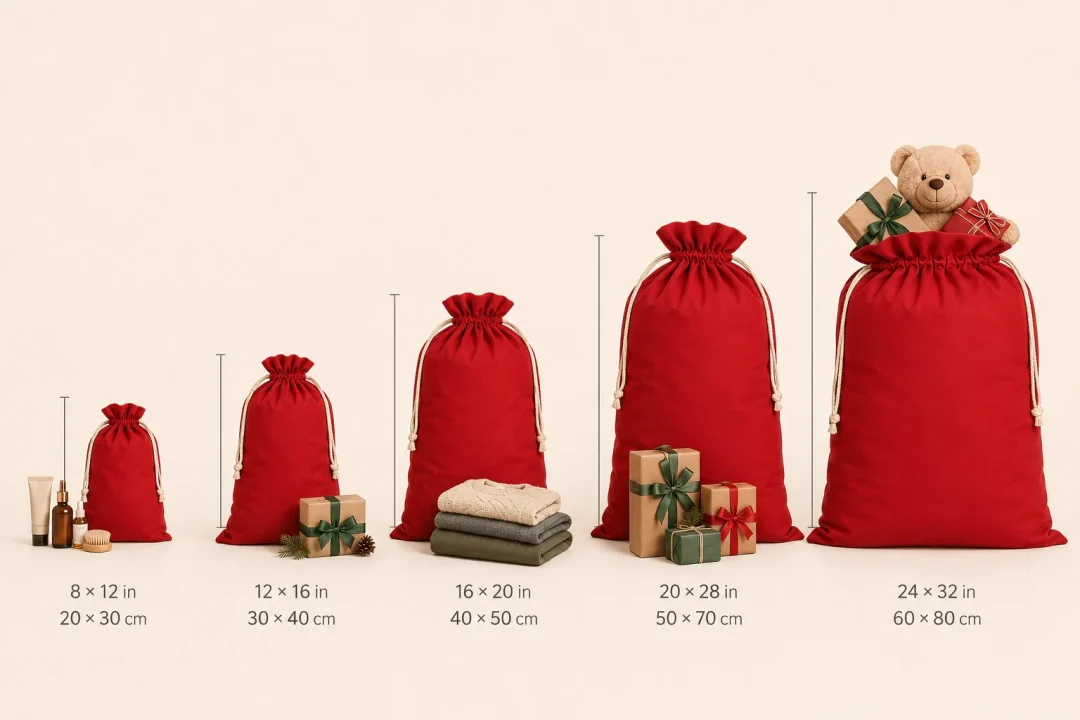
Quick Santa Sack Size Chart
The following dimensions provide practical starting points for selecting or developing a Santa sack.
| Starting size | Metric size | Suitable contents | Aplicaciones comunes |
|---|---|---|---|
| 8 × 12 in | 20 × 30 cm | Candy, jewelry, small cosmetics and promotional items | Retail giveaways, hotel amenities and holiday parties |
| 12 × 16 in | 30 × 40 cm | Skincare sets, stationery, accessories and small toys | Beauty gift sets, employee gifts and promotions |
| 16 × 20 in | 40 × 50 cm | Books, pajamas, toy sets and small gift boxes | Children’s gifts and branded holiday packages |
| 20 × 28 in | 50 × 70 cm | Shoe boxes, several wrapped gifts and medium plush toys | Family use, retail collections and larger gift sets |
| 24 × 32 in | 60 × 80 cm | Large toys, multiple boxes and bulky plush toys | Children’s gifts, events and seasonal displays |
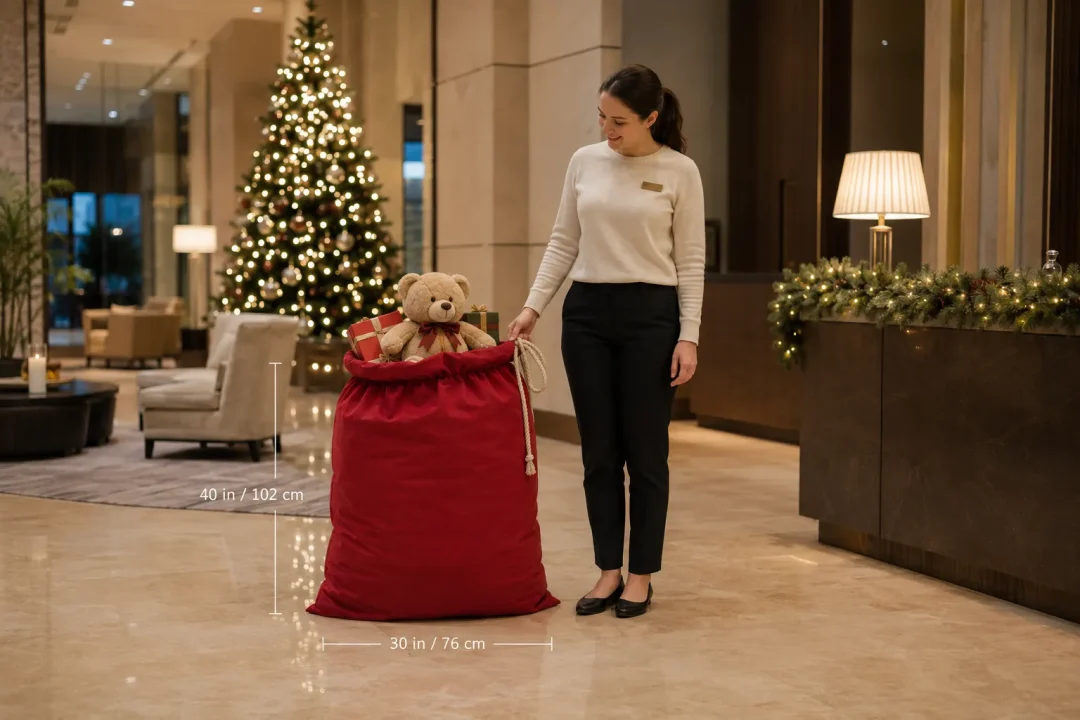
| 30 × 40 in or larger | 75 × 100 cm or larger | Oversized toys, lightweight bulk gifts and display props | Shopping malls, photography and Santa events |
These are recommended evaluation ranges rather than compulsory industry standards.
A hard rectangular box may require more width or a gusset than a soft product of the same volume. A large sack intended for plush toys may not need a heavy fabric, while a smaller sack containing books, bottles or ceramic mugs may require considerably stronger construction.
For bulk custom orders, an actual packing test should be completed before the final dimensions are approved.
Cómo Emparejamos los Tamaños de Sacos de Santa a Diferentes Escenarios Personalizados
The Santa sack requests received by a factory are not limited to family Christmas gifts. Buyers use these bags for retail collections, corporate gift programs, hotel amenities, promotional events, toy packaging and seasonal displays.
Each type of project creates a different sizing priority. The following ranges reflect useful starting points derived from those recurring applications.
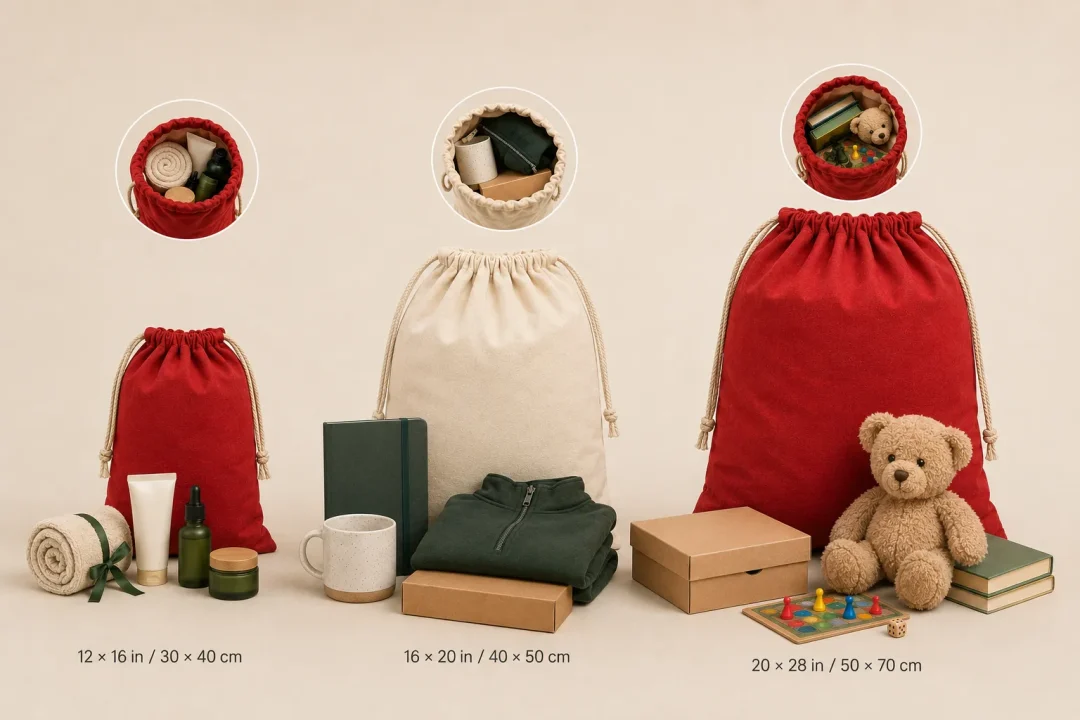
Juegos de Regalo de Belleza y Cuidado Personal
Beauty and personal care buyers often need Santa sacks for combinations of bottles, jars, tubes, boxed skincare products and accessories.
An 8 × 12-inch sack may be sufficient for a few small cosmetics or samples. A more complete skincare or spa set will often start around 12 × 16 inches.
Making the sack too large can weaken the presentation. Small bottles may fall randomly at the bottom, leaving the upper part of the bag empty and making the gift set look less substantial. For these projects, we generally evaluate the smallest size that holds the complete set comfortably while retaining enough room for the drawstring to close.
Product weight also deserves attention. Cosmetics may occupy little space but become surprisingly heavy when several glass bottles or jars are packed together. The factory should therefore check:
- The complete retail box rather than the unpackaged bottle
- Whether the bottles will stand upright or lie flat
- The combined weight of the full set
- Whether an inner bag, lining or bottom reinforcement is required
- Whether the sack will be carried or only placed inside another package
Typical applications include branded beauty sets, spa packages, hotel Christmas amenities and influencer gift kits.
Programas de Regalos Minoristas y Promocionales
Retail and promotional projects usually prioritize consistency, packing efficiency and unit cost.
A buyer may need each sack to hold a fixed set of items that will be distributed across multiple shops or event locations. In this situation, excess space increases material use, shipping volume and the time required to arrange the contents.
Common starting sizes include:
- 8 × 12 inches for candy, coupons, accessories or small promotional items
- 12 × 16 inches for stationery, drinkware accessories and compact merchandise sets
- 16 × 20 inches for apparel, notebooks, small toys and mixed promotional gifts
- 20 × 28 inches for larger multi-item holiday packages
For a bulk promotional program, the most practical option is often the smallest size that allows the full set to be inserted and closed consistently. It should not be so tight that staff struggle during bulk packing, but unnecessary empty space should also be avoided.
The position of the logo must be checked after the bag is filled. If the contents push the print into a fold, gusset or curved area, the branding may no longer appear as intended.
Juegos de Regalos Corporativos para las Fiestas
Corporate gift sacks may contain notebooks, tumblers, mugs, clothing, food, electronics accessories or pre-assembled gift boxes. A useful starting range is usually 12 × 16 to 20 × 28 inches, but the outer gift-box dimensions often matter more than the individual products.
If the set must remain in a fixed arrangement, a flat sack may not provide the required presentation. A bottom gusset, side gusset or boxed bottom can create a more stable base and prevent products from collecting in an untidy pile.
Weight is another important consideration. A set containing a notebook and T-shirt creates a very different load from one containing a ceramic mug, wine bottle or multiple jars of food, even when their external dimensions are similar.
For corporate projects, we normally evaluate:
- The final dimensions of the assembled gift set
- How the products should be arranged
- Whether the sack needs to stand for presentation
- Whether recipients will carry it by the drawstrings
- Whether separate handles should be added
- Where the logo should appear when the sack is full
A larger flat sack is not automatically the best option. Adding depth through a gusset can often produce a better-looking and more material-efficient package.
Regalos y Colecciones de Juguetes para Niños
Toy size varies considerably, so the child’s age is not a reliable basis for selecting a Santa sack.
A toddler’s large plush toy may require more space than a set of books intended for an older child. The correct size should be based on the largest packaged item and the way all items will be placed inside.
Practical starting points include:
- 16 × 20 inches for books, puzzles, pajamas and smaller toy sets
- 20 × 28 inches for shoe boxes, board games and several wrapped presents
- 24 × 32 inches for larger plush toys and bulky children’s gifts
- 30 × 40 inches or more for oversized toys or display-focused applications
Plush toys are usually bulky but relatively light. Books, puzzles and boxed games may use less volume while placing more stress on the bottom seams. This is why size and load capacity must be evaluated independently.
The widest toy box must also pass through the opening. It is possible for the theoretical volume of a sack to be sufficient while the actual bag opening remains too narrow for the box.
Food, Beverage and Hospitality Projects
Food, beverage and hospitality buyers have different structural requirements from buyers packing clothing or plush toys.
Wine bottles, glass jars and ceramic containers may fit inside a relatively small bag, but their concentrated weight can strain the bottom and side seams. Food hampers may need more base depth so that the products remain upright and presentable.
Typical starting points include:
- 12 × 16 inches for small snack or hotel amenity sets
- 16 × 20 inches for several packaged food items
- 20 × 28 inches for larger food and beverage combinations
- A fully customized size for fixed hampers, rigid gift boxes or multiple bottles
Depending on the products, a traditional drawstring sack may not always be the most suitable construction. A gusseted sack with separate carrying handles, a reinforced base or internal dividers may offer better protection and easier handling.
For glass products, size selection should also leave room for any protective inserts or dividers. The bag should not be used as a substitute for the protective packaging required to prevent impact damage.
Events, Displays and Oversized Props
Event companies, shopping malls, photography studios and seasonal display teams often need Santa sacks for visual effect rather than ordinary gift packaging.
Sizes may begin at 24 × 32 inches and extend beyond 30 × 40 inches, depending on the display.
Important questions include:
- Will the sack be filled with real gifts or lightweight props?
- Does it need to be carried after filling?
- Should it stand upright or retain a rounded shape?
- Will the drawstring be operated frequently?
- Does the artwork need to remain visible from a distance?
- How small must the sack fold for shipping and storage?
An oversized sack made for static display can use a different structure from one carried by a Santa performer. If it will be moved while full, the factory must evaluate seams, handles, fabric and load distribution rather than simply increasing the dimensions.
Why the Same Gifts May Need Different Sack Sizes
Two buyers packing similar products may still require different Santa sack dimensions. Packaging, presentation and distribution methods can all change the amount of usable space required.
Measure the Products After Packaging
Product dimensions should be measured in the final condition in which the items will enter the sack.
This may include:
- Retail boxes
- Gift wrapping
- Ribbons and bows
- Protective inserts
- Inner cartons
- Tissue paper or other fillers
- A larger box combining several products
A common sizing problem occurs when the dimensions of the bare product are supplied, but the final gift box is significantly wider or thicker. The product may fit the bag body while its package cannot pass through the opening.
For a multi-item set, the planned arrangement should also be measured. Products placed side by side require different dimensions from the same products stacked vertically.
Compact, Standard or Relaxed Fit
The desired appearance influences the final size.
| Fit preference | Appearance and result | Uso habitual |
| Compact fit | Full appearance with limited unused space | Promotions and high-volume distribution |
| Standard fit | Natural bag shape with sufficient closing space | Family gifts and general retail |
| Relaxed fit | More open space and a softer presentation | Premium gifts and reusable packaging |
A compact fit reduces excess material but allows less tolerance for packing variations. A relaxed fit is easier to pack and may create a more premium presentation, but a sack that is excessively large can make the contents look sparse.
Before sampling, the buyer and manufacturer should agree on how full the finished sack is expected to look.
How Bag Construction Changes the Size You Need
Flat dimensions do not tell the complete story. Two sacks with the same stated width and height can provide different usable capacities if their bottom, sides, lining or closure structures are different.
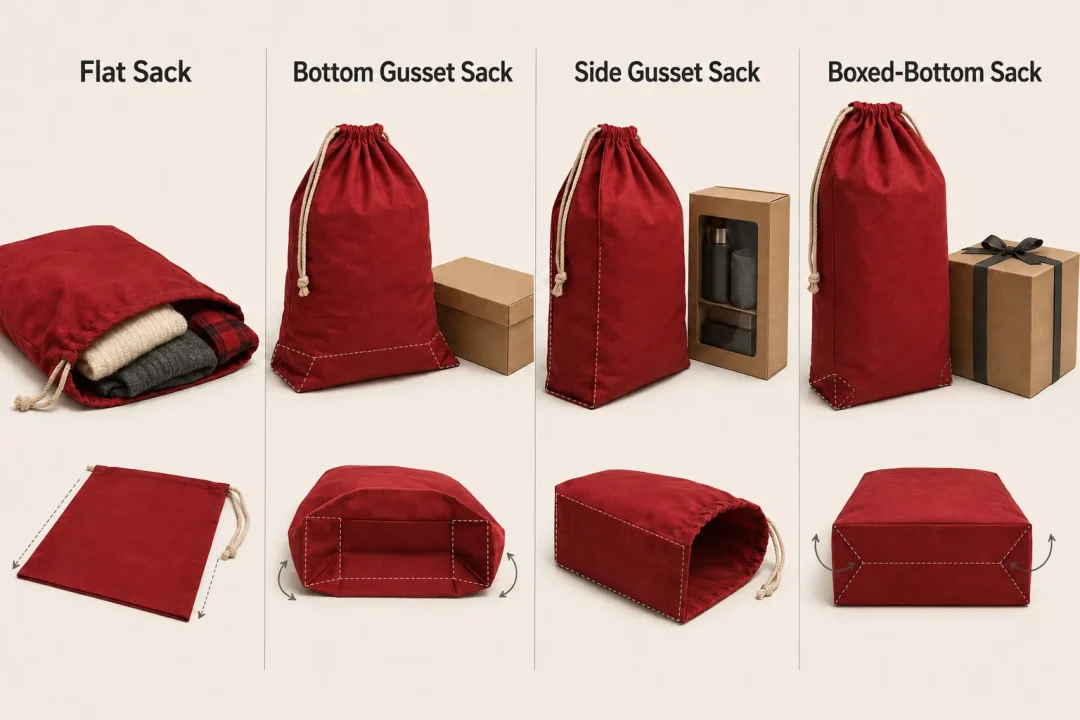
Flat Santa Sack
A flat sack is made from two panels or a folded piece of fabric without a separate depth measurement.
Es adecuado para:
- Clothing
- Pajamas
- Plush toys
- Blankets
- Other flexible gifts
Flat sacks are easy to fold, pack and store. However, when a thick box is inserted, part of the flat width is used to wrap around the sides of the box. The remaining front width becomes smaller, and the bag may feel tighter than expected.
A flat sack is therefore less efficient for rigid, deep products even if its flat measurements appear generous.
Bottom-Gusset Santa Sack
A bottom gusset unfolds as products are inserted, creating additional depth at the base.
This structure is useful for:
- Cajas de zapatos
- Food packages
- Corporate gift boxes
- Several smaller items
- Products that need a broader base
A bottom gusset can improve capacity without increasing the entire width of the sack. It also helps the contents sit more naturally at the bottom.
However, a gusset does not automatically make the bag stronger. Its seams and corners must still be designed for the expected load.
Side-Gusset Santa Sack
Side gussets create depth along the vertical sides of the bag. They are useful when the contents are thick, numerous or arranged in a block-like formation.
Common applications include:
- Multi-product retail sets
- Large rectangular boxes
- Food packages
- Bulky promotional kits
The artwork must be positioned carefully. A design printed too close to a side gusset may wrap around the fold or appear distorted after filling.
Boxed-Bottom Construction
A boxed bottom creates a more defined base by forming corners at the bottom of the bag. It can give the sack a more structured appearance when filled.
This construction is often selected for:
- Premium corporate gifts
- Structured retail sets
- Products intended for display
- Gifts that need to remain upright
Compared with an ordinary flat sack, a boxed bottom can produce a neater presentation. It involves additional construction considerations, so the finished depth and intended loading arrangement should be confirmed during sampling.
Lined Santa Sack
A lining may be added for appearance, protection or additional structure. It is often used with velvet, premium cotton or decorative seasonal fabrics.
Because the lining and outer shell occupy space, a lined sack may have slightly less internal room than an unlined sack with the same external dimensions. The additional thickness can also affect how tightly the opening gathers.
When a lining is required, the capacity and closure should be tested on the completed construction rather than estimated from the outer shell alone.
When Increasing the Flat Size Is Not the Best Solution
When a thick gift box does not fit a flat sack, the immediate response is often to increase the overall bag width. This can create an unnecessarily large front panel, increase material consumption and leave excess fabric around the product.
Adding a bottom or side gusset may be a more effective solution. It creates depth where it is needed and can improve the appearance of the filled sack.
The most suitable option depends on the product shape, desired presentation, manufacturing budget and whether the sack must fold flat for distribution.
Flat Dimensions Are Not the Same as Usable Space
The stated dimensions of a Santa sack usually describe the finished external width and height when laid flat. They do not necessarily represent the entire usable storage area.
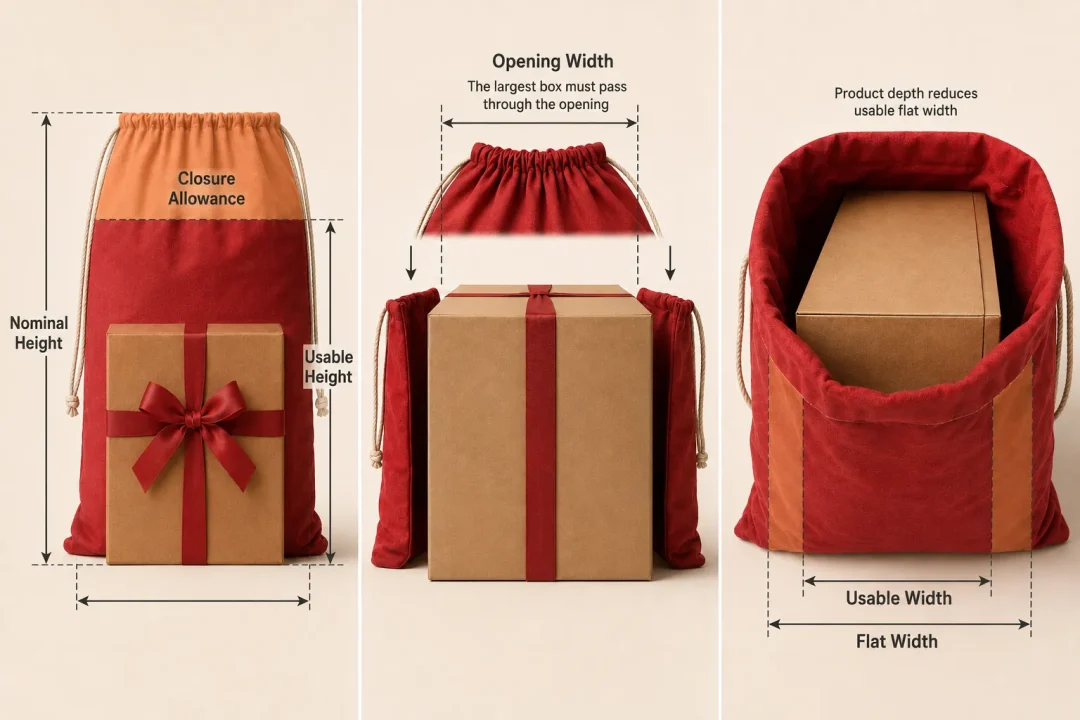
The Drawstring Channel Uses Part of the Height
The drawstring channel, top hem and gathering area occupy space at the upper part of the sack. Gifts should remain below this area so the opening can gather and close.
A 28-inch-tall sack does not provide 28 inches of usable vertical packing space. The exact reduction depends on:
- The width of the drawstring channel
- The position of the drawstring
- The amount of fabric required for gathering
- Whether the sack uses one or two drawstrings
- The thickness and stiffness of the material
Bulky items packed too close to the drawstring may prevent full closure even though they remain within the external height.
The Opening May Be Smaller Than the Bag Body
The largest product must pass through the finished opening.
The opening can become more restrictive when the sack uses:
- Heavy canvas
- A wide folded hem
- A lining
- Double drawstring channels
- Reinforced top stitching
- Thick cords or internal cord structures
For rigid boxes, the opening width should be tested directly. A box that fits inside the lower body may still be difficult or impossible to insert.
Product Depth Uses Part of the Flat Width
For a flat sack, product depth consumes part of the available width as the fabric wraps around both sides of the object.
As an initial estimate for a simple flat sack, buyers sometimes consider:
Required flat width ≈ product width + product depth + fitting allowance
This is only a preliminary guide. Fabric flexibility, seam construction, loading direction and the shape of the product can all affect the final result.
A rigid box usually needs more controlled allowance than soft clothing because it cannot compress or adapt to the bag shape.
Size and Weight Must Be Evaluated Separately
A large Santa sack is not automatically heavy-duty, and a smaller sack is not automatically suitable for dense products.
Capacity describes whether the products fit inside. Load capacity describes whether the material, seams and carrying structure can safely support the products during intended use.
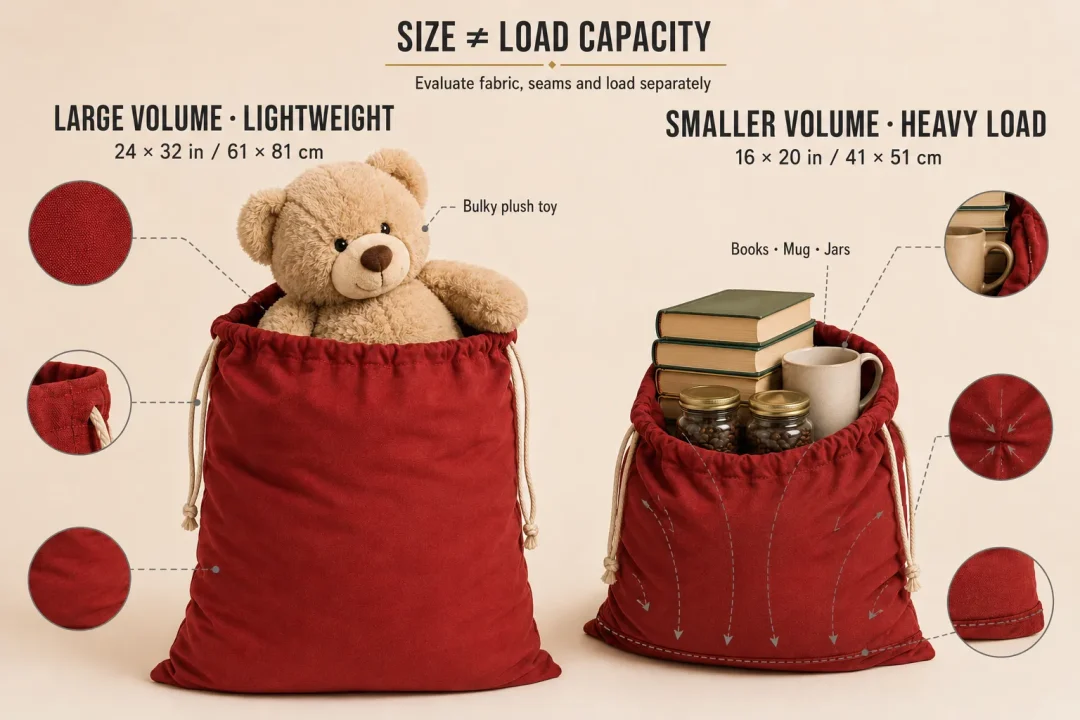
Large but Lightweight Contents
A 24 × 32-inch sack filled with a large plush toy may have substantial volume but relatively little weight.
The main concerns are likely to be:
- Whether the toy passes through the opening
- Whether the sack can close properly
- Whether the filled shape looks balanced
- Whether the fabric is opaque enough
- Whether the print remains visible when the bag expands
A moderate-weight cotton or polyester fabric may be sufficient if the sack is only carried a short distance and the structure is properly sewn.
Using an excessively heavy canvas could make the drawstring difficult to gather without adding meaningful value to this application.
Compact but Heavy Contents
A 16 × 20-inch sack containing books, ceramic mugs, glass jars or bottles may be much smaller but create significantly greater stress.
The factory must evaluate:
- Total product weight
- Whether the load is concentrated at one point
- Fabric tensile and tear performance
- Bottom and side seam construction
- Seam allowance and stitch density
- Whether raw edges are bound or reinforced
- Whether the drawstring is expected to function as a handle
- Whether separate carrying handles are required
If several heavy products rest directly on the bottom seam, increasing the fabric weight alone may not solve the problem. Reinforced seams, a double-layer base or a different bag construction may also be required.
How Bag Structure Changes Load Distribution
A flat sack usually directs the weight toward the bottom seam and lower corners. When rigid objects are packed inside, their edges may create concentrated pressure against the fabric.
A bottom-gusset sack distributes the contents across a broader base, but the gusset seams become important load-bearing areas.
A side-gusset structure provides more depth, although the lower junctions between the front, back and side panels must be constructed carefully for heavier sets.
A boxed bottom can improve stability and distribute products more evenly when they are arranged correctly. However, its corners and seams still require suitable reinforcement for the intended weight.
A lining may provide a cleaner interior and reduce abrasion, but it should not automatically be treated as structural reinforcement. Its material and attachment method determine whether it contributes meaningfully to load support.
Drawstrings Are Not Always Carrying Handles
Many people naturally lift a Santa sack by its drawstrings. For a lightweight gift bag, this may be acceptable. For heavy products, it can place substantial force on the drawstring channel and upper side seams.
If the filled sack will be carried over a meaningful distance, separate handles may be more reliable and comfortable. The handle material, attachment points and reinforcement should then be evaluated as part of the load-bearing structure.
The intended method of carrying should be communicated before the sample is made.
When Reinforcement May Be Required
Depending on the contents and intended use, the manufacturer may recommend:
- Reinforced bottom and side seams
- Costuras internas unidas
- A double-layer bottom
- A higher fabric weight
- A lining or protective insert
- Box stitching at handle attachment points
- Separate carrying handles
- Internal dividers for bottles or fragile products
- A gusseted structure that distributes the load more effectively
These features should be selected based on the actual product and use case rather than added automatically to every large sack.
Why Actual Load Testing Is Necessary
Fabric specifications can help narrow the options, but they cannot replace a completed-bag test.
Before bulk production, the sample should be packed with the real products or substitutes of equivalent dimensions and weight. It should then be closed, lifted and handled in the same way it will be used.
This test helps reveal:
- Seam stretching
- Localized pressure at the bottom
- Fabric distortion
- Drawstring-channel stress
- Handle discomfort
- Excessive sagging
- Product movement inside the sack
- Changes in logo appearance after loading
A reliable load recommendation should be based on the complete construction rather than a fabric name or bag size alone.
How Material Affects the Final Size
Material selection influences flexibility, usable capacity, closure performance and the appearance of the filled sack.
Algodón
Cotton is flexible and works well for traditional drawstring sacks. It can adapt to soft gifts and irregular shapes, although rigid boxes may create visible corners through the fabric.
Different cotton weights produce different levels of softness and strength. A heavier cotton fabric also takes up more space in the gathered opening.
Lona
Canvas provides a more structured and reusable feel. It is often selected for large branded sacks, corporate programs and products intended for repeated use.
Very heavy canvas can be difficult to gather at the top. The drawstring channel and cord thickness must be compatible with the material, and additional closing allowance may be needed.
Poliéster
Polyester is often used for lightweight, large-format sacks and projects requiring vivid printed graphics. Its performance still depends on the fabric construction and weight; “polyester” alone is not a load-capacity specification.
It may be useful for oversized but lightweight applications in which reducing the sack’s own weight is important.
Terciopelo
Velvet provides a decorative and premium seasonal appearance. The pile, lining and top construction can make the finished bag thicker than a basic cotton sack.
This additional bulk may reduce usable space and make the opening more difficult to gather. Velvet sacks should be evaluated in their complete lined or unlined structure.
Jute or Burlap
Jute has a firmer hand and a rustic appearance. It does not conform around square boxes as easily as soft cotton, so more fitting allowance or a gusset may be necessary.
The opening, internal seams and possible lining also deserve attention, particularly when the contents may catch on the fabric or require a cleaner interior.
Non-Woven Fabric
Non-woven fabric can be suitable for promotional distributions and short-term event projects. The appropriate specification depends on the fabric weight, seam method, product weight and how the sack will be carried.
For larger or heavier contents, the manufacturer should confirm whether the selected non-woven construction is appropriate rather than assuming that a larger sheet automatically provides more strength.
What Buyers Should Provide for a Size Recommendation
The more complete the product information is, the more accurately a manufacturer can recommend a starting size and construction.
Ideally, provide:
- The length, width and depth of each product after packaging
- The number of products packed in each sack
- The largest individual product
- The estimated total weight
- The preferred arrangement of the products
- The desired compact, standard or relaxed fit
- Whether the bag needs a flat, gusseted or boxed-bottom structure
- Whether a lining is required
- Whether separate handles are needed
- The proposed print or embroidery dimensions
- The order quantity
- The intended distribution and carrying method
If the project is still at the concept stage, buyers can send product photographs, packaging images, arrangement sketches, reference-bag photographs or links to similar products.
A simple diagram showing how the items should sit inside the sack is often more useful than describing the required size as “large.”
What We Verify Before Bulk Production
Once an initial size and structure have been selected, a pre-production sample should be checked under realistic packing conditions.
The evaluation normally includes:
- Whether the largest packaged item passes through the opening
- Whether all products fit in the intended arrangement
- Whether the drawstring closes after the sack is filled
- Whether sufficient space remains above the products
- Whether the bag looks too loose or excessively stretched
- Whether the bottom and side seams support the actual load
- Whether the sack can be lifted in the intended way
- Whether the filled shape distorts the logo
- Whether artwork enters a fold or gusset
- Whether the selected fabric gathers correctly
- Whether the sack retains the intended presentation
- Whether its folding and carton dimensions remain practical for bulk shipping
If possible, the actual products should be used for this test. When they are unavailable, substitutes should match both the dimensions and weight as closely as possible.
Common Santa Sack Sizing Mistakes
1. Specifying Only “Large” or “Extra Large”
These descriptions vary between suppliers and cannot be used as final production specifications. Always confirm finished dimensions in inches or centimeters.
2. Measuring Unpackaged Products
Retail boxes, gift wrapping and protective inserts can add substantial width, height and depth. Measure the final packed products.
3. Ignoring Product Depth
A flat sack loses usable front width as its fabric wraps around a deep box. Consider a gusset when packing rigid or thick products.
4. Checking the Bag Body but Not the Opening
The bag may have enough internal volume while the largest box cannot pass through its opening.
5. Treating the Full Height as Usable Space
The drawstring channel and gathering area require space above the products. Filling the sack to its top edge may prevent closure.
6. Assuming a Larger Sack Has Greater Load Capacity
Capacity and strength are separate specifications. Material, seams, gussets, handles and load distribution must be evaluated together.
7. Enlarging the Entire Bag Instead of Adjusting Its Structure
Adding a bottom or side gusset may accommodate a thick gift box more effectively than increasing the full flat width.
8. Finalizing Artwork Before Confirming Dimensions
Changes to the size or gusset can alter the visual proportions and safe print area. Final artwork should follow structural approval.
9. Skipping the Packing Test
Measurements and formulas can establish a starting point, but an actual packing and carrying test is the most reliable way to approve the final size.
Preguntas Frecuentes
What is the most common Santa sack size?
There is no official standard, but approximately 20 × 28 pulgadas (50 × 70 cm) is a practical large size for several family gifts, shoe boxes or medium plush toys. Retail and corporate gift sets often use smaller sizes, while oversized toys may require 24 × 32 inches or more.
Is a 20 × 28-inch Santa sack large enough for Christmas gifts?
It is generally suitable for several wrapped gifts or one or two medium-sized boxes. The result depends on product depth, the size of the opening and how much space is required above the gifts for closure.
What size Santa sack fits a shoe box?
A 16 × 20-inch o 20 × 28-inch sack can be an initial option, depending on the shoe-box dimensions. Measure the complete box and check its thickness. A bottom gusset may provide a better fit than a wider flat sack.
What size is suitable for several wrapped presents?
For a combination of books, clothing and small gift boxes, start by evaluating 16 × 20 inches. For larger boxes or a more generous family gift collection, 20 × 28 inches may be more appropriate.
Arrange and measure all wrapped presents together rather than adding their individual dimensions without considering placement.
Should a Santa sack have a gusset?
A gusset is helpful for deep boxes, food sets, shoe boxes and products that need a broader or more stable base. Soft clothing and plush toys may fit well in a simpler flat sack.
Does a larger Santa sack require heavier fabric?
Not necessarily. A large sack holding a lightweight plush toy may place less stress on its seams than a smaller sack containing books or bottles. Fabric and construction should be selected according to the actual load and carrying method.
Can Santa sacks be made in custom dimensions?
Yes. Custom manufacturers can adjust the width, height, gusset, drawstring position, material and artwork to match a specific product set. Final dimensions should be verified through a sample and packing test before bulk production.
Recomendación final
For most family gift applications, start by evaluating a Santa sack around 20 × 28 inches. Smaller retail, beauty and corporate gift sets often work better in the 12 × 16 to 16 × 20-inch range. Bulky toys and event displays may require 24 × 32 inches or more.
These dimensions should not be treated as fixed standards. The final size must account for the packaged products, their arrangement, the opening width, the space needed for closing and the total load.
For a custom Santa sack project, send us the packaged product dimensions, quantity per sack, estimated weight and intended application. We can then evaluate the size, gusset structure, material and carrying method together before sampling.
 Spanish
 English
 French
 German
 Japanese
 Arabic
 Thai
 Vietnamese
 Russian
 Portuguese