
Pour la plupart des demandes de cadeaux familiaux, un sac de Noël mesurant environ 20 × 28 pouces (50 × 70 cm) est un point de départ pratique. Les ensembles de cadeaux plus petits pour le commerce de détail ou les entreprises s'adaptent souvent mieux dans 12 × 16 pouces (30 × 40 cm) ou 16 × 20 pouces (40 × 50 cm) sacs, tandis que les jouets encombrants et les accessoires d'affichage peuvent nécessiter 24 × 32 pouces (60 × 80 cm) or more.
Cependant, il n'existe pas de taille universelle pour les sacs de Noël.
D'après les questions saisonnières et les projets de sacs personnalisés que nous avons gérés, les bonnes dimensions dépendent généralement de quatre facteurs :
- Les dimensions des produits après emballage pour le commerce de détail ou en cadeau
- Le nombre et l'agencement des articles à l'intérieur de chaque sac
- L'espace de fermeture requis au-dessus des produits
- Le poids total et la méthode de transport prévue pour le sac
Un sac décrit comme “ grand ” par un fournisseur peut être considéré comme “ extra grand ” par un autre. Pour la production sur mesure, les noms de taille ne sont donc qu'un point de départ. La spécification finale doit toujours être écrite en largeur finie × hauteur finie, avec les dimensions du soufflet ajoutées le cas échéant.
Rapide Sac de Noël Tableau des tailles
Les dimensions suivantes fournissent des points de départ pratiques pour sélectionner ou développer un sac de Noël.
| Taille de départ | Taille métrique | Contenus adaptés | Applications courantes |
|---|---|---|---|
| 20 × 30 cm | 20 × 30 cm | Bonbons, bijoux, petits cosmétiques et articles promotionnels | Cadeaux de détail, commodités d'hôtel et fêtes de fin d'année |
| 30 × 40 cm | 30 × 40 cm | Jeux de soins de la peau, papeterie, accessoires et petits jouets | Coffrets cadeaux de beauté, cadeaux pour employés et promotions |
| 40 × 50 cm | 40 × 50 cm | Livres, pyjamas, ensembles de jouets et petites boîtes cadeaux | Cadeaux pour enfants et emballages de vacances de marque |
| 50 × 70 cm | 50 × 70 cm | Boîtes à chaussures, plusieurs cadeaux emballés et jouets en peluche moyens | Utilisation familiale, collections de détail et plus grands ensembles cadeaux |
| 60 × 80 cm | 60 × 80 cm | Grands jouets, plusieurs boîtes et peluches encombrantes | Cadeaux pour enfants, événements et présentations saisonnières |
| 30 × 40 po ou plus grand | 75 × 100 cm ou plus grand | Jouets surdimensionnés, cadeaux en vrac légers et accessoires d'affichage | Centres commerciaux, photographie et événements avec le Père Noël |
Ce sont des plages d'évaluation recommandées plutôt que des normes industrielles obligatoires.
Une boîte rectangulaire rigide peut nécessiter plus de largeur ou un soufflet qu'un produit souple de même volume. Un grand sac destiné aux peluches peut ne pas nécessiter un tissu lourd, tandis qu'un petit sac contenant des livres, des bouteilles ou des tasses en céramique peut nécessiter une construction considérablement plus solide.
Pour les commandes spéciales en vrac, un test d'emballage réel doit être réalisé avant que les dimensions finales soient approuvées.
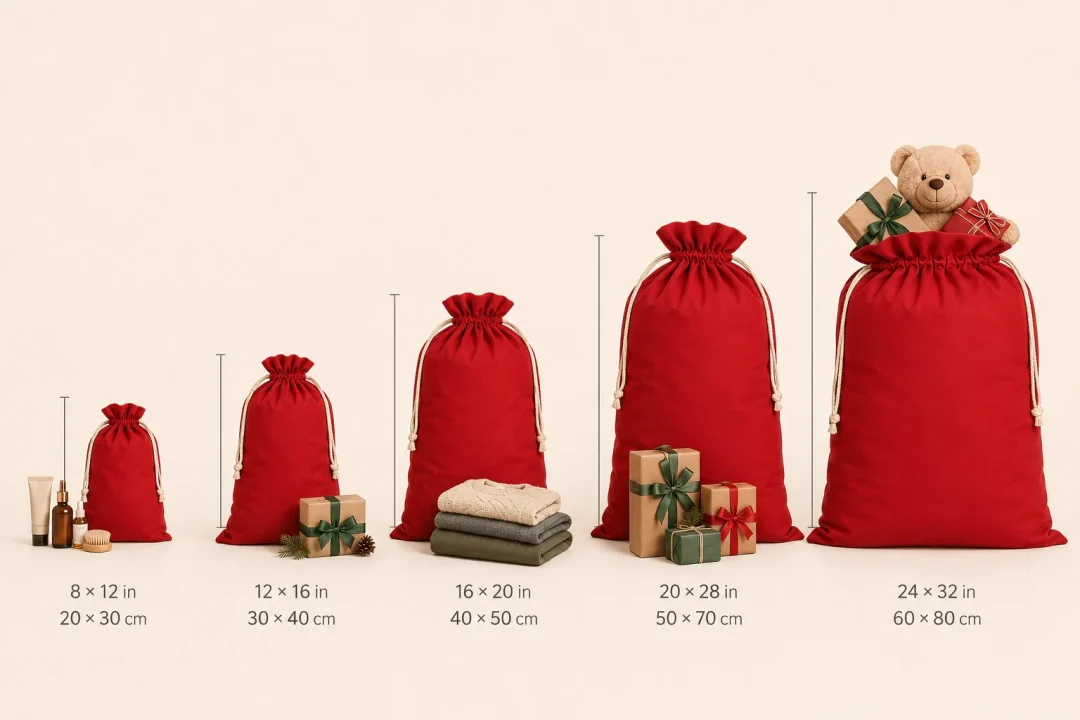
Comment nous assortissons les tailles de sacs de Noël à différents scénarios personnalisés
Les demandes de sacs de Noël reçues par une usine ne se limitent pas aux cadeaux de Noël familiaux. Les acheteurs utilisent ces sacs pour des collections de détail, des programmes de cadeaux d'entreprise, des commodités hôtelières, des événements promotionnels, des emballages de jouets et des présentations saisonnières.
Chaque type de projet crée une priorité de taille différente. Les gammes suivantes reflètent des points de départ utiles dérivés de ces applications récurrentes.
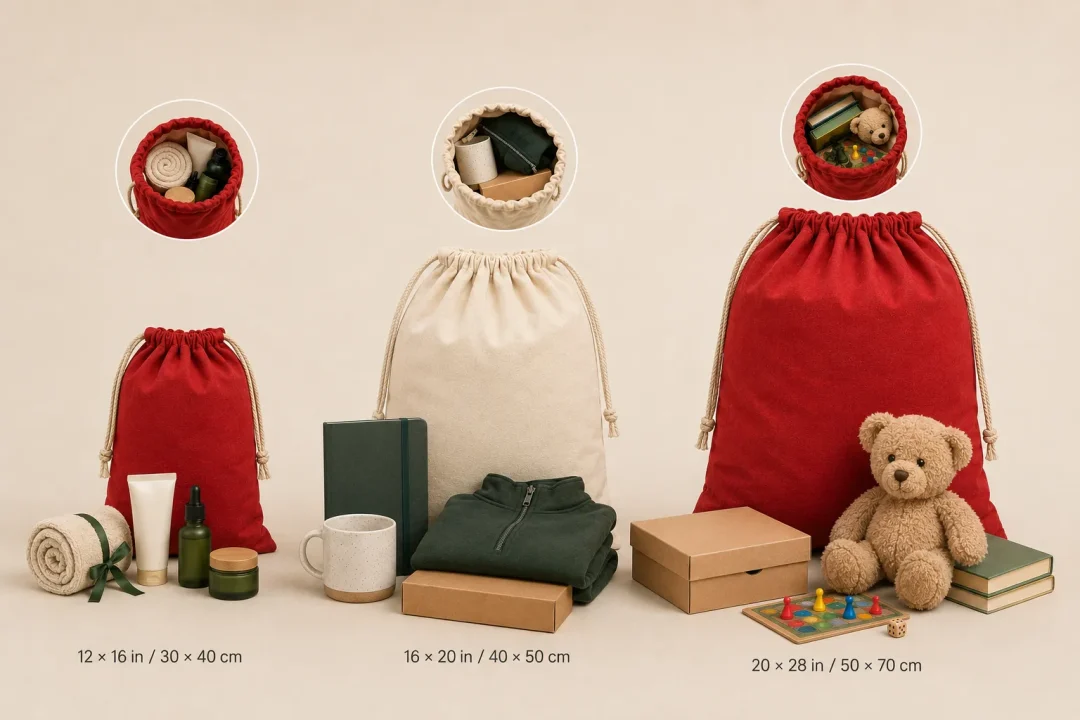
Ensembles de cadeaux beauté et soins personnels
Les acheteurs de produits de beauté et de soins personnels ont souvent besoin de sacs de Noël pour des combinaisons de bouteilles, de pots, de tubes, de produits de soin en boîte et d'accessoires.
Un 8 × 12 pouces un sac peut être suffisant pour quelques petits cosmétiques ou échantillons. Un ensemble de soins ou de spa plus complet commencera souvent autour de 12 × 16 pouces.
Rendre le sac trop grand peut affaiblir la présentation. De petites bouteilles peuvent tomber aléatoirement au fond, laissant la partie supérieure du sac vide et rendant l'ensemble cadeau moins substantiel. Pour ces projets, nous évaluons généralement la plus petite taille qui contient l'ensemble complet confortablement tout en laissant suffisamment de place pour fermer le cordon.
Le poids du produit mérite également d'être pris en compte. Les cosmétiques peuvent occuper peu d'espace mais devenir étonnamment lourds lorsque plusieurs bouteilles ou pots en verre sont empilés ensemble. L'usine doit donc vérifier :
- La boîte de détail complète plutôt que la bouteille non emballée
- Si les bouteilles seront debout ou couchées
- Le poids combiné de l'ensemble complet
- Si un sac intérieur, un revêtement ou un renforcement du fond est nécessaire
- Si le sac sera transporté ou seulement placé à l'intérieur d'un autre emballage
Les applications typiques incluent des ensembles de beauté de marque, des forfaits de spa, des commodités de Noël pour hôtels et des kits cadeaux pour influenceurs.
Programmes de cadeaux de vente au détail et promotionnels
Les projets de détail et promotionnels donnent généralement la priorité à la cohérence, à l'efficacité de l'emballage et au coût unitaire.
Un acheteur peut avoir besoin que chaque sac contienne un ensemble fixe d'articles qui seront distribués dans plusieurs magasins ou lieux d'événements. Dans cette situation, l'espace excessif augmente l'utilisation de matériel, le volume d'expédition et le temps nécessaire pour organiser le contenu.
Les tailles de départ courantes incluent :
- 8 × 12 pouces pour les bonbons, les coupons, les accessoires ou les petits articles promotionnels
- 12 × 16 pouces pour les accessoires de papeterie, de vaisselle et les ensembles de marchandises compacts.
- 16 × 20 pouces pour les vêtements, les cahiers, les petits jouets et les cadeaux promotionnels mixtes
- 20 × 28 pouces pour des paquets de vacances multi-articles plus volumineux
Pour un programme promotionnel en gros, l'option la plus pratique est souvent la taille la plus petite qui permet d'insérer et de fermer l'ensemble complet de manière cohérente. Il ne devrait pas être si serré que le personnel a des difficultés pendant le conditionnement en gros, mais il faut également éviter les espaces vides inutiles.
La position du logo doit être vérifiée après que le sac soit rempli. Si le contenu pousse l'impression dans un pli, une soufflet ou une zone courbée, la marque peut ne plus apparaître comme prévu.
Ensembles de cadeaux d'entreprise pour les fêtes
Les sacs-cadeaux d'entreprise peuvent contenir des cahiers, des tumblers, des tasses, des vêtements, de la nourriture, des accessoires électroniques ou des boîtes-cadeaux pré-assemblées. Une plage de départ utile est généralement 12 × 16 à 20 × 28 pouces, mais les dimensions externes de la boîte-cadeau importent souvent plus que les produits individuels.
Si l'ensemble doit rester dans un agencement fixe, un sac plat peut ne pas fournir la présentation requise. Un soufflet au fond, un soufflet latéral ou un fond boîté peuvent créer une base plus stable et empêcher les produits de s'accumuler en désordre.
Le poids est un autre facteur important. Un ensemble contenant un cahier et un T-shirt crée une charge très différente de celle contenant une tasse en céramique, une bouteille de vin ou plusieurs bocaux de nourriture, même lorsque leurs dimensions externes sont similaires.
Pour les projets d'entreprise, nous évaluons généralement :
- Les dimensions finales de l'ensemble de cadeaux assemblé
- Comment les produits doivent être disposés
- Si le sac doit tenir en position pour la présentation
- Si les destinataires le porteront par les cordons
- Si des poignées séparées doivent être ajoutées
- Où le logo doit apparaître lorsque le sac est plein
Un sac plat plus grand n'est pas automatiquement la meilleure option. Ajouter de la profondeur grâce à un soufflet peut souvent produire un package plus esthétique et plus efficace en matière.
Cadeaux pour enfants et collections de jouets
La taille des jouets varie considérablement, donc l'âge de l'enfant n'est pas une base fiable pour sélectionner un sac de Noël.
Un grand jouet en peluche pour tout-petit peut nécessiter plus d'espace qu'un ensemble de livres destiné à un enfant plus âgé. La taille correcte doit être basée sur le plus grand article emballé et la manière dont tous les articles seront placés à l'intérieur.
Des points de départ pratiques incluent :
- 16 × 20 pouces pour les livres, puzzles, pyjamas et ensembles de petits jouets
- 20 × 28 pouces pour les boîtes à chaussures, les jeux de société et plusieurs cadeaux emballés
- 24 × 32 pouces pour les gros jouets en peluche et les cadeaux encombrants pour enfants
- 30 × 40 pouces ou plus pour des jouets surdimensionnés ou des applications axées sur l'affichage
Les jouets en peluche sont généralement encombrants mais relativement légers. Les livres, puzzles et jeux en boîte peuvent utiliser moins de volume tout en exerçant plus de stress sur les coutures inférieures. C'est pourquoi la taille et la capacité de charge doivent être évaluées indépendamment.
La plus large boîte à jouets doit également passer par l'ouverture. Il est possible que le volume théorique d'un sac soit suffisant tandis que l'ouverture réelle du sac reste trop étroite pour la boîte.
Projets de nourriture, de boissons et d'hospitalité
Food, beverage and hospitality buyers have different structural requirements from buyers packing clothing or plush toys.
Wine bottles, glass jars and ceramic containers may fit inside a relatively small bag, but their concentrated weight can strain the bottom and side seams. Food hampers may need more base depth so that the products remain upright and presentable.
Typical starting points include:
- 12 × 16 pouces for small snack or hotel amenity sets
- 16 × 20 pouces for several packaged food items
- 20 × 28 pouces for larger food and beverage combinations
- A fully customized size for fixed hampers, rigid gift boxes or multiple bottles
Depending on the products, a traditional drawstring sack may not always be the most suitable construction. A gusseted sack with separate carrying handles, a reinforced base or internal dividers may offer better protection and easier handling.
For glass products, size selection should also leave room for any protective inserts or dividers. The bag should not be used as a substitute for the protective packaging required to prevent impact damage.
Événements, présentations et accessoires surdimensionnés
Event companies, shopping malls, photography studios and seasonal display teams often need Santa sacks for visual effect rather than ordinary gift packaging.
Sizes may begin at 24 × 32 pouces and extend beyond 30 × 40 inches, depending on the display.
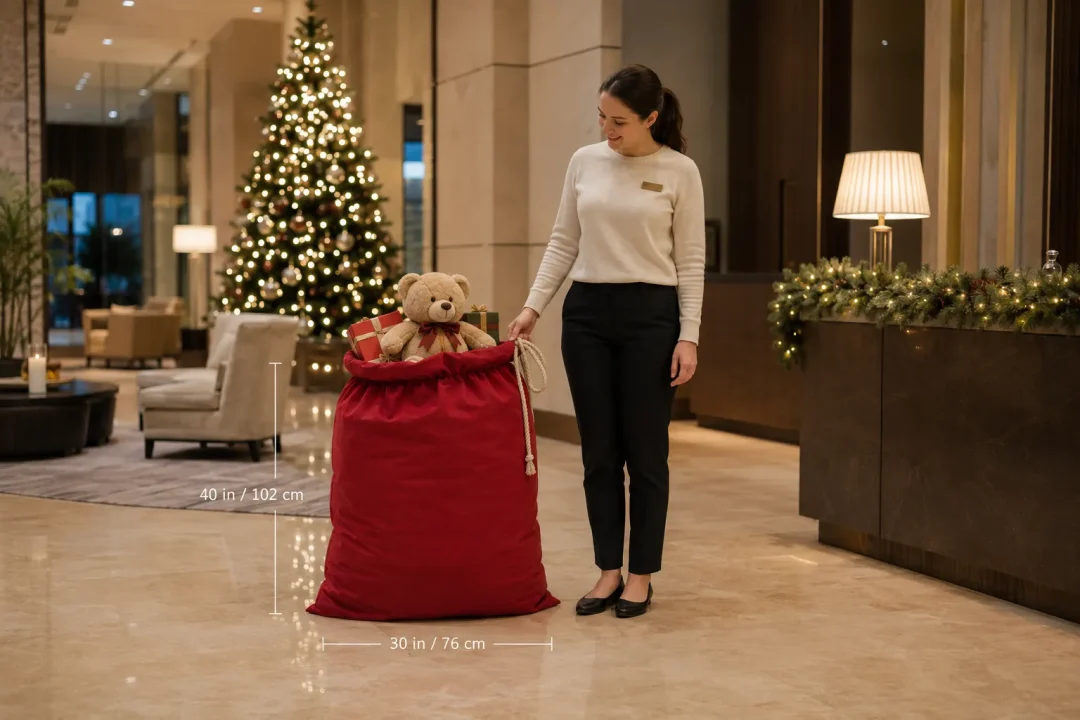
Important questions include:
- Will the sack be filled with real gifts or lightweight props?
- Does it need to be carried after filling?
- Should it stand upright or retain a rounded shape?
- Will the drawstring be operated frequently?
- Does the artwork need to remain visible from a distance?
- How small must the sack fold for shipping and storage?
An oversized sack made for static display can use a different structure from one carried by a Santa performer. If it will be moved while full, the factory must evaluate seams, handles, fabric and load distribution rather than simply increasing the dimensions.
Pourquoi les mêmes cadeaux peuvent nécessiter des tailles de sacs différentes
Two buyers packing similar products may still require different Santa sack dimensions. Packaging, presentation and distribution methods can all change the amount of usable space required.
Mesurez les produits après emballage
Product dimensions should be measured in the final condition in which the items will enter the sack.
This may include:
- Retail boxes
- Gift wrapping
- Ribbons and bows
- Protective inserts
- Inner cartons
- Tissue paper or other fillers
- A larger box combining several products
A common sizing problem occurs when the dimensions of the bare product are supplied, but the final gift box is significantly wider or thicker. The product may fit the bag body while its package cannot pass through the opening.
For a multi-item set, the planned arrangement should also be measured. Products placed side by side require different dimensions from the same products stacked vertically.
Ajustement compact, standard ou décontracté
The desired appearance influences the final size.
| Fit preference | Appearance and result | Common use |
| Compact fit | Full appearance with limited unused space | Promotions and high-volume distribution |
| Standard fit | Natural bag shape with sufficient closing space | Family gifts and general retail |
| Relaxed fit | More open space and a softer presentation | Premium gifts and reusable packaging |
A compact fit reduces excess material but allows less tolerance for packing variations. A relaxed fit is easier to pack and may create a more premium presentation, but a sack that is excessively large can make the contents look sparse.
Before sampling, the buyer and manufacturer should agree on how full the finished sack is expected to look.
Comment la construction du sac modifie la taille dont vous avez besoin
Flat dimensions do not tell the complete story. Two sacks with the same stated width and height can provide different usable capacities if their bottom, sides, lining or closure structures are different.
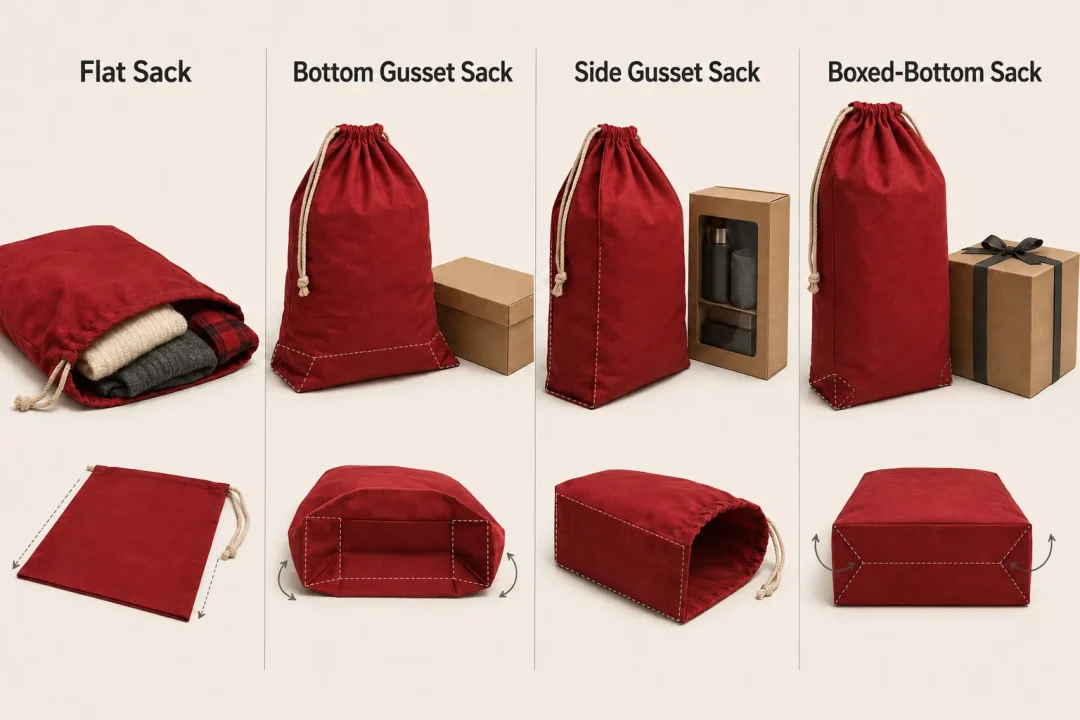
Sac de Noël plat
A flat sack is made from two panels or a folded piece of fabric without a separate depth measurement.
Il convient pour :
- Clothing
- Pajamas
- Plush toys
- Blankets
- Other flexible gifts
Flat sacks are easy to fold, pack and store. However, when a thick box is inserted, part of the flat width is used to wrap around the sides of the box. The remaining front width becomes smaller, and the bag may feel tighter than expected.
A flat sack is therefore less efficient for rigid, deep products even if its flat measurements appear generous.
Sac de Noël à fond godet
A bottom gusset unfolds as products are inserted, creating additional depth at the base.
This structure is useful for:
- Shoe boxes
- Food packages
- Corporate gift boxes
- Several smaller items
- Products that need a broader base
A bottom gusset can improve capacity without increasing the entire width of the sack. It also helps the contents sit more naturally at the bottom.
However, a gusset does not automatically make the bag stronger. Its seams and corners must still be designed for the expected load.
Sac de Noël à godet latéral
Side gussets create depth along the vertical sides of the bag. They are useful when the contents are thick, numerous or arranged in a block-like formation.
Common applications include:
- Multi-product retail sets
- Large rectangular boxes
- Food packages
- Bulky promotional kits
The artwork must be positioned carefully. A design printed too close to a side gusset may wrap around the fold or appear distorted after filling.
Construction à fond intégré
A boxed bottom creates a more defined base by forming corners at the bottom of the bag. It can give the sack a more structured appearance when filled.
This construction is often selected for:
- Premium corporate gifts
- Structured retail sets
- Products intended for display
- Gifts that need to remain upright
Compared with an ordinary flat sack, a boxed bottom can produce a neater presentation. It involves additional construction considerations, so the finished depth and intended loading arrangement should be confirmed during sampling.
Sac de Noël doublé
A lining may be added for appearance, protection or additional structure. It is often used with velvet, premium cotton or decorative seasonal fabrics.
Because the lining and outer shell occupy space, a lined sack may have slightly less internal room than an unlined sack with the same external dimensions. The additional thickness can also affect how tightly the opening gathers.
When a lining is required, the capacity and closure should be tested on the completed construction rather than estimated from the outer shell alone.
Quand augmenter la taille plate n'est pas la meilleure solution
When a thick gift box does not fit a flat sack, the immediate response is often to increase the overall bag width. This can create an unnecessarily large front panel, increase material consumption and leave excess fabric around the product.
Adding a bottom or side gusset may be a more effective solution. It creates depth where it is needed and can improve the appearance of the filled sack.
The most suitable option depends on the product shape, desired presentation, manufacturing budget and whether the sack must fold flat for distribution.
Les dimensions plates ne sont pas identiques à l'espace utilisable
The stated dimensions of a Santa sack usually describe the finished external width and height when laid flat. They do not necessarily represent the entire usable storage area.
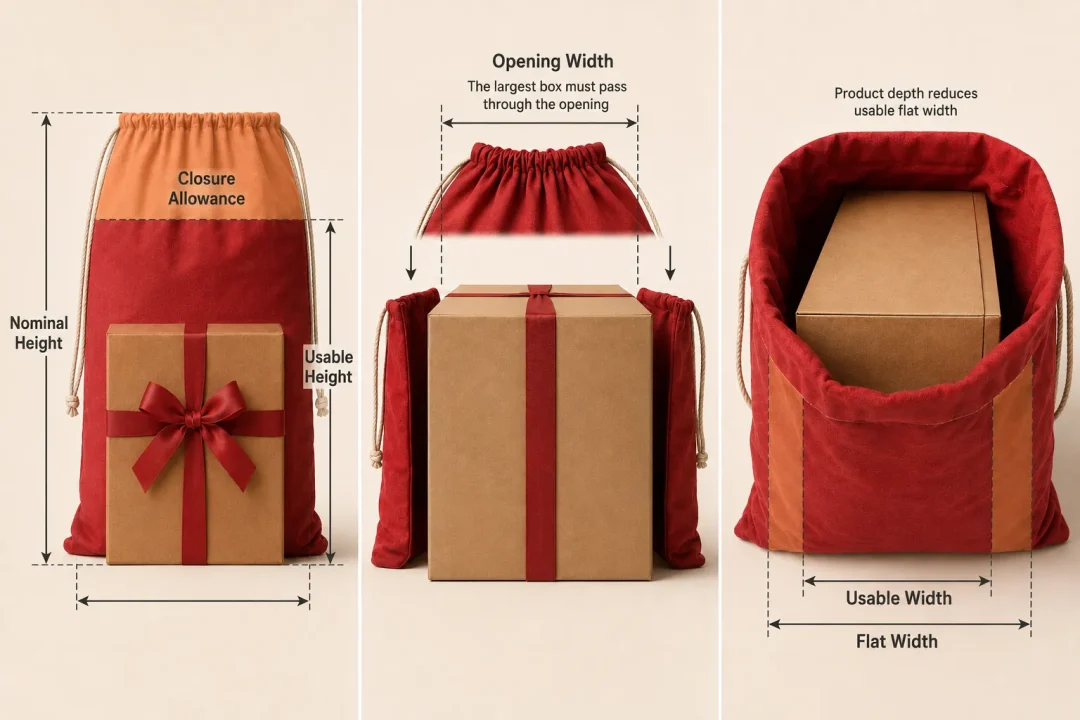
Le canal du cordon de serrage utilise une partie de la hauteur
The drawstring channel, top hem and gathering area occupy space at the upper part of the sack. Gifts should remain below this area so the opening can gather and close.
A 28-inch-tall sack does not provide 28 inches of usable vertical packing space. The exact reduction depends on:
- The width of the drawstring channel
- The position of the drawstring
- The amount of fabric required for gathering
- Whether the sack uses one or two drawstrings
- The thickness and stiffness of the material
Bulky items packed too close to the drawstring may prevent full closure even though they remain within the external height.
L'ouverture peut être plus petite que le corps du sac
The largest product must pass through the finished opening.
The opening can become more restrictive when the sack uses:
- Heavy canvas
- A wide folded hem
- A lining
- Double drawstring channels
- Reinforced top stitching
- Thick cords or internal cord structures
For rigid boxes, the opening width should be tested directly. A box that fits inside the lower body may still be difficult or impossible to insert.
La profondeur du produit utilise une partie de la largeur plate
For a flat sack, product depth consumes part of the available width as the fabric wraps around both sides of the object.
As an initial estimate for a simple flat sack, buyers sometimes consider:
Required flat width ≈ product width + product depth + fitting allowance
This is only a preliminary guide. Fabric flexibility, seam construction, loading direction and the shape of the product can all affect the final result.
A rigid box usually needs more controlled allowance than soft clothing because it cannot compress or adapt to the bag shape.
La taille et le poids doivent être évalués séparément
A large Santa sack is not automatically heavy-duty, and a smaller sack is not automatically suitable for dense products.
Capacity describes whether the products fit inside. Load capacity describes whether the material, seams and carrying structure can safely support the products during intended use.
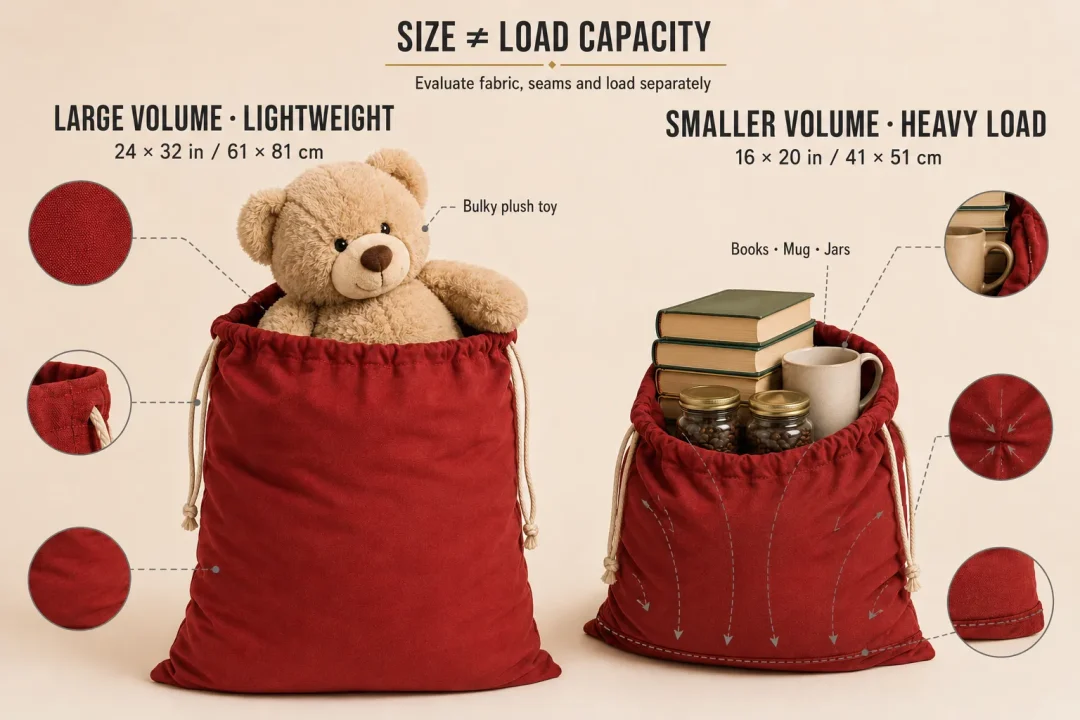
Contenu volumineux mais léger
A 24 × 32-inch sack filled with a large plush toy may have substantial volume but relatively little weight.
The main concerns are likely to be:
- Whether the toy passes through the opening
- Whether the sack can close properly
- Whether the filled shape looks balanced
- Whether the fabric is opaque enough
- Whether the print remains visible when the bag expands
A moderate-weight cotton or polyester fabric may be sufficient if the sack is only carried a short distance and the structure is properly sewn.
Using an excessively heavy canvas could make the drawstring difficult to gather without adding meaningful value to this application.
Contenu compact mais lourd
A 16 × 20-inch sack containing books, ceramic mugs, glass jars or bottles may be much smaller but create significantly greater stress.
The factory must evaluate:
- Total product weight
- Whether the load is concentrated at one point
- Fabric tensile and tear performance
- Bottom and side seam construction
- Seam allowance and stitch density
- Whether raw edges are bound or reinforced
- Whether the drawstring is expected to function as a handle
- Whether separate carrying handles are required
If several heavy products rest directly on the bottom seam, increasing the fabric weight alone may not solve the problem. Reinforced seams, a double-layer base or a different bag construction may also be required.
Comment la structure du sac modifie la répartition de la charge
A flat sack usually directs the weight toward the bottom seam and lower corners. When rigid objects are packed inside, their edges may create concentrated pressure against the fabric.
A bottom-gusset sack distributes the contents across a broader base, but the gusset seams become important load-bearing areas.
A side-gusset structure provides more depth, although the lower junctions between the front, back and side panels must be constructed carefully for heavier sets.
A boxed bottom can improve stability and distribute products more evenly when they are arranged correctly. However, its corners and seams still require suitable reinforcement for the intended weight.
A lining may provide a cleaner interior and reduce abrasion, but it should not automatically be treated as structural reinforcement. Its material and attachment method determine whether it contributes meaningfully to load support.
Les cordons ne sont pas toujours des poignées de transport
Many people naturally lift a Santa sack by its drawstrings. For a lightweight gift bag, this may be acceptable. For heavy products, it can place substantial force on the drawstring channel and upper side seams.
If the filled sack will be carried over a meaningful distance, separate handles may be more reliable and comfortable. The handle material, attachment points and reinforcement should then be evaluated as part of the load-bearing structure.
The intended method of carrying should be communicated before the sample is made.
Quand un renforcement peut être nécessaire
Depending on the contents and intended use, the manufacturer may recommend:
- Reinforced bottom and side seams
- Coutures internes reliées
- A double-layer bottom
- A higher fabric weight
- A lining or protective insert
- Box stitching at handle attachment points
- Separate carrying handles
- Internal dividers for bottles or fragile products
- A gusseted structure that distributes the load more effectively
These features should be selected based on the actual product and use case rather than added automatically to every large sack.
Pourquoi les tests de charge réels sont nécessaires
Fabric specifications can help narrow the options, but they cannot replace a completed-bag test.
Before bulk production, the sample should be packed with the real products or substitutes of equivalent dimensions and weight. It should then be closed, lifted and handled in the same way it will be used.
This test helps reveal:
- Seam stretching
- Localized pressure at the bottom
- Fabric distortion
- Drawstring-channel stress
- Handle discomfort
- Excessive sagging
- Product movement inside the sack
- Changes in logo appearance after loading
A reliable load recommendation should be based on the complete construction rather than a fabric name or bag size alone.
Comment le matériau affecte la taille finale
Material selection influences flexibility, usable capacity, closure performance and the appearance of the filled sack.
Coton
Cotton is flexible and works well for traditional drawstring sacks. It can adapt to soft gifts and irregular shapes, although rigid boxes may create visible corners through the fabric.
Different cotton weights produce different levels of softness and strength. A heavier cotton fabric also takes up more space in the gathered opening.
Toile
Canvas provides a more structured and reusable feel. It is often selected for large branded sacks, corporate programs and products intended for repeated use.
Very heavy canvas can be difficult to gather at the top. The drawstring channel and cord thickness must be compatible with the material, and additional closing allowance may be needed.
Polyester
Polyester is often used for lightweight, large-format sacks and projects requiring vivid printed graphics. Its performance still depends on the fabric construction and weight; “polyester” alone is not a load-capacity specification.
It may be useful for oversized but lightweight applications in which reducing the sack’s own weight is important.
Velours
Velvet provides a decorative and premium seasonal appearance. The pile, lining and top construction can make the finished bag thicker than a basic cotton sack.
This additional bulk may reduce usable space and make the opening more difficult to gather. Velvet sacks should be evaluated in their complete lined or unlined structure.
Jute ou toile de jute
Jute has a firmer hand and a rustic appearance. It does not conform around square boxes as easily as soft cotton, so more fitting allowance or a gusset may be necessary.
The opening, internal seams and possible lining also deserve attention, particularly when the contents may catch on the fabric or require a cleaner interior.
Tissu non tissé
Non-woven fabric can be suitable for promotional distributions and short-term event projects. The appropriate specification depends on the fabric weight, seam method, product weight and how the sack will be carried.
For larger or heavier contents, the manufacturer should confirm whether the selected non-woven construction is appropriate rather than assuming that a larger sheet automatically provides more strength.
Ce que les acheteurs doivent fournir pour une recommandation de taille
The more complete the product information is, the more accurately a manufacturer can recommend a starting size and construction.
Ideally, provide:
- The length, width and depth of each product after packaging
- The number of products packed in each sack
- The largest individual product
- The estimated total weight
- The preferred arrangement of the products
- The desired compact, standard or relaxed fit
- Whether the bag needs a flat, gusseted or boxed-bottom structure
- Whether a lining is required
- Whether separate handles are needed
- The proposed print or embroidery dimensions
- The order quantity
- The intended distribution and carrying method
If the project is still at the concept stage, buyers can send product photographs, packaging images, arrangement sketches, reference-bag photographs or links to similar products.
A simple diagram showing how the items should sit inside the sack is often more useful than describing the required size as “large.”
Ce que nous vérifions avant la production en série
Once an initial size and structure have been selected, a pre-production sample should be checked under realistic packing conditions.
The evaluation normally includes:
- Whether the largest packaged item passes through the opening
- Whether all products fit in the intended arrangement
- Whether the drawstring closes after the sack is filled
- Whether sufficient space remains above the products
- Whether the bag looks too loose or excessively stretched
- Whether the bottom and side seams support the actual load
- Whether the sack can be lifted in the intended way
- Whether the filled shape distorts the logo
- Whether artwork enters a fold or gusset
- Whether the selected fabric gathers correctly
- Whether the sack retains the intended presentation
- Whether its folding and carton dimensions remain practical for bulk shipping
If possible, the actual products should be used for this test. When they are unavailable, substitutes should match both the dimensions and weight as closely as possible.
Erreurs courantes de taille de sac de Noël
1. Spécifier uniquement “Grand” ou “Très Grand”
These descriptions vary between suppliers and cannot be used as final production specifications. Always confirm finished dimensions in inches or centimeters.
2. Mesurer des produits non emballés
Retail boxes, gift wrapping and protective inserts can add substantial width, height and depth. Measure the final packed products.
3. Ignorer la profondeur du produit
A flat sack loses usable front width as its fabric wraps around a deep box. Consider a gusset when packing rigid or thick products.
4. Vérifier le corps du sac mais pas l'ouverture
The bag may have enough internal volume while the largest box cannot pass through its opening.
5. Considérer la hauteur totale comme un espace utilisable
The drawstring channel and gathering area require space above the products. Filling the sack to its top edge may prevent closure.
6. Partir du principe qu'un sac plus grand a une plus grande capacité de charge
Capacity and strength are separate specifications. Material, seams, gussets, handles and load distribution must be evaluated together.
7. Agrandir l'ensemble du sac au lieu d'ajuster sa structure
Adding a bottom or side gusset may accommodate a thick gift box more effectively than increasing the full flat width.
8. Finaliser l'œuvre d'art avant de confirmer les dimensions
Changes to the size or gusset can alter the visual proportions and safe print area. Final artwork should follow structural approval.
9. Sauter le test d'emballage
Measurements and formulas can establish a starting point, but an actual packing and carrying test is the most reliable way to approve the final size.
Questions fréquemment posées
Quelle est la taille de sac de Noël la plus courante ?
There is no official standard, but approximately 20 × 28 pouces (50 × 70 cm) is a practical large size for several family gifts, shoe boxes or medium plush toys. Retail and corporate gift sets often use smaller sizes, while oversized toys may require 24 × 32 inches or more.
Un sac de Noël de 20 × 28 pouces est-il suffisamment grand pour des cadeaux de Noël ?
It is generally suitable for several wrapped gifts or one or two medium-sized boxes. The result depends on product depth, the size of the opening and how much space is required above the gifts for closure.
Quelle taille de sac de Noël convient à une boîte à chaussures ?
A 16 × 20-inch ou 20 × 28-inch sack can be an initial option, depending on the shoe-box dimensions. Measure the complete box and check its thickness. A bottom gusset may provide a better fit than a wider flat sack.
Quelle taille convient pour plusieurs cadeaux emballés ?
For a combination of books, clothing and small gift boxes, start by evaluating 16 × 20 pouces. For larger boxes or a more generous family gift collection, 20 × 28 pouces may be more appropriate.
Arrange and measure all wrapped presents together rather than adding their individual dimensions without considering placement.
Un sac de Noël doit-il avoir un soufflet ?
A gusset is helpful for deep boxes, food sets, shoe boxes and products that need a broader or more stable base. Soft clothing and plush toys may fit well in a simpler flat sack.
Un sac de Noël plus grand nécessite-t-il un tissu plus épais ?
Not necessarily. A large sack holding a lightweight plush toy may place less stress on its seams than a smaller sack containing books or bottles. Fabric and construction should be selected according to the actual load and carrying method.
Les sacs de Noël peuvent-ils être fabriqués sur mesure ?
Yes. Custom manufacturers can adjust the width, height, gusset, drawstring position, material and artwork to match a specific product set. Final dimensions should be verified through a sample and packing test before bulk production.
Recommandation finale
For most family gift applications, start by evaluating a Santa sack around 20 × 28 pouces. Smaller retail, beauty and corporate gift sets often work better in the 12 × 16 to 16 × 20-inch range. Bulky toys and event displays may require 24 × 32 inches or more.
These dimensions should not be treated as fixed standards. The final size must account for the packaged products, their arrangement, the opening width, the space needed for closing and the total load.
For a custom Santa sack project, send us the packaged product dimensions, quantity per sack, estimated weight and intended application. We can then evaluate the size, gusset structure, material and carrying method together before sampling.
 French
 English
 German
 Japanese
 Arabic
 Thai
 Vietnamese
 Russian
 Spanish
 Portuguese