
Tay cầm túi thường trông giống như một chi tiết thứ cấp - cho đến khi túi hoàn thiện trở nên khó chịu để mang, khó để đóng gói, hoặc bắt đầu rách xung quanh các điểm gắn.
Chúng tôi thường nhận được các yêu cầu về túi trong đó vật liệu chính, kích thước và phương pháp in được chỉ rõ ràng, trong khi yêu cầu về tay cầm chỉ được mô tả bằng một vài từ:
- “Sử dụng tay cầm bằng cotton.”
- “Làm cho các dây đeo chắc chắn.”
- “Chúng tôi muốn tay cầm dài.”
- “Vui lòng sử dụng tay cầm giống như trong ảnh tham khảo.”
Những mô tả này là dễ hiểu, nhưng chúng không đủ cho sản xuất. Hai tay cầm làm từ cùng một vật liệu có thể hoạt động rất khác nhau tùy thuộc vào chiều rộng, độ dày, cấu trúc và phương pháp gắn.
Lựa chọn đúng không tự động là tay cầm mạnh nhất hoặc đắt nhất. Nó cần phải phù hợp với thân túi, nội dung dự kiến, phong cách mang, định vị thương hiệu và ngân sách dự án.
Hướng dẫn này giải thích các loại tay cầm túi chính từ góc độ sản xuất túi tùy chỉnh - và cách lựa chọn giữa chúng.
Đầu tiên, Tay cầm túi được tính là gì?
Các thuật ngữ “tay cầm” và “dây đeo” thường được sử dụng thay thế cho nhau, nhưng chúng có thể chỉ các phần khác nhau của một chiếc túi.
A handle thông thường có nghĩa là một thành phần ngắn hơn được sử dụng để xách túi bằng tay hoặc qua cẳng tay. A dây đeo thường dài hơn và được thiết kế để mang vai hoặc chéo thân.
Cũng có hai kích thước mà người mua thường nhầm lẫn:
- Handle length được đo dọc theo toàn bộ tay cầm từ một điểm kết nối đến điểm khác.
- Handle drop là khoảng cách theo chiều dọc giữa cạnh trên của túi và điểm cao nhất bên trong tay cầm.
Một tay cầm có thể có tổng chiều dài tương đối dài nhưng vẫn cung cấp khoảng trống vai hạn chế do hình dạng hoặc vị trí gắn.
Nếu bạn đang quyết định khoảng trống mà một chiếc túi đeo cần cho việc xách tay, cẳng tay hoặc vai, hãy xem hướng dẫn riêng của chúng tôi: [Tay cầm túi xách nên dài bao nhiêu? ].
Tay cầm túi có thể được phân loại theo nhiều cách:
- Theo cấu tạo, chẳng hạn như dây đai, cuộn hoặc đệm.
- Theo vật liệu, chẳng hạn như cotton, polyester, nylon hoặc PU.
- Theo kiểu mang, chẳng hạn như ngắn, dài vai hoặc có thể điều chỉnh.
- Theo cách kết nối, chẳng hạn như khâu trực tiếp, đinh tán hoặc phần cứng có thể tháo rời.
Để tránh việc trộn lẫn các loại này, chúng tôi sẽ bắt đầu với các cấu trúc tay cầm thực tế thường được sử dụng trong việc sản xuất túi tùy chỉnh.
So sánh nhanh các loại tay cầm túi thông thường
| Handle type | Carrying comfort | Khả năng chịu tải tương đối | Mức độ chi phí | Ứng dụng phổ biến |
|---|---|---|---|---|
| Tay cầm cùng chất liệu | Trung bình | Nhẹ đến trung bình | Low to medium | Túi vải cotton, vải canvas và vải lanh |
| Cotton webbing | Cao | Trung bình đến nặng | Trung bình | Túi mua sắm và túi phong cách có thể tái sử dụng |
| Dây polyester hoặc nylon | Trung bình đến cao | Nặng | Low to medium | Túi du lịch, thể thao, giữ lạnh và túi đa năng |
| Tay cầm dây | Cao cho việc xách tay | Trung bình | Trung bình đến cao | Túi biển, khu nghỉ dưỡng và quà tặng |
| Tay cầm cuộn | Cao cho việc xách tay | Trung bình | Cao | Túi thời trang và cao cấp |
| Tay cầm đệm | Cao | Trung bình đến nặng | Trung bình đến cao | Túi giữ lạnh, laptop, dụng cụ và du lịch |
| Tay cầm cắt tạo hình | Low to medium | Light | Thấp | Túi quảng cáo và bán lẻ |
| Tay cầm cứng | Phụ thuộc vào hình dạng | Nhẹ đến trung bình | Cao | Túi thời trang, giỏ và túi chuyên dụng |
| Dây đeo rời | Adjustable | Trung bình đến nặng | Trung bình đến cao | Túi du lịch, laptop và đa năng |
Những so sánh này là tương đối hơn là đánh giá tải cố định. Độ bền của tay cầm không thể được đánh giá riêng biệt với thân túi và khu vực gắn kết.
Một tay cầm đai rộng, chắc chắn vẫn có thể bị rách nếu nó được may trên một loại vải mỏng, không hỗ trợ.
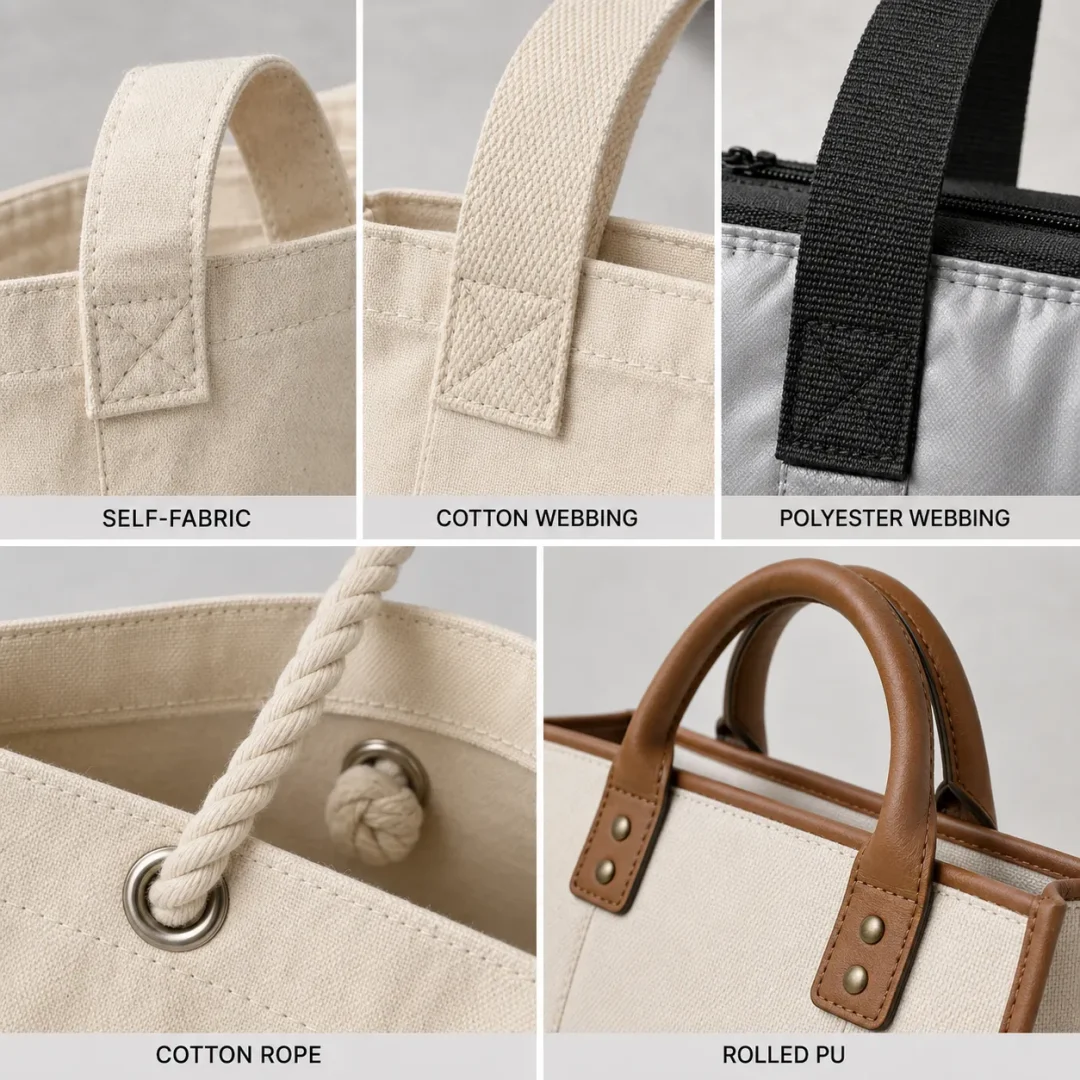
1. Tay cầm tự làm bằng vải
Tay cầm tự tạo được làm từ cùng một vật liệu - hoặc vật liệu tương tự - như thân túi. Vải thường được cắt thành các dải, gập lại và may để tạo thành một cạnh sạch sẽ.
Chúng thường được sử dụng trên:
- Túi tote cotton
- Túi vải canvas
- Linen bags
- Túi quảng cáo in
- Túi không dệt nhẹ
Lợi thế chính của chúng là tính nhất quán về mặt hình ảnh. Thân và tay cầm có thể sử dụng cùng một màu sắc, kết cấu hoặc in toàn bộ, tạo ra một vẻ ngoài sạch sẽ và thống nhất.
Tuy nhiên, việc sử dụng chính xác cùng một loại vải không phải lúc nào cũng là lựa chọn kỹ thuật tốt nhất.
When a bag is made from heavy canvas, folding several layers of the same fabric can create an excessively thick handle. The attachment area may become bulky, difficult to stitch and less visually even. A lighter matching fabric or an internal reinforcement strip may produce a better result.
Self-fabric handles work well for light and medium everyday loads. For heavier products, the handle attachment should be reinforced, or a webbing handle may be more suitable.
2. Tay cầm dây phẳng
Webbing is one of the most versatile choices for custom bags. It is woven separately from the bag body and supplied in different materials, widths, thicknesses, colors and weave patterns.
The most common options are cotton, polyester, nylon and polypropylene.
Dây cotton
Cotton webbing has a natural, relatively soft appearance that works particularly well with canvas and cotton bags.
It is commonly chosen for:
- Premium reusable shopping bags
- Canvas retail totes
- Lifestyle products
- Corporate gift bags
- Eco-positioned promotional bags
Compared with a narrow self-fabric handle, wider cotton webbing can distribute pressure more evenly across the hand or shoulder.
Cotton webbing is not a single standard material, however. A loose, lightweight cotton tape and a dense, thick cotton webbing may look similar in a photograph but perform very differently.
When requesting a quotation, specify the width, thickness, weave, color and required feel—not only “cotton handle.”
Dây polyester
Polyester webbing is dimensionally stable, abrasion-resistant and less absorbent than cotton. It can be produced in a wide variety of colors and is commonly used in both promotional and functional bags.
Các ứng dụng điển hình bao gồm:
- Túi giữ lạnh
- Sports bags
- Travel bags
- Laptop bags
- Túi mua sắm tái sử dụng
- Promotional totes
Polyester is also suitable for printed, woven or jacquard branding. For brands that need consistent colors across a large production run, it often provides more predictable results than some natural-fiber options.
Dây nylon
Nylon webbing is usually associated with functional and heavy-duty bags. It can provide high tensile strength and good abrasion resistance while maintaining a relatively smooth surface.
Common applications include utility bags, luggage, travel bags and technical carrying products.
However, smooth synthetic webbing should not automatically be described as nylon. Many commercial straps that appear to be nylon are actually polyester. Material composition should be confirmed if it affects performance, labeling or compliance.
Dây polypropylene
Polypropylene, or PP webbing, is an economical and moisture-resistant option commonly used for:
- Túi mua sắm không dệt
- Promotional bags
- Budget reusable bags
- Túi giữ lạnh
- Large-volume retail projects
Its appearance is generally more practical than premium, but the final result depends on the weave density and finish. It can be a sensible choice when cost, moisture resistance and high-volume production matter more than a natural hand feel.
3. Tay cầm dây thừng
Rope handles create a softer, more relaxed appearance than flat webbing. Their rounded profile can also feel comfortable in the hand, especially when the rope diameter suits the expected load.
Common materials include:
- Cotton rope
- Polyester rope
- Polypropylene rope
- Nylon rope
- Jute or other natural-fiber rope
Rope handles are frequently used for beach bags, resort totes, canvas bags, wine bags and premium gift packaging.
The material is only one part of the specification. Buyers should also confirm:
- Rope diameter
- Braid or twist structure
- Màu sắc
- End treatment
- Attachment method
- Eyelet size and finish
- Whether the rope is knotted or stitched
Rope handles can be passed through eyelets and knotted inside the bag, inserted into a seam, or fixed with separate tabs. Each method creates a different appearance and load path.
They may also increase packing volume. Unlike flat handles, thick ropes do not always lie neatly against the bag body, which can affect carton quantity and shipping costs.
For a broader visual reference covering cotton, jute, synthetic rope and other less common handle styles, see [20 Types of Bag Handles: A Visual Guide – INTERNAL LINK TO ECOBAGFACTORY ARTICLE].
4. Tay cầm cuộn hoặc ống
Rolled handles are made by wrapping fabric, leather or PU around an internal cord or filler. This creates a rounded, three-dimensional handle rather than a flat strap.
They are widely used on:
- Structured handbags
- Business totes
- Premium cosmetic cases
- Fashion bags
- Corporate gift bags
The diameter of the internal core affects both appearance and grip. A very thin rolled handle can look refined but may become uncomfortable when the bag is heavily loaded. A thicker handle is easier to grip but may look disproportionate on a small bag.
Rolled handles require more production steps than standard webbing. Depending on the design, these may include skiving, folding, edge painting, inserting the filler and attaching metal hardware.
The attachment ends are particularly important. A visually strong rolled handle can still fail if the ends are connected to small, unsupported areas of the bag body.
5. Tay cầm đệm
Padded handles contain foam, neoprene or another cushioning material inside the grip area. They are intended to reduce pressure when a bag carries heavier contents.
Chúng thường được sử dụng trên:
- Large cooler bags
- Tool bags
- Travel bags
- Laptop bags
- Gym bags
- Equipment cases
The entire handle can be padded, or padding can be limited to the central grip section.
More padding does not necessarily mean better comfort. An overly thick handle may feel bulky, resist folding and increase packaging volume. A very soft handle may roll or twist under load.
During sampling, the padding thickness, handle width and flexibility should be evaluated with the bag loaded—not only when it is empty.
For heavy bags that use two handles, another option is a wrapped grip that joins both handles in the middle. This component can be made from fabric, neoprene or PU and closed with hook-and-loop tape or snaps.
6. Tay Nắm Dập hoặc Tích Hợp
A die-cut handle is created by cutting a hand opening directly into the bag body. No separate strap is required.
This structure is commonly found on:
- Non-woven promotional bags
- Laminated woven polypropylene bags
- Plastic retail bags
- Túi felt
- Paper shopping bags
Die-cut handles keep the bag relatively flat, simplify packing and reduce the number of separate components. They are suitable for lightweight retail, exhibition and promotional applications.
Their main limitations are carrying comfort and load capacity. A narrow cut edge concentrates pressure on the fingers, and the area around the opening may stretch or tear.
Depending on the material and expected contents, the handle area can be strengthened with:
- An additional internal patch
- A thicker material layer
- Heat-sealed reinforcement
- Stitched reinforcement
- A separate plastic insert
This type of handle should not be selected only because it is economical. The size and shape of the opening must also provide enough space for the intended users.
7. Tay Nắm Cứng
Rigid handles include bamboo, wood, metal, acrylic, resin and molded plastic structures. Rather than disappearing into the bag design, they usually become a visible styling feature.
They are often used for:
- Straw or woven bags
- Crochet bags
- Fashion handbags
- Evening bags
- Resort products
- Specialty gift packaging
Rigid handles offer strong visual differentiation, but they also introduce additional production considerations.
The handle needs to be checked for smooth edges, surface finish, color consistency and attachment security. Wooden and bamboo handles may require attention to moisture content and natural variation, while metal handles require suitable plating and protection from scratching.
Because these handles do not fold, they can substantially increase packing volume. They are generally less suitable for projects where flat shipment, low weight and economical distribution are priorities.
8. Tay Nắm Có Thể Tháo Rời và Điều Chỉnh
Detachable straps connect to the bag through hardware such as snap hooks, D-rings or swivel hooks. Adjustable straps normally include a slider or buckle.
These structures allow one bag to support several carrying methods:
- Hand carry
- Shoulder carry
- Crossbody carry
- Short and long handle combinations
They are commonly found on travel bags, gym bags, laptop bags, cosmetic cases and multifunctional totes.
The strap itself is not the only component that needs to be evaluated. The snap hook, ring, slider, stitching and fabric tab all form part of the load-bearing system.
In many cases, the small tab holding the D-ring becomes the weakest point. It should be reinforced internally and positioned where the bag body can distribute the load.
Chất Liệu Tay Nắm Ảnh Hưởng Đến Việc Sử Dụng Thực Tế Như Thế Nào
| Vật liệu | Feel and appearance | Độ bền | Moisture resistance | Branding options | Common uses |
|---|---|---|---|---|---|
| Cotton | Natural and relatively soft | Trung bình đến cao | Thấp | Printing, woven labels, jacquard | Canvas and reusable totes |
| Polyester | Smooth and consistent | Cao | Cao | Printing, sublimation, jacquard | Sports, cooler and travel bags |
| Nylon | Smooth and technical | Cao | Cao | Printing and woven branding | Utility and functional bags |
| PP | Practical and economical | Trung bình đến cao | Cao | Color matching and printing | Promotional and non-woven bags |
| Leather or PU | Premium and structured | Varies | Varies | Embossing, foil and stitching | Fashion and corporate gifts |
| Rope | Casual, natural or nautical | Material-dependent | Material-dependent | Color, knots and end details | Túi biển, khu nghỉ dưỡng và quà tặng |
| Wood, bamboo or metal | Decorative and rigid | Structure-dependent | Material-dependent | Engraving, printing or plating | Specialty and fashion bags |
A handle should not be described as sustainable based only on its material name.
For example, a cotton bag body combined with polyester webbing, foam padding and metal hardware may be durable, but it is more difficult to process as a single material at the end of its usable life.
When environmental requirements are important, consider:
- Whether the material is recycled or certified
- Whether it contains blended fibers
- Whether the handle can be separated
- Whether the handle and bag body use compatible materials
- Whether the design is durable enough for repeated use
An RPET webbing handle may be appropriate for an RPET bag, while recycled cotton webbing can complement a recycled cotton or canvas body. Certificates and transaction documents should be discussed before sampling if they are required for the final product claim.
Tay Nắm Ngắn, Tay Nắm Vai Hay Dây Đeo Chéo?
After selecting the construction and material, the next decision is how the bag will be carried.
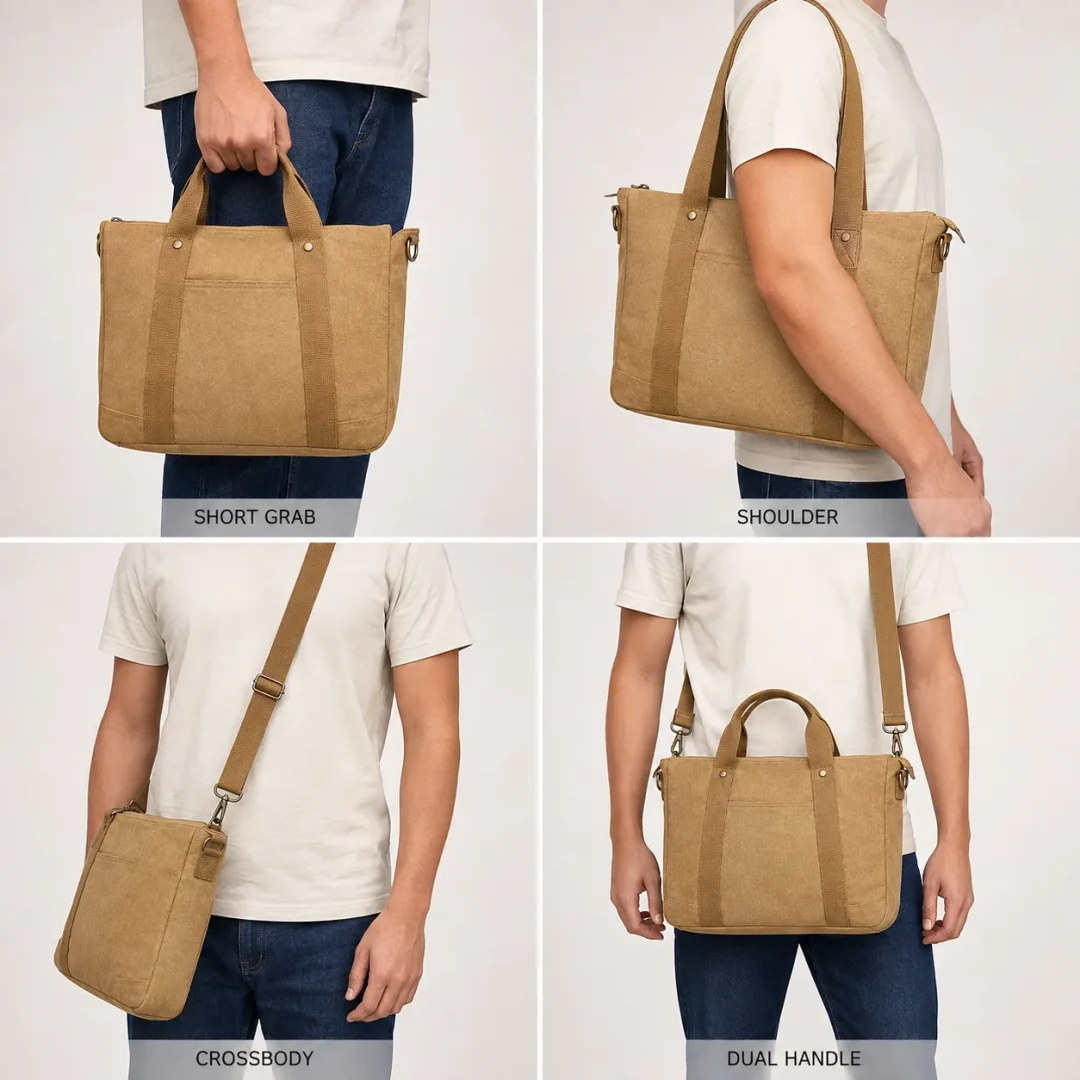
Tay Nắm Ngắn
Short handles suit quick hand carrying, gift packaging and products that need a more compact or formal appearance.
They work well for small retail bags, wine bags, lunch bags and structured cases. They are less suitable when users need to carry a loaded bag for a long distance.
Tay Nắm Đến Vai
Shoulder-length handles are common on tote bags, reusable shopping bags and everyday carry products.
The required clearance depends on more than the user’s body size. Bag height, opening structure, winter clothing and the way the contents fill the bag can all change how the handle feels.
A handle that fits comfortably on an empty sample may become awkward once the bag is fully loaded.
Dây Đeo Chéo
Crossbody straps provide hands-free carrying and usually require an adjustable length.
They also require stronger side attachment points. The bag width and depth should be considered because a very wide bag may not sit comfortably against the body.
Thiết Kế Có Hai Tay Nắm
A pair of short handles combined with a detachable shoulder strap is common on travel, gym and laptop bags.
This provides greater flexibility but adds material, hardware, sewing operations and packing requirements. It should be used when the second carrying method has real value, rather than added only as a visual feature.
Tay Nắm Nên Được Gắn Với Túi Như Thế Nào?
The attachment structure is often more important than the apparent strength of the handle material.
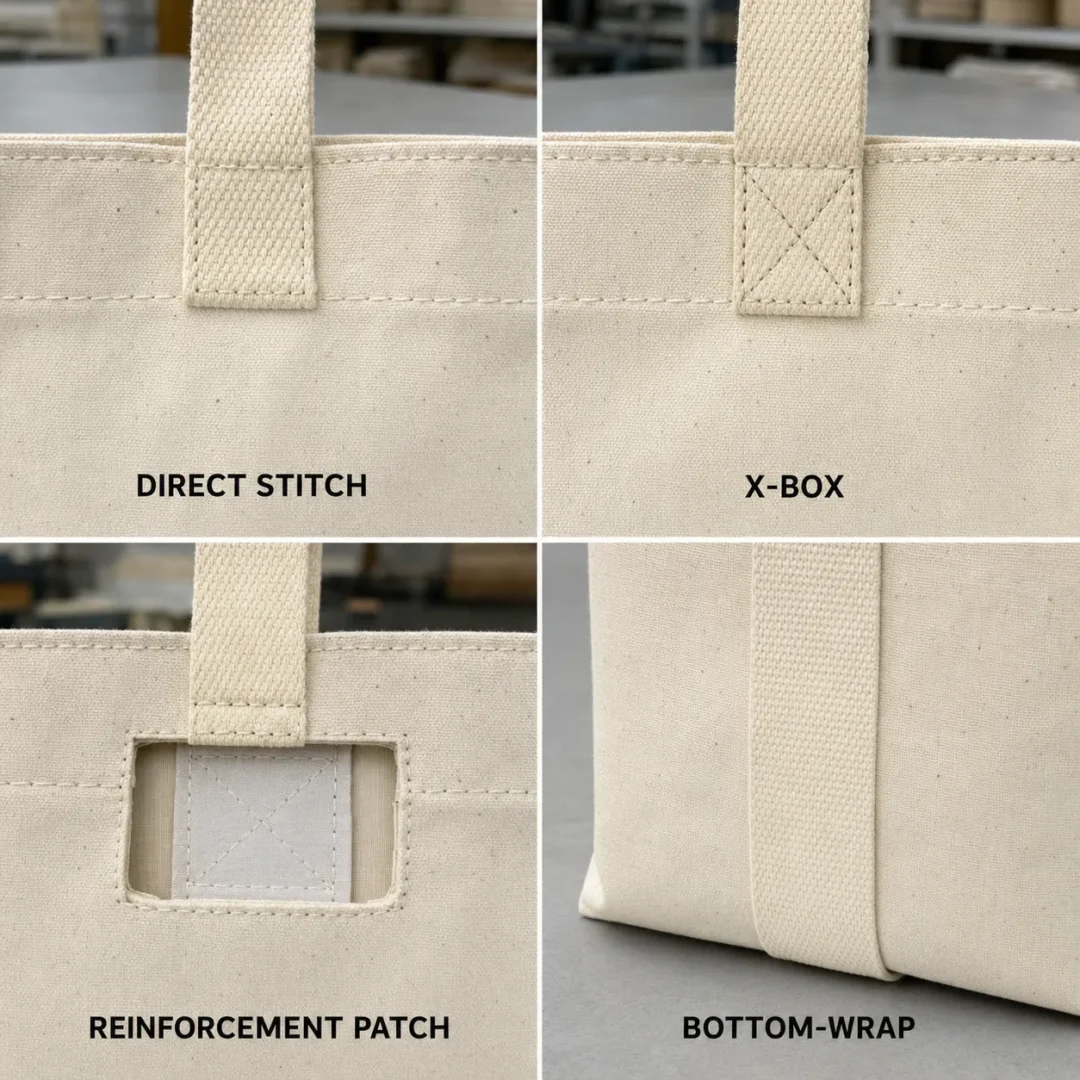
Khâu Trực Tiếp
Direct stitching is widely used for canvas totes, cotton bags and reusable shopping bags. The handle ends are positioned on the bag body and stitched in place.
A simple horizontal stitch may be sufficient for lightweight applications. Heavier use may require parallel stitching, a box stitch or an X-box pattern.
Củi Mảnh Tăng Cường
A bar tack is a short area of dense stitching added at a stress point. It is commonly used on webbing handles, backpack straps and functional bags.
It provides localized reinforcement but should still be matched to the fabric. Dense stitching placed too close to the edge of a weak material may cut or perforate the fabric rather than strengthen it.
Tay Nắm Toàn Chiều Dài Hoặc Chạy Dọc Đáy
Full-length handles extend farther down the bag body. Some continue underneath the bag and form a continuous support structure.
This construction is often used for:
- Heavy shopping bags
- Tool bags
- Large insulated bags
- Delivery bags
- Equipment carriers
It distributes weight across a larger area and reduces dependence on a small attachment point. The trade-offs are greater webbing consumption, more sewing and a stronger visual presence on the bag exterior.
Đinh Vít và Phụ Kiện
Rivets are often used with leather, PU and structured fashion bags. They can provide a clean, premium appearance, but a rivet should not be fixed directly through thin, unsupported fabric.
An internal washer, patch or reinforcement layer may be needed to spread the force.
Lỗ, Nút và Các Gắn Kết Nhiệt
Rope handles are often passed through metal eyelets and secured with internal knots. Plastic and non-woven handles may use heat-sealed attachment. Each method has different equipment, appearance and strength implications.
The central principle is simple:
A stronger handle does not create a stronger bag if the attachment area is not reinforced.
Bạn Nên Chọn Tay Nắm Nào?
| Bag or project | Recommended handle | Why it is commonly selected |
|---|---|---|
| Lightweight promotional tote | Self-fabric or PP webbing | Economical and easy to customize |
| Reusable grocery bag | Wide cotton or polyester webbing | Better pressure distribution and repeated-use performance |
| Premium canvas retail tote | Cotton webbing or reinforced self-fabric | Balances appearance, comfort and durability |
| Beach or resort bag | Cotton or synthetic rope | Comfortable grip and distinctive casual appearance |
| Túi cách lạnh | Reinforced polyester or PP webbing, optionally padded | Better suited to heavier contents and moisture |
| Travel or gym bag | Full-length webbing with a detachable shoulder strap | Supports load and multiple carrying methods |
| Luxury gift bag | Rope, ribbon or PU handle | Adds presentation value |
| Flat promotional bag | Reinforced die-cut handle | Compact packing and economical production |
| Fashion handbag | Rolled, rigid or detachable handle | Provides shape and visual differentiation |
| Túi dụng cụ nặng | Bottom-wrap webbing | Distributes weight over a larger area |
These are starting points rather than fixed rules. A premium canvas tote may use rope for a resort collection, while a promotional bag may use cotton webbing when comfort and repeated use are more important than the lowest unit cost.
Năm Yếu Tố Cần Xác Nhận Trước Khi Phê Duyệt Một Tay Nắm
1. Nội Dung Dự Kiến và Tải Trọng
Do not provide only a target weight. Tell the supplier what the bag will carry, how the items are arranged and how frequently the bag will be used.
Several rigid bottles create different stress points from the same weight in clothing or soft products.
2. Thời Gian Mang
A handle suitable for carrying a retail purchase from a store to a car may not be comfortable for a 30-minute commute.
Longer carrying time generally increases the importance of handle width, padding and shoulder clearance.
3. Chất Liệu Thân Túi
A thick handle does not compensate for a weak body material. The handle, reinforcement and bag body need to be designed as one system.
Thin non-woven fabric, soft cotton and laminated woven PP each respond differently to concentrated pulling and dense stitching.
4. Định vị thương hiệu
Changing the handle can significantly change the perceived value of the same bag.
A canvas tote with self-fabric handles feels simple and coordinated. Cotton webbing creates a heavier lifestyle look. Rope suggests leisure or resort use. Rolled PU handles move the product closer to a fashion accessory.
5. Chi phí, đóng gói và vận chuyển
Handle cost is not limited to the raw material. Consider:
- Sewing and assembly time
- Hardware and molds
- Manual finishing
- Packing volume
- Ability to stack the bags flat
- Protective packaging
- Inspection and potential rework
A rigid or thick rope handle may add more to freight and carton volume than its unit material price suggests.
Những sai lầm phổ biến trong thông số kỹ thuật tay cầm
Several avoidable issues appear repeatedly during bag development:
- Specifying “cotton handle” without width, thickness or weave.
- Treating handle length and handle drop as the same measurement.
- Confirming the strap material but not the attachment structure.
- Approving handle length using an empty bag only.
- Reducing handle width to save cost without adjusting the expected load.
- Folding heavy bag fabric into an unnecessarily bulky handle.
- Testing the webbing alone rather than testing the finished bag.
- Approving color from a screen instead of an actual material sample.
- Ignoring the carton volume created by rope, padded or rigid handles.
- Using heavy metal hardware with a lightweight attachment tab.
- Selecting a soft handle that twists when the bag is loaded.
Reference photos are helpful, but they should support—not replace—a written specification.
Những gì cần được bao gồm trong thông số kỹ thuật tay cầm túi?
A clear handle specification should include:
- Handle construction
- Material composition
- Width or rope diameter
- Thickness
- Total handle length
- Handle drop
- Number of handles
- Color or Pantone reference
- Fixed, detachable or adjustable structure
- Hardware material and finish
- Vị trí gắn
- Stitching and reinforcement method
- Intended contents or working load
- Logo method
- Reference sample or technical drawing
If the final handle measurement is not yet known, the bag dimensions, carrying method and intended contents can help the factory recommend a starting point for sampling.
Chúng tôi đánh giá tay cầm trong quá trình lấy mẫu và sản xuất như thế nào?
At the sampling stage, a handle should be evaluated as part of the completed bag.
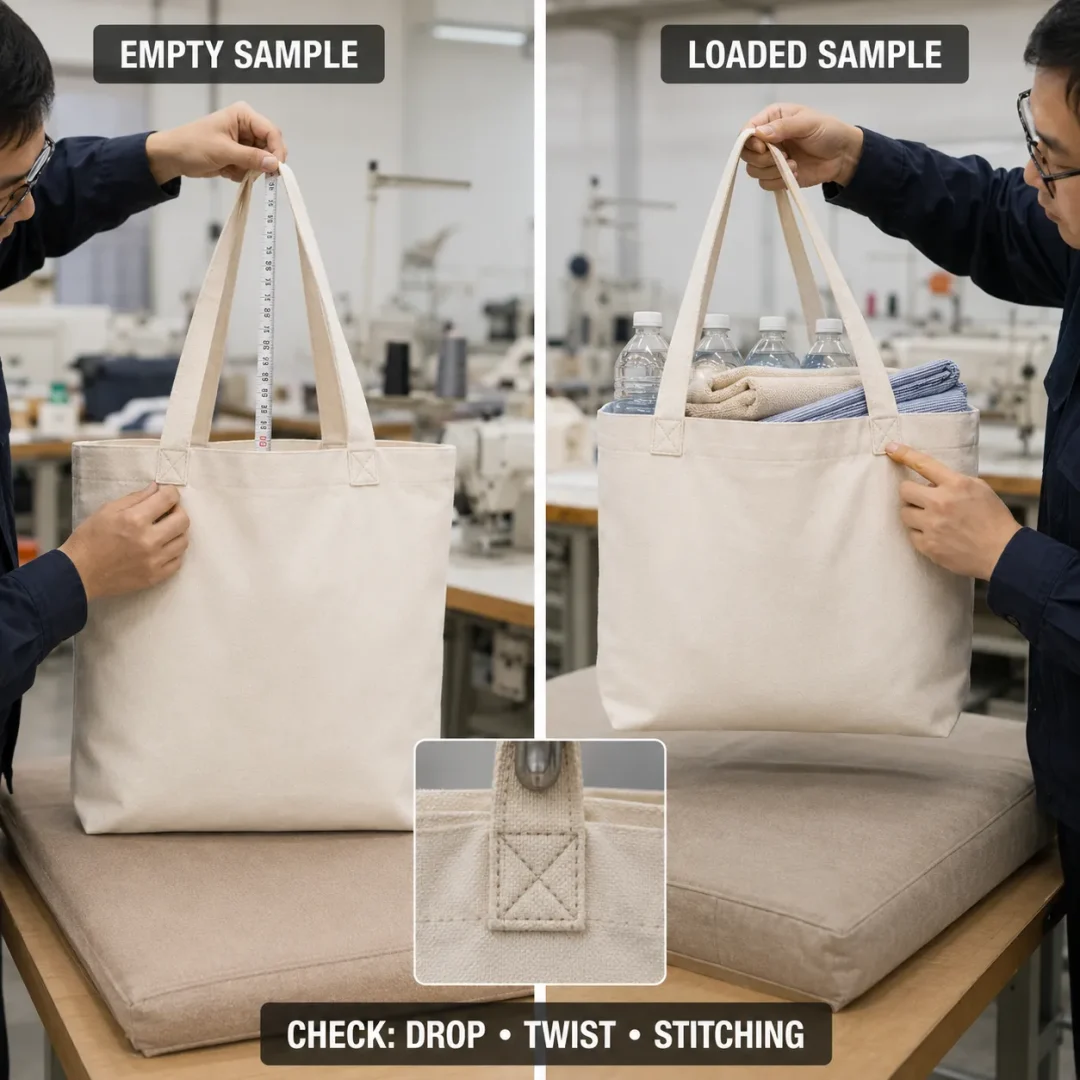
We normally review:
- Handle length and drop
- Grip and shoulder clearance
- Position and symmetry
- Proportion relative to the bag
- Twisting or rolling under load
- Stitching and reinforcement
- Hardware movement and finish
- Appearance when the bag is empty and loaded
The sample should then be filled with representative contents. This can reveal issues that are not visible on an empty bag, including handle distortion, uncomfortable pressure, unstable balance and stress around the attachment points.
During bulk production, inspection should cover handle placement, length consistency, stitching, reinforcement, hardware and color against the approved sample.
The purpose is not merely to test whether the strap itself can resist pulling. The handle, stitching, reinforcement and bag body work together as one load-bearing system.
Khuyến nghị Cuối cùng
For most lightweight promotional bags, self-fabric, PP webbing or reinforced die-cut handles provide a practical balance of cost and function.
For reusable shopping and canvas bags, cotton or polyester webbing offers better comfort and repeat-use performance.
For heavier cooler, travel and utility bags, use wider reinforced webbing, bottom-wrap construction or a padded grip.
Rope handles are well suited to beach, resort and lifestyle products, while rolled, PU, leather and rigid handles are more appropriate when shape and presentation are central to the design.
For multipurpose bags, short handles combined with a detachable adjustable strap offer greater carrying flexibility—but also require more attention to hardware and attachment reinforcement.
If you are choosing between two handle options, send the factory more than a reference photo. Include the bag body material, dimensions, expected contents, carrying method and desired brand positioning. A loaded sample will usually provide a more reliable answer than comparing the handles on appearance alone.
Câu Hỏi Thường Gặp
Loại tay cầm túi nào bền nhất?
There is no single most durable handle independent of the rest of the bag. Wide polyester or nylon webbing is commonly used for heavy-duty applications, but the bag body, stitching and attachment reinforcement determine whether the completed bag can support the load.
Tay cầm cotton có mạnh hơn tay cầm polyester không?
Not necessarily. Strength depends on yarn, width, thickness and weave density. Cotton generally offers a softer, more natural feel, while polyester usually provides better moisture resistance, abrasion resistance and dimensional stability.
Sự khác biệt giữa tay cầm và dây đeo là gì?
A handle is usually shorter and designed for hand or forearm carrying. A strap is normally longer and intended for shoulder or crossbody use. In everyday product descriptions, however, the terms are sometimes used interchangeably.
Tay cầm túi tote nên rộng bao nhiêu?
The correct width depends on the expected load, carrying time, bag size and desired appearance. Wider handles generally distribute pressure more comfortably, but they also use more material and can look too heavy on a small bag.
Có thể thêm logo vào tay cầm túi không?
Yes. Depending on the material, handles can be customized through screen printing, heat transfer, sublimation, jacquard weaving, embroidery, embossing, foil stamping or an attached woven label.
Tay cầm được gia cố như thế nào cho những túi nặng?
Common methods include X-box stitching, bar tacks, internal reinforcement patches, extended webbing and bottom-wrap construction. The correct method depends on the bag body material and intended load.
Tay cầm dây có phù hợp cho túi tái sử dụng không?
Yes, particularly for beach, resort and lifestyle bags. Buyers should consider the rope material, attachment method, washing requirements and additional packing volume.
Tay cầm có nên sử dụng cùng vật liệu với túi không?
Not always. Using the same material can create a coordinated appearance and may simplify some end-of-life material considerations. A different handle material may provide better comfort, strength, moisture resistance or visual positioning.

 Vietnamese
 English
 French
 German
 Japanese
 Arabic
 Thai
 Russian
 Spanish
 Portuguese