
Une poignée de sac ressemble souvent à un détail secondaire - jusqu'à ce que le sac fini soit inconfortable à porter, difficile à emballer ou commence à se déchirer autour des points d'attache.
Nous recevons régulièrement des demandes de sacs dans lesquelles le matériau du corps, les dimensions et la méthode d'impression sont clairement spécifiés, tandis que l'exigence de la poignée est décrite en seulement quelques mots :
- “ Utilisez des poignées en coton. ”
- “ Rendre les sangles solides. ”
- “ Nous voulons des poignées longues. ”
- “ Veuillez utiliser la même poignée que sur la photo de référence. ”
Ces descriptions sont compréhensibles, mais elles ne suffisent pas pour la production. Deux poignées faites du même matériau peuvent avoir des performances très différentes selon leur largeur, leur épaisseur, leur construction et leur méthode d'attache.
Le bon choix n'est pas automatiquement la poignée la plus forte ou la plus chère. Elle doit correspondre au corps du sac, au contenu attendu, au style de port, au positionnement de la marque et au budget du projet.
Ce guide explique les principaux types de poignées de sac d'un point de vue de fabrication de sacs sur mesure - et comment choisir entre eux.
D'abord, qu'est-ce qui compte comme une poignée de sac ?
Les termes “ poignée ” et “ sangle ” sont souvent utilisés de manière interchangeable, mais ils peuvent désigner différentes parties d'un sac.
A poignée en général, désigne un composant plus court utilisé pour porter le sac à la main ou sur l'avant-bras. Une sangle est normalement plus longue et conçue pour être portée sur l'épaule ou en travers du corps.
Il existe également deux mesures que les acheteurs confondent fréquemment :
- Handle length est mesurée le long de la poignée complète d'un point de fixation à l'autre.
- Abaissement de la poignée est la distance verticale entre le bord supérieur du sac et le point le plus élevé à l'intérieur de la poignée.
Une poignée peut avoir une longueur totale relativement longue mais offrir une liberté d'épaule limitée en raison de sa forme ou de sa position de fixation.
Si vous décidez de combien d'espace une sacoche a besoin pour un port à la main, sur l'avant-bras ou sur l'épaule, consultez notre guide séparé : [Quelle devrait être la longueur des poignées de sac à dos ? ].
Les poignées de sac peuvent être classées de plusieurs manières :
- Par construction, comme la sangle, roulée ou rembourrée.
- Par matériau, comme le coton, le polyester, le nylon ou le PU.
- Par style de portage, comme court, longueur d'épaule ou ajustable.
- Par fixation, comme la couture directe, les rivets ou le matériel amovible.
Pour éviter de mélanger ces catégories, nous allons commencer par les constructions de poignées réelles couramment utilisées dans la production de sacs sur mesure.
Comparaison rapide des types de poignées de sac courants
| Type de poignée | Confort de Transport | Conformité relative à la charge | Niveau de coût | Applications courantes |
|---|---|---|---|---|
| Poignée en tissu | Moyen | Léger à moyen | Faible à moyen | Sacs en coton, toile et lin |
| Cotton webbing | Haut | Moyen à lourd | Moyen | Sacs de shopping et de style de vie réutilisables |
| Sangle en polyester ou en nylon | Moyen à élevé | Heavy | Faible à moyen | Sacs de voyage, de sport, de refroidissement et utilitaires |
| Poignée en corde | Élevé pour le transport à la main | Moyen | Moyen à élevé | Sacs de plage, de station et cadeaux |
| Poignée enroulée | Élevé pour le transport à la main | Moyen | Haut | Sacs de mode et premium |
| Poignée rembourrée | Haut | Moyen à lourd | Moyen à élevé | Sacs de refroidissement, d'ordinateur portable, à outils et de voyage |
| Poignée découpée | Faible à moyen | Light | Faible | Sacs promotionnels et de détail |
| Poignée rigide | Dépendant de la forme | Léger à moyen | Haut | Mode, sacs de panier et sacs spécialisés |
| Bandoulière détachable | Adjustable | Moyen à lourd | Moyen à élevé | Sacs de voyage, sacs pour ordinateur portable et sacs multifonctionnels |
Ces comparaisons sont relatives plutôt que des évaluations de charge fixes. La résistance de la poignée ne peut pas être évaluée séparément du corps du sac et de la zone d'attache.
Une large poignée en sangle robuste peut toujours se déchirer si elle est cousue sur un tissu fin et non supporté.
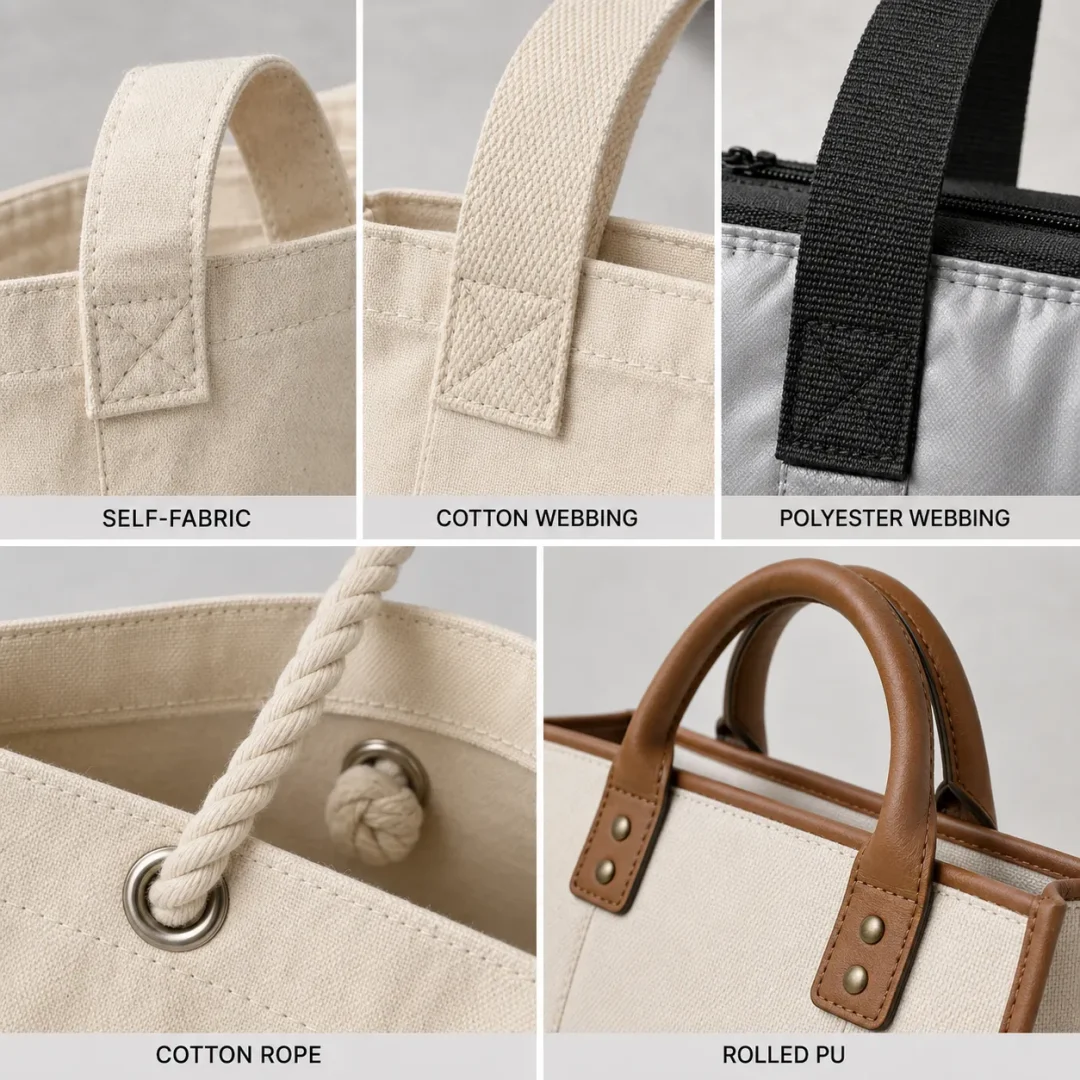
1. Poignées en tissu auto-fabriqué
Les poignées en tissu auto-enveloppant sont faites du même matériau—ou d'un matériau assorti—que le corps du sac. Le tissu est normalement découpé en bandes, plié et cousu pour créer un bord net.
Elles sont fréquemment utilisées sur :
- Sacs fourre-tout en coton
- Sacs de shopping en toile
- Sacs en lin
- Sacs promotionnels imprimés
- Sacs légers non tissés
Leur principal avantage est la cohérence visuelle. Le corps et les poignées peuvent utiliser la même couleur, texture ou impression intégrale, créant ainsi une apparence propre et unifiée.
Cependant, utiliser exactement le même tissu n'est pas toujours le meilleur choix technique.
Lorsqu'un sac est fabriqué en toile épaisse, plier plusieurs couches du même tissu peut créer une poignée excessivement épaisse. La zone de fixation peut devenir encombrante, difficile à coudre et visuellement inégale. Un tissu coordonné plus léger ou une bande de renforcement interne peuvent donner un meilleur résultat.
Les poignées en tissu se révèlent efficaces pour des charges quotidiennes légères et moyennes. Pour des produits plus lourds, la fixation de la poignée doit être renforcée, ou une poignée en sangle peut être plus appropriée.
2. Poignées plates en sangle
La sangle est l'un des choix les plus polyvalents pour les sacs sur mesure. Elle est tissée séparément du corps du sac et fournie dans différents matériaux, largeurs, épaisseurs, couleurs et motifs de tissage.
Les options les plus courantes sont le coton, le polyester, le nylon et le polypropylène.
Sangle en coton
La sangle en coton a une apparence naturelle et relativement douce qui fonctionne particulièrement bien avec les sacs en toile et en coton.
Elle est généralement choisie pour :
- Sacs de shopping réutilisables premium
- Tote bags en toile
- Produits de style de vie
- Sacs cadeaux d'entreprise
- Sacs promotionnels éco-positionnés
Comparé à une poignée en tissu étroite, une sangle en coton plus large peut répartir la pression plus uniformément sur la main ou l'épaule.
Cependant, la sangle en coton n'est pas un matériau standard unique. Un ruban en coton léger et lâche et une sangle en coton dense et épaisse peuvent avoir l'air similaires sur une photo mais se comportent très différemment.
Lors de la demande d'un devis, précisez la largeur, l'épaisseur, le tissage, la couleur et la sensation requise—pas seulement “poignée en coton.”
Sangle en polyester
La sangle en polyester est dimensionnellement stable, résiste à l'abrasion et est moins absorbante que le coton. Elle peut être produite dans une large gamme de couleurs et est couramment utilisée tant dans les sacs promotionnels que fonctionnels.
Les applications typiques incluent :
- Sacs isothermes
- Sports bags
- Travel bags
- Sacs pour ordinateurs portables
- Sacs de shopping réutilisables
- Tote bags promotionnels
Le polyester est également adapté pour le marquage imprimé, tissé ou en jacquard. Pour les marques qui ont besoin de couleurs cohérentes sur une grande production, il offre souvent des résultats plus prévisibles que certaines options en fibres naturelles.
Sangle en nylon
La sangle en nylon est généralement associée à des sacs fonctionnels et de qualité professionnelle. Elle peut offrir une haute résistance à la traction et une bonne résistance à l'abrasion tout en conservant une surface relativement lisse.
Les applications courantes incluent les sacs utilitaires, les bagages, les sacs de voyage et les produits techniques de transport.
Cependant, la sangle synthétique lisse ne doit pas être automatiquement décrite comme de la nylon. De nombreuses sangles commerciales qui semblent être en nylon sont en réalité en polyester. La composition du matériau doit être confirmée si elle affecte la performance, l'étiquetage ou la conformité.
Sangle en polypropylène
La sangle en polypropylène, ou sangle PP, est une option économique et résistante à l'humidité couramment utilisée pour :
- Sacs à provisions en non-tissé
- Promotional bags
- Des sacs réutilisables à bas prix
- Sacs isothermes
- Des projets de vente au détail en grande volume
Son apparence est généralement plus pratique que celle des matériaux premium, mais le résultat final dépend de la densité du tissage et de la finition. Cela peut être un choix judicieux lorsque le coût, la résistance à l'humidité et la production en grande quantité sont plus importants qu'une sensation naturelle au toucher.
3. Poignées en cordage
Les poignées en corde créent une apparence plus douce et plus décontractée que les sangles plates. Leur profil arrondi peut également être confortable dans la main, surtout lorsque le diamètre de la corde convient à la charge prévue.
Les matériaux courants incluent :
- Corde en coton
- Corde en polyester
- Corde en polypropylène
- Corde en nylon
- Corde en jute ou en d'autres fibres naturelles
Les poignées en corde sont fréquemment utilisées pour les sacs de plage, les totes de loisirs, les sacs en toile, les sacs à vin et les emballages cadeaux premium.
Le matériau n'est qu'une partie de la spécification. Les acheteurs doivent également confirmer :
- Le diamètre de la corde
- La structure de tressage ou de torsion
- Couleur
- Le traitement des extrémités
- La méthode de fixation
- Taille et finition des œillets
- Que la corde soit nouée ou cousue
Les poignées en corde peuvent être passées à travers les œillets et nouées à l'intérieur du sac, insérées dans une couture ou fixées avec des onglets séparés. Chaque méthode crée une apparence et un chemin de charge différents.
Elles peuvent également augmenter le volume d'emballage. Contrairement aux poignées plates, les cordes épaisses ne se posent pas toujours proprement contre le corps du sac, ce qui peut affecter la quantité de cartons et les coûts d'expédition.
Pour une référence visuelle plus large couvrant le coton, le jute, la corde synthétique et d'autres styles de poignées moins courants, voir [20 Types de poignées de sac : Un guide visuel – LIEN INTERNE VERS L'ARTICLE ECOBAGFACTORY].
4. Poignées roulées ou tubulaires
Les poignées enroulées sont fabriquées en enroulant du tissu, du cuir ou du PU autour d'un cordon ou rembourrage interne. Cela crée une poignée ronde et tridimensionnelle plutôt qu'une sangle plate.
Elles sont largement utilisées sur :
- Sacs à main structurés
- Sacs d'affaires
- Trousse à cosmétique premium
- Fashion bags
- Sacs cadeaux d'entreprise
The diameter of the internal core affects both appearance and grip. A very thin rolled handle can look refined but may become uncomfortable when the bag is heavily loaded. A thicker handle is easier to grip but may look disproportionate on a small bag.
Rolled handles require more production steps than standard webbing. Depending on the design, these may include skiving, folding, edge painting, inserting the filler and attaching metal hardware.
The attachment ends are particularly important. A visually strong rolled handle can still fail if the ends are connected to small, unsupported areas of the bag body.
5. Poignées rembourrées
Padded handles contain foam, neoprene or another cushioning material inside the grip area. They are intended to reduce pressure when a bag carries heavier contents.
Elles sont fréquemment utilisées sur :
- Large cooler bags
- Tool bags
- Travel bags
- Sacs pour ordinateurs portables
- Gym bags
- Equipment cases
The entire handle can be padded, or padding can be limited to the central grip section.
More padding does not necessarily mean better comfort. An overly thick handle may feel bulky, resist folding and increase packaging volume. A very soft handle may roll or twist under load.
During sampling, the padding thickness, handle width and flexibility should be evaluated with the bag loaded—not only when it is empty.
For heavy bags that use two handles, another option is a wrapped grip that joins both handles in the middle. This component can be made from fabric, neoprene or PU and closed with hook-and-loop tape or snaps.
6. Poignées découpées ou intégrées
A die-cut handle is created by cutting a hand opening directly into the bag body. No separate strap is required.
This structure is commonly found on:
- Non-woven promotional bags
- Laminated woven polypropylene bags
- Plastic retail bags
- Sacs en feutre
- Paper shopping bags
Die-cut handles keep the bag relatively flat, simplify packing and reduce the number of separate components. They are suitable for lightweight retail, exhibition and promotional applications.
Their main limitations are carrying comfort and load capacity. A narrow cut edge concentrates pressure on the fingers, and the area around the opening may stretch or tear.
Depending on the material and expected contents, the handle area can be strengthened with:
- An additional internal patch
- A thicker material layer
- Heat-sealed reinforcement
- Stitched reinforcement
- A separate plastic insert
This type of handle should not be selected only because it is economical. The size and shape of the opening must also provide enough space for the intended users.
7. Poignées rigides
Rigid handles include bamboo, wood, metal, acrylic, resin and molded plastic structures. Rather than disappearing into the bag design, they usually become a visible styling feature.
They are often used for:
- Straw or woven bags
- Crochet bags
- Fashion handbags
- Evening bags
- Resort products
- Specialty gift packaging
Rigid handles offer strong visual differentiation, but they also introduce additional production considerations.
The handle needs to be checked for smooth edges, surface finish, color consistency and attachment security. Wooden and bamboo handles may require attention to moisture content and natural variation, while metal handles require suitable plating and protection from scratching.
Because these handles do not fold, they can substantially increase packing volume. They are generally less suitable for projects where flat shipment, low weight and economical distribution are priorities.
8. Poignées amovibles et réglables
Detachable straps connect to the bag through hardware such as snap hooks, D-rings or swivel hooks. Adjustable straps normally include a slider or buckle.
These structures allow one bag to support several carrying methods:
- Hand carry
- Shoulder carry
- Crossbody carry
- Short and long handle combinations
They are commonly found on travel bags, gym bags, laptop bags, cosmetic cases and multifunctional totes.
The strap itself is not the only component that needs to be evaluated. The snap hook, ring, slider, stitching and fabric tab all form part of the load-bearing system.
In many cases, the small tab holding the D-ring becomes the weakest point. It should be reinforced internally and positioned where the bag body can distribute the load.
Comment les matériaux des poignées affectent l'utilisation réelle
| Matériau | Feel and appearance | Durabilité | Moisture resistance | Branding options | Utilisations courantes |
|---|---|---|---|---|---|
| Coton | Natural and relatively soft | Moyen à élevé | Faible | Printing, woven labels, jacquard | Canvas and reusable totes |
| Polyester | Smooth and consistent | Haut | Haut | Printing, sublimation, jacquard | Sports, cooler and travel bags |
| Nylon | Smooth and technical | Haut | Haut | Printing and woven branding | Utility and functional bags |
| PP | Practical and economical | Moyen à élevé | Haut | Color matching and printing | Promotional and non-woven bags |
| Leather or PU | Premium and structured | Varie | Varie | Embossing, foil and stitching | Fashion and corporate gifts |
| Rope | Casual, natural or nautical | Material-dependent | Material-dependent | Color, knots and end details | Sacs de plage, de station et cadeaux |
| Wood, bamboo or metal | Decorative and rigid | Structure-dependent | Material-dependent | Engraving, printing or plating | Specialty and fashion bags |
A handle should not be described as sustainable based only on its material name.
For example, a cotton bag body combined with polyester webbing, foam padding and metal hardware may be durable, but it is more difficult to process as a single material at the end of its usable life.
When environmental requirements are important, consider:
- Whether the material is recycled or certified
- Whether it contains blended fibers
- Whether the handle can be separated
- Whether the handle and bag body use compatible materials
- Whether the design is durable enough for repeated use
An RPET webbing handle may be appropriate for an RPET bag, while recycled cotton webbing can complement a recycled cotton or canvas body. Certificates and transaction documents should be discussed before sampling if they are required for the final product claim.
Poignées courtes, poignées d'épaule ou sangles croisées ?
After selecting the construction and material, the next decision is how the bag will be carried.
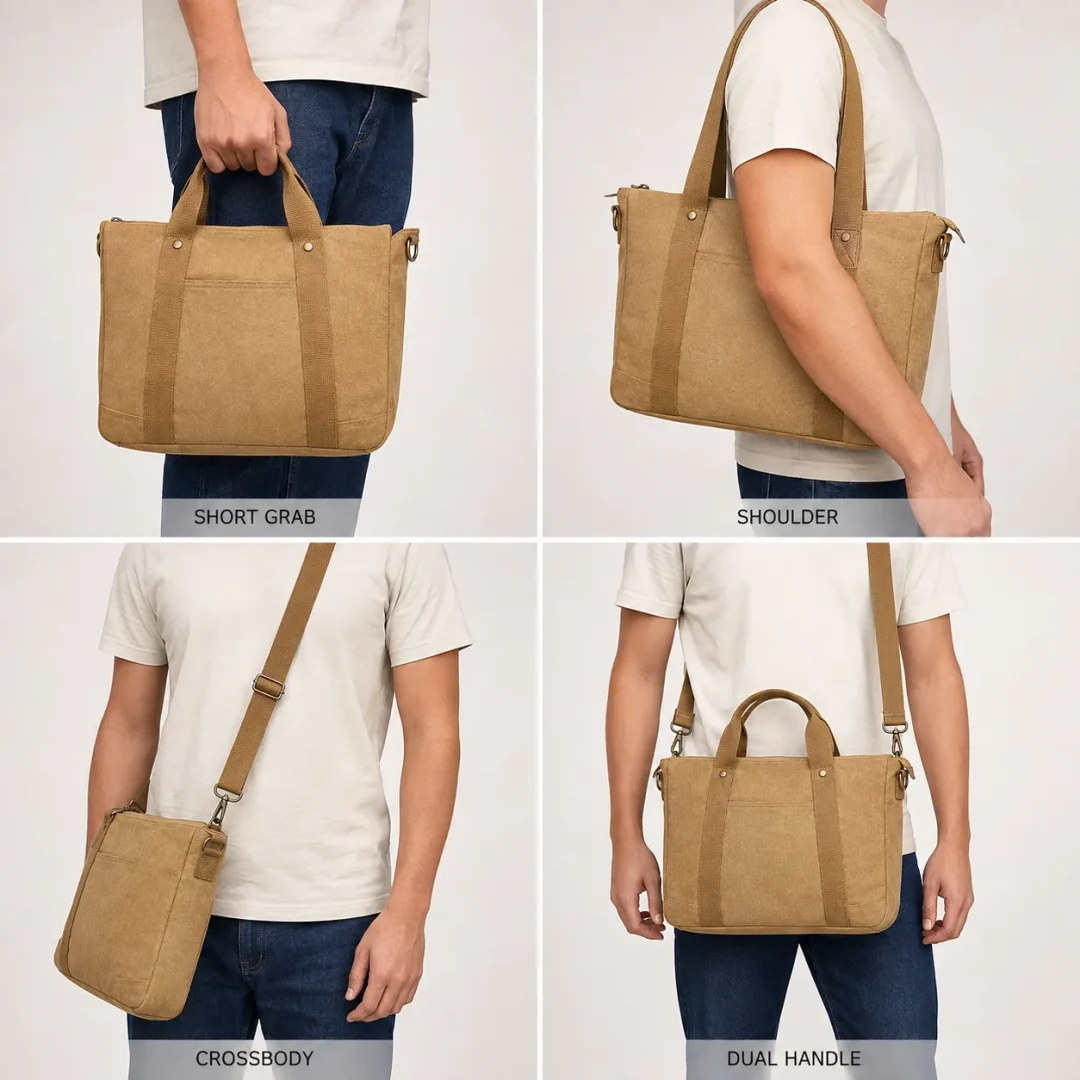
Poignées de préhension courtes
Short handles suit quick hand carrying, gift packaging and products that need a more compact or formal appearance.
They work well for small retail bags, wine bags, lunch bags and structured cases. They are less suitable when users need to carry a loaded bag for a long distance.
Poignées de longueur épaule
Shoulder-length handles are common on tote bags, reusable shopping bags and everyday carry products.
The required clearance depends on more than the user’s body size. Bag height, opening structure, winter clothing and the way the contents fill the bag can all change how the handle feels.
A handle that fits comfortably on an empty sample may become awkward once the bag is fully loaded.
Sangles croisées
Crossbody straps provide hands-free carrying and usually require an adjustable length.
They also require stronger side attachment points. The bag width and depth should be considered because a very wide bag may not sit comfortably against the body.
Conceptions à double poignée
A pair of short handles combined with a detachable shoulder strap is common on travel, gym and laptop bags.
This provides greater flexibility but adds material, hardware, sewing operations and packing requirements. It should be used when the second carrying method has real value, rather than added only as a visual feature.
Comment une poignée doit-elle être attachée au sac ?
The attachment structure is often more important than the apparent strength of the handle material.
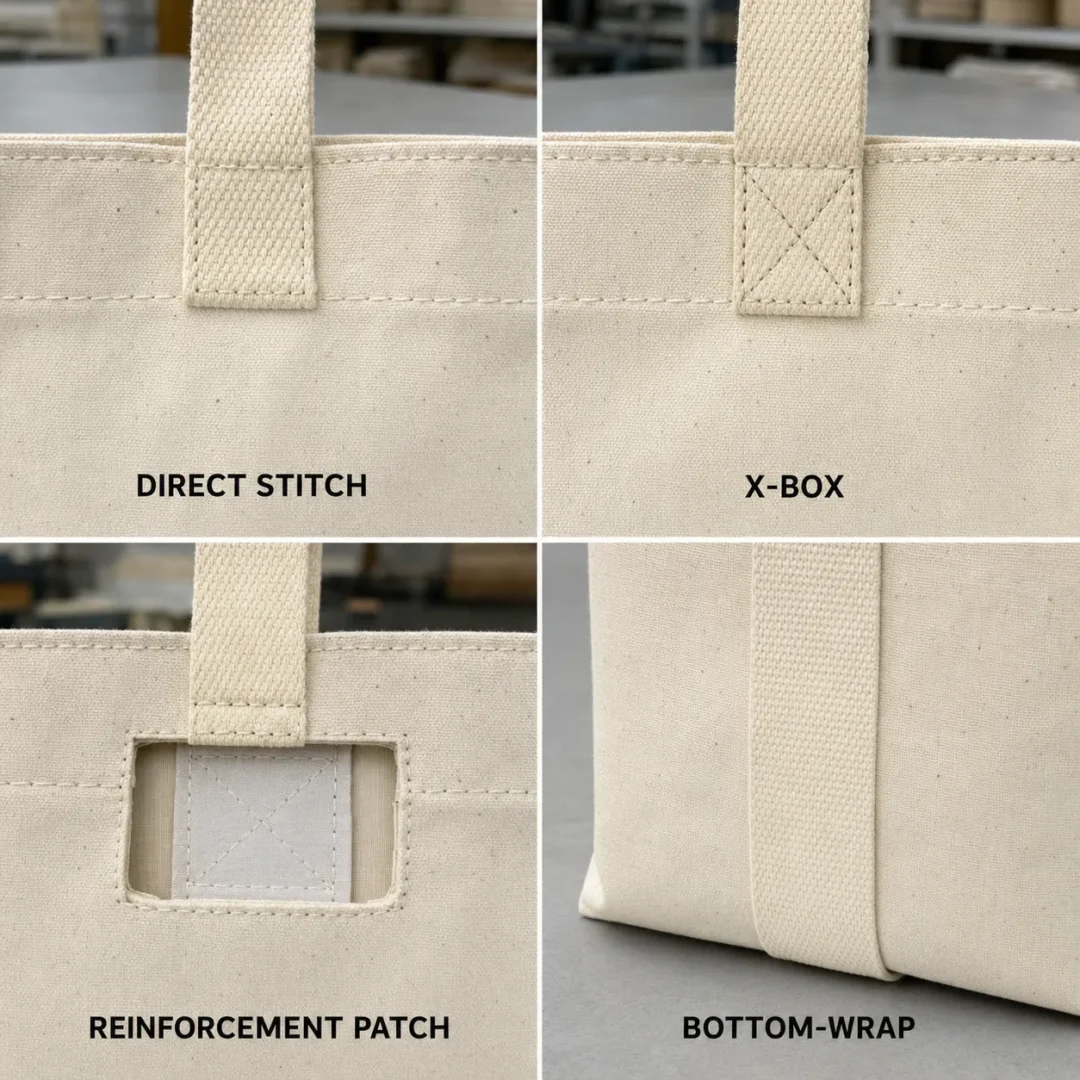
Couture directe
Direct stitching is widely used for canvas totes, cotton bags and reusable shopping bags. The handle ends are positioned on the bag body and stitched in place.
A simple horizontal stitch may be sufficient for lightweight applications. Heavier use may require parallel stitching, a box stitch or an X-box pattern.
Renforcement par points de bar
A bar tack is a short area of dense stitching added at a stress point. It is commonly used on webbing handles, backpack straps and functional bags.
It provides localized reinforcement but should still be matched to the fabric. Dense stitching placed too close to the edge of a weak material may cut or perforate the fabric rather than strengthen it.
Poignées pleine longueur ou enroulées par le bas
Full-length handles extend farther down the bag body. Some continue underneath the bag and form a continuous support structure.
This construction is often used for:
- Heavy shopping bags
- Tool bags
- Large insulated bags
- Delivery bags
- Equipment carriers
It distributes weight across a larger area and reduces dependence on a small attachment point. The trade-offs are greater webbing consumption, more sewing and a stronger visual presence on the bag exterior.
Rivet et matériel
Rivets are often used with leather, PU and structured fashion bags. They can provide a clean, premium appearance, but a rivet should not be fixed directly through thin, unsupported fabric.
An internal washer, patch or reinforcement layer may be needed to spread the force.
Œillets, nœuds et fixations thermosoudées
Rope handles are often passed through metal eyelets and secured with internal knots. Plastic and non-woven handles may use heat-sealed attachment. Each method has different equipment, appearance and strength implications.
The central principle is simple:
A stronger handle does not create a stronger bag if the attachment area is not reinforced.
Quelle poignée devriez-vous choisir ?
| Bag or project | Recommended handle | Why it is commonly selected |
|---|---|---|
| Lightweight promotional tote | Self-fabric or PP webbing | Economical and easy to customize |
| Reusable grocery bag | Wide cotton or polyester webbing | Better pressure distribution and repeated-use performance |
| Premium canvas retail tote | Cotton webbing or reinforced self-fabric | Balances appearance, comfort and durability |
| Beach or resort bag | Cotton or synthetic rope | Comfortable grip and distinctive casual appearance |
| Sac isotherme | Reinforced polyester or PP webbing, optionally padded | Better suited to heavier contents and moisture |
| Travel or gym bag | Full-length webbing with a detachable shoulder strap | Supports load and multiple carrying methods |
| Luxury gift bag | Rope, ribbon or PU handle | Adds presentation value |
| Flat promotional bag | Reinforced die-cut handle | Compact packing and economical production |
| Fashion handbag | Rolled, rigid or detachable handle | Provides shape and visual differentiation |
| Sac utilitaire lourd | Bottom-wrap webbing | Distributes weight over a larger area |
These are starting points rather than fixed rules. A premium canvas tote may use rope for a resort collection, while a promotional bag may use cotton webbing when comfort and repeated use are more important than the lowest unit cost.
Cinq facteurs à confirmer avant d'approuver une poignée
1. Contenus et charges prévus
Do not provide only a target weight. Tell the supplier what the bag will carry, how the items are arranged and how frequently the bag will be used.
Several rigid bottles create different stress points from the same weight in clothing or soft products.
2. Temps de portage
A handle suitable for carrying a retail purchase from a store to a car may not be comfortable for a 30-minute commute.
Longer carrying time generally increases the importance of handle width, padding and shoulder clearance.
3. Matériau du corps du sac
A thick handle does not compensate for a weak body material. The handle, reinforcement and bag body need to be designed as one system.
Thin non-woven fabric, soft cotton and laminated woven PP each respond differently to concentrated pulling and dense stitching.
4. Positionnement de la marque
Changing the handle can significantly change the perceived value of the same bag.
A canvas tote with self-fabric handles feels simple and coordinated. Cotton webbing creates a heavier lifestyle look. Rope suggests leisure or resort use. Rolled PU handles move the product closer to a fashion accessory.
5. Coût, emballage et expédition
Handle cost is not limited to the raw material. Consider:
- Sewing and assembly time
- Hardware and molds
- Manual finishing
- Packing volume
- Ability to stack the bags flat
- Protective packaging
- Inspection and potential rework
A rigid or thick rope handle may add more to freight and carton volume than its unit material price suggests.
Erreurs courantes dans la spécification des poignées
Several avoidable issues appear repeatedly during bag development:
- Specifying “cotton handle” without width, thickness or weave.
- Treating handle length and handle drop as the same measurement.
- Confirming the strap material but not the attachment structure.
- Approving handle length using an empty bag only.
- Reducing handle width to save cost without adjusting the expected load.
- Folding heavy bag fabric into an unnecessarily bulky handle.
- Testing the webbing alone rather than testing the finished bag.
- Approving color from a screen instead of an actual material sample.
- Ignoring the carton volume created by rope, padded or rigid handles.
- Using heavy metal hardware with a lightweight attachment tab.
- Selecting a soft handle that twists when the bag is loaded.
Reference photos are helpful, but they should support—not replace—a written specification.
Que doit-on inclure dans une spécification de poignée de sac ?
A clear handle specification should include:
- Handle construction
- Material composition
- Width or rope diameter
- Thickness
- Total handle length
- Abaissement de la poignée
- Number of handles
- Color or Pantone reference
- Fixed, detachable or adjustable structure
- Hardware material and finish
- Position de fixation
- Stitching and reinforcement method
- Intended contents or working load
- Logo method
- Reference sample or technical drawing
If the final handle measurement is not yet known, the bag dimensions, carrying method and intended contents can help the factory recommend a starting point for sampling.
Comment nous évaluons les poignées lors de l'échantillonnage et de la production
At the sampling stage, a handle should be evaluated as part of the completed bag.
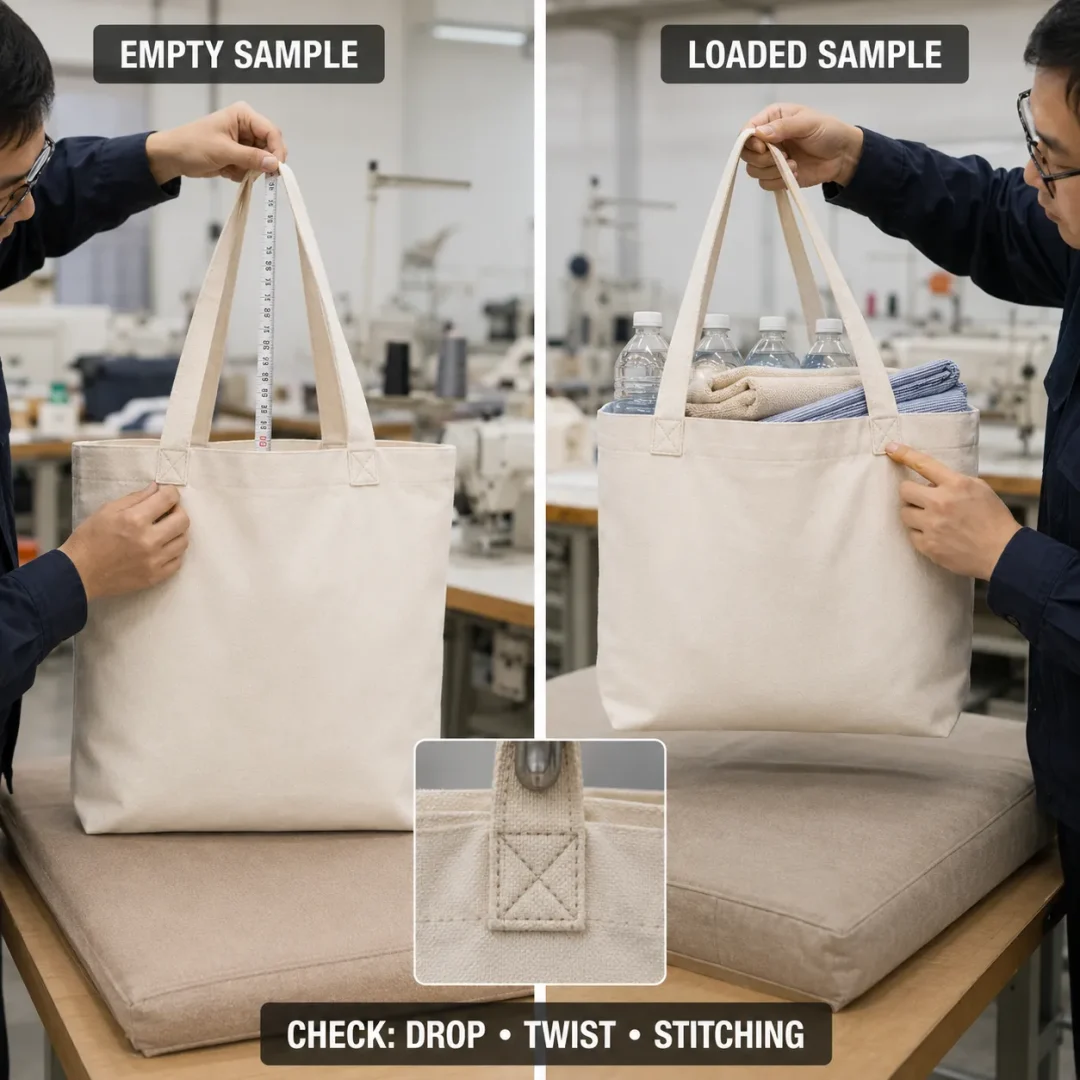
We normally review:
- Handle length and drop
- Grip and shoulder clearance
- Position and symmetry
- Proportion relative to the bag
- Twisting or rolling under load
- Stitching and reinforcement
- Hardware movement and finish
- Appearance when the bag is empty and loaded
The sample should then be filled with representative contents. This can reveal issues that are not visible on an empty bag, including handle distortion, uncomfortable pressure, unstable balance and stress around the attachment points.
During bulk production, inspection should cover handle placement, length consistency, stitching, reinforcement, hardware and color against the approved sample.
The purpose is not merely to test whether the strap itself can resist pulling. The handle, stitching, reinforcement and bag body work together as one load-bearing system.
Recommandation finale
For most lightweight promotional bags, self-fabric, PP webbing or reinforced die-cut handles provide a practical balance of cost and function.
For reusable shopping and canvas bags, cotton or polyester webbing offers better comfort and repeat-use performance.
For heavier cooler, travel and utility bags, use wider reinforced webbing, bottom-wrap construction or a padded grip.
Rope handles are well suited to beach, resort and lifestyle products, while rolled, PU, leather and rigid handles are more appropriate when shape and presentation are central to the design.
For multipurpose bags, short handles combined with a detachable adjustable strap offer greater carrying flexibility—but also require more attention to hardware and attachment reinforcement.
If you are choosing between two handle options, send the factory more than a reference photo. Include the bag body material, dimensions, expected contents, carrying method and desired brand positioning. A loaded sample will usually provide a more reliable answer than comparing the handles on appearance alone.
Questions fréquemment posées
Quel est le type de poignée de sac le plus durable ?
There is no single most durable handle independent of the rest of the bag. Wide polyester or nylon webbing is commonly used for heavy-duty applications, but the bag body, stitching and attachment reinforcement determine whether the completed bag can support the load.
Les poignées en coton sont-elles plus résistantes que les poignées en polyester ?
Not necessarily. Strength depends on yarn, width, thickness and weave density. Cotton generally offers a softer, more natural feel, while polyester usually provides better moisture resistance, abrasion resistance and dimensional stability.
Quelle est la différence entre une poignée et une sangle ?
A handle is usually shorter and designed for hand or forearm carrying. A strap is normally longer and intended for shoulder or crossbody use. In everyday product descriptions, however, the terms are sometimes used interchangeably.
Quelle doit être la largeur des poignées de sac fourre-tout ?
The correct width depends on the expected load, carrying time, bag size and desired appearance. Wider handles generally distribute pressure more comfortably, but they also use more material and can look too heavy on a small bag.
Un logo peut-il être ajouté à une poignée de sac ?
Yes. Depending on the material, handles can be customized through screen printing, heat transfer, sublimation, jacquard weaving, embroidery, embossing, foil stamping or an attached woven label.
Comment les poignées sont-elles renforcées pour des sacs lourds ?
Common methods include X-box stitching, bar tacks, internal reinforcement patches, extended webbing and bottom-wrap construction. The correct method depends on the bag body material and intended load.
Les poignées en corde conviennent-elles pour des sacs réutilisables ?
Yes, particularly for beach, resort and lifestyle bags. Buyers should consider the rope material, attachment method, washing requirements and additional packing volume.
La poignée doit-elle utiliser le même matériau que le sac ?
Not always. Using the same material can create a coordinated appearance and may simplify some end-of-life material considerations. A different handle material may provide better comfort, strength, moisture resistance or visual positioning.

 French
 English
 German
 Japanese
 Arabic
 Thai
 Vietnamese
 Russian
 Spanish
 Portuguese