
Two suppliers can both list a “4×6 inch satin pouch” and hand you two genuinely different bags. The number on a spec sheet only tells you the cut size — what the flat fabric measures before it’s sewn. It doesn’t tell you how much usable space is actually inside, and it says nothing about whether the pouch can hold a flat item versus something with real volume. Choosing the right satin pouch isn’t a matter of looking up a size chart and stopping there. It’s a matter of getting three variables right: cut size, internal capacity, and gusset depth — and knowing which general size range to start from before you fine-tune with a sample.
Step 1: Measure the actual Satin Pouch Size, not the listing photo
Before you size anything, measure the item that’s actually going inside the pouch — never estimate from a product photo or a competitor’s packaging. Use a ruler or tape measure and record the width and height of the item in both inches and centimeters. Recording both units matters more than it sounds like it should: a spec written as “4×6” with no unit attached is genuinely ambiguous, and inches versus centimeters is roughly a 2.5x difference per unit — a “4×6” read as inches is about 10×15 cm, while the same digits read as centimeters would be a much smaller bag. Confirm the unit with your supplier in writing before approving any sample, not after a misread spec turns into a bulk order of the wrong size.
The sizing buffer: why pouch dimensions should exceed product dimensions
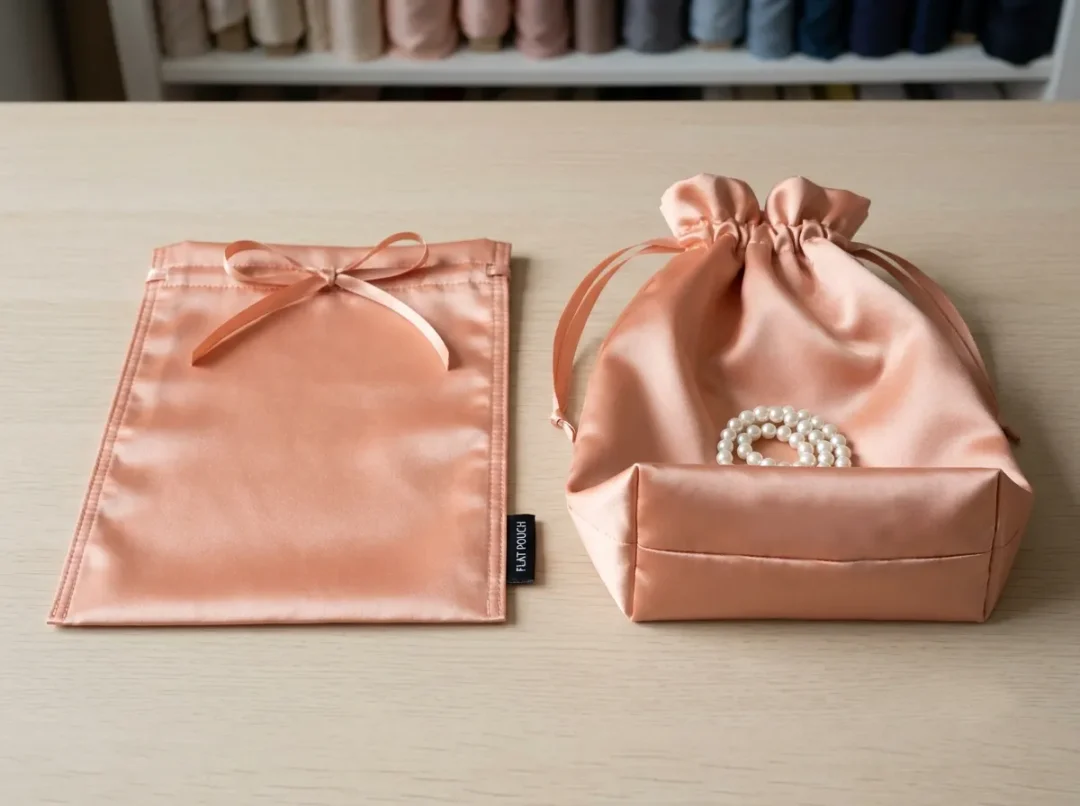
Once you have the item’s actual dimensions, the pouch needs to be larger than the item on every side — not just long enough to technically fit it. A pouch cut to the exact dimensions of the item inside it won’t close properly, because the drawstring channel and seam allowances both eat into usable space, and there’s no room left for the item to slide in and out without forcing it.
A practical starting point: add roughly an inch of clearance to both width and height beyond the item’s measured dimensions. So an item measuring 2×2 inches typically needs a pouch closer to 3×4 inches to leave room for clean insertion, seam allowance, and a drawstring that actually closes. This is a starting point to confirm with your supplier and a sample, not a fixed rule — fabric weight and gusset depth (both covered below) shift the right buffer in either direction.
General size reference: where to start before fine-tuning
The ranges below are common starting points across the industry, organized by general capacity tier rather than a single fixed chart — treat them as a starting conversation with your supplier, not a final spec.
| Tier | Typical cut size (in) | Typical cut size (cm) | Cấu trúc | Common items |
|---|---|---|---|---|
| Small | 3×4 – 4×6 | ~7.5×10 – 10×15 | Flat or shallow gusset | Rings, earrings, pendants, small charms, coins |
| Trung bình | 5×7 – 6×8 | ~12.5×17.5 – 15×20 | Flat for multi-piece jewelry sets; gusseted for compact bottles | Bracelets, watches, layered jewelry sets, small cosmetics, travel-size bottles |
| Large | 8×10 – 10×12 | ~20×25 – 25×30 | Gusseted | Cosmetics gift sets, multi-piece accessory kits, boxed items, larger bottles |
| Oversized | 12×14 and up | ~30×35 and up | Gusseted, often with reinforced seams | Multi-item gift bundles, larger boxed products, bulkier accessory sets |
These tiers describe cut size, not internal capacity — apply the buffer and gusset-depth logic below to translate a tier into an actual spec for your product.
Cut size vs. internal capacity: why the same number can mean two different bags
This is the gap that catches the most buyers off guard. “Cut size” is the flat fabric dimension before sewing. “Internal capacity” is what’s actually usable once the seams, drawstring channel, and fabric thickness are accounted for. Two pouches both labeled 4×6 inches can have meaningfully different internal capacity depending on construction and material — which is exactly why the spec you should be asking your supplier for is internal usable dimensions, not just the cut size printed on a product listing.
Fabric weight is part of why this gap exists. A heavier, denser satin takes up more physical space in the seams and drawstring channel than a lightweight satin does, which means a thicker fabric quietly reduces internal capacity even when the external cut size is identical. If you’re switching fabric weights on an existing pouch design — say, moving to a heavier RPET satin for durability — confirm whether the internal capacity holds steady or needs the cut size adjusted to compensate.
Flat pouch vs. gusseted Satin pouch: the variable that actually decides capacity
This is the part most sizing guides skip entirely, and it matters more than the width-by-height number on its own.
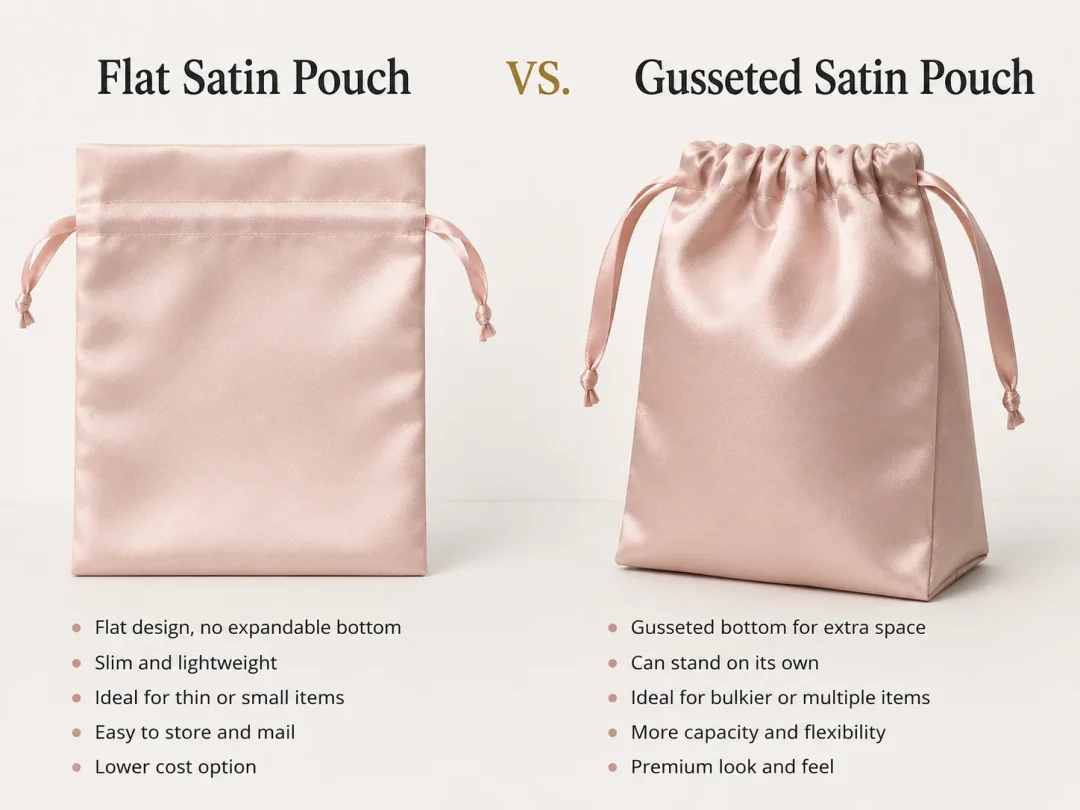
A flat pouch is built from two layers of fabric sewn together at the sides and bottom, with no expansion built into the base. Its usable capacity is essentially the cut size folded in half, minus seam allowance — which makes it well suited to items that are themselves flat or thin: jewelry laid in tissue, ribbon, folded fabric items, or anything that doesn’t need the pouch to stand upright or hold real volume.
A gusseted pouch has an expandable panel built into the base (or sides), which unfolds when the pouch is filled to create genuine three-dimensional volume. A gusseted satin pouch can stand upright on its own and hold items with real depth — a cosmetics bottle, a boxed item, a multi-piece gift set — in a way a flat pouch of the same width and height simply cannot.
The deciding question isn’t “what size is the item” — it’s “is the item flat, or does it have volume?” A flat item in a gusseted pouch wastes capacity and looks under-filled. A dimensional item in a flat pouch either won’t fit or will distort the pouch’s shape and strain the seams.
Gusset depth: a starting reference
Like overall size, gusset depth has rough starting tiers worth knowing before you customize:
- Shallow gusset (roughly 1–1.5 in / 2.5–4 cm) — enough to let a pouch hold a slightly thick stack of items (a few folded jewelry pieces, a slim compact) without fully standing upright on its own.
- Moderate gusset (roughly 2–3 in / 5–7.5 cm) — the most common range for single bottles, boxed items, and standard gift sets; deep enough for the pouch to stand independently when filled.
- Deep gusset (roughly 3.5 in / 9 cm and up) — needed for bulkier multi-item sets or larger boxed products where the contents have significant footprint as well as height.
As with overall size, gusset depth should be sized to exceed the item’s actual depth, not match it exactly — the same clearance logic applies so the gusset can fully expand around the product rather than straining against it.
Sizing by application: jewelry, cosmetics, and accessories
Rather than treating the reference table above as a fixed lookup, here’s how to reason through structure and tier by category:
- Jewelry — most individual pieces (rings, earrings, single pendants, chains) are flat or near-flat, so a small flat pouch or shallow-gusset pouch is usually the right structure. Layered necklace sets or multi-piece jewelry collections often need a step up to medium tier even though each individual piece is small, since the combined footprint is larger than any single item suggests.
- Cosmetics and beauty — single bottles, compacts, and multi-item sets have real depth and usually need a gusseted structure to stand upright and hold shape. A wide, short bottle and a tall, narrow one at similar volume need different gusset depths — measure the product’s actual footprint, not just its height, before picking a tier.
- Accessories (tech accessories, small gift sets, multi-piece kits) — these often sit in the medium-to-large tier with a moderate gusset: enough depth to hold a kit’s combined footprint, but not always bulky enough to need a deep gusset. If the kit includes multiple items, measure the stacked or arranged footprint together, not just the largest single piece.
Common sizing mistakes that lead to a bad bulk order
- Sizing to the cut size chart without checking internal capacity — the most frequent mistake; a pouch can match every number on a chart and still feel too tight once seams and drawstring channel are accounted for.
- Picking gusset depth based on overall size tier alone — a “medium” pouch doesn’t automatically need a “moderate” gusset; gusset depth should follow the item’s actual depth, independent of width and height.
- Assuming fabric weight doesn’t affect fit — switching to a heavier or more structured satin on an existing design without re-checking internal capacity is a common source of “it used to fit, now it doesn’t” complaints after a fabric change.
- Approving bulk production from a spec sheet alone — a correct-looking spec on paper can still feel wrong with the actual product inside; a physical sample catches this before a full run does.
How to spec sizing with your supplier
Putting the above into a workflow that avoids a costly bulk-order mismatch:
- Measure the actual product — width, height, and depth if it’s dimensional — and record both inches and centimeters.
- Confirm the unit in writing before any quote or sample is approved.
- Use the general tier table as a starting point, not a final answer.
- Request internal usable dimensions, not just cut size, for any pouch you’re evaluating.
- Decide flat vs. gusseted based on whether the item has real depth, not just its width and height, and size the gusset to the item’s actual depth plus clearance.
- Confirm the fabric weight/GSM being used, since heavier fabric reduces internal capacity at the same cut size.
- Approve a physical sample with your actual product inside it before signing off on bulk production.
Câu hỏi thường gặp
How much bigger should a satin pouch be than the item going inside it? A rough starting point is about an inch of clearance on width and height beyond the item’s measured dimensions, adjusted based on fabric weight and whether the item has volume that needs a gusset. Confirm the exact buffer with a physical sample rather than relying on the number alone.
Is a gusseted satin pouch always more expensive than a flat one? Gusset construction typically involves more fabric and an additional seam, which can affect cost — but the right comparison is structure-for-structure: a flat pouch oversized to compensate for a dimensional item may not be cheaper than a properly gusseted pouch sized correctly. Get a quote for both rather than assuming.
If I switch to a heavier satin fabric, do I need to resize the pouch? Possibly. Heavier fabric takes up more space in the seams and drawstring channel, which can reduce internal capacity even at the same cut size. Confirm with your supplier whether the existing cut size still delivers the internal capacity you need, or whether it should be adjusted.
What’s the difference between a bottom gusset and a side gusset? A bottom gusset expands at the base of the pouch, letting it stand upright with a flat footprint — common for cosmetics and boxed items. A side gusset expands along the sides instead, which can suit differently shaped items. The two are generally mutually exclusive on a single design, so the choice depends on the item’s shape and how it needs to sit inside the pouch.
Can I use the same gusset depth across different pouch sizes? Not reliably — gusset depth should track the item’s actual depth, not the overall pouch tier. A small pouch holding a thick compact may need a deeper gusset than a large pouch holding several flat items, so size each dimension independently rather than assuming gusset depth scales with overall size.
Can I get a sample before committing to bulk production? Yes — and it’s worth doing for any new size or structure, since a cut-size spec on paper doesn’t always reveal how a pouch performs with your actual product inside it. Contact us with your product dimensions and we can walk through sample options before you finalize a production run.
Sourcing satin pouches and want help matching size and gusset depth to your actual product? [Liên hệ với đội ngũ của chúng tôi ] with your product dimensions and we’ll recommend a structure and size, with samples available before you commit to bulk production.
 Vietnamese
 English
 French
 German
 Japanese
 Arabic
 Thai
 Russian
 Spanish
 Portuguese