
Tại sao mọi người lại hỏi những câu hỏi này về túi lưới
The surge in searches for “are mesh bags recyclable” and “does a mesh bag count as a clear bag” reflects widespread confusion about mesh bag properties and regulations. This confusion stems from several factors:
- Material complexity: Mesh bags are made from various materials with different environmental impacts
- Regulatory variations: Security policies differ significantly across venues and jurisdictions
- Marketing claims: Conflicting information from manufacturers and retailers
- Environmental awareness: Growing consumer concern about sustainability and waste reduction
This comprehensive guide addresses these questions from three critical perspectives: material composition, practical use scenarios, and regulatory compliance. Rather than providing oversimplified answers, we’ll explore the nuanced reality of mesh bag applications and environmental impact.
Túi lưới có thể tái sử dụng được không?
Yes, mesh bags are inherently designed for reuse, and this reusability is their primary environmental advantage. Unlike single-use plastic bags or low-quality fabric alternatives, quality mesh bags can withstand hundreds of use cycles when properly maintained.
Tại sao túi lưới xuất sắc trong việc tái sử dụng
| Tính năng | Benefit for Reusability | Comparison to Alternatives |
|---|---|---|
| Breathable Design | Prevents odor buildup and moisture retention | Better than solid fabric bags |
| Lightweight Construction | Easy to carry, store, and clean | More convenient than heavy canvas |
| Flexible Structure | Adapts to various contents without damage | More versatile than rigid containers |
| Quick Drying | Reduces bacterial growth between uses | Safer than non-breathable materials |
Các yếu tố ảnh hưởng đến khả năng tái sử dụng
Several design elements determine how many times you can reuse a mesh bag:
- Zipper quality: Metal zippers generally outlast plastic ones but may corrode
- Mesh density: Finer mesh provides better containment but may be more fragile
- Seam construction: Double-stitched or reinforced seams prevent early failure
- Handle attachment: Properly reinforced handles distribute weight effectively
Quality mesh bags can be reused 200-500 times or more, making them significantly more sustainable than single-use alternatives when evaluated on a per-use basis.
Túi lưới có thể tái chế được không?
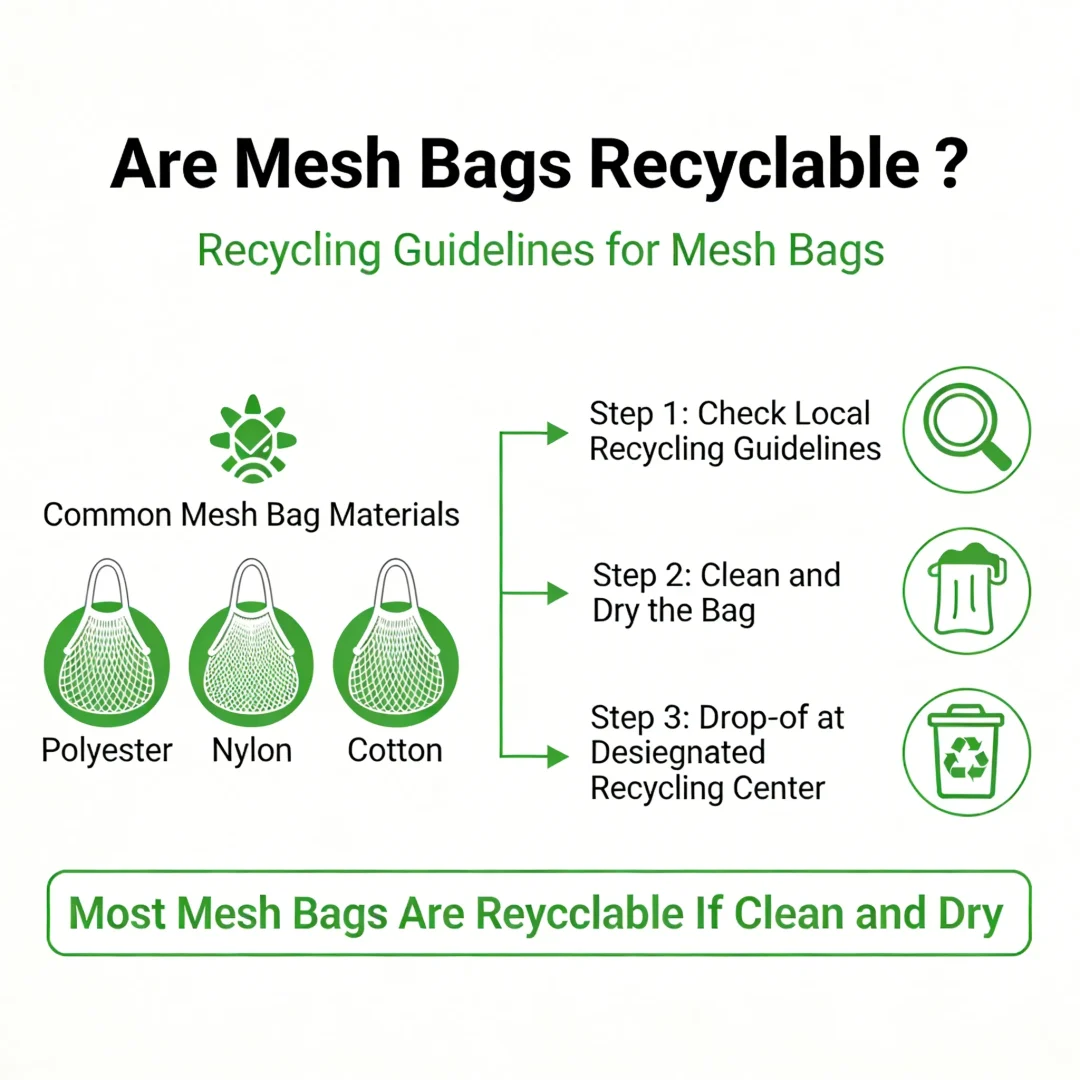
The answer to “are mesh bags recyclable” is not straightforward—it depends entirely on the material composition and your local recycling infrastructure.
Khả năng tái chế phụ thuộc vào vật liệu
The mesh structure itself doesn’t determine recyclability; the underlying material does. Here’s what you need to know:
Túi lưới polyester
- Material code: Usually PET (#1) or other polyester variants
- Recyclability: Theoretically recyclable in many systems
- Thực tế: Often rejected due to bag format and contamination
- Best disposal: Check with local recycling programs specifically
Túi lưới nylon
- Material properties: Durable but complex polymer structure
- Recyclability: Limited recycling options in most areas
- Challenges: Requires specialized processing facilities
- Alternatives: Focus on maximizing reuse rather than recycling
Túi lưới cotton / sợi tự nhiên
- Biodegradability: Naturally decomposes under proper conditions
- Compostability: May be suitable for industrial composting
- Limitations: Often blended with synthetic fibers
- Verification: Check fiber content labels carefully
| Material Type | Recycling Likelihood | Key Challenges | Best Practice |
|---|---|---|---|
| Polyester (PET) | Moderate | Bag format rejection | Contact local programs |
| Nylon | Thấp | Limited processing facilities | Maximize reuse lifespan |
| Cotton Blend | Biến đổi | Synthetic fiber contamination | Check composition labels |
| PP (Polypropylene) | Moderate | Sorting difficulties | Clean thoroughly before disposal |
Túi lưới màu cam có thể tái chế được không?
The question “are orange mesh bags recyclable” comes up frequently because orange mesh bags are commonly used for produce packaging (onions, citrus fruits, potatoes). These bags present specific recycling challenges:
- Chất liệu: Usually made from polypropylene or polyethylene
- Contamination: Often contain food residues and organic matter
- Size and format: Small, flexible bags are difficult for sorting equipment
- Volume concerns: Individual bags represent minimal material value
Reality check: Most curbside recycling programs cannot process orange mesh produce bags, regardless of the material’s theoretical recyclability. The combination of contamination, size, and processing complexity makes them problematic for standard recycling streams.
Tái chế và tái sử dụng: Cái nào quan trọng hơn?
Understanding the environmental hierarchy helps put mesh bags in proper perspective: reuse almost always trumps recycling in terms of environmental impact.
Tại sao khả năng tái sử dụng lại quan trọng hơn
- Energy savings: Reusing a bag 100 times avoids the energy cost of producing 99 replacements
- Resource conservation: Extends the useful life of materials already extracted and processed
- Waste reduction: Directly reduces the volume entering waste streams
- Economic efficiency: Provides value without additional processing costs
Thực tế về việc tái chế
Even theoretically recyclable mesh bags face practical obstacles:
- Contamination issues: Food residues, dirt, and mixed materials
- Economic viability: Low material value compared to processing costs
- Infrastructure limitations: Many facilities lack appropriate sorting equipment
- Market demand: Limited demand for recycled mesh bag materials
Key insight: A mesh bag used 300 times has a far smaller environmental footprint than a “recyclable” bag used once, even if that single-use bag is successfully recycled.
Túi lưới có được tính là túi trong suốt không?
This is one of the most misunderstood aspects of mesh bag regulations. No, mesh bags generally do not count as clear bags for security purposes, despite their see-through properties.
Hiểu biết về các chính sách túi trong suốt
Clear bag requirements exist for security screening efficiency. The key distinction is:
- Clear bags: Made from transparent plastic or vinyl with unobstructed views
- Mesh bags: Feature perforated or woven construction that can obscure contents
Tại sao các chính sách an ninh lại phân biệt giữa túi trong suốt và túi lưới
| Security Concern | Clear Bag Advantage | Mesh Bag Limitation |
|---|---|---|
| Visual Inspection | Complete, unobstructed view | Grid pattern can hide small items |
| X-ray Screening | Minimal interference | Mesh pattern creates visual noise |
| Quick Assessment | Instant content identification | Requires closer examination |
| Standardization | Consistent policy enforcement | Subjective mesh density judgments |
Quy tắc “Tính khả thi ≠ Tuân thủ”
Many people assume that if they can see through a mesh bag, it should qualify as a clear bag. However, security policies are designed around:
- Speed of inspection: Clear bags allow instant visual confirmation
- Equipment efficiency: X-ray and metal detection work better with minimal interference
- Consistent enforcement: Clear-cut rules prevent subjective interpretations
- Liability concerns: Venues prefer unambiguous policies to avoid security gaps
Khi nào túi lưới được chấp nhận tại các sân vận động hoặc địa điểm an ninh?
While mesh bags don’t typically qualify as clear bags, some venues may accept them under specific circumstances:
Các tình huống chấp nhận tiềm năng
- Very fine mesh: Bags with extremely small holes that provide near-clear visibility
- Specific exemptions: Medical needs or accessibility accommodations
- Pre-approval programs: Some venues allow pre-screened bags for season ticket holders
- Venue discretion: Individual security personnel may make case-by-case decisions
Tại sao các chính sách lại khác nhau
Different venues implement varying interpretations of “clear bag” policies:
- Risk assessment: Higher-profile events demand stricter compliance
- Screening capacity: Venues with more security staff may allow marginal cases
- Insurance requirements: Some policies are mandated by insurance providers
- Precedent concerns: Venues avoid setting precedents that complicate enforcement
Critical advice: Never assume a mesh bag will be accepted at a secure venue. Always check specific policies in advance and have a backup plan.
Túi Lưới và Túi Trong Suốt: Bạn Nên Chọn Cái Nào?
The choice between mesh and clear bags depends on your primary use case and requirements:
| Yếu tố | Túi lưới | Túi Trong Suốt | Best Choice |
|---|---|---|---|
| Breathability | Excellent airflow | No airflow | Mesh for wet/damp items |
| Stadium Compliance | Usually not accepted | Generally accepted | Clear for events |
| Độ bền | High reuse potential | Prone to punctures | Mesh for long-term use |
| Privacy | Partial content obscuring | Complete visibility | Mesh for some privacy |
| Cost Over Time | Low (reusable) | Higher (frequent replacement) | Mesh for economics |
Khung Quyết Định
Choose mesh bags when:
- You need breathable storage for sports equipment, laundry, or produce
- Durability and reusability are priorities
- You’re organizing items at home, gym, or non-regulated environments
- You want to minimize long-term costs
Choose clear bags when:
- Attending events with clear bag policies
- You need complete visibility for security compliance
- Temporary or single-use applications
- Working in regulated environments requiring transparent containers
Túi Lưới Có Thân Thiện Với Môi Trường Thực Sự Không?
The environmental friendliness of mesh bags depends entirely on how they’re used rather than their theoretical properties.
Các Yếu Tố Quyết Định Tác Động Môi Trường
Tần Suất Sử Dụng
Environmental benefit scales directly with reuse:
- 1-10 uses: Minimal environmental advantage
- 50-100 uses: Moderate improvement over disposables
- 200+ uses: Significant environmental benefit
- 500+ uses: Excellent environmental performer
Những Gì Chúng Thay Thế
The environmental calculation changes based on alternatives:
- Replacing single-use plastic bags: Almost always beneficial
- Replacing paper bags: Beneficial after 20-30 uses
- Replacing other reusable bags: May not provide additional benefit
- Used in addition to existing bags: Potential negative impact
Quản Lý Đến Cuối Đời
How you dispose of mesh bags affects their overall environmental impact:
| Disposal Method | Tác động môi trường | When Appropriate |
|---|---|---|
| Continued Use | Best option | While bag remains functional |
| Repurposing | Very good | When original use ends |
| Donation/Sharing | Good | When you no longer need it |
| Proper Recycling | Moderate | When local programs exist |
| Landfill Disposal | Poor | Only when no alternatives exist |
Đánh Giá Môi Trường Thực Tế
A typical polyester mesh bag becomes environmentally beneficial after approximately 15-25 uses compared to single-use plastic bags, considering:
- Manufacturing energy and materials
- Transportation impacts
- Use phase benefits
- End-of-life processing
Những Huyền Thoại Thông Thường Về Túi Lưới
Several persistent misconceptions about mesh bags create confusion among consumers and retailers:
Huyền Thoại 1: “Túi Lưới Luôn Có Thể Tái Chế” ❌
Thực tế: Recyclability depends entirely on material composition and local infrastructure. Many mesh bags cannot be recycled through standard programs regardless of their material.
Huyền Thoại 2: “Túi Lưới Giống Như Túi Lưới Bằng” ❌
Thực tế: While both feature open weave construction, mesh bags typically use finer materials and more structured designs. Net bags are usually larger, looser constructions for different applications.
Huyền Thoại 3: “Túi Lưới Có Thể Thay Thế Túi Trong Suốt Mọi Nơi” ❌
Thực tế: Security policies specifically distinguish between mesh and clear bags. Mesh bags rarely qualify as clear bag alternatives for regulated environments.
Huyền Thoại 4: “Tất Cả Túi Lưới Đều Thân Thiện Với Môi Trường” ❌
Thực tế: Environmental benefit depends on usage patterns, material type, and what alternatives they replace. Poorly used mesh bags can have negative environmental impacts.
Huyền Thoại 5: “Túi Lưới Đắt Tiền Luôn Tốt Hơn” ❌
Thực tế: Price doesn’t always correlate with quality or environmental benefit. Some expensive bags use environmentally problematic materials or construction methods.
Câu Hỏi Thường Gặp Về Túi Lưới & Tính Bền Vững
Túi lưới có thể tái sử dụng không?
Yes, quality mesh bags are designed for extensive reuse and can typically withstand 200-500+ use cycles when properly maintained.
Túi lưới có thể tái chế không?
It depends on the material composition and your local recycling infrastructure. Many polyester mesh bags are theoretically recyclable but often rejected by standard programs due to format and contamination issues.
Túi lưới màu cam có thể tái chế không?
Most orange mesh produce bags cannot be recycled through curbside programs due to contamination, size, and processing challenges, despite being made from recyclable materials.
Túi lưới có được tính là túi trong suốt không?
No, mesh bags generally do not qualify as clear bags for security purposes because the mesh pattern can obscure contents and interfere with screening equipment.
Túi lưới kéo dài bao lâu?
Quality mesh bags can last 1-5 years with regular use, depending on construction quality, usage intensity, and maintenance practices.
Can I wash mesh bags?
Yes, most mesh bags can be machine washed on gentle cycles or hand washed. This actually extends their useful life and maintains hygiene.
When Are Mesh Bags the Right Choice?
Optimal Use Scenarios
Mesh bags excel in situations requiring:
- Breathability: Wet swimwear, sports equipment, produce storage
- Visibility with durability: Organizing gear, laundry sorting, toy storage
- Long-term use: Home organization, gym bags, travel accessories
- Flexible capacity: Items that vary in size and quantity
When to Choose Alternatives
Consider other options when you need:
- Security compliance: Choose clear bags for regulated venues
- Weather protection: Solid bags for rain or dust protection
- Privacy: Opaque bags for personal items
- Heavy-duty use: Canvas or leather bags for extreme durability
Making the Sustainable Choice
Choose mesh bags when they will:
- Replace multiple single-use bags over their lifetime
- Serve a specific functional need that other bags can’t meet
- Be used regularly rather than occasionally
- Complement rather than duplicate your existing bag collection
Environmental Impact Summary
| Impact Factor | Low Impact Scenario | High Impact Scenario |
|---|---|---|
| Tần Suất Sử Dụng | Used 500+ times | Used fewer than 20 times |
| Replacement Pattern | Replaces single-use bags | Adds to existing bag collection |
| Material Choice | Recycled content, natural fibers | Virgin synthetic materials |
| End of Life | Repurposed or properly recycled | Discarded to landfill |
Related Guides & Further Reading
Expand your knowledge about mesh bags and sustainable practices with these comprehensive resources:
Key Takeaways
- Reusability matters more than recyclability for environmental impact
- Mesh bags generally don’t qualify as clear bags for security purposes
- Material composition determines recyclability, not mesh structure
- Environmental benefit depends on usage patterns and what they replace
- Quality and frequency of use are the most important sustainability factors
 Vietnamese
 English
 French
 German
 Japanese
 Arabic
 Thai
 Russian
 Spanish
 Portuguese