
There is no single best material for a foldable bag — and the pages that claim otherwise are answering a different question.
Most guides compare fabrics the way you would compare T-shirts: which feels better, which is more “eco-friendly,” which costs less. That comparison is fine for a tote that lives in a drawer. It falls apart for a foldable bag, because a foldable bag has to survive something a tote never does: being folded and unfolded, hundreds of times, along the same lines.
So the honest answer is conditional. The best material is the one that satisfies three numbers at once: how small you need the bag to fold, how many uses it has to survive, and where you intend to sell it. Change any one of those and the answer changes.
This guide covers the material and specification side of that decision — what each candidate fabric actually is, what it costs you in folded size, where it fails, and what the standards and regulations actually require. If you want the structural side first (what a foldable bag is, how the different folding mechanisms work, and where these bags physically break), start with our explanation of what a foldable bag actually is.
The Short Answer (and Why It Needs Three Numbers)
What is the best material for a foldable bag?
If fold size and weight come first, a lightweight woven synthetic — thin polyester taffeta or nylon, usually with a light coating — is the usual starting point. If durability and market compliance come first, a heavier woven fabric meeting at least 80 gsm is the safer base. The deciding factor is not the fiber name but the construction, the fabric weight and the coating system, evaluated against three constraints: required folded size, required number of uses, and target market rules.
The three constraints that decide everything
Every material argument collapses into these three questions. Answer them in this order and most of the confusion disappears.
The second and third are related more tightly than most buyers expect. California and Washington do not regulate what a bag is made of so much as how much fabric is in it and how many trips it can take. A material choice that ignores those numbers is not a design decision — it is a market-access decision you did not know you were making.
Quick reference: where to start
This table is a starting point for a conversation with a supplier, not a recommendation. Every cell still has to be checked against your own fold-size target and destination market.
Before Comparing Materials: Fiber vs Fabric Construction
Here is the single most common mistake in material comparisons, including the ones ranking on page one: they put different layers of the specification into the same table.
A product page will list “190T polyester taffeta” on one row and “600D Oxford polyester” on the next and “recycled polyester” on the third, as though a buyer were choosing between three equivalent options. They are not equivalent. One row describes a fabric built from a particular fiber in a particular weave; another describes a fiber family at a different weight; the third describes where the raw material came from.
Before any comparison is meaningful, the layers have to be separated.
A foldable bag spec has four layers, not one
A foldable bag specification contains four distinct layers:
- Layer 1 — Fiber: what the plastic or natural material actually is (polyester, nylon, polypropylene, cotton).
- Layer 2 — Material source: where that fiber came from (virgin or recycled) — an attribute, not a fiber type.
- Layer 3 — Fabric construction: how those fibers were turned into cloth (taffeta, Oxford, ripstop, canvas, non-woven, mesh).
- Layer 4 — Finish and coating: what was added on top of the cloth (PU, PVC, acrylic, TPU).
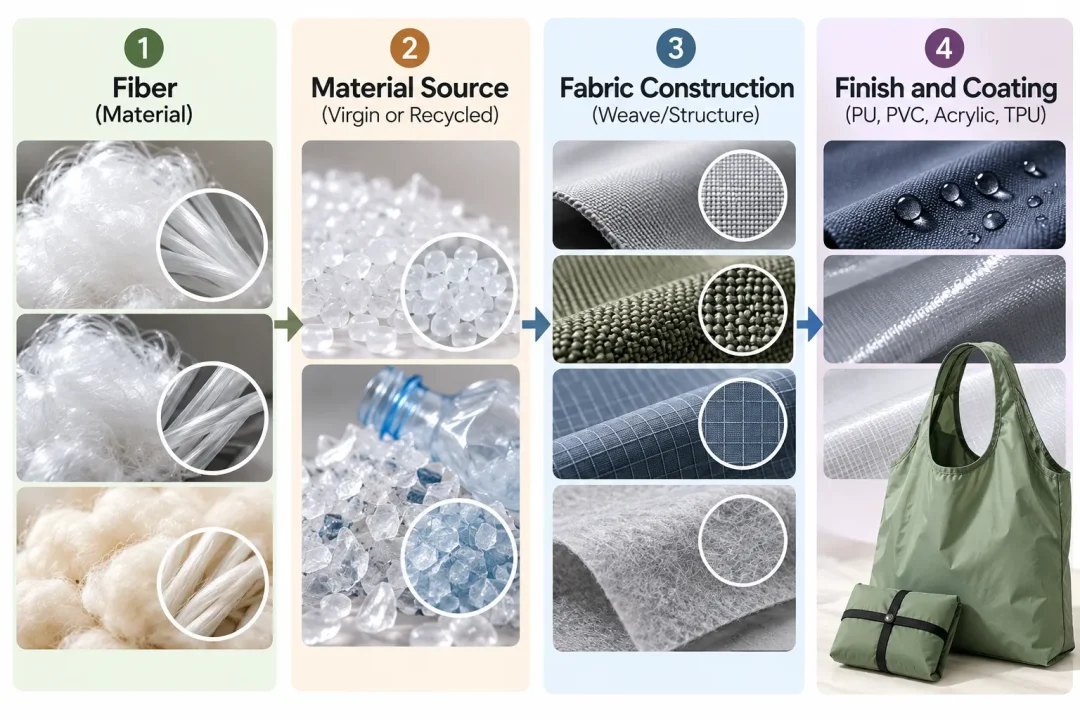
“Ripstop” is not a material. “Oxford” is not a material. “Non-woven” is not a material. They are all Layer 3 — descriptions of how fibers were assembled. Every one of them can be made from more than one fiber.
Reading a spec string: which token belongs to which layer
Supplier specifications are usually abbreviations from all four layers joined together. Decoding one tells you what to ask next — and, more usefully, what the specification left out.
The blank cells are the point. “600D Oxford polyester” says nothing about coating, and coating is the layer that decides whether the bag survives folding. That gap is what you close at the quotation stage.
Where the metrics belong: D, T, GSM, oz and mm
The four layers also explain an argument that never gets resolved on supplier pages: whether 210T is better than 210D.
They cannot be compared, because they are recorded against different layers.
210T and 210D cannot be compared — not because the numbers differ, but because they are recorded against different layers. One is a weave-density notation; the other is a yarn-fineness notation. A supplier that presents them as alternatives is repeating a convention rather than describing a specification.
One honest caveat
The “T” notation in 210T has no definition in any dictionary, standard or certification body consulted for this guide. That does not make it meaningless — it is standard trade language and suppliers understand it. It does mean that when a specification says “210T,” you are relying on a convention rather than a measured, standardized value. If the fabric weight matters to your product, ask for it in g/m² as well, and treat that number as the one you hold the supplier to.
What Actually Sits in Each Layer
With the layers separated, each one can be evaluated on its own terms — and the trade-offs stop contradicting each other.
Layer 1 — Fibers: polyester, nylon, polypropylene, cotton
Polyester. The most widely produced fiber in the world: “Polyester continues to be the most widely produced fiber. It now makes up 59% of total global fiber output of which 88 % is fossil-based” (Textile Exchange, Materials Market Report 2025). It is also the most elastic word in bag specifications. In a single fabric supplier’s reference table, “polyester” appears against fabrics from 190T taffeta at 55–80 g/m² to 600D Oxford at 230–350 g/m².
That range is the point: polyester is not one specification, it is a fiber family that spans the entire weight spectrum. A quotation that says “polyester” has told you nothing about how small the bag will fold.
Nylon. Also called polyamide — a family, not a single substance: “Nylon is a family of synthetic polymers characterized by amide linkages” (Wikipedia). Compared with polyester, the handling difference is usually described as follows by fabric suppliers: “Nylon is softer and more flexible, offering a smoother texture—good for foldable or packable bags.” Supplier weight tables place nylon across 70D, 210D, 420D and 500D, plus ripstop, high-tenacity and ballistic variants.
At comparable weights, nylon generally feels softer and folds more cleanly than polyester. Treat that as a handling difference, not a durability guarantee.
Polypropylene (PP). The weakness most often attributed to “PP bags” is not really a fiber problem. “Some non-woven materials lack sufficient strength unless densified or reinforced by a backing” (Wikipedia). That sentence is about Layer 3 — the non-woven structure — not about polypropylene itself. Specify PP with reinforcement and you have addressed the concern; blame the polymer and you will fix the wrong thing.
Cotton. Supplied across a wide weight band: “Lightweight cotton 80–140 g/m²,” “Cotton poplin 100–160 g/m²,” “Cotton twill 160–260 g/m²” (fabric supplier reference ranges). Cotton absorbs water, takes decoration readily, and is machine washable — a property that matters for compliance, not just for the customer. It is not the natural choice for a bag that must fold into a pocket.
Layer 1 conclusion: fiber choice sets up abrasion resistance, tear behaviour, hand feel and dyeing. It does not by itself determine folded volume.
Layer 2 — Material source: virgin vs recycled
“rPET” is often listed as though it were a material. It is a source designation: the chemistry is PET either way. The distinction is real, but it lives in sourcing and certification, not in the fiber’s physical family.
Scale, from the certification body’s own market report: “Recycled polyester is still primarily made from plastic bottles (98%)” and “In total, recycled polyester increased from around 8.9 million tonnes in 2023 to approximately 9.3 million tonnes in 2024. But because of the larger increase in virgin polyester production, its market share declined slightly from 12.5% in 2023 to 12% in 2024” (Textile Exchange).
On the fiber itself, no dictionary or standards body definition of “recycled polyester” was located for this guide. What exists instead is a certification framework with two different thresholds:
In the standard’s own words: “You can use the GRS as a business-to-business tool for any products that contain at least 20% recycled content, but if you want to use consumer-facing labeling, the product must contain at least 50% recycled content.”
Two administrative notes that affect how you word a specification. First, the standard accepts both pre-consumer and post-consumer material: “Materials are verified to meet the ISO definition of ‘recycled.’ Both pre-consumer and post-consumer material is accepted.” Second, the framework is in transition: “The criteria for Materials Matter Standard were released on December 12, 2025, with the standard becoming effective on December 31, 2026 and mandatory from December 31, 2027.”
Layer 2 conclusion: source determines compliance and claim language. It does not change the physical fiber type. This guide found no authoritative evidence that recycled polyester is more or less durable than virgin polyester, and claims in either direction should be treated as unproven rather than repeated.
Layer 3 — Fabric construction: taffeta, Oxford, ripstop, canvas, non-woven, mesh
This is the layer where the folded-size question actually lives. One fabric supplier’s reference table for bag fabrics makes the trade-off unusually legible, because it publishes a weight range and a limitation side by side:
(Ranges as published by a fabric supplier’s technical reference page for bag fabrics. The page itself cautions that “fabric-weight ranges vary because coating thickness, yarn quality, weave density, and finishing all affect the final result.” Treat these as indicative, not guaranteed.)
Read the second column against the fourth and a pattern appears: as published weight rises, packability falls. “Bulky for carry-on use” is a folded-size verdict in four words. The fabric that survives abrasion best is the fabric that folds worst, and that is the trade-off every foldable bag buyer is actually negotiating.
Ripstop deserves separate treatment because it is the most misunderstood entry in this layer. It is a weave, not a material: “of, relating to, or being a fabric woven with a double thread at regular intervals so that small tears do not spread” (Merriam-Webster). The mechanism: “During weaving, stronger (and often thicker) reinforcement yarns are interwoven at regular intervals in a crosshatch pattern. The intervals are typically 5 to 8 millimeters (0.2 to 0.3in)” (Wikipedia). Those reinforcement yarns act as crack arresters — a small tear stops at the next grid line instead of running the length of the panel.
Ripstop nylon and ripstop polyester are both common. Saying “ripstop” tells you the fabric resists tear propagation. It tells you nothing about the fabric’s weight until you also see the weight.
Non-woven. A structure, not a fabric in the woven sense: “Nonwoven fabric or non-woven fabric is a fabric-like material made from staple fibre (short) and long fibres, bonded together by chemical, mechanical, heat or solvent treatment” (Wikipedia). Its limitation is specifically a folding limitation — the supplier reference table above lists “Frequent folding and unfolding” among the conditions non-woven is not suited to. Buyers’ experience is consistent: a shopper on r/BuyItForLife, describing non-woven reusable grocery bags, wrote that “they definitely wear out quickly (a year or so) and end up as more plastic in the dump.”
Non-woven polypropylene belongs in light-load, low-cycle applications. As the body fabric of a bag expected to fold daily, it needs weight and reinforcement specified deliberately rather than assumed.
Canvas. “A firm closely woven cloth usually of linen, hemp, or cotton used for clothing and formerly much used for tents and sails” (Merriam-Webster) — a construction, which is why “canvas” can be cotton, linen or polyester. In the supplier cotton table, “light canvas” begins at 180–260 g/m² and heavy canvas at 380 g/m² and above. At those weights canvas sits at the heavy end of the fold-volume scale, which is a legitimate choice for structure and brand feel — provided the folded-size target accounts for it.
Canvas also concentrates the washing question. One buyer reported a fabric tote that “shrunk down to the size of a clutch purse” after washing. For an ordinary bag that is an annoyance; for a foldable bag it can void the folded dimension you specified, because the whole product promise depends on the bag returning to a known size.
Canvas is also the construction most often specified by buyers who want a heavier, more branded feel — see our custom foldable canvas bags for how that specification reads in production.
Layer 3 conclusion: construction is the first variable for folded volume. Change the construction while keeping the fiber — polyester taffeta to polyester Oxford — and the folded result changes completely.
Layer 4 — Finish and coating: PU, PVC, acrylic, TPU, silicone
The coating is the layer most often left blank on a specification sheet, and the one most likely to decide the product’s fate.
Take PU first, because the failure mode is documented in the supplier’s own technical writing: “The limitation of standard PU is brittleness: at low temperatures, the coating can crack under flexing, and repeated folding can cause delamination from the base fabric” (material supplier technical page).
That single sentence is the most consequential fact in this guide for anyone specifying a foldable bag. It states, in a supplier’s own words, the exact sequence a foldable bag will experience: flexing, then cracking, then separation from the fabric it was applied to.
A supplier’s consolidated list of coating failure modes is worth keeping next to your specification, because it names each one plainly: “Common failure modes in conventional materials include: Surface cracking after repeated bending / Loss of coating adhesion / Air or water leakage at stress points / Reduced flexibility at low temperatures.”
Note the sources here. These are material suppliers’ technical pages, not standards bodies or independent test labs. They describe mechanisms credibly and consistently, and one of them (PU delamination) is corroborated by the academic literature below — but a supplier describing why one coating system outperforms another has a commercial interest, so treat the mechanism claims as sound and the comparative verdicts as unverified.
One ambiguity worth writing out in full. In coating specifications, “PA” almost always means polyacrylate (acrylic). In fiber specifications, “PA” means polyamide — nylon. A specification reading “PA-coated 420D PA fabric” is not contradictory, but it is genuinely ambiguous to a reader who does not know the convention. Write the coating name out.
Layer 4 conclusion: the coating is where folding failure begins. This guide draws no general conclusion that PU is better or worse than PVC — the available sources are supplier documentation with a commercial interest, and no independent comparative test data was located.
The four layers side by side
A note on how to use this table: do not read across rows as though the layers were alternatives. “Ripstop” and “polyester” are not competing choices; a bag will have a fiber and a construction and a coating. The layers stack. The error this guide is trying to correct is the habit — visible on many supplier pages — of placing a construction, a fiber and a source in one column and inviting the buyer to pick one.
What Actually Decides How Small a Foldable Bag Folds
Fabric weight and thickness set the floor
Three independent industry sources converge on the same claim: weight and thickness govern folding behaviour.
- “Fabric thickness matters because it influences cushioning, folding behavior, seam bulk, shape retention, abrasion resistance, and perceived quality.” — fabric supplier technical page
- “A 0.25 mm coated nylon fabric can be strong enough for a compact travel pouch. A 2 mm neoprene material provides much more cushioning but occupies significantly more space.” — same source
- “Fabric weight affects the strength, structure, and folding performance of foldable bags.” — foldable bag manufacturer
- “The material you choose affects everything: the bag’s durability, how small it can be folded, its cost, and its environmental impact.” — reusable bag manufacturer
These are supplier pages, so read them as industry consensus rather than measured data. What is striking is not the claim itself but the gap behind it: across the sources reviewed for this guide, none published a table mapping fabric weight or thickness to an actual folded dimension in centimetres. The relationship is asserted everywhere and quantified nowhere. If a supplier tells you a fabric “folds small,” ask for the folded measurement — in the same way you would ask for a weight in g/m² rather than a denier.
Why “210T” and “210D” cannot be compared directly
The reason is not the numbers. It is that they belong to different layers, as set out above.
Denier describes yarn fineness: “a unit of fineness for yarn equal to the fineness of a yarn weighing one gram for each 9000 meters” (Merriam-Webster). GSM describes the finished fabric’s mass per unit area, measured with thread count in ends and picks per inch (Wikipedia). “T” appears in neither definition — it is a taffeta-count convention with no dictionary, standard or certification-body definition.
There is a second reason to slow down here, and it is more practical. Denier is widely treated as a proxy for strength, and that treatment does not survive contact with the sources. One fabric supplier states flatly that “Denier should not be used as the only indicator of strength,” and illustrates it: “A tightly woven 420D nylon can outperform a loosely woven 600D polyester in some abrasion conditions.” The same source warns that “a fabric should therefore not be approved from the label ‘210D polyester’ alone.”
By contrast, a retail buying guide reviewed for this guide tells readers the opposite: “Look for the ‘D’ (Denier) rating, which indicates the thickness of the fibre. A higher number, such as 30D, signifies a stronger fabric.” Two industry sources, two incompatible readings of the same number.
The defensible position sits between them: denier is a real and useful specification that describes yarn fineness, and a higher denier usually means a heavier, more abrasion-resistant fabric within one construction and one fiber. It is not a strength certificate, and it cannot be compared across constructions.
Specify three numbers, not one
Open size and folded size are different specifications, and a supplier should be able to state both. Ask for three numbers per model:
- Unfolded dimensions — the working size.
- Folded dimensions — the size the customer actually experiences in a pocket or drawer.
- Volume in litres — the load the bag carries in its open state.
Then add the fourth number that makes the material decision real: fabric weight in g/m², with the unit stated. A specification that gives you denier but not g/m² is answering a question about yarn, not about the cloth you are buying.
One caution that costs money when it is missed: packaging size is not folded size. A folded dimension is only meaningful if the specification also states whether the storage pouch is included in the measurement and how many folds the bag takes to get there. Those definitions are covered in detail in our guide to what makes a bag genuinely foldable.
Fold Durability: Where Coated Bags Fail First
The failure sequence: the coating cracks before the fabric does
If you take one technical point from this guide, take this one. On a coated foldable bag, the fabric is usually not what fails first. The coating does.
A fabric supplier states the same mechanism in one line, in the context of coating specification: “A thick coating can improve water resistance but crack after repeated folding.”
Note what this means for the trade-offs discussed earlier. A heavier coating is usually sold as an upgrade — more water resistance, more durability, a more substantial hand. For a flat bag that is largely true. For a foldable bag it contains a built-in liability, because the coating that provides the water resistance is also the layer that cracks at the fold line.
Three microscopic failure modes
The mechanism has been characterised at fiber level in peer-reviewed work on coated fabrics. Testing found three distinct failure modes: “Three failure modes were found in this study, i.e., fiber slippage, coating point rupture and fiber breakage” (published materials research, PMC).
Three modes matter because they mean there is no single weak point to design around:
- Fiber slippage — the yarns move relative to each other before any fiber breaks. In a foldable bag this shows up as a fold line that will not hold a crisp crease and gradually sags.
- Coating point rupture — the coating fails at the points where it bonds the structure together.
- Fiber breakage — individual fibers fail outright, usually last.
The reason coating rupture matters so much is explained in the same research: “It is the back-coating process that changed the binding mode between pile fibers and ground yarns from mechanical fixation into chemical combination.” In other words, the coating is not merely a surface layer sitting on top of the fabric. It is also part of what holds the fabric together. When the coating fails at a fold line, it does not just lose its water resistance — it removes some of the structural fixation in exactly the place that is being worked hardest.
That is why “which coating?” belongs in the same conversation as “which fabric?” rather than in a later conversation about water resistance.
Why abrasion and tear numbers do not predict fold life
This is the most useful thing a buyer can know, and it comes from the standards themselves rather than from any supplier.
Read those statements plainly. A high abrasion number tells you the fabric resists rubbing in a laboratory machine. It does not tell you how many times the bag can be folded before the coating cracks, and the abrasion standard says so explicitly. A high tear strength number tells you how much force is needed to extend a tear that has already been started — not how hard it is to tear the fabric in the first place, as the tear standard says explicitly.
Aggregate performance figures borrowed from unrelated applications should be treated with the same caution. A Martindale cycle count, or a projected service life in years, may be a perfectly honest number for the product it was measured on — but if it was measured on a shoe bag or a storage bag, it is not a folding specification for your product until someone establishes the relationship, which is precisely what the abrasion standard requires.
The one standard that targets repeated flexing — and what it does not give you
There is a standard written for the exact stress a foldable bag experiences. ISO 7854:1995 is described as follows: “Describes the De Mattia method, Schildknecht method and crumple/flex method for the assessment of the resistance of coated fabrics to damage by repeated flexing.”
Three named methods, one subject: coated fabric, repeated flexing.
What the standard does not provide is a limit. It tells you how to run the test; it does not tell you that a bag must survive 1,000 folds, or 10,000. Across the sources reviewed for this guide, no standard body, certification body or supplier published a fold-cycle threshold for foldable bags. The nearest thing found is a fabric supplier listing test items for its own QC — “Repeated-fold testing,” “Fold durability,” “Whether coatings crack after repeated folding” — together with an acceptance requirement of “No visible coating cracks after folding test.” A sensible acceptance criterion, and still no cycle count.
The practical reading: you can specify the test method for fold resistance. You cannot yet specify a defensible number, because the industry has not agreed on one.
How to write fold durability into a specification
Given the above, a specification can be made specific in some places and has to stay honest in others.
Two columns of that table are worth reading together. You can be precise about the method and precise about the fabric, and still have to be careful about the number. A supplier who offers you a fold-cycle guarantee is either testing your specific construction or estimating.
Compliance: Your Material Choice Is a Market-Access Decision
Material selection is usually discussed as a design question. In several major markets it is a legal one, because “reusable bag” is a defined term with numbers attached. Those numbers constrain the fabric you can use before any aesthetic or cost consideration applies.
California: the 80 gsm line
California’s reusable bag standards sit in the Public Resources Code, and the provision that applies to fabric bags — as opposed to plastic film — is the strictest material requirement covered in this guide.
For a reusable grocery bag “that is not made of plastic film” and is made from any other natural or synthetic fabric — including woven or nonwoven nylon, polypropylene, PET or Tyvek — the law requires all of the following: “It shall be sewn,” “It shall be capable of carrying 22 pounds over a distance of 175 feet for a minimum of 125 uses,” and “It shall have a minimum fabric weight of at least 80 grams per square meter.”
Three requirements, and the third is a direct fabric specification. A 210T taffeta at a published range of 55–80 g/m² sits at or below that line depending on the actual production weight of the roll. For a California-bound program, 80 g/m² is not a preference, it is a floor — and it should be confirmed by test on the actual fabric rather than by reference to a published range.
The same section applies general requirements to reusable grocery bags: a handle and design for at least 125 uses, a volume capacity of at least 15 litres, machine washability or a material that can be cleaned and disinfected, and no lead, cadmium or other toxic material.
Plastic film bags face a separate regime — minimum post-consumer recycled content rising from 20% to 40%, and a minimum thickness of 2.25 mils measured according to ASTM D6988-13. If your product is a film bag rather than a fabric bag, a different set of numbers applies.
Washington: 125 uses and the 2028 film threshold
Washington defines the category rather than listing materials: a reusable carryout bag means “a carryout bag made of cloth or other durable material with handles that is specifically designed and manufactured for long-term multiple reuse.”
The performance standard is again lifetime-based: the bag must “have a minimum lifetime of one hundred twenty-five uses, which for purposes of this subsection means the capacity to carry a minimum of twenty-two pounds one hundred twenty-five times over a distance of at least one hundred seventy-five feet,” and must be machine washable or made from a durable material that may be cleaned or disinfected.
For film plastic bags specifically, two thresholds move over time: a minimum of 20% post-consumer recycled content until 1 July 2022 and 40% thereafter, and a minimum thickness of 2.25 mils until 31 December 2027 — after which, from 1 January 2028, the minimum rises to four mils. Washington also sets pass-through charges on retail distribution, with the charge for film reusable bags rising to twelve cents from 1 January 2026.
EU: what changes on 12 August 2026
The EU’s Packaging and Packaging Waste Regulation sets the framework for the European market, and it applies on a fixed date: “It shall apply from 12 August 2026.”
Its thresholds are defined by wall thickness rather than fabric weight. A “‘lightweight plastic carrier bag'” is one “with a wall thickness below 50 microns”; a “‘very lightweight plastic carrier bag'” is one “with a wall thickness below 15 microns.” Very lightweight bags are the ones singled out for restriction — as the regulation’s recital puts it, they “have a high potential to become waste and contribute to marine pollution,” and measures should be taken to restrict their placing on the market except for strictly necessary uses.
For lightweight plastic carrier bags, the regulation sets a consumption-reduction target: sustained reduction is achieved if annual consumption “does not exceed 40 lightweight plastic carrier bags per capita, or the equivalent target in weight, by 31 December 2025.”
Recycled content enters on a longer timeline. From 1 January 2030, plastic packaging must contain minimum recycled content calculated per packaging type, with 35% applying to plastic packaging not covered by the contact-sensitive PET, other contact-sensitive plastic or beverage-bottle categories; from 1 January 2040, that rises to 65%.
One caution against over-reading. The EU regulation does not set a fabric weight threshold for foldable bags, and it should not be described as if it does. What it does is define plastic carrier bag categories by thickness, restrict the thinnest category, and impose recycled-content obligations on a 2030–2040 timeline. If you are sourcing for the EU, those are the levers to check — not a gsm limit.
New York: no weight threshold
For contrast, New York State defines a reusable bag without a material specification at all. A “‘reusable bag'” means “a bag: (a) made of cloth or other machine washable fabric that has handles; or (b) a durable bag with handles that is specifically designed and manufactured for multiple reuse.”
No fabric weight, no thickness, no recycle-content threshold in that definition. The compliance burden rests on the bag being made of washable cloth or designed for repeated use — which is a matter of construction and documentation rather than a number a fabric supplier can certify.
The practical consequence for anyone selling across state lines: the same bag can be compliant in one market and non-compliant in another, and the difference is fabric weight. A product optimised for the lightest possible fold can fall below a floor that only applies in some jurisdictions.
Recycled content: 20% and 50% are two different thresholds
Because recycled content has become a standard selling point, the two GRS thresholds are worth repeating in a compliance context, since they govern what you may legally say:
- ≥ 20% recycled content — GRS usable as a business-to-business tool.
- ≥ 50% recycled content — consumer-facing labeling permitted.
And a date to plan around: the successor framework, Materials Matter Standard, becomes “effective on December 31, 2026 and mandatory from December 31, 2027” (Textile Exchange).
Compliance summary
Material Decisions That Surface After Delivery
Three material decisions do not show up in a sample review, and all three show up in customer complaints.
Washing: some materials lose the property you bought them for
Washability is a compliance issue before it is a comfort issue. California requires reusable grocery bags to be “machine washable or made from a material that can be cleaned and disinfected” — so a bag that cannot survive washing is not merely inconvenient, it can fall outside the standard.
Two failure patterns are worth planning for.
Cotton can change size. One buyer reported a fabric tote that, after washing, “shrunk down to the size of a clutch purse.” For a foldable bag this is more serious than for a fixed-size tote, because the product promise includes a folded dimension. If the fabric shrinks, the bag may no longer fold into the pouch it was designed around. Where cotton or canvas is chosen, shrinkage behaviour belongs in the pre-production sample review.
Coated fabrics are attacked by more than folding. Water-repellent and coated surfaces sit on the outside of the fiber structure, where they face continuous wear from abrasion, contamination and laundering — a supplier technical page lists exactly that combination, including “flex fatigue, and laundering,” among the factors that degrade a surface treatment. The practical consequence: if the coating is what makes your bag water-resistant, washing is part of the durability story, not separate from it.
Printing: material and decoration method must match
Decoration is decided by two of the four layers, and mismatches between them are a real production constraint rather than a marketing question.
A print-on-demand supplier explained the fiber-layer constraint plainly for nylon: “Nylon is not a suitable fabric for DTG, so you’d need to find a POD print shop that uses direct to film/digital transfer to film/DTF printing method.”
Canvas, by contrast, presents a texture-layer constraint. The weave that makes canvas durable is the same weave that resists a crisp dark print, and buyers working with canvas totes consistently report that dark coverage on a textured surface is harder to achieve cleanly than on a smooth one.
The layer framework from earlier answers this cleanly: Layer 1 (fiber) determines which decoration chemistries will bond; Layer 3 (construction and texture) determines how sharp the result looks. A 600D Oxford and a 190T taffeta may share a fiber and behave completely differently under the same print method. If you are specifying a foldable bag with a logo programme, name the decoration method in the same document as the fabric specification, and let the supplier confirm compatibility before sampling rather than after.
Load paths: the material choice does not fix a weak joint
A material upgrade cannot compensate for a weak attachment point. Describing reusable bags in the retail environment, one grocery worker wrote that “the worst are flat, floppy cloth bags, especially with tiny handles,” with handles that were “nearly disintegrated.”
This is where fabric and structure meet, and it is important not to overstate what a fabric choice can deliver. Choosing a stronger fiber raises the ceiling on how much load a panel can carry. It does nothing about a handle attachment that concentrates the whole load on a short seam. For the structural side of that problem — how fold constructions distribute stress, and which points fail first — see our guide to how foldable bags are built and where they fail.
Material Selection by Application (Spec-Level Cheat Sheet)
The tables below are organised by specification tier rather than by lifestyle scenario, because the specification is what you order. Each row is a starting point to be modified against your own fold target and destination market — not a finished specification.
Every row still needs one further check before it becomes an order: whether the fabric weight clears the compliance floor in your destination market.
Tier 1 — Light load, high cycle count
Two notes on this tier. First, the 190T taffeta range overlaps the California floor at its upper end — which means the same nominal fabric can pass or fail depending on the actual weight of the roll. Test it. Second, this tier is where “light” and “compliant” conflict most directly: the lightest constructions are the ones most likely to sit under a regulated floor.
Tier 2 — Everyday retail and grocery
This tier is where most foldable bag programmes sit, and it is also where the compliance floor becomes unavoidable. A 210D fabric quoted at “90–140 g/m²” sits above the 80 g/m² floor across its published range — but the same reference page notes that these ranges vary with coating thickness, yarn quality, weave density and finishing, so the number that matters is the weight of the roll you actually receive. Specify the weight in g/m², then verify it by test.
Tier 3 — Heavy load, long cycle
Two cautions in this tier. Heavier fabric is not automatically compliant-safe in every respect — recycled-content obligations are a separate axis from weight, so a heavy bag can still miss a recycled-content requirement. And heavier fabric is the tier where the fold-volumetrics penalty is largest: a 600D Oxford at 230–350 g/m² is described by its own supplier as “bulky for carry-on use.” If your product must fold into a pocket, this tier is the wrong starting point regardless of how durable it is.
What to Send Your Factory Before You Ask for a Quote
Most material misunderstandings are resolved by supplying complete information up front. Grouped by the four layers, this is the minimum a supplier needs to quote accurately.
The list is short, and each line exists because leaving it out produces a quotation that cannot be compared with the next supplier’s. If you want to see how these specifications resolve into finished products, our foldable bag manufacturing overview shows the constructions we build against them.
Frequently Asked Questions
What is the best material for a foldable bag?
There is no single best material, because the answer depends on three numbers: required folded size, required number of uses, and the markets you sell in. If folded size and weight come first, a thin woven synthetic — polyester taffeta or nylon, usually with a light coating — is the usual starting point. If durability and compliance come first, a woven fabric meeting at least 80 g/m² is the safer base. The decisive variables are construction, fabric weight and coating system, not the fiber name alone.
Is nylon or polyester better for a foldable bag?
They behave differently rather than ranking. Nylon is generally softer and more flexible at a comparable weight, which suits packable and foldable designs. Polyester is the most widely produced fiber worldwide and spans the widest weight range, which is exactly why “polyester” on its own is not a specification. Both appear in taffeta and ripstop constructions.
Is ripstop a material? What does the “D” in 210D mean — and is 210T the same as 210D?
Ripstop is a weave, not a material: a fabric woven with reinforcement threads at intervals so that small tears do not spread. Denier (D) describes yarn fineness — one gram per 9,000 metres of yarn. GSM describes the finished fabric’s weight per square metre. “T” is a taffeta-count convention that has no definition in any dictionary, standard or certification body consulted for this guide. Because D and T are recorded against different layers of the specification, they cannot be compared directly.
What GSM should a foldable bag be?
There is no single correct figure. The only hard floor located for a fabric foldable bag is California’s requirement that a reusable grocery bag made from fabric have “a minimum fabric weight of at least 80 grams per square meter.” Elsewhere, the right weight is the one that meets your folded-size target while clearing any applicable legal floor — and it should be confirmed by test on the actual fabric rather than from a published range.
Is canvas good for a foldable bag?
Canvas is a construction — a firm, closely woven cloth — rather than a fiber, and it can be cotton, linen or synthetic. It is available from light canvas at 180–260 g/m² upward. It delivers structure and a premium hand feel, and it sits at the heavy end of folding fabrics, so it produces a bulkier folded bundle. If cotton canvas is used, plan for shrinkage behaviour, because a bag that changes size after washing may no longer meet its folded specification.
Is rPET as strong as virgin polyester?
This guide found no authoritative evidence in either direction. rPET is the same PET chemistry sourced from recycled feedstock, which primarily means plastic bottles. The measurable differences sit in sourcing, traceability and certification rather than in the fiber family. Claims that recycled polyester is equally or more durable should be treated as unproven unless supported by test data on the specific fabric.
Is non-woven polypropylene good for foldable bags?
Non-woven is a structure in which fibers are bonded rather than woven. The reference literature notes that “some non-woven materials lack sufficient strength unless densified or reinforced by a backing,” and a fabric supplier’s table lists “frequent folding and unfolding” among the conditions non-woven is not suited to. It works well for light-load, low-cycle applications; as the body fabric of a bag expected to fold daily, it needs weight and reinforcement specified deliberately.
Do foldable bags crack along the fold lines?
Coatings can. A material supplier’s technical documentation states that with standard PU “the coating can crack under flexing, and repeated folding can cause delamination from the base fabric,” and lists “surface cracking after repeated bending” and “loss of coating adhesion” among common failure modes. Because the coating also acts as part of the bonding structure, its failure at a fold line affects more than water resistance. That is why coating specification belongs in the same document as fabric specification.
Can I put a foldable bag in the washing machine?
In some markets you may have to be able to. California requires reusable grocery bags to be machine washable or made from a material that can be cleaned and disinfected. Whether washing is advisable depends on the material: cotton can shrink, and coated surfaces are subject to degradation from laundering as well as from flexing.
Does a foldable bag need to meet any standards to be sold in California?
Yes, if it is sold as a reusable grocery bag. A fabric bag must be sewn, must be capable of carrying 22 pounds over a distance of 175 feet for a minimum of 125 uses, and must have “a minimum fabric weight of at least 80 grams per square meter.” Plastic film bags face a separate set of requirements covering post-consumer recycled content and minimum thickness.
What does GRS certification actually prove about a foldable bag?
GRS is a recycled-content and chain-of-custody certification, not a durability certification. Its thresholds govern what you may claim: at least 20% recycled content permits use of the standard as a business-to-business tool, while consumer-facing labeling requires at least 50%. It does not certify that a bag will survive any particular number of folds.
Can you print a logo on a foldable bag?
Usually, but the decoration method has to match the material. Nylon is not suitable for DTG printing, and textured constructions such as canvas make crisp dark prints harder to achieve. The decoration method should be confirmed alongside the fabric specification rather than after sampling, because the fiber determines which chemistries bond and the weave determines how sharp the result looks.
The Takeaway
The question “what is the best material for a foldable bag” has a better version: which fiber, construction, weight and coating will meet my folded-size target, my reuse expectation and my destination market’s rules, at the lowest cost that does not compromise any of the three.
Answering it that way changes what you ask for. Instead of a material name, you specify four layers. Instead of accepting “folds small,” you ask for folded dimensions in centimetres. Instead of judging durability from an abrasion number, you check whether the coating is specified at all — because that is the layer that fails first on a bag that gets folded.
If you are specifying a foldable bag programme, the two companion guides below cover the ground this one deliberately left out: what makes a bag genuinely foldable, and how fold constructions behave under load.
 English
 French
 German
 Japanese
 Arabic
 Thai
 Vietnamese
 Russian
 Spanish
 Portuguese