
A foldable bag is a reusable bag designed to collapse into a compact form for storage and expand into a full-size carrying bag when needed. Most purpose-designed foldable bags use an integrated pocket, a separate pouch, an elastic strap, a snap closure, a zipper, or a similar system to keep the bag compact once it has been folded.
That definition matters more than it looks, because it separates two things the market constantly blurs.
A plain cotton tote can be folded. That does not make it a foldable bag. What makes a bag “foldable” in the commercial sense is that its construction was designed around two states — an open state and a folded state — and the bag has to work in both. A foldable bag needs a defined folded size, a way to hold that folded shape, and a fabric specification light and flexible enough to make the fold repeatable over hundreds of cycles.
This page explains what foldable bags are, how the folding mechanisms actually work, what they are made from, how they differ from ordinary totes, and — for buyers sourcing them in volume — what has to be confirmed before a single bag is made.
What Makes a Bag “Foldable”?
Three things separate a purpose-designed foldable bag from a soft bag that happens to fold: a specified folded size, a built-in way to hold the folded shape, and a construction light enough to fold without fighting back.
Compact Folded Size
A foldable bag is designed around a sequence, not an afterthought:
Open size → folding process → folded size → storage
The key consequence for buyers is that open size and folded size are two different specifications, and a supplier should be able to state both. Retail listings that publish real measurements make this visible. The Foldie weekender, for example, is listed at 17.8 × 14 × 8 inches unfolded and 11 × 7 inches folded. The Baggu standard bag is listed at 25.5 × 15.5 × 6 inches unfolded and 5 × 5 inches folded. The Paravel foldable duffel is listed at 8 × 5 × 2 inches unfolded and 3.8 × 5 × 1 inches folded. (All figures as published by the retailers’ own product listings — see Sources.)
Two useful observations follow from that small sample:
- Folded size varies far more than open size. A bag that carries 20 litres and a bag that carries 40 litres can both disappear into a pocket; what separates them is the fabric and the fold system, not the volume.
- Weight and folded size are not the same promise. In the same set of listings, weights run from 0.9 ounces to 1.4 pounds. A light bag is not automatically a bag that folds small, and a bag that folds small is not automatically light.
For manufacturers, the practical discipline is to treat folded size as a specification to be verified on a physical sample, not as a marketing adjective. A folded dimension written on a spec sheet means little unless it also states whether the pouch is included in the measurement, how many folds were used, and whether the number refers to the bag or to its retail packaging. (Packaging size is not folded size — a distinction that gets lost surprisingly often.)
If you are comparing suppliers, ask each one for three numbers per model: unfolded dimensions, folded dimensions, and volume in litres. The models themselves — shopping, grocery, canvas, travel — are covered on our foldable bags overview.
Built-In Storage or Closure
The second defining feature is the system that keeps the bag compressed. Without it, a “folded” bag springs open again in a handbag and the convenience disappears.
The constructions in commercial production fall into a small number of families:
These are engineering choices with different cost, packing and usability profiles — not tiers of quality. A zipper produces the tidiest folded package and introduces an extra component that can fail. An integrated pocket is often the cheapest route to a genuinely foldable bag and eliminates the lost-pouch problem entirely; a separate pouch costs less again and gives you a second surface to print on, at the price of a bag that walks away from its own pouch.
The constructions above are the ones we build and specify daily. You can see two of them in physical product form in our one-pull folding construction and our pleated foldable shopper.
Lightweight and Flexible Construction
The third requirement pulls in the opposite direction from the first two: the bag has to be thin and flexible enough to fold, and strong enough to carry a real load.
This is where most of the misunderstanding sits. Buyers often assume that a heavier fabric makes a better foldable bag. It does not. A heavy fabric folds worse — it produces a bulkier bundle, resists a clean fold, and puts more stress on the fold lines. What a foldable bag actually needs is a high strength-to-weight ratio: a fabric that carries the load at the lowest possible weight and volume.
That single requirement explains most of what follows about materials — and it is the reason the foldable bag category settled on thin woven synthetics rather than on heavier natural fabrics.
How Does a Foldable Bag Work?

Functionally, every foldable bag runs the same cycle:
Unfold → Use → Empty → Fold → Secure → Store
The differences between products live entirely in the fourth and fifth steps. How easily does the bag fold, and what holds it folded? That is what separates the two dominant designs.
Self-Pouch Foldable Bags

In a self-pouch design, part of the bag body is the pouch.
Bag → fold → turn the pocket inside out → stored
The bag is compressed, then inverted into its own pocket, so the pouch ends up on the outside holding everything in. Two things follow. First, there is no separate component to lose — the pouch cannot be separated from the bag because it is the bag. Second, the fold is self-contained, so the packed result is consistent: same size, same shape, every time, which makes retail packing and carton planning predictable.
The trade-off is at the fold itself. The inversion point and the pocket mouth take repeated stress every time the bag is packed, which puts the construction quality of that one seam under a spotlight for the life of the product. It is a place we specify carefully, and a place worth asking about when you compare samples.
Separate-Pouch Foldable Bags

In a separate-pouch design, the bag and its storage pouch are two components.
The advantages are real: the bag body can be a cleaner, simpler shape without an internal pocket interrupting it; the pouch becomes a second printable surface; and the pouch can double as retail packaging, letting a brand show the folded product on a shelf without a hang tag. For some product concepts that flexibility is worth more than the integrated pouch’s tidiness.
The disadvantage is equally real: a pouch that is not attached to the bag gets separated from it. In practice this is one of the most common complaints from long-term users of foldable bags — the pouch is the first thing to go missing, and once it is gone the bag no longer packs down to its designed size.
Neither design is automatically better. The right choice depends on how often the bag will be folded and unfolded, how the product will be packed and displayed, who the end user is, and how much piece control matters in production and distribution. A high-frequency grocery bag used several times a week usually points toward an integrated pocket. A gift-with-purchase or promotional piece where the pouch is part of the brand presentation can justify a separate pouch — provided the retail packing is designed so the two components stay together.
If you are weighing the two against your own volume and packing requirements, that conversation belongs with custom foldable reusable bags rather than in a general guide.
What Materials Are Foldable Bags Made From?
The material list for foldable bags is short. That is not an accident — the fold requirement rules most fabrics out before cost is even discussed.
The general ranking above is consistent across published supplier specifications and retail listings: polyester, nylon and RPET dominate the compact end of the market, while cotton and canvas appear mainly where the brand wants a natural hand feel and is willing to accept a larger folded bundle.
Why Are Polyester and Nylon So Common?
Not simply because they are cheap, and not simply because they are durable. The foldable bag imposes one specific requirement that most materials cannot meet:
high strength-to-weight ratio + low folded volume
Polyester and nylon are the materials that satisfy both at the same time. Both are woven from fine synthetic yarn, so the fabric can carry a meaningful load while staying thin enough to compress into a small, stable bundle. Cotton and canvas are strong, but they are also dense and bulky — the same properties that make a heavy canvas tote feel premium make it a poor choice for a bag that is supposed to live in a coat pocket.
Two practical points follow, and both are specified rather than assumed:
Weight, not thickness, is the number that matters. Within the same fabric family, the yarn specification decides how small the bag can fold. Lightweight taffeta — the 190T and 210T thread-count family — packs down smallest. Mid-weight oxford — typically 210D to 300D — folds into a small pouch while still carrying a full shopping load. Heavy oxford at 600D and above holds a rigid shape and does not fold small at all. If a quotation says only “polyester”, the spec is unfinished: denier (D) and thread count (T) measure different things and are not interchangeable.
Coating changes the fold. A PU coating adds water resistance and a little body while keeping the bag foldable. A PVC coating is heavier, stiffer and fully waterproof — and it costs you foldability. As a rule, the more water protection you build into a lightweight bag, the larger the folded bundle becomes. Ask any supplier whether the quoted fabric weight is the base fabric or the coated fabric; at volume, that gap is real money, and it is the easiest way for two quotations to look comparable when they are not.
For the recycled-material path specifically, RPET keeps polyester’s folding behaviour and adds recycled content — covered in more depth on our RPET bags page, and in the material comparison inside our guide to eco-friendly foldable shopping bags.
What Are Foldable Bags Used For?
Foldable bags are used anywhere someone needs to be able to carry something without having planned to. That single job description splits into four quite different buying contexts.
Grocery and Everyday Shopping
The classic use: a bag that lives folded in a handbag, a coat pocket, a glove compartment or a desk drawer, and comes out when an unplanned purchase happens. What matters here is availability, not capacity. A bag that is awkward to fold does not get carried, and a bag that does not get carried does not get used — which is the real reason fold speed and folded size drive satisfaction more than maximum load in this category.
Long-term users tend to describe the same two things when they explain why one bag survived and another did not: the fold stayed easy, and the load-bearing construction held.
Travel
The second bag problem. Foldable bags travel in a suitcase, a backpack or a handbag and come out as an extra shopping bag, a day bag, or a temporary storage bag for laundry or souvenirs. Lightweight travel models are often listed between 20 and 40 litres — a range some brand specifications publish as their typical span — and weight is the number that matters most here, because the bag is being carried alongside everything else. At the extreme end of that trade-off, some ultralight models are listed under an ounce.
If travel is the primary use case, our practical uses of foldable bags walks through the day-to-day scenarios in more detail.
Retail
Retailers use foldable bags in four distinct ways, and they are different products:
- Reusable shopping bag — sold or given at checkout, sized for a full grocery load
- Merchandise — sold as a branded product in its own right
- Gift-with-purchase — bundled with a qualifying purchase, where the folded size and the pouch presentation do the work
- Loyalty gift — a longer-life item intended to be carried repeatedly
The product specification shifts with the role. A checkout bag optimises for capacity and load. A gift-with-purchase optimises for folded size, presentation quality and print impact.
Events and Promotional Giveaways
This is where foldable bags are unusually well matched to the job, because they solve two problems that pull against each other.
Folded, the bag is small — so shipping thousands of units to a trade show, a conference, or a distributor costs far less than shipping an equivalent quantity of rigid or bulky bags, and the bags can be handed out on-site without a handling problem. Unfolded, the same bag presents a large, flat, continuous print surface. Very few promotional items are simultaneously this cheap to freight and this generous with brand real estate.
The evidence that this works over time comes from the people who received them. Long-term users of promotional foldable bags describe keeping and using them for well over a decade:
“I received a few of these packable totes as promotional items about 12 years ago and they will outlive me for sure.”
“Been using some random cotton tote bags I got at some trade show 15 years ago. Still going strong.”
“I got one from Atlas over 15 years ago as a wedding favor, and it’s still going strong!”
For a brand, a bag in weekly use for fifteen years is not a giveaway. It is a recurring impression. That only holds when the construction is specified properly — which is the subject of the next two sections. If you are planning a promotional or corporate programme, the event-focused formats are set out under foldable bags.
Foldable Bag vs Regular Tote Bag: What’s the Difference?
The two categories overlap, and that overlap is the source of most confusion in this keyword space. The differences are in intent and construction, not in shape.
The last two rows are the ones worth internalising. A regular tote only has to work when it is open. A foldable bag has to work when it is open and when it is folded, and those two requirements compete: the fabric must be light enough to compress and strong enough to carry, and the print must survive being folded along the same lines for years.
A foldable bag can be a tote bag, but not every tote bag is a purpose-designed foldable bag.
That is also why the two are specified differently. Buying a tote means agreeing on dimensions, fabric, handle and print. Buying a foldable bag means agreeing on all of that plus the fold system, the folded dimensions and the fold-related durability of both the fabric and the print.
What Makes a Good Foldable Bag?
Five factors decide whether a foldable bag is genuinely good or merely foldable. All five come down to construction — and the failure pattern of real bags over time tells you which ones matter most.
1. Easy to Fold
If a bag takes concentration to pack away, it will be left at home. The fold has to be repeatable from memory — a few seconds, no tools, no forcing.
This is a specification, not a feeling. Ask what the fold sequence requires, and whether the bag can be returned to its folded size after the first ten times you have stuffed it. Long-term users notice when it degrades: one experienced reviewer of packable bags noted that one model had great capacity but that “re-folding it feels a bit more involved compared to” a simpler competitor. The fold’s usability decides the bag’s real-world usage rate.
2. Small Enough When Folded
The relevant number is not the bag’s weight. It is the folded dimensions and folded thickness — and specifically whether the folded bundle still fits the pocket or compartment the user bought it for.
Be careful here: a bag sold as “lightweight” is often not the same bag sold as “fold small”. Ultralight models go down to a fraction of an ounce; larger folding shoppers are listed over a pound and still fold into a pouch. Both are legitimate products. They solve different problems, and the specification to compare is always folded size, never weight alone.
3. Strong Handles and Seams
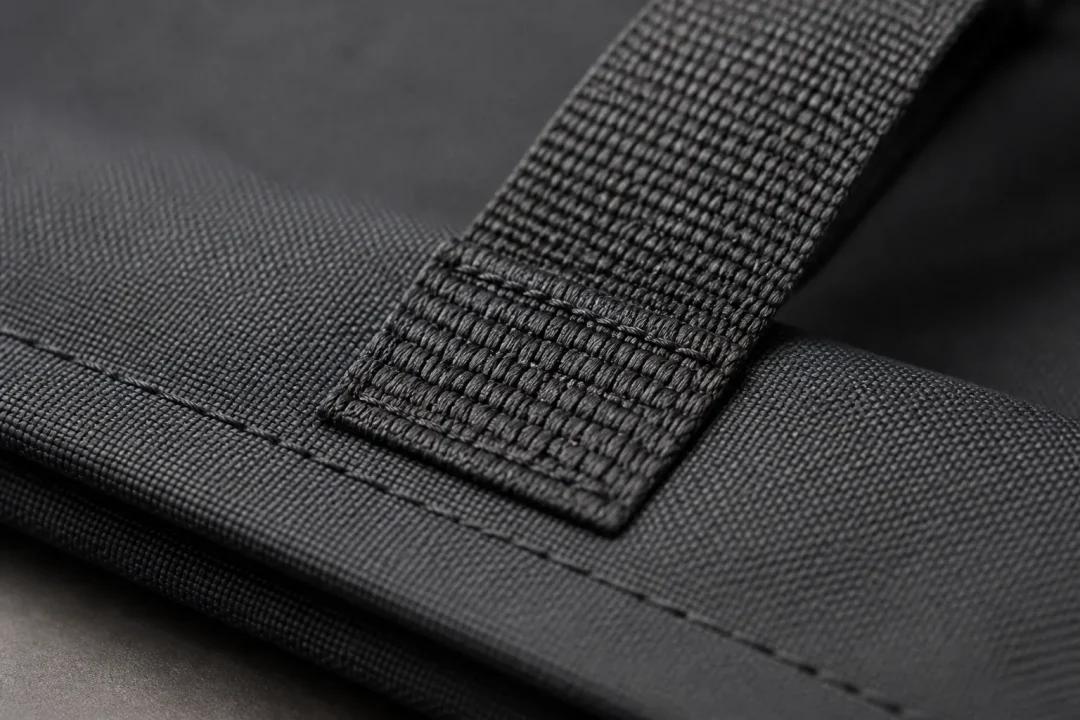
This is where foldable bags actually fail. In our review of long-term user reports, the failures cluster in four places — not one of them is “the fabric wore out”.
Handle attachment. The single most common point of failure. Users describe straps that “eventually wearing through at the seams”, and bags where the handles are so weak they are “not strong enough to carry the weight of the amount of groceries that fit in the bag”. The remedy is construction, not fabric weight: a bar tack or X-box stitch at the handle join, adequate stitching depth into the bag body, and polyester rather than cotton thread (cotton degrades faster than the fabric around it, so the bag fails while the material is still sound).
Bottom corners and base. Users report “delamination on the bottom” on bags that otherwise show no wear, and bags that “start to get a tiny hole at the bottom”. Bases take abrasion and point loads; a reinforced base and a properly bonded coating matter more here than a heavier main panel.
Pouch seam. On an integrated-pocket design, the pocket mouth and the inversion point are worked every single time the bag is used. This seam should be reinforced as a matter of course.
Side seams. On very light fabrics, a cut edge that has not been sealed will unravel. Panels should be hot-knife cut on synthetics, with seams overlocked or bound, and stitch density specified — too few stitches is weak, too many perforates a light fabric into a tear line.
4. Suitable Capacity
Compact is not the goal in itself. A bag that folds to nothing but cannot hold a week’s groceries has missed the point of the exercise.
Match capacity to the actual job: a checkout or grocery bag needs volume and load capacity; a travel backup bag needs a useful day-bag volume at minimum weight; a promotional bag needs enough presence to be used at all. Capacity is quoted in litres on most retail listings, and it should appear on your specification next to the folded size.
5. Durable Folding Mechanism
Repeated folding wears a different set of components from ordinary carrying. The cycle loads the fabric at the fold lines, the pouch, and the closure hardware — zipper, snap or elastic. Each of those is a consumable, and each should be specified separately.
Elastic loops lose tension. Snaps and zippers can fail outright. Zippers in particular add a component and a failure point, which is why snaps and elastic are more common on foldable bags despite being less tidy. Fabric at a permanent fold line can crack if the ink film on top of it is not flexible enough — a print problem rather than a fabric problem, but a real one, and one that shows up in the field as a logo that fades years before the bag does.
The conclusion is structural: durability in a foldable bag is a property of the whole construction, not of the fabric alone. Two bags in the same 210D polyester can differ by years of service life depending on the handle join, the seam finish and the fold-line design. Experienced buyers say it plainly:
“One thing I’ve noticed with long-lasting shopping bags is that structure matters more than the brand. A bag with reinforced corners and stitched handles tends to outlive the super minimalist ones.”
“The trick seems to be slightly thicker fabric rather than the ultra-thin ones. Wider handles also make a real difference, helping to prevent unnecessary stress on the seams when carrying heavier items.”
Are Foldable Bags Reusable?
Generally, yes — foldable bags are designed for repeated use. But “designed for repeated use” is not the same claim as “environmentally better”, and it is worth being precise about the difference.
The environmental case for any reusable bag rests on how many times it is actually used. One widely cited comparison puts the energy cost of a single reusable bag at the equivalent of roughly 28 traditional plastic shopping bags or eight paper bags — a break-even that is only reached through repeat use. The same source notes that the average cotton bag is used only 51 times before being discarded. In other words, the benefit is a function of behaviour, not of the material alone.
So a foldable bag’s environmental profile depends on several things at once:
- material — recycled content, virgin polymer, or natural fibre
- manufacturing — energy and water used in production
- product lifespan — how many folds and loads the construction survives
- number of reuses — which depends on whether the folded size makes people actually carry it
- end-of-life handling — whether it is reused, repaired, recycled or landfilled
“Reusable” describes how a product is intended to be used; it does not mean every foldable bag has the same environmental impact. A bag that is too bulky to carry gets used twice and then lives in a cupboard. A well-specified bag that folds into a pocket gets used weekly for years — and that usage pattern, not the material label, is what delivers the benefit.
What Regulators Now Require
This is no longer only a consumer preference. Several jurisdictions have written durability requirements into law, and they apply to the “reusable” claim specifically.
California wrote one of the most detailed quantified baselines for a reusable grocery bag into law: the bag must have a handle, be designed for a minimum lifetime of 125 uses, hold at least 15 litres, be machine washable or cleanable, and — for fabric bags — be sewn and carry 22 pounds over a distance of at least 175 feet, 125 times. Fabric bags must reach a minimum fabric weight of 80 g/m²; film bags must be at least 2.25 mils thick and contain at least 40% post-consumer recycled material. It remains the clearest published benchmark of what “reusable” is supposed to mean in practice.
California also closed a loophole worth knowing about. Legislation that took effect on 1 January 2026 ended the practice of handing out thicker plastic bags at checkout, on the legislative finding that those thicker “reusable” plastic bags “were not generally reused by consumers and resulted in an increased amount of plastic and plastic waste.” The lesson is directly relevant to foldable bags: a durability claim that is not evidenced does not survive contact with either consumers or regulators.
The European Union has moved in the same direction. Regulation (EU) 2025/40 — the Packaging and Packaging Waste Regulation — applies from 12 August 2026, with mandatory reuse targets that rise to 40% of transport packaging by 2030 and 70% by 2040, and a requirement to retain technical documentation for reusable packaging for ten years. The European Commission frames the need bluntly: packaging waste in the EU runs at more than 180 kg per person per year, accounts for around a third of municipal waste, and about half of marine litter.
Washington State has set a fee and a thickness threshold for reusable plastic film bags: a $0.12 pass-through charge from 1 January 2026, and a minimum thickness of 4 mils from 1 January 2028.
Two practical takeaways for anyone specifying foldable bags:
- Foldability and reusability are separate claims and need separate evidence. A bag that folds flat has demonstrated nothing about its service life. If you are making a reusable claim in a regulated market, the load cycle and reuse count need to be tested on the finished bag — including the fold lines.
- The fold is a durability variable. A construction that survives 125 standard carry cycles may still fail earlier if the same bag is folded and unfolded 125 times as well, because the fold lines, pouch seam and closure hardware take their own wear. Fold-related durability belongs in the test plan, not in the afterthoughts.
How to Choose a Foldable Bag
For a personal purchase, the decision sequence is short:
Size → Material → Capacity → Folded size → Handle comfort → Closure
Start with what you need to carry, not with how small the bag folds. Then work out the folded size that still fits where you intend to keep it — a coat pocket, a glove box and a backpack side pocket have very different limits. Handle comfort matters more than it sounds: narrow handles on a loaded bag are the complaint that comes up most often among long-term users.
For a B2B buyer, the same list extends with the commercial requirements:
Printing → Branding area → Packaging → Recycled-content requirements → Intended use
Two items on that list deserve more attention than they usually get. Branding area has to be evaluated in both states, because a logo that reads well on the open bag may be entirely hidden once it is folded. And intended use determines which specification is correct — a bulk promotional giveaway, a retail loyalty bag and a sold merchandise item should not be built to the same specification, even if they look similar in a catalogue.
What Should Buyers Consider When Customizing Foldable Bags?
For custom and private-label programmes, five items need to be settled before production. Each one is a place where an unfinished specification turns into a rework order.
Open Size and Folded Size
Confirm both, in writing. Open size drives capacity and load. Folded size drives packing, retail presentation and whether the bag is actually carried. State the folded measurement with its measurement conditions defined: measured on a single bag, after a standard fold, with the pouch included or excluded, in centimetres. If the numbers are left to interpretation, the first bulk shipment will settle the argument the expensive way.
Material Specification
Do not order a “polyester foldable bag”. Specify the fabric construction and weight: denier or thread count written explicitly (210D and 210T are different fabrics with different weights, feel and fold behaviour, despite sharing a number), the weight in g/m², and whether that weight is base or coated fabric. Then confirm the coating type and which face it sits on — the coating decision affects water resistance, stiffness, printability and how small the bag still folds.
Folding Mechanism
Choose the fold system deliberately: integrated pocket, attached pouch, separate pouch, elastic band, snap strap, or zipper pouch. Each carries a different cost, a different packing implication and a different failure mode. If a separate pouch is specified, define how the pouch stays with the bag through packing and retail handling. If an attached pouch is specified, require the tether to be reinforced independently.
Logo Placement — in Both States
This is the design question specific to foldable bags, and it is easy to miss until artwork is approved. The bag has two display states, so it has two branding surfaces:
- Main bag panel — the large print surface that shows while the bag is in use
- Pouch or folded-facing panel — the surface that shows while the bag is folded and stored
A brand that only prints the main panel has a bag whose branding disappears whenever it is packed away — which, for a bag whose entire purpose is to live folded in a bag or pocket, is most of the time. Planning a secondary mark for the folded state typically costs very little at the artwork stage and nothing afterwards.
One constraint to design around: keep artwork off permanent fold lines. Ink films that are not flexible enough will crack along a fold that is repeatedly creased, and a logo that cracks or lifts years before the bag itself wears out is a brand problem, not a bag problem.
Load and Seam Construction
Load capacity is a property of the construction, not of the fabric. A heavier fabric with a weak handle join fails before a lighter fabric with a properly reinforced one. Specify the handle attachment method (bar tack or X-box stitch), the stitch density, the thread type, the seam finish (overlocked or bound), and whether panels are hot-knife cut. Then ask for load capacity to be stated for the finished bag, with the test method behind it, rather than inferred from the denier.
If you want these points turned into a concrete specification against your own volumes and artwork, the fastest route is to send the bag you are using now to our team via custom foldable reusable bags or contact us directly.
FAQ
What is another name for a foldable bag?
Several terms are used, and they are not fully interchangeable:
Dictionary definitions treat the first five as near-synonyms: foldable is defined as “capable of being folded (as for storage)”, collapsible as “able to be folded into a more compact shape”, and packable as simply “capable of being packed”. Because the words are not sharply separated in general usage, they are frequently mixed within a single product page.
That looseness is exactly why the words alone are a poor basis for a purchase. In engineering and procurement, the distinction is drawn properly — there, foldable, nestable and fixed containers are three separate categories with different mechanisms and different handling consequences. Applied to bags, the same discipline is what separates a purpose-designed foldable bag from a soft bag that can be squashed: does it have a fold system, and does it hold its folded shape? If the answer is no, it is a packable bag, not a foldable one.
What is a foldable shopping bag?
A foldable shopping bag is a foldable bag sized and built for retail or grocery carrying — a load-bearing body, handles suitable for carrying weight, and a fold system that lets it be stored compactly between shopping trips. It is the most common sub-type in the category. Our own foldable shopping bags and foldable grocery bags ranges follow that brief, and if your material preference is canvas, the same construction logic applies in foldable canvas bags.
What is the best material for a foldable bag?
For regular use, a coated polyester oxford in the 210D class is the usual answer: it folds into a small pouch and still carries a full shopping load. For a giveaway that must pack as small as possible, lightweight 190T–210T taffeta is lighter, cheaper and packs smaller. For a premium travel bag, nylon offers a better strength-to-weight ratio. “Best” depends entirely on whether you are optimising for folded size, durability, print quality or cost — no material wins all four. A dedicated comparison is worth its own article; the working principles are set out above.
Are foldable bags strong?
They vary widely, and the determining factor is not the word “foldable”. Strength comes from the combination of fabric weight, handle attachment, seam construction and base reinforcement. A lightweight bag with a bar-tacked handle join and bound seams will outlast a heavier bag with a handle tacked into the top hem. Judge strength by asking for the tested load capacity of the finished bag and the test method, not by reading the fabric weight.
Can foldable bags be washed?
It depends on the material and the print — a single blanket answer would be wrong. Non-woven polypropylene is generally not designed to be washed and degrades with heat and light; users report exactly this. Woven polyester and nylon are typically more washable, though hot washing and aggressive drying can shrink or distort the fabric and make it harder to return to the original folded size — one long-term user described a fabric tote shrinking “down to the size of a clutch purse” after washing. Heat-transfer prints are more vulnerable to washing than dye-based prints. Confirm the care instruction for your specific material and decoration before committing to a laundry claim.
Are foldable bags good for travel?
Yes — travel is one of the strongest use cases, because the bag adds almost nothing to a packed bag until it is needed. They work best as a second bag: a spare shopping bag, a day bag at the destination, or a laundry and souvenir bag. Choose on weight and folded size rather than volume, and if the bag will be used as cabin baggage, check it against the specific airline’s dimension and weight allowance rather than assuming.
How small are foldable bags when folded?
There is no standard. Folded size depends on the bag’s open dimensions, the fabric weight and coating, the fold system, and whether the pouch is included in the measurement. Published retail listings show folding shoppers as small as a few square inches and as large as a folded weekender, within the same category. Because the range is so wide, folded size should be treated as an individual specification to be confirmed per model — requested in writing, and verified on a physical pre-production sample rather than accepted from a catalogue photo.
The Short Version
A foldable bag is not simply a bag that can be folded. It is a bag engineered around two states, with a defined folded size, a mechanism that holds the fold, and a fabric light enough to compress and strong enough to carry.
That dual requirement is what makes the category different from ordinary totes — and it is why the specification matters more than the fabric label. Fold system, folded dimensions, fabric weight and coating, handle attachment, seam finish and logo placement across both states are the six things that decide whether a foldable bag gets used weekly for a decade or is folded once and forgotten.
Explore the full range of constructions and formats on our foldable bags page, or tell us what the bag needs to do and we will specify it with you.

 English
 French
 German
 Japanese
 Arabic
 Thai
 Vietnamese
 Russian
 Spanish
 Portuguese