
A boat tote bag is a canvas carryall with two handles, a defined flat base, and a roomy main compartment. Many versions use substantial fabric, reinforced attachment points, and contrasting handles or bottom panels. They are practical for everyday carry, shopping, beach trips, and personalized gifts, with both open-top and zip-top designs available.
The familiar appearance is only part of the story. Two bags can look almost identical in a photograph yet feel very different once packed. Fabric weight, base depth, handle drop, and sewing details determine much of that difference.
“Boat tote” describes a style rather than a universal material or performance specification. It does not guarantee a particular canvas weight, carrying capacity, or level of water protection. Understanding the construction helps you choose a useful bag—or develop one for a retail collection or branded merchandise program.
Why Is It Called a Boat Tote?
The clearest documented background comes from L.L.Bean’s classic bag. According to the company’s history of the Boat and Tote, its predecessor appeared in 1944 as Bean’s Ice Carrier, designed to transport ice from a car to a household ice chest. It was reintroduced in 1965 as the Boat and Tote, in nautical red and blue.
That history connects the familiar name with a nautical presentation and a practical carrying design. It also explains why descriptions that say the original bag was invented exclusively for boating miss an earlier part of the story. The official account establishes the product’s history, but it does not establish that the bag was named after looking like a boat.
Today, the name no longer limits where the bag is used. A boat tote can hold office supplies on a weekday and towels on the weekend. Its usefulness comes from the combination of accessible storage, a broad base, and a relatively simple construction.
Who Makes the Original Boat and Tote?
L.L.Bean makes the original branded Boat and Tote®. When shoppers ask about “the original boat tote,” this is generally the product they mean.
Other brands and bag manufacturers offer their own boat-style canvas totes. These may share familiar features, but they are separate products. A fabric specification, manufacturing location, or load-test result published for L.L.Bean’s bag should not be treated as a standard that applies to every boat tote on the market.
Boat Tote, Canvas Tote, and Boat Bag: What Do the Names Mean?
The terms overlap, but they do not all describe the same thing. A product name is a starting point for comparing bags; the dimensions and construction provide the more useful detail.
| Term | What it describes | What to check |
|---|---|---|
| Boat tote / canvas boat tote | A carryall style commonly associated with a defined base and visible handle attachments | Actual fabric, base construction, and handle configuration |
| Boat and Tote® | L.L.Bean’s branded product line | The specifications of that particular model |
| Canvas tote | A broad material-based category, including flat and structured designs | Whether the bag has depth, reinforcement, lining, or pockets |
| Two-tone tote | A bag combining two colors | Color alone does not define the construction or strength |
| Beach bag | A bag chosen or designed for beach use | Material, sand removal, wet-item separation, and drying requirements |
| Boat bag / boating bag | An ambiguous description that may include canvas carryalls or dedicated marine gear bags | Whether the intended use requires weather resistance or waterproof protection |
A boat tote can also be a canvas tote, a two-tone tote, and a beach bag. These descriptions highlight different aspects of the same product.
What Are the Main Features of a Boat Tote Bag?
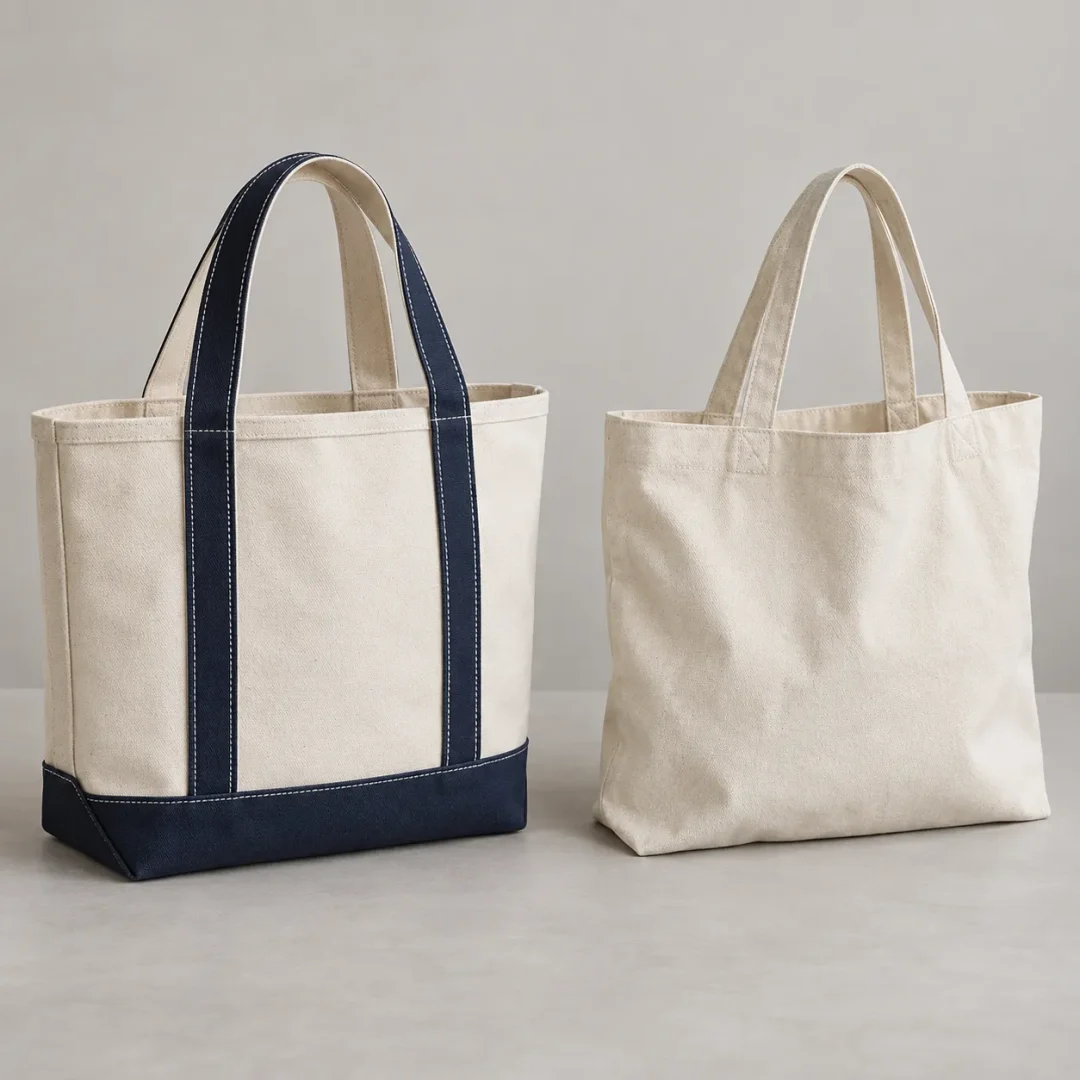
There is no single specification shared by every boat tote. However, several recurring features help distinguish the style from a simple, lightweight shopping bag.
A Substantial Canvas Body
Canvas gives many boat totes their textured appearance and substantial feel. Compared with a thin fabric shopping tote, a heavier canvas version often feels more structured when opened and loaded.
Fabric weight is only one part of that result. The weave, finishing treatment, lining, and overall pattern also affect how the bag behaves. A thick fabric may soften with use, while a lined or reinforced construction may retain more structure.
For everyday users, the practical tradeoff is between structure and carrying weight. A substantial bag can feel reassuring when carrying books or supplies, but it also adds weight before anything goes inside. For a custom collection, selecting the heaviest available canvas is therefore not automatically the best decision.
A Flat Base and a Roomy Main Compartment
A defined base gives the bag depth, making room for objects that do not fit comfortably into a flat tote. Think of a folded towel, a lunch container, or several small storage pouches arranged side by side.
This construction also affects how the bag sits on a surface. Some models remain upright when empty; others need contents to support them. A flat base alone does not guarantee that a bag will stand independently. It can be formed through gusseting or a separate panel; neither construction is a universal requirement for the style. Ask how the base is made rather than assuming that an exterior color panel reveals the complete structure.
The wide main compartment makes packing straightforward, although it can leave small items difficult to find. An internal pocket, a key attachment, or a separate pouch can make a bigger difference to everyday convenience than adding more overall volume.
Reinforced Handles and Seams
The points where the handles join the body deserve close attention. These connections carry the load whenever the bag is lifted, while bottom seams must withstand the contents pressing against them.
Boat totes may use extended handle attachments, additional stitching, or extra fabric at these areas. The exact method varies, and visible reinforcement should be considered alongside fabric quality and sewing consistency. Handles attached at a reinforced top hem are not automatically weak, and longer handle extensions are not proof of a higher carrying capacity.
For wholesale orders, describe the intended contents and expected use when discussing construction. A tote intended for clothing has different demands from one regularly carrying books or bottled drinks. Any stated carrying capacity should relate to the actual finished bag and an appropriate test, rather than the appearance of its handles.
Contrast Handles and Base Panels
A natural-colored body with colored handles and a matching bottom panel is a familiar boat tote design. It creates clearly defined areas of color while leaving much of the main panel available for decoration.
However, contrast trim is a common design choice, not a requirement. Boat totes can also be monochrome, patterned, or made with different panel combinations. For a branded collection, these areas provide opportunities to coordinate the bag with an existing color palette without covering the entire surface with graphics. A cotton boat tote bag is one product direction to consider when developing this style.
Open-Top and Zip-Top Options
An open-top boat tote is easy to load and convenient when you frequently reach inside. It suits tasks such as taking out groceries, grabbing a towel, or carrying items between a car and a building.
A zip-top version helps keep loose belongings contained when the bag tips or moves around. It can be useful for commuting and travel, although the zipper opening may limit the size of objects that fit through the top.
Neither option is universally better. Choose according to how the bag will be handled, and remember that adding a conventional zipper does not make a canvas bag waterproof.
How Is a Boat Tote Different from a Regular Tote Bag?
A boat tote is a type of tote bag. The useful comparison is usually between a structured boat-style carryall and a basic lightweight shopping tote, rather than between two completely separate categories.
| Feature | Typical canvas boat tote | Basic lightweight shopping tote |
|---|---|---|
| Construction | Often has a defined base and reinforced areas | Often uses a simpler flat or lightly gusseted design |
| Feel | More substantial, sometimes relatively stiff | Usually soft and flexible |
| Empty weight | Often heavier | Usually lighter |
| Packing | Accommodates bulky items more readily when the base is deep | Convenient for flatter items and lighter purchases |
| Storage between uses | May take up more space when folded | Usually folds into a smaller bundle |
| Common applications | Daily carry, trips, gifts, and retail merchandise | Backup shopping bags, lightweight giveaways, and occasional carry |
These are typical differences, not fixed rules. An ordinary canvas tote can also have strong handles, pockets, and a sturdy base. Similarly, a boat-style bag can use a lighter fabric for a softer feel.
If you want a bag to keep folded inside another bag, a lightweight tote may be more convenient. If you want a main carryall for several bulky belongings, a boat tote with suitable dimensions may work better. The construction and intended load matter more than the category name.
A beach bag introduces a different comparison: it is a use category, not one construction. It might be a canvas boat tote, a mesh bag, or a molded carryall. There is no reliable rule that all beach bags are taller, softer, or lighter than boat totes. Compare the specific designs and the conditions in which they will be used.
Canvas Weight Explained: What Do 12 oz, 18 oz, and 24 oz Mean?
Canvas weight describes the mass of fabric over a given area. When the unit is ounces per square yard, it can be converted to grams per square meter, commonly abbreviated as GSM:
1 oz/yd² ≈ 33.906 g/m².
| Canvas weight | Approximate GSM |
|---|---|
| 10 oz/yd² | 339 |
| 12 oz/yd² | 407 |
| 14 oz/yd² | 475 |
| 16 oz/yd² | 542 |
| 18 oz/yd² | 610 |
| 20 oz/yd² | 678 |
| 24 oz/yd² | 814 |
These are unit conversions, not durability grades. An 18 oz fabric has three-quarters of the mass per area of a 24 oz fabric, but that does not mean the finished bag carries three-quarters as much weight. Nor does a 24 oz fabric guarantee that the bag stands upright.
The well-known L.L.Bean design uses 24 oz cotton canvas, as described in its official design account. That is a useful heavyweight reference, not a minimum requirement for every product sold as a boat tote. A lighter version can retain the same broad style while being easier to fold and carry.
How Should You Choose the Fabric Weight?
Compare actual swatches and finished samples whenever possible. A heavier fabric can provide a substantial feel, but yarn, weave, finishing, panel proportions, and lining also influence stiffness and performance. Do not use an ounce figure alone to predict abrasion resistance or seam strength.
For a retail carryall, consider whether the intended customer values a firm body or a softer bag. For a gift program, think about the recipient’s everyday use and the weight of the complete gift set. Extra fabric weight also adds to transport weight, so it should serve a practical purpose.
When discussing fabric with a supplier, confirm that “oz” means oz/yd², rather than ounces per linear yard. A linear-yard figure depends on fabric width and cannot be compared directly with weight per square yard. Also confirm fiber composition: cotton canvas, recycled cotton blends, and recycled polyester are different material descriptions. RPET means recycled polyester, not recycled cotton.
Why Are Boat Totes So Popular?
Their appeal combines practical storage, a recognizable design, and room for personalization. Those qualities help explain why the style works across different routines and audiences.
They Fit Different Daily Routines
A simple main compartment can adapt to changing contents. The same bag might carry a sweater and a lunch container one day, then groceries or picnic supplies the next.
This flexibility is especially useful for people who prefer packing with smaller pouches instead of using a separate fixed compartment for every object. It also makes the style relevant to gift programs where recipients have different lifestyles.
The Design Is Easy to Recognize and Coordinate
The combination of a plain body, visible handles, and a defined base creates a clear silhouette. It can look casual without needing elaborate hardware or decorative details.
For buyers developing merchandise, that simplicity creates room for differentiation through proportion, color, and construction. A compact tote with short handles communicates something different from a large shoulder-carry version, even when both use a similar panel layout.
Personalization Gives the Bag a Specific Purpose
Initials, names, short phrases, and illustrations can turn a standard carryall into a personal gift. A company or event logo can give the same basic format a different role.
L.L.Bean’s own design account highlights monogramming for names, celebrations, and humorous messages. This offers a concrete example of how personalization adds appeal beyond the bag’s storage function. It does not mean every design needs a large logo: a small, carefully positioned mark may suit the intended audience better.
What Are Boat Tote Bags Used For?
Boat totes are useful wherever you need accessible space for a changing mix of belongings. The most suitable version depends on the contents and the conditions in which it will be carried.
| Use | Typical contents | Features worth considering |
|---|---|---|
| Shopping and errands | Groceries, books, and personal items | Comfortable handles, suitable base depth, and reliable seams |
| Work and study | Documents, lunch, a bottle, and a laptop sleeve | Adequate opening width, useful pockets, and comfortable shoulder carry |
| Beach days and picnics | Towels, spare clothing, and outdoor essentials | Generous volume, easy access, and suitable care instructions |
| Short trips | Clothing, toiletries, and a shoe pouch | A closure, manageable packed weight, and practical dimensions |
| Gifts and merchandise | A welcome kit or the recipient’s own belongings | Appropriate size, coordinated colors, and considered decoration |
Everyday Errands and Shopping
A boat tote can make it easier to keep several purchases together, particularly when the base gives containers enough room to sit flat. A few internal pouches can separate personal belongings from shopping.
Volume and weight should be considered separately. A bag that has room for more bottles or books may already be uncomfortable to carry. Packing it to the top is not always the most practical choice.
Work and Study
The accessible opening suits documents, notebooks, and the items needed throughout a working day. A dedicated pocket also helps keep a phone or access card within reach.
For a laptop, check the bag’s usable internal dimensions and the opening through which the device must pass. A canvas main compartment provides storage, but it does not automatically provide padding or impact protection. A fitted sleeve is useful when the tote has no protective laptop compartment.
Beach Days and Weekend Trips
A spacious boat tote is convenient for towels and dry clothing. However, damp swimwear is better separated in a suitable wet bag, and electronics need protection appropriate to the surroundings.
For an overnight trip, a zip-top version can help contain clothing and small pouches. If you plan to use it on a flight, compare the packed dimensions with the airline’s current allowance; “large” and “travel tote” are not standardized baggage sizes.
Gifts and Branded Merchandise
Boat totes can serve as employee gifts, event merchandise, retail products, or welcome bags. The useful starting point is what recipients will do with them after receiving them.
A compact event bag may need to fit a specific set of items, while an everyday retail tote benefits from proportions that remain comfortable outside the event. For custom manufacturing, share the intended packing list before finalizing dimensions. This gives the supplier a more concrete brief than simply requesting a medium or large bag.
Boat Tote Sizes: Compare Measurements Before Size Labels
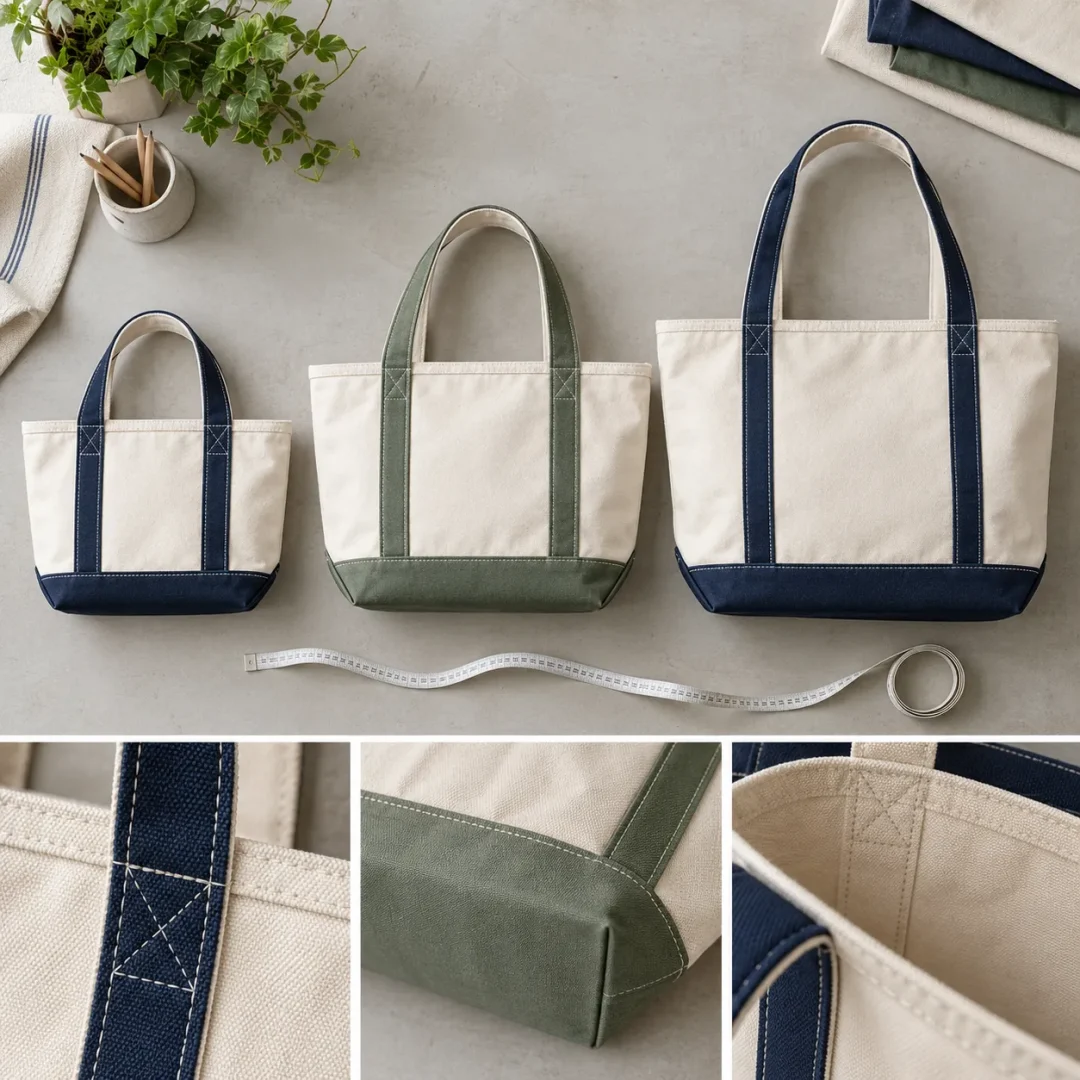
Small, medium, and large are convenient labels within a seller’s range. They are not reliable measurements across brands. A bag called medium may be wide and shallow, while another medium is narrower with a deeper base.
The most useful size is the one that accommodates your actual contents without unnecessary bulk. For a work bag, test your laptop sleeve, lunch container, and bottle together. For a welcome kit, pack all the items in the arrangement recipients will receive.
| Intended use | Start by checking | Why it matters |
|---|---|---|
| Small personal items or a compact gift set | Opening width and internal height | A compact exterior can hide an opening that is too narrow for the gift box |
| Work or study | Laptop-sleeve dimensions, internal height, and base depth | A screen-size label does not describe the laptop’s exterior measurements |
| Grocery shopping | Base footprint and comfortable packed weight | Containers need floor space; dense items can make a roomy bag uncomfortable |
| Beach or family outings | Space occupied by towels and spare clothing | Bulky, light items may need volume more than heavy construction |
| Overnight travel | Usable space after the closure is fastened | A bag that fits everything open may not close comfortably |
How to Measure a Boat Tote
Ask for measurements in a stated order, preferably with a simple dimension drawing. Record both the top and base widths when they differ.
| Measurement | How to record it | Common source of confusion |
|---|---|---|
| Body height | From the top edge of the body to the bottom, excluding handles | Including the handles in overall height |
| Top width | Across the top opening, stating whether the bag is flattened or opened | Treating flattened width as usable internal width |
| Base width | Across the base from side to side, with the bag opened | Assuming the base and mouth are equally wide |
| Base depth / gusset | From front to back at the opened bottom | Omitting depth when comparing bags |
| Handle drop | Clearance from the top edge to the inside top of the extended handle | Confusing drop with total strap length |
| Usable internal space | Space available inside, including the opening and closure restrictions | Assuming external dimensions guarantee that a rigid item fits |
For a rough geometric example, a rectangular space measuring 35 × 30 × 15 cm is 15,750 cm³, or 15.75 liters. That calculation does not establish the capacity of a soft bag with those external dimensions. Tapering, seam allowances, pockets, and closure position can change the usable space.
Sewn-product tolerances should be agreed with the supplier for each measurement. Avoid assuming a universal tolerance, especially if a bag must hold a close-fitting box or insert.
Open-Top or Zip-Top? Match the Closure and Handles to the Routine
An open-top tote offers quick access, while a zip-top tote helps contain loose items. It is worth considering how often you reach into the bag and whether it is likely to tip during transport.
| Configuration | Useful when | Check before choosing |
|---|---|---|
| Open top | Loading groceries, towels, or supplies frequently | Whether valuables need a separate secured pocket |
| Zip top | Commuting or transporting items that could spill out | Opening width, zipper operation, and room below the closed top |
| Shorter handles | Carrying by hand or moving between nearby surfaces | Whether a loaded bag clears the ground comfortably |
| Longer handles | Carrying on the shoulder | Clearance over clothing and how the filled bag sits against the body |
Handle drop and total handle length are not interchangeable. Part of a handle’s total length may be sewn onto the body, and the spacing between attachment points also changes the available clearance. Use a dimension drawing or a worn sample to confirm what the supplier’s measurement means.
Try the bag with realistic contents and the clothing you are likely to wear. An empty sample may fit comfortably over a shoulder but become awkward when the upper body of the bag is filled. Longer handles are useful only when the resulting position is comfortable for the user.
How to Check the Construction of a Boat Tote
A quick visual check can identify obvious problems before a sample is approved. It cannot establish a carrying capacity or replace testing, but it helps focus the conversation on specific details.
| Check | What to look for | What needs further confirmation |
|---|---|---|
| Handle attachments | Even placement, secure stitching, and no visible pulling | Reinforcement design and performance under the intended load |
| Main seams | Consistent stitching, secure seam ends, and no skipped stitches | Seam allowance, thread choice, stitch type, and any strength requirement |
| Base | An even shape and the specified panels or layers | Whether reinforcement is decorative, structural, or removable |
| Fabric panels | Consistent appearance and the agreed hand feel | Fiber content, weight, shrinkage, and colorfastness where relevant |
| Zipper and pockets | Smooth operation without catching or distorting the opening | Whether they still work properly with the bag packed |
| Decoration | Correct placement and clear detail, without unwanted puckering | Resistance to the agreed use and cleaning conditions |
More stitches do not automatically mean a stronger seam. Stitch density must suit the fabric, thread, needle, and seam design; excessive stitching can damage some materials. Likewise, a neat reinforcement pattern is useful only when the complete attachment performs as intended.
For a custom bag intended to carry substantial loads, agree on a finished-bag test relevant to the application. Ask what load was applied, for how long, whether lifting was repeated, and what counted as failure. A handle-only test does not describe every potential weakness in the assembled bag.
The same questions apply when comparing canvas totes with reinforced handles: inspect how the handle attachment works with the body and base, rather than judging strength from the visible strap alone.
Are Boat Totes Suitable for Use Around Water?
A canvas boat tote can be convenient for carrying dry belongings to a beach or waterfront. Untreated cotton canvas should not be relied on as waterproof protection. Its name, thickness, and reinforced base do not establish how much water can enter the finished bag.
A water-repellent finish, wax treatment, coated fabric, or protective liner may change performance, but these approaches are not interchangeable. Protection depends on the complete construction, including seams and openings. A liner also does not stop the outer canvas from becoming wet.
If water exposure is likely, ask what protection the finished product has been designed and tested to provide. Sensitive equipment may need a separate, appropriately rated waterproof enclosure. Simply choosing a heavier canvas or adding a conventional zipper will not address that need.
Cleaning and Storage
Follow the care instructions for the specific bag and decoration. Spot cleaning may be appropriate where full washing could cause shrinkage, dye transfer, or changes in structure. Coatings, leather details, backing materials, and embroidery can all affect the suitable method.
After damp use, empty the bag, open it fully, and let it dry thoroughly in a ventilated location before storing it. Avoid leaving wet clothing inside or folding the bag while damp. For salt exposure, follow the maker’s cleaning instructions rather than assuming the complete bag can be rinsed or soaked.
For a custom program, decide on the intended care method during development. If washability is part of the product brief, assess a finished, decorated sample using that method before making the claim on a product label.
Custom Boat Tote Bags: What Should Brands Specify?
A useful brief connects the intended use with measurable product details. “Heavy canvas boat tote with a logo” leaves too much open to interpretation, particularly when comparing quotes from several suppliers.
| Specification | What to define |
|---|---|
| Intended use | Typical contents, recipient, and expected carrying conditions |
| Material | Fiber composition, fabric weight with units, finish, and supporting documentation for any material claims |
| Dimensions | Body height, top and base widths, base depth, handle drop, and agreed tolerances |
| Construction | Base build, handle attachment, lining, pockets, and closure |
| Decoration | Artwork, method, dimensions, colors, and placement clearances |
| Performance and care | Expected load, relevant tests, and intended cleaning instructions |
| Quantity and packing | Quantity per design or color, labels, individual packing, and carton requirements |
| Schedule | Sample timing, approval milestones, production timing, and shipping allowance |
Match the Decoration to the Actual Bag
Embroidery gives initials and suitable logos a textured finish, while screen printing can suit bold artwork with defined colors. A suitable transfer process may support more detailed or multicolor images. The best method depends on the artwork, fabric surface, finish, and expected care.
Handle placement, pockets, and seams reduce the clear decoration area. A logo that looks balanced on a flat mockup may sit too close to a handle when the bag is filled. Review a decorated sample for position, clarity, puckering, and visibility during use.
Personalization and corporate branding also have different production needs. Repeating one logo across an order is different from embroidering a separate name on every bag. Specify that distinction at the quotation stage.
Compare Quotes on the Same Basis
Bag size, fabric consumption, construction, decoration, packaging, and order quantity all influence price. Compare the same specification and confirm whether artwork setup, samples, decoration, and transport are included. A blank-bag quote and a personalized retail price are not equivalent figures.
A heavier material may raise both material and shipping costs, while additional pockets or a lining add components and sewing work. The most useful cost reduction preserves the features recipients need and simplifies details they are unlikely to use.
INITI’s custom tote bag range provides a starting point for considering alternative structures. For a boat tote project, use a clear specification and approved sample to establish the version that fits the intended audience and budget.
Frequently Asked Questions
Does a Boat Tote Need to Be Made from 24 oz Canvas?
No. That weight is associated with a particular heavyweight reference design, rather than a universal definition of the style. Choose the material together with the dimensions, reinforcement, carrying comfort, and expected use. A lower weight does not automatically disqualify a bag from being described as a boat tote.
How Much Weight Can a Boat Tote Carry?
There is no single capacity for the category. Fabric, seams, handles, base construction, and the distribution of the contents all matter. Use the maker’s guidance for the specific model, and ask for relevant finished-bag testing when developing a custom product. Do not infer a safe load from fabric weight alone.
Will a Boat Tote Stand Up on Its Own?
Some will, particularly when the fabric and construction provide enough support. Others need contents to hold them upright. A flat base or an extra fabric layer does not guarantee empty-bag stability. If standing open is important, include it in the sample assessment.
Can a Boat Tote Carry a Laptop?
Yes, if its opening and internal dimensions accommodate the laptop and any protective sleeve. Check the packed weight and carrying comfort as well. Unless the bag includes a suitable padded compartment, use separate protection and keep drinks securely closed and apart from the device.
Is a Boat Tote the Same as a Boating Bag?
Not necessarily. “Boat tote” often describes a canvas carryall used on land as well as near the water. “Boating bag” can refer more broadly to bags designed for equipment or conditions on a vessel. The best choice for a boating trip depends on exposure to water, the equipment being carried, and the protection required.
Choosing a Boat Tote That Fits Its Purpose
A boat tote combines a familiar canvas-bag style with adaptable storage. Its usefulness depends on the details: dimensions that fit the contents, handles that feel comfortable, an appropriate closure, and construction suited to the expected load.
For personal use, those details determine whether the bag earns a place in your daily routine. For a branded collection or gift program, they help turn an attractive design into something recipients will keep using. Begin with the purpose, assess a realistic sample, and let the fabric, structure, and decoration support that choice.
 English
 French
 German
 Japanese
 Arabic
 Thai
 Vietnamese
 Russian
 Spanish
 Portuguese