
Coated canvas has become a staple material in bag manufacturing, from everyday totes to luxury handbags and heavy-duty travel gear. Yet despite its popularity, coated canvas is frequently misunderstood as a single, uniform material. In reality, it’s a composite: a base fabric (usually cotton, cotton-polyester blend, or polyester canvas) combined with a surface coating system that dramatically alters its properties.
The coating does far more than add a layer of protection. It determines:
- Longevity — how well the bag withstands abrasion, scuffs, and daily wear.
- Appearance — whether the surface looks glossy and structured, soft and matte, or develops a natural patina over time.
- Hand feel — the tactile experience, ranging from rigid and firm to supple and fabric-like.
- Brand positioning — luxury brands often choose coatings that support high-definition prints and controlled aging, while utility brands prioritize toughness.
This guide explores the major types of coatings used in coated canvas for bags, explains how each transforms the base material, and provides practical advice on selecting the right one for different bag applications. Whether you’re a designer, buyer, manufacturer, or consumer, understanding these coatings empowers better decisions.
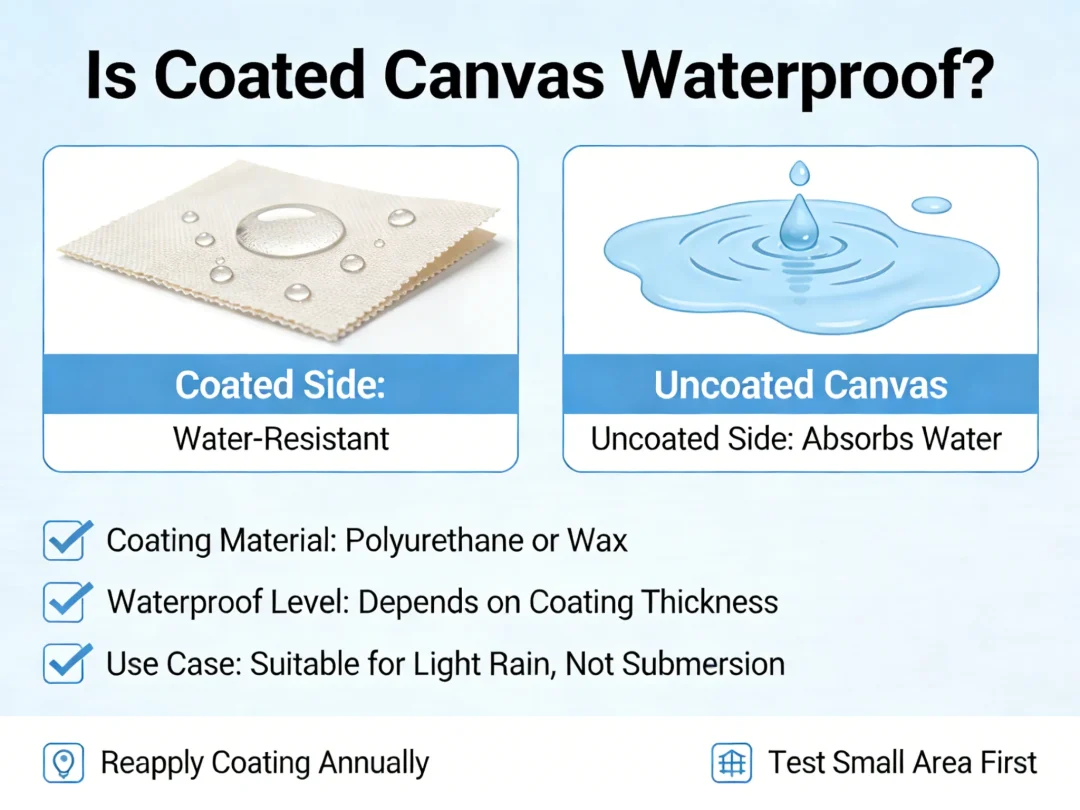
Is Coated Canvas Waterproof?
One of the most searched questions about coated canvas is: “Is it waterproof?” The short answer is no — not inherently. Raw canvas absorbs water like a sponge, and the degree of water protection depends entirely on the coating type, thickness, application method, and quality.
Here’s a quick comparison of common coatings:
- PVC (Polyvinyl Chloride): Fully waterproof — forms an impermeable plastic barrier. Ideal for heavy rain or wet environments.
- PU (Polyurethane): Water-resistant to near-waterproof. High-quality PU can achieve strong resistance (often 800–5000 mm hydrostatic head), but it may allow moisture through under prolonged exposure.
- Resin (often acrylic or synthetic resin): Provides surface-level water protection — repels splashes and light rain but not suitable for submersion.
- Wax: Water-repellent only — beads up and rolls off light moisture, but heavy rain eventually penetrates.
This distinction is crucial. A “waterproof” label on a bag often refers to the coating’s performance, not the material itself. For the rest of this guide, we’ll dive into how each coating type performs across multiple dimensions.
How Coatings Transform Canvas Performance
Raw canvas is breathable, flexible, and affordable, but it’s vulnerable to water, stains, abrasion, and deformation. Coatings upgrade it from a simple textile to a high-performance engineered material.
| Performance Dimension | Raw Canvas | After Coating (General) |
|---|---|---|
| Water behavior | Absorbs water quickly | Repels or blocks water |
| Stain resistance | Low — stains set deeply | High — surface resists penetration |
| Surface strength | Fibers exposed and fragile | Protected by durable layer |
| Shape retention | Soft and floppy | Structured and form-holding |
| Print compatibility | Limited — inks bleed | High-definition printing possible |
| Lifespan | Shorter under heavy use | Extended — resists wear and fading |
The coating essentially “encapsulates” the fibers, turning a porous fabric into a functional composite. This transformation is why coated canvas dominates categories where durability and aesthetics must coexist.
PVC-Coated Canvas
What it is Polyvinyl chloride (PVC) coated canvas consists of a PVC film or paste bonded or laminated onto the base canvas. It’s one of the most common heavy-duty coatings.
Key Characteristics
- Exceptional waterproofing — fully impermeable even under prolonged exposure.
- Outstanding abrasion and tear resistance.
- Firm, structured hand feel with good shape retention.
- Glossy or semi-glossy finish (depending on formulation).
- Long service life in demanding conditions.
Typical Applications
- Travel luggage and duffels.
- Heavy-duty totes and backpacks.
- Utility bags, outdoor gear, and work bags.
Manufacturing Insight PVC is often applied via knife-coating (spreading a paste) or lamination (bonding a pre-formed film). Thickness (commonly 0.2–0.5 mm) directly impacts stiffness — thicker layers create more rigid bags. Adhesion is strong, but low-quality PVC can delaminate over time.
Considerations PVC adds weight compared to other coatings. It has faced environmental criticism due to plasticizers and production processes, though many manufacturers now offer phthalate-free versions. In extreme cold, PVC can stiffen, but modern formulations mitigate this.
PVC excels when maximum toughness and weatherproofing are priorities.
PU-Coated Canvas
What it is Polyurethane (PU) is applied as a liquid coating that cures into a flexible film on the canvas surface. It comes in water-based and solvent-based variants, with water-based being more eco-conscious.
Key Characteristics
- Lighter and more flexible than PVC.
- Softer, textile-like touch with excellent drape.
- Good water resistance — often near-waterproof in thicker applications.
- Balanced durability and comfort.
- Available in matte, semi-gloss, or textured finishes.
Typical Applications
- Fashion totes and shoulder bags.
- Everyday lifestyle bags.
- Mid-range branded products.
Manufacturing Insight PU allows precise thickness control and better adhesion on textured bases. Water-based PU reduces VOC emissions and improves peel strength in high-quality production. Solvent-based offers stronger bonding but higher environmental impact.
PVC vs PU (Brief Comparison)
- PVC prioritizes structure, toughness, and absolute waterproofing — ideal for heavy use.
- PU emphasizes comfort, aesthetics, and lighter weight — preferred for fashion-forward designs.
PU strikes an excellent balance for bags that need to feel premium without being overly rigid.
Resin-Coated Canvas
What it means Resin-coated canvas uses a thin synthetic resin layer (often acrylic, polyurethane-resin blends, or other polymers) to create a smooth, print-receptive surface. It’s frequently multi-layered: base print + protective clear coat.
Key Characteristics
- Thin and uniform protective layer.
- Superior print clarity and color vibrancy.
- Semi-gloss to matte luxury finishes.
- Excellent visual consistency — resists fading and cracking.
- Moderate water and stain resistance.
Typical Applications
- Monogram and logo-heavy designs.
- Luxury-style coated fabrics.
- Branded fashion bags requiring sharp graphics.
Manufacturing Insight Resin coatings are often applied in multiple passes: one for print adhesion, another for protection. This creates a stable surface for high-resolution patterns without bleeding. The result is a premium look with controlled aging.
Resin coatings are ideal when visual fidelity and brand identity are paramount.
Wax-Coated Canvas (Waxed Canvas)
How it differs from synthetic coatings Unlike PVC, PU, or resin — which form a surface film — wax penetrates the fibers and fills the weave. Traditional paraffin or beeswax blends are used.
Key Characteristics
- Natural, heritage aesthetic with a matte, slightly mottled look.
- Develops a unique patina over time (scuffs and marks become character).
- Water-resistant — beads up light rain but not fully waterproof.
- Flexible, breathable, and lightweight.
- Ages gracefully when maintained.
Typical Applications
- Heritage-style bags and messenger bags.
- Outdoor and lifestyle brands.
- Rugged yet stylish everyday carry.
Manufacturing Insight Wax is applied hot (dipping or rubbing), often in multiple layers. Paraffin offers affordability; beeswax blends provide better flexibility and eco-friendliness. Re-waxing restores performance.
Maintenance Considerations Periodic re-waxing (every 1–2 years) maintains water resistance. Surface marks are intentional — part of the charm.
Waxed canvas appeals to those who value authenticity and natural evolution.
Comparing Coating Types: Which One Is Right for Your Bag?
Here’s a decision table to guide selection:
| Coating | Water Resistance | Durability | Flexibility | Appearance | Maintenance | Cost Level | Typical Market Position |
|---|---|---|---|---|---|---|---|
| PVC | ★★★★★ | ★★★★★ | ★★ | Glossy / Structured | Low | Low–Mid | Travel / Utility |
| PU | ★★★★☆ | ★★★★☆ | ★★★★★ | Smooth / Fashion | Low | Mid | Lifestyle / Fashion |
| Resin | ★★★☆☆ | ★★★★ | ★★★★ | Luxury Print Surface | Low | Mid–High | Branded / Luxury |
| Wax | ★★★ | ★★★★ | ★★★★★ | Natural / Heritage | Medium | Mid | Outdoor / Heritage |
No single coating is “best” — the right choice aligns with the bag’s intended use, target market, and aesthetic goals.
How Luxury Brands Choose Coatings
Luxury brands treat coating selection as a strategic decision that supports long-term brand equity.
Priorities include:
- Visual consistency over time — The surface must age intentionally, not degrade unattractively.
- Surface print fidelity — Logos, monograms, and patterns require stable, non-porous surfaces for sharp reproduction.
- Controlled aging — Brands favor coatings that resist cracking (negative aging) while allowing subtle patina if desired (e.g., waxed canvas).
Common choices: Resin-based or PU-based systems for print-heavy designs (e.g., monogram patterns), often with PVC elements for added durability in flagship lines. High-end manufacturers invest in multi-layer coatings to achieve premium hand feel without compromising performance.
FAQ: Coated Canvas Coatings Explained
Is coated canvas more durable than leather?
It depends on the context. Coated canvas often outperforms leather in water resistance, stain protection, and abrasion under heavy use. Leather excels in natural aging, breathability, and luxury perception. For daily commuters or travelers, coated canvas can be more practical.
Does coated canvas crack over time?
High-quality coatings (especially PU and resin) resist cracking. Low-grade PVC or aged wax can crack or peel in extreme conditions (cold, flexing, or poor storage). Proper care and quality manufacturing prevent this.
Which coating is best for printed logos?
Resin-coated or high-quality PU/resin blends offer the best print clarity and longevity. They provide a smooth, stable surface for sharp, fade-resistant graphics.
Is coated canvas eco-friendly?
It varies. PVC has environmental drawbacks (plasticizers, production emissions). Water-based PU and natural wax are more sustainable. Many brands now offer eco-conscious formulations.
How do you clean coated canvas bags?
Wipe with a damp cloth and mild soap. Avoid soaking, harsh chemicals, or machine washing. For waxed canvas, gently brush off dirt and re-wax as needed. Always test cleaners on a hidden area.
Final Thoughts: Coating Choice Defines the Bag Experience
The coating is as critical as the base canvas itself. It transforms a basic textile into a purposeful material tailored to specific needs — whether that’s rugged waterproofing, luxurious print fidelity, or timeless heritage appeal.
There’s no universal “best” coating — only the one that best matches the bag’s purpose, user expectations, and market positioning. By understanding these options, designers, buyers, and consumers can make informed choices that elevate performance, appearance, and longevity.
 English
 French
 German
 Japanese
 Arabic
 Thai
 Vietnamese
 Russian
 Spanish
 Portuguese