
Clear backpacks can be a good choice when your school, workplace, or event requires visible bag contents. They also make everyday items easier to locate. However, reduced privacy, limited padding on some designs, and wear around high-stress areas can make them less suitable for heavy loads or all-day use.
The right choice depends on where you will carry the backpack, what you need to pack, and how well the bag is constructed. Before buying, consider both the practical benefits and the compromises.
| Your situation | Is a clear backpack a good fit? | What matters most |
|---|---|---|
| Your school or employer requires one | A practical choice when it meets the exact policy | Visibility, usable capacity, comfort, and reinforced attachments |
| You need a small bag for an event | Potentially, if that event allows backpacks | Permitted style, external dimensions, and pocket limits |
| You carry heavy books or a laptop every day | Evaluate the particular design carefully | Load support, device cushioning, opening size, and daily wear |
| You prioritize privacy and have no clear-bag requirement | A conventional opaque backpack may suit you better | Concealed storage and personal comfort |
The strongest reason to choose a clear backpack is a specific need for visibility. It is not automatically an upgrade over an ordinary backpack.
What Is the Point of a Clear Backpack?
A clear backpack makes its contents visible through transparent panels. It provides the hands-free carrying function of a backpack while allowing someone to see inside without first opening every compartment.
That visibility is useful wherever bag contents need to be checked. It does not remove the need for screening, and it should not be treated as proof that a bag contains only permitted items.
Schools
Some schools require transparent bags as part of their campus procedures. Students therefore need a backpack that meets those requirements while still accommodating folders, books, and everyday supplies.
For example, Jefferson Parish Schools’ clear backpack policy requires transparent bags without tint, iridescence, or frost and does not allow mesh bags. This illustrates why choosing a bag simply labeled “see-through” may not be enough.
It also helps explain the question, “Why do Americans have clear backpacks?” The practice is associated with particular schools, workplaces, and venues; it is not a general requirement for everyone in the United States.
Workplaces
Where an employer requires visible belongings, a clear backpack can carry work essentials while leaving both hands free. The practical priorities may include an accessible ID pocket, space for permitted equipment, and straps that remain comfortable during a commute.
Food storage deserves separate consideration. A transparent backpack is not automatically insulated, and packing lunch beside work equipment may be inconvenient. Our guide to what clear lunch bags are used for explains when a separate meal bag makes sense.
Sporting Events and Concerts
A compact clear backpack can be convenient for carrying permitted essentials at an event, provided the venue allows that style.
Check the actual policy before buying. For example, Lumen Field’s clear bag policy permits clear backpacks within its 12 × 6 × 12-inch limit and with no more than two pockets. Those conditions should not be assumed to apply to every stadium or concert.
The contrast is significant: Q2 Stadium’s visitor guidance states that its bag prohibition includes clear bags, with specified exceptions. A bag can meet a familiar size limit and still be unsuitable for the venue you are visiting.
What Are the Benefits of Clear Backpacks?
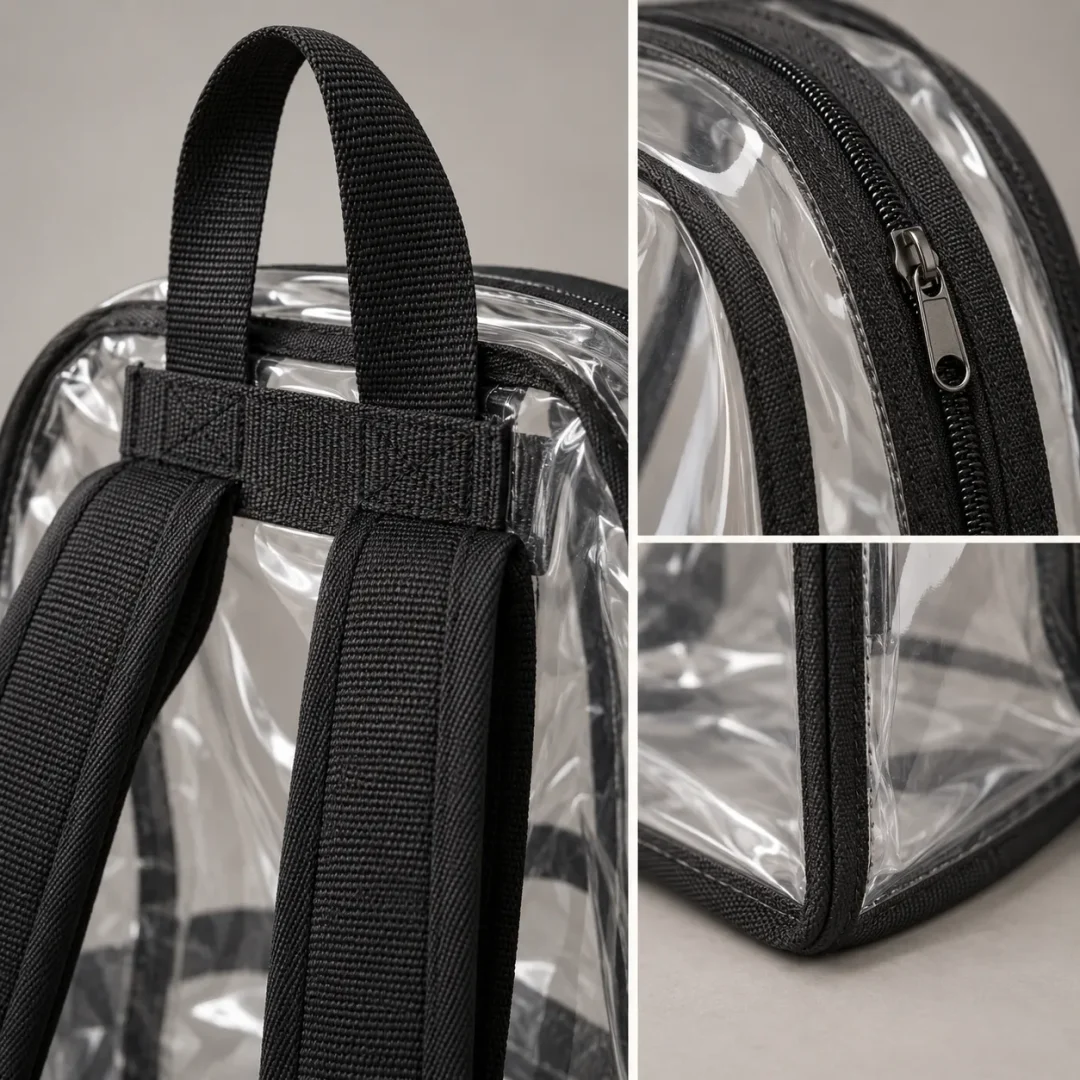
The main benefits come from visibility and convenient carrying. Their value depends on whether those features solve a problem in your routine.
Visible Contents
A transparent bag lets you check whether you packed your notebook, keys, or charger without unpacking everything. It can also make belongings more accessible for visual inspection where this is required.
However, items can still overlap or hide behind one another. Packing neatly matters, and a clear exterior does not guarantee faster entry or exemption from a search.
Easier Organization
Being able to see an item before opening the bag can reduce rummaging. This is particularly useful for smaller essentials that otherwise disappear into a dark compartment.
Pocket placement still matters more than pocket quantity. An accessible front pocket may help with small items, while a well-sized main compartment keeps larger belongings from being crushed together.
A Surface That Can Be Wiped Clean
Smooth transparent panels can be convenient for routine surface cleaning. The fabric edging, straps, zipper tape, and seams still need separate attention, so “wipe-clean” should not be confused with maintenance-free.
Hands-Free Carrying
Compared with a tote or clutch, a backpack keeps both hands available and can distribute the load across two shoulders. Whether it feels comfortable depends on strap width, adjustability, fit, and the contents—not on transparency alone.
A Distinctive Appearance
Some buyers like the transparent look itself. Colored edging, straps, and neatly arranged belongings can make the bag feel more personal. For unrestricted casual use, that appearance may be part of the appeal; in a controlled setting, check before adding stickers, large logos, or opaque organizers.
What Are the Drawbacks of Clear Backpacks?
The biggest trade-off is privacy. Other drawbacks depend heavily on the design and manufacturing quality.
Less Privacy for Personal Belongings
A clear backpack exposes more of what you carry, including valuables, documents, and personal care items.
A small opaque pouch may help where the applicable policy permits one. Check that permission first: adding a large inner bag or lining can defeat the required visibility. Consider what will be exposed during the entire journey, not only at the entrance.
Limited Cushioning on Some Designs
Simple clear backpacks may have little back padding or protection for electronic devices. A laptop or the corners of a textbook can press against your back, especially when the bag is full.
A protective sleeve can add cushioning, but it also occupies space and may conflict with visibility requirements. If a laptop is essential, check both the bag’s usable internal dimensions and the rules governing sleeves or inserts.
Construction Can Limit Durability
A thick-looking panel does not tell you whether a backpack will withstand daily use. Shoulder-strap anchors, zipper ends, seams, and bottom corners all need to handle repeated loading.
When assessing a sample, look for reinforcement that spreads force over a wider area rather than concentrating it at a small attachment point. Avoid forcing oversized books or equipment through a narrow opening.
Wear Is Easy to See
Scratches, scuffs, and loss of clarity can be conspicuous on a transparent surface. Discoloration may involve surface contamination or changes in the material itself, so cleaning will not always restore the original appearance.
For everyday use, ask about the specific material and care instructions rather than relying on a general claim such as “premium clear plastic.”
Comfort Features Can Conflict With Visibility
An opaque padded back, fabric base, or large organizer panel may improve usability but obscure contents. The most comfortable-looking design is therefore not automatically the best choice for a strict clear-bag setting.
This tension is especially relevant when sourcing bags for a school or workplace: the finished design needs to satisfy the actual users and the organization’s requirements.
Replacement Costs Can Add Up
A low purchase price is less attractive if the bag needs frequent replacement. For an individual, check the warranty and return terms. For a school or employer, consider replacement stock, distribution costs, and whether the design can handle the items people actually carry.
Avoid judging the entire category from one failed bag—or assuming that the words “heavy-duty” guarantee a full school year of use. Ask what has been tested, under what load, and against which acceptance criteria.
Do Clear Backpacks Actually Improve Security?
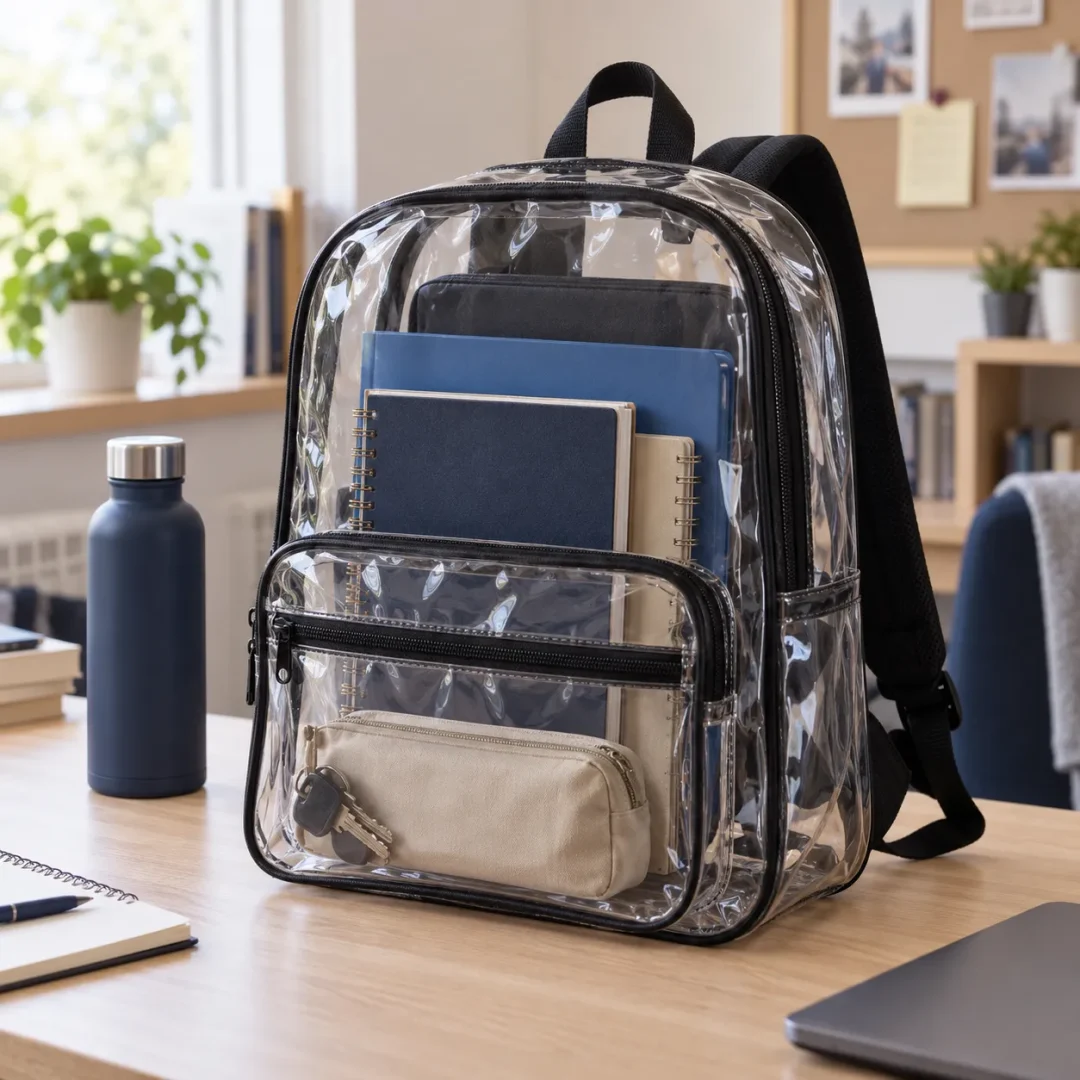
Clear panels make belongings easier to view, but visibility and proven security outcomes are different questions. A transparent bag does not eliminate blind spots, establish that every item is permitted, or replace the procedures used by trained staff.
In a WWBT report on clear backpack policies, a security expert cautioned against treating transparent bags as a complete solution or developing a false sense of security. This is a reason to describe their function accurately, not a reason to disregard a school’s rules.
For buyers and suppliers, “designed to make contents visible” is a more supportable description than promising that a backpack prevents theft or guarantees safety.
What Types of Clear Backpacks Are Available?
Separate the bag’s format from its intended use. A standard zippered backpack may serve either school or work, while “heavy-duty” describes a claimed level of performance rather than a distinct shape.
| Format | Main features | Potential use | สิ่งที่ควรตรวจสอบ |
|---|---|---|---|
| Standard clear backpack | Zippered main compartment, two shoulder straps, optional front pocket | School or work essentials | Folder fit, opening width, and strap attachments |
| Mini clear backpack | Compact body with limited storage | Light outings or events that allow it | Actual external dimensions; “mini” is not a compliance standard |
| Multi-compartment clear backpack | Separate zippered sections and optional bottle pockets | Organizing several everyday items | Whether every compartment remains visible and the pocket count is permitted |
| Clear drawstring backpack | Simple body with a cinch closure | Light promotional or occasional use | Cord comfort, closure, and suitability for the intended load |
| Rolling clear backpack | Wheels, pull handle, and a transparent main body | Moving belongings with less carrying where permitted | Empty weight, stairs, storage space, and any ban on wheeled bags |
Reinforced versions may be available within these formats. Compare the finished construction rather than assuming that a larger or more complicated bag will last longer. Likewise, a backpack with only a clear front window is not equivalent to one that is transparent on all sides.
How to Choose the Best Clear Backpack for Your Needs
The best clear backpack is one that meets your destination’s requirements, holds your essentials, and remains comfortable under your normal load.
Start With the Rules
Before comparing colors or prices, establish whether the destination allows backpacks and whether it restricts dimensions, pockets, tinted panels, mesh sections, or opaque inserts.
For a group order, obtain the organization’s written requirements and use them when approving the sample. A product listing’s “school-approved” or “stadium-approved” wording is not a substitute for that check.
Check Usable Space
External measurements do not fully describe what will fit inside. Curved corners, narrow zipper openings, and pocket construction can reduce usable space.
Measure your largest essential item, then allow room to insert and remove it without stretching the bag. If possible, test a sample with the actual folder, laptop, lunch container, or equipment.
Evaluate Construction as a Whole
Material thickness is only one purchasing detail. Ask about the material specification, then inspect how it works with the straps, seams, and closure.
A practical sample review should include:
- Packing the intended everyday load and checking the shape.
- Wearing the bag with both straps adjusted.
- Opening and closing the zipper with the bag packed.
- Examining strap attachments and bottom corners for concentrated strain.
- Checking visibility from the front, sides, and back.
For bulk purchases, agree on a test method and acceptance criteria with the supplier. A quick sample check can reveal obvious problems but does not establish long-term durability by itself.
Request precise material specifications, including panel thickness in a stated unit. Terms such as “vinyl,” “plastic,” and “premium PVC” are not enough for comparing samples. If a supplier offers PVC and TPU alternatives, compare the actual finished samples and relevant test documentation; the material name alone does not establish load capacity, lifespan, or environmental performance.
Keep Branding Proportionate
Colored straps, zipper details, or a modest printed logo can give a custom backpack a distinct identity. Large printed areas may reduce visibility.
Approve the full design with the intended school, employer, or event organizer when relevant. Show logo dimensions and placement on the sample rather than approving artwork in isolation.
Where Can You Buy Clear Backpacks?
For individual purchases, school-supply shops, bag retailers, and online marketplaces offer ready-made options. Compare the full dimensions, construction photos, care instructions, and return terms.
For school programs, employee distribution, or resale, a wholesale supplier or manufacturer may be more suitable when you need consistent specifications or custom branding.
Prepare a short sourcing brief covering intended use, quantity, dimensions, material requirements, pocket layout, strap design, and logo placement. Ask for a finished sample before confirming the order, and evaluate replacement arrangements as well as the initial price.
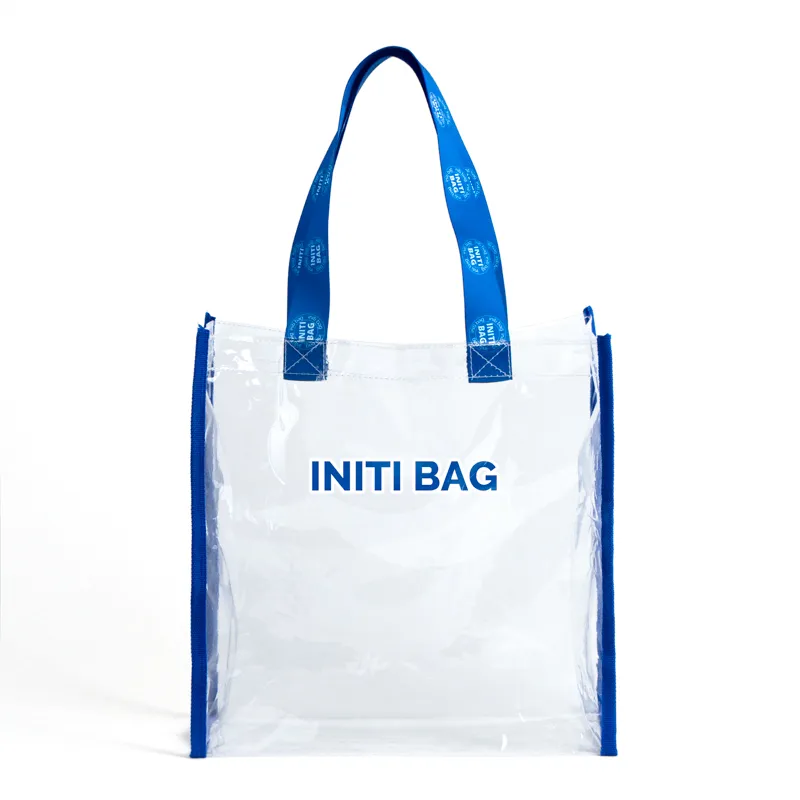
INITI’s custom clear bag options provide a starting point for comparing backpack, tote, and pouch formats. Select the carrying style first, then refine its construction around your project.
คำถามที่พบบ่อย
Are Clear Backpacks Required by TSA?
TSA does not have a general requirement that passengers use transparent backpacks. Its packing guidance discusses ordinary backpacks and other carry-on styles.
The quart-sized bag rule for certain carry-on liquids is a separate requirement concerning the liquids bag, not the entire backpack. Consult TSA’s What Can I Bring? guidance for item-specific rules, and check your airline’s baggage allowance separately.
If you have seen claims about a new 2026 transparent carry-on requirement, one circulating Upgraded Points article explicitly identifies itself as an April Fools’ Day joke. It is not a TSA policy announcement.
Are Clear Backpacks Allowed in All Stadiums?
No. Check the venue and event policy for the permitted bag styles, dimensions, and compartment limits. Transparency alone does not establish permission to enter.
Does a Mesh Backpack Count as a Clear Backpack?
Do not assume it does. Mesh has openings between its fibers, while a clear backpack uses transparent panels. A policy may accept one and reject the other, so follow the destination’s wording.
How Do You Clean a Clear Backpack?
Follow the manufacturer’s care label. For routine cleaning where permitted, empty the bag, remove loose debris, and gently wipe the panels with a soft cloth and diluted mild soap. Remove soap residue with a damp cloth and leave the bag open to air-dry.
Clean straps and fabric trim according to their care instructions. Avoid abrasive scrubbing and unapproved solvents, and test any cleaner on an inconspicuous area first.
Can You Put a Clear Backpack in the Washing Machine?
Only if its care instructions explicitly allow machine washing. Otherwise, use gentle hand cleaning. Do not assume that instructions for a fabric backpack also apply to a transparent bag with different panels and attachments.
How Long Do Clear Backpacks Last?
There is no reliable lifespan that applies to every clear backpack. Construction, daily load, handling, storage, and care all affect how long a particular bag remains usable. Inspect strap anchors, zipper ends, and bottom corners regularly, and do not keep loading a bag whose attachments are separating. Treat a warranty as a set of coverage terms, not a guarantee of a particular service life.
Are Clear Backpacks Waterproof?
A water-resistant panel does not establish that the whole backpack is waterproof. Water may enter through zippers, stitched seams, or openings. Look for a specific waterproof construction and supported performance claim if that protection is necessary.
Can You Carry a Laptop in a Clear Backpack?
Yes, if the laptop fits and the bag provides adequate support and protection for the intended use. Check internal dimensions rather than relying only on the laptop’s screen size. Confirm whether protective sleeves are allowed wherever you plan to carry it.
A clear backpack is most useful when visibility serves a practical purpose. Choose a design that meets the relevant requirements while giving enough attention to fit, privacy, and construction to work well beyond the en

 Thai
 English
 French
 German
 Japanese
 Arabic
 Vietnamese
 Russian
 Spanish
 Portuguese