
It has been used to carry flat-pack furniture, rescue a swan from a London rooftop, return a stolen Van Gogh painting, and transport a bride’s wedding dress to the bathroom. It inspired a $2,145 Balenciaga leather tote. It has been reimagined by Virgil Abloh, Zandra Rhodes, and the Danish design firm HAY. It costs less than a dollar.
The IKEA FRAKTA bag is, by any reasonable measure, the most improbable design icon of the past 30 years. This is the story of how it got there — and what it teaches us about why some products become permanent fixtures of the cultural landscape while most are simply forgotten.
What Is the IKEA FRAKTA Bag?
The History of the FRAKTA Bag
The FRAKTA’s origin story begins not with a designer brief, but with a problem observed on a shop floor.
In the 1960s, IKEA began expanding beyond furniture into smaller home furnishing products — tealights, glasses, duvet covers, the kinds of items customers wanted to buy in quantity but struggled to carry. The store’s plastic baskets were inadequate. Customers loaded up, got overwhelmed, and left items behind. Sales were being lost not because people didn’t want the products, but because they had no practical way to take them home.
IKEA founder Ingvar Kamprad noticed. In 1986, he tasked his assistant Sten Lundén with solving the problem. On a sourcing trip to Taiwan, Kamprad and head of purchasing Lars Göran Peterson found a manufacturer capable of making the bag they had in mind. The specification was precise: it needed to hold at least 50 kg, be large enough to carry wallpaper rolls, and work as a shoulder bag, a hand-carry, and a shopping cart attachment simultaneously.
To test the prototype, Peterson later recalled: “We found someone at the office who weighed about 50 kilos and asked them to stand in the bag. I took one handle and Ingvar took the other. We lifted the bag up, and it didn’t break.”
The design was handed to siblings Knut and Marianne Hagberg, who had joined IKEA’s design team in 1979 and would go on to design more than 2,100 products together over four decades. Their most famous creation was this one.
After early yellow prototypes were tested in 1989 at IKEA Hamburg — where they immediately created chaos at checkouts because customers’ bags were indistinguishable from the store’s own transport bags — IKEA decided to make the customer-facing version a different color. The blue FRAKTA, as it is known today, entered consumer markets in the early 1990s. The name, fittingly, means “to freight” in Swedish.
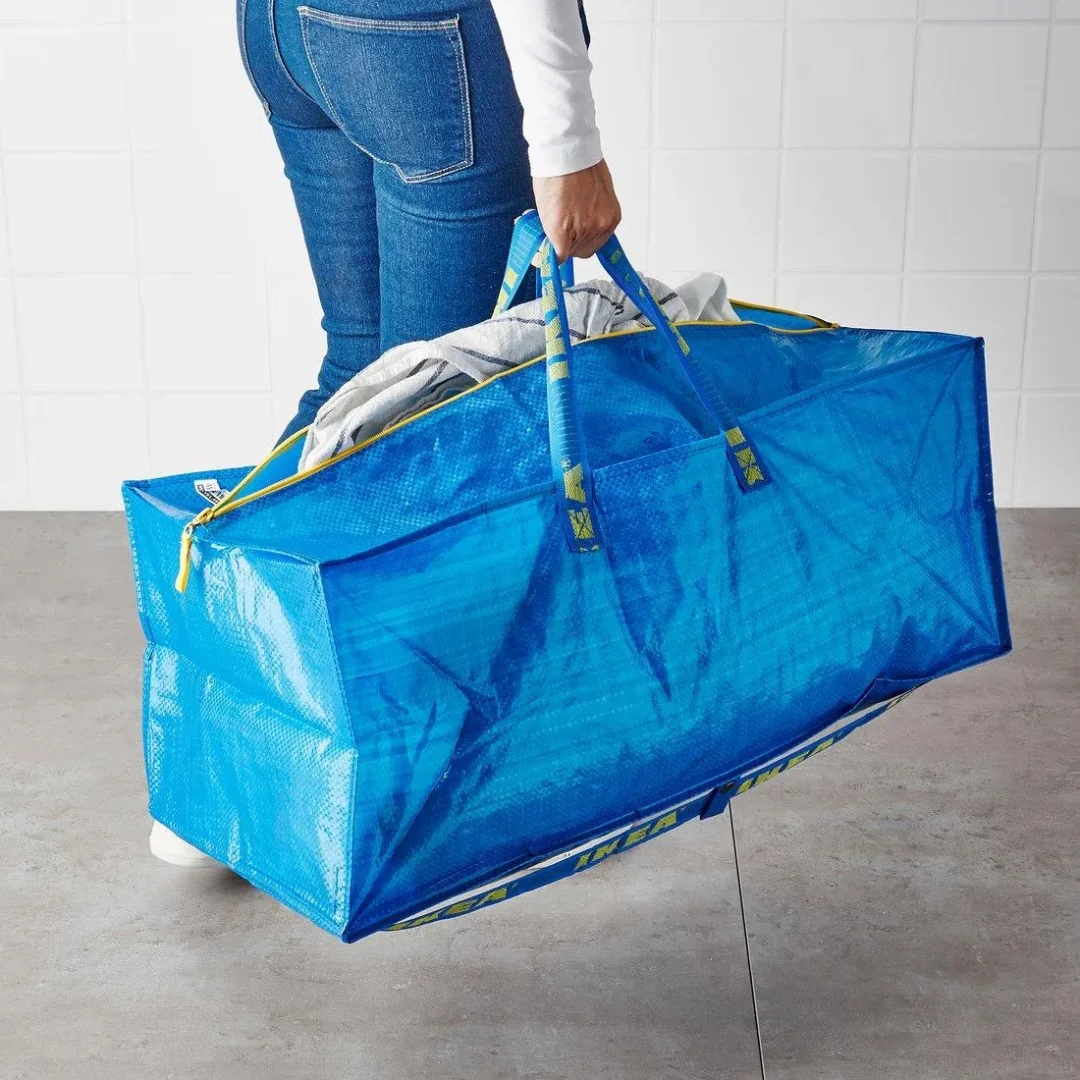
Basic Features of the FRAKTA Bag
The FRAKTA’s specifications have remained essentially unchanged since its introduction, which is itself a statement about how well the original design worked:
- Размеры: Approximately 21¾ × 14½ × 13¾ inches (55 × 37 × 35 cm)
- Емкость: 19 gallons (71 liters)
- Maximum load: 50 kg (110 lbs)
- Материал: Woven polypropylene (PP)
- Вес: Extremely lightweight despite its structural strength
- Закрытие: Open top with reinforced long shoulder handles
- Care: Wipe clean with a damp cloth or rinse with a garden hose
- Хранение: Folds flat to the size of a small purse
The price has varied by market and era, but has consistently remained under $1 in most countries — currently €0.49 in the Netherlands, and typically $0.99–$1.49 in the United States.
Why the Blue Color Became Iconic
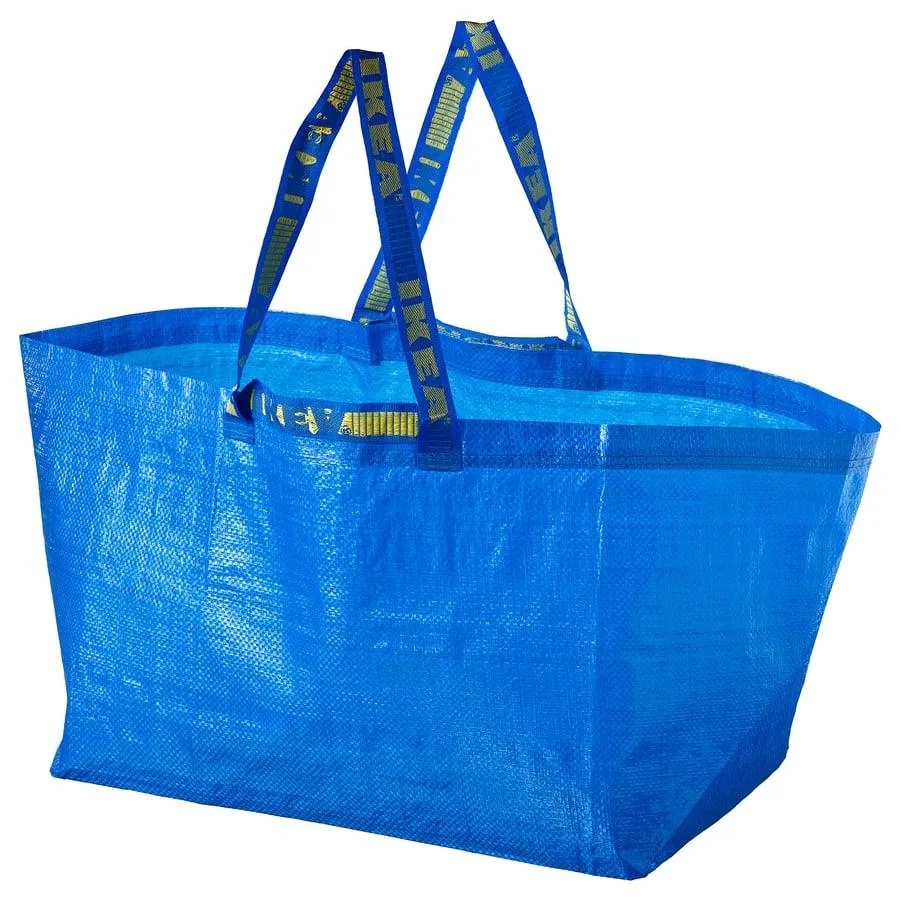
The choice of blue was partly practical and partly fortunate. IKEA needed a color that was visually distinct from the yellow in-store transport bags, and that would be easy to identify in the large, warehouse-style stores. Blue — specifically, the bright cobalt used in the FRAKTA — did both jobs.
What no one anticipated was how that color would function at urban scale. IKEA stores are typically located in high-traffic suburban areas. Millions of FRAKTA bags leave those stores every year, making their way onto public transit, into city apartments, and through streets and markets worldwide. The bag’s large size and distinctive color make it instantly recognizable from a distance — effectively transforming every person carrying one into a mobile billboard.
The blue also aligns naturally with the broader visual identity of Scandinavian design: clean, functional, undecorated, and confident in its simplicity. In a global market saturated with logos and branding, the FRAKTA’s restraint — minimal text, no pattern, one color — reads as a design choice, not an absence of one.
What Material Is the IKEA FRAKTA Bag Made Of?
Understanding Woven Polypropylene (PP)
The FRAKTA is made from woven polypropylene — a material that most consumers interact with daily without ever knowing its name.
Polypropylene is a thermoplastic polymer, a member of the same family as the plastic used in food containers, bottle caps, and automotive parts. In its woven form, thin strips of polypropylene are interlaced at right angles — like a fabric, but made entirely from plastic — creating a sheet material that is simultaneously flexible, lightweight, water-resistant, and structurally strong.
The key distinction is between woven PP и non-woven PP, which is an entirely different product:
| Woven PP | Non-Woven PP | |
|---|---|---|
| Construction | Interlaced strips, like fabric | Bonded/fused fibers, like felt |
| Strength | High tensile strength; holds heavy loads | Moderate; suitable for light loads |
| Appearance | Structured, slightly textured, fabric-like | Softer, slightly fuzzy surface |
| Долговечность | Long-lasting with proper care | Lower lifespan; prone to tearing |
| Typical use | Grocery bags, agricultural bags, FRAKTA | Promotional giveaway bags, pharmacy bags |
| Стоимость | Умеренный | Very low |
The FRAKTA is woven PP. The distinction matters because it explains why the bag can hold 50 kg without tearing, survive years of heavy use, and be rinsed clean rather than discarded.
Recent iterations of the FRAKTA incorporate more than 90% recycled polypropylene — including at least 70% sourced from post-consumer food packaging — without any measurable change in performance.
Why IKEA Chose Woven PP
The material decision was driven by IKEA’s core design philosophy, sometimes called “democratic design”: products should be functional, well-made, sustainable, and affordable — for everyone, not just those who can pay a premium.
Woven PP delivered on all four criteria simultaneously:
- Durability: The interlaced structure distributes load stress across the entire surface, allowing the bag to carry weights that would destroy cotton or non-woven alternatives.
- Water resistance: Polypropylene does not absorb moisture, making the bag suitable for wet groceries, beach trips, and outdoor use without degradation.
- Low cost: Polypropylene is one of the most widely produced plastics in the world. High availability keeps material costs low even at massive production scale.
- Reusability: A bag that lasts years — rather than months — is both more sustainable and more economical over its lifespan.
Advantages of Woven PP Bags for Retail Brands
For businesses sourcing reusable shopping bags at scale, woven PP offers a set of advantages that few other materials can match across all dimensions simultaneously:
- Load-bearing capacity: Handles grocery loads, bulk purchases, and event materials without structural failure. Appropriate for any retail context where customers buy in volume.
- Long usable lifespan: A quality woven PP bag, properly handled, can last three to five years of regular use. Every additional use extends the brand exposure period at no additional cost.
- Printability: Laminated woven PP provides a smooth, high-quality print surface suitable for logos, full-color graphics, and detailed brand imagery. Unlaminiated woven PP supports simpler screen printing.
- Recyclable potential: Polypropylene (resin code #5) is accepted by an increasing number of recycling programs, and suppliers offering recycled-content woven PP are now widely available.
- Cost-effective at wholesale: Woven PP bags can be produced and sourced at competitive prices even at high volumes, making them viable for mass retail, promotional campaigns, and corporate gifting programs alike.
Why the IKEA FRAKTA Bag Became So Popular Worldwide
Extremely Functional Design
The FRAKTA’s popularity begins with the most straightforward explanation: it works exceptionally well, for an unusually wide range of tasks.
The bag’s oversized format — 71 liters, 50 kg capacity — makes it genuinely useful in ways that smaller bags simply are not. It can hold a full week of groceries for a family. It can transport a disassembled flatpack bookcase. It can serve as a laundry bag, a moving box substitute, a beach bag, a gardening supply carrier, or, in at least one documented case, a temporary container for a rescued swan.
The foldable structure means it takes up essentially no space when empty, removing the most common objection to carrying a reusable bag: the inconvenience of having it with you when you need it. When not in use, the FRAKTA disappears into a pocket or handbag.
This combination of maximum capacity and minimum footprint when empty is genuinely difficult to achieve in bag design, and it remains one of the FRAKTA’s most underappreciated engineering achievements.
Affordable but Durable
The price-to-performance ratio of the FRAKTA is, by the standards of any consumer product category, remarkable. A bag that retails for under $1 and regularly survives five or more years of use represents a cost-per-use figure so low it approaches zero.
This creates a specific psychological effect. Consumers who experience a product as delivering far more value than its price suggested tend to develop an attachment to it — and to the brand that made it — that is disproportionate to the original transaction. The FRAKTA doesn’t just earn its keep; it consistently exceeds expectations, which is the most reliable path to brand loyalty that exists.
Fits the Global Reusable Bag Trend
The FRAKTA’s rise as a cultural object coincided with a structural shift in consumer behavior and public policy. Over the past two decades, single-use plastic bag bans have been implemented across Europe, large parts of Asia, many U.S. states, and dozens of other markets globally. Reusable bags moved from an environmental preference to a practical necessity.
The FRAKTA was already there. It had been available, cheap, and effective for years before reusable bags became a mainstream consumer priority. When the cultural and legislative moment arrived, the FRAKTA was positioned not as a new product responding to a trend, but as a long-established solution that the world had finally caught up with.
Strong IKEA Brand Power
The FRAKTA also benefits from what might be called the IKEA halo effect. IKEA is one of the most globally recognized retail brands in the world, with stores in more than 60 countries and a customer base that spans virtually every income level and demographic. Its brand is associated with a specific set of values: practicality, affordability, Scandinavian restraint, and the idea that well-designed objects should be available to everyone.
The FRAKTA embodies all of those values in a single, inexpensive object. Carrying it is, for many people, a mild but genuine expression of affinity for what IKEA stands for — in the same way that carrying certain other branded items communicates membership in a particular cultural tribe.
How the FRAKTA Bag Became a Pop Culture Symbol
Social Media and Viral Trends
The FRAKTA’s transition from useful bag to cultural object accelerated dramatically with the rise of social media. On TikTok, Instagram, and Pinterest, the bag became a recurring subject of creative content: styling videos, “FRAKTA hacks,” DIY transformations, and straightforward celebrations of its absurd versatility.
Much of this content has a comedic undertone — the FRAKTA is funny, in a good way. It is large to the point of parody, cheap to the point of disbelief, and durable beyond all reasonable expectation. It generates a particular kind of affectionate humor: look at this ridiculous, indestructible, $1 bag that somehow does everything. That combination of genuine utility and inherent absurdity makes it ideal social media content, and has kept it in rotation as a reference point for years.
Luxury Fashion References: The Balenciaga Moment
In 2017, Balenciaga released what it called an “extra large shopper tote” — a large, structured blue leather bag priced at $2,145. The resemblance to the FRAKTA was immediately and universally noted. The internet’s response was swift, loud, and largely gleeful.
IKEA’s response was one of the most effective pieces of reactive marketing in recent retail history. Working with creative consultancy Acne, IKEA published a set of “tips” for identifying a genuine FRAKTA bag — shake it (if it rustles, it’s real), check the price tag (only $0.99), rinse it with a garden hose (a true FRAKTA survives). The campaign was produced within 48 hours of the Balenciaga bag’s appearance and was shared millions of times globally. An IKEA spokesperson told press that the company was “deeply flattered” by the resemblance, and suggested that customers might prefer to simply purchase the original.
The Balenciaga episode accomplished something that years of advertising could not have: it placed the FRAKTA, definitively and publicly, in a conversation with luxury fashion — and won that conversation on every available metric. The $2,145 bag confirmed that the $0.99 bag had achieved something real. You cannot parody what isn’t iconic.
The fashion collaborations that followed have extended this positioning further. Virgil Abloh — then artistic director of Louis Vuitton menswear — created a limited-edition version for IKEA’s MARKERAD collection. Designer Zandra Rhodes reimagined it in pink with frills. HAY gave it a minimal forest-green makeover. Each collaboration reinforced the same point: the FRAKTA is a design object serious enough to attract serious designers.
In 2025, the Groninger Museum in the Netherlands placed a FRAKTA bag on permanent display alongside a Van Gogh painting — the same bag that had been used to return the stolen painting after it was recovered. The museum hung them side by side on the same wall.
Street Style and Everyday Urban Use
Beyond its fashion moments, the FRAKTA has earned a permanent place in the practical vocabulary of urban life. Its uses, documented across social media and mainstream press, include: grocery shopping (primary), laundry transport, apartment moving, beach bag, gym bag, travel carry-on overflow, camping equipment carrier, gardening supply bag, dog transport (for large dogs on New York City subway, with leg holes cut out), disaster relief supply distribution, and impromptu planter.
This range of applications is not a curiosity — it is the product working exactly as designed. Kamprad’s original specification called for a bag that could carry wallpaper rolls and hold 50 kg. A product built to those standards does not limit itself to a single use case.
Why Retail Brands Love Large Reusable Shopping Bags
Excellent Brand Exposure
A large reusable shopping bag is, in marketing terms, a walking advertisement with a particularly favorable set of characteristics. Unlike a digital ad that disappears when a session ends, or a printed flyer that is discarded within hours, a reusable bag continues to generate brand impressions for as long as it remains in use — which, for a well-made woven PP bag, can be years.
The FRAKTA’s size is not incidental to this effect. A larger bag offers a larger print surface, which allows for clearer logo placement and more complex brand graphics. At the scale of a FRAKTA — roughly 55 × 37 cm of front-facing surface — a brand identity can be communicated with clarity and impact rather than squeezed into a small corner.
Low Cost, High Visibility Marketing
The economics of branded reusable bags, measured in cost-per-impression, compare favorably with almost any alternative marketing channel. A woven PP bag produced at wholesale might cost $1–$3. Used three times per week for two years, it generates over 300 individual brand impressions — each in a different location, visible to different people — at a total media cost that a single digital ad placement could not match.
The FRAKTA makes this case more powerfully than any other product in its category: a $0.99 bag that has generated decades of global media coverage, spawned luxury fashion references, and been placed in a museum. No marketing budget produced that outcome. The product did.
Consumers Reuse Them Frequently
The reuse rate of well-designed bags significantly outperforms disposable packaging on every environmental and marketing metric. A bag that consumers genuinely like — because it is large enough to be useful, durable enough to last, and distinctive enough to carry proudly — gets used more often and retained longer.
This is the fundamental insight behind the FRAKTA’s marketing value: it is not distributed and forgotten. It becomes part of the daily routine of the people who receive it, reappearing in grocery stores, on public transit, at markets, and in homes — every appearance another impression, every impression another reminder.
What Businesses Can Learn from the IKEA FRAKTA Bag
Simplicity Can Become Iconic
The FRAKTA has no pattern, no decoration, no elaborate branding. Its identity is communicated entirely through color, proportion, and material. This restraint was initially a cost and production decision, but it proved to be a design decision of lasting consequence.
Highly decorated or trend-driven designs age. A bag that looked fashionable in 2015 may feel dated by 2025. The FRAKTA, because it avoids any reference to fashion trends, has no expiration date. Its simplicity reads as timeless rather than minimal because it was never trying to be fashionable in the first place — it was trying to be useful.
For brands developing custom reusable bags, this suggests a counterintuitive principle: restraint in design often produces longer-lasting brand assets than complexity. A clean, well-executed logo on a well-chosen material will represent a brand effectively for years. An over-designed bag with trend-dependent graphics may not.
Functionality Drives Long-Term Use
The bags that remain in circulation longest are the bags that earn their keep. A bag that is genuinely useful for multiple purposes — not just carrying items out of a specific store, but useful enough to be taken along on trips to the market, the gym, the beach — becomes part of the owner’s regular rotation rather than accumulating at the back of a cupboard.
Every time a bag is used instead of being stored, it generates a brand impression. Designing for maximum utility directly correlates with maximum marketing return.
Affordable Promotional Bags Can Build Strong Branding
The FRAKTA is perhaps the strongest available argument that the unit cost of a promotional bag does not determine its brand impact. A $0.99 bag became one of the most recognized objects in the world. What determined its impact was not its price but its quality, utility, and design consistency.
This has direct implications for B2B buyers and brand managers. The right question is not how cheap can we make this but how useful will this actually be. A bag that recipients use daily for two years delivers more brand value than a bag that costs twice as much but gets used twice.
How to Customize Similar Reusable Shopping Bags
Popular Customization Options
Custom reusable shopping bags inspired by the FRAKTA format can be adapted across a wide range of brand specifications:
- Logo printing: Screen printing for solid-color logos; heat transfer or UV printing for full-color graphics on laminated surfaces
- Color customization: Custom Pantone-matched fabric colors; stock colors (black, white, navy, red, natural) for faster turnaround
- Handle styles: Short grab handles, long shoulder straps, or dual-function configurations; handle material options include polypropylene webbing, cotton rope, or leather
- Laminated finish: Matte or gloss lamination applied over the woven surface for improved print quality and a more premium appearance
- Gusset options: Side and bottom gussets to increase capacity and allow the bag to stand independently
- Size variations: From compact medium formats to oversized FRAKTA-scale configurations
Best Materials for Bulk Reusable Bags
| Материал | Лучший выбор для | Load Capacity | Price Range |
|---|---|---|---|
| Woven PP | Grocery retail, heavy-duty use, large-format bags | Very high (up to 50 kg) | Low–moderate |
| Laminated woven PP | Branded retail bags, promotional campaigns | Высокий | Умеренный |
| Non-woven PP | High-volume giveaways, lightweight promotions | Умеренный | Very low |
| rPET (recycled polyester) | Sustainability-positioned brands, CSR campaigns | Высокий | Умеренный |
| Холст / Хлопок | Premium branding, lifestyle brands | Умеренный | Moderate–high |
Industries Using Custom Reusable Shopping Bags
Virtually every retail and consumer-facing sector has a use case for custom reusable bags at volume:
- Supermarkets and grocery retailers: Branded checkout bags that replace single-use plastic; high-volume, cost-sensitive sourcing where woven PP excels
- Retail chains: Seasonal campaigns, store opening promotions, loyalty program gifts; canvas and laminated PP are common choices for visual impact
- Trade shows and conferences: Delegate bags, sponsor-branded giveaways, product sample carriers; medium-size bags with multiple interior pockets
- Food and beverage brands: Insulated reusable bags for grocery and food delivery; thermal-lined woven PP or canvas with food-safe inner lining
- Promotional campaigns: Mass distribution events where cost-per-unit is the primary constraint; non-woven PP for very high volumes, rPET for eco-positioned campaigns
Why Work With a Custom Reusable Bag Manufacturer
Sourcing custom reusable shopping bags at scale requires a manufacturing partner with capabilities across the full production cycle — not just the ability to print a logo on an existing stock bag.
Initipacking provides end-to-end support for custom reusable bag programs:
- OEM & ODM capability: Full custom design from scratch, or modifications to existing proven formats — whichever fits your brief and timeline
- Bulk production: Normally minimum orders from 1000 units, with scaling capacity for large promotional campaigns and retail programs
- Sustainable material sourcing: rPET, recycled PP, GOTS-certified organic cotton, and GRS-certified materials available across all major bag formats
- Custom sizing and printing: All standard print methods supported — screen printing, DTG, heat transfer, sublimation, UV printing — with Pantone color matching for brand accuracy
- Fast sampling: Physical samples produced and shipped for approval before full production commitment, with clear lead times at every stage
Get in touch with our team to discuss your project — whether you’re sourcing 500 bags for a product launch or 50,000 for a national retail rollout.
Часто задаваемые вопросы
What does FRAKTA mean?
FRAKTA is the Swedish word for “to freight” — a reference to the bag’s original purpose and its remarkable load-bearing capacity of up to 50 kg.
Is the IKEA FRAKTA bag waterproof?
The woven polypropylene construction is water-resistant rather than fully waterproof. The bag repels moisture effectively and can be rinsed clean with water, but the open-top design means it is not sealed against rain or submersion.
What material are IKEA shopping bags made from?
The FRAKTA is made from woven polypropylene (PP). Recent production versions incorporate more than 90% recycled polypropylene, including at least 70% sourced from post-consumer food packaging.
Are woven PP bags recyclable?
Polypropylene (resin identification code #5) is technically recyclable and is accepted by a growing number of municipal recycling programs. However, acceptance varies by location. Check local recycling guidelines for current specifications in your area.
Why are reusable shopping bags popular?
The combination of single-use plastic bag restrictions in many markets, growing consumer preference for sustainable products, and the practical utility of well-made reusable bags has driven consistent growth in adoption over the past decade. For brands, reusable bags also offer long-lasting visibility that disposable packaging cannot match.
Can businesses customize woven PP shopping bags?
Yes. Woven PP bags are among the most customizable formats in the reusable bag category — available in custom colors, sizes, handle configurations, and with laminated or unlaminated finishes to suit different print requirements. Logo printing via screen printing or heat transfer is standard; laminated surfaces support full-color printing with sharper detail.
 Russian
 English
 French
 German
 Japanese
 Arabic
 Thai
 Vietnamese
 Spanish
 Portuguese