
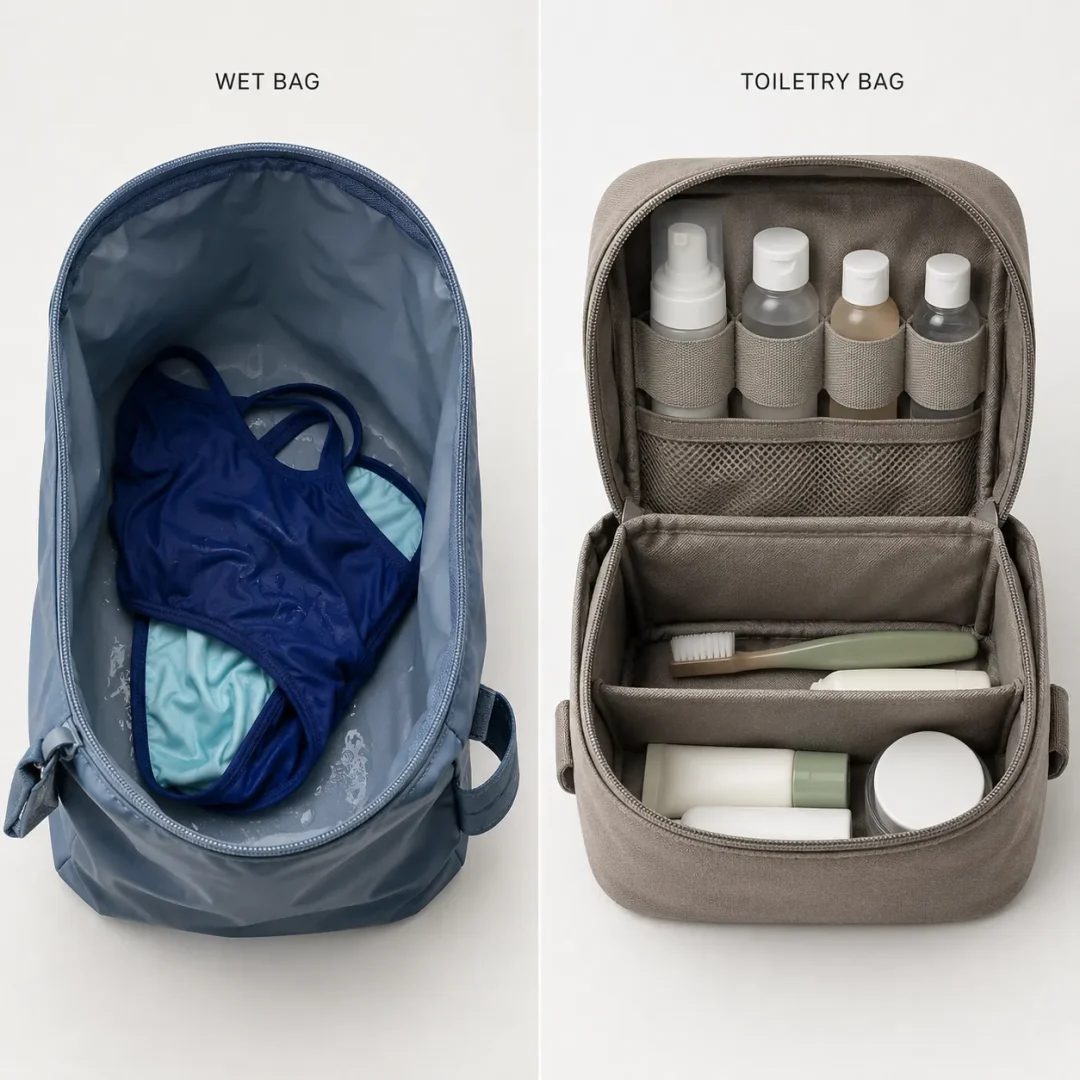
A wet bag and a toiletry bag can look surprisingly similar. Both may be zippered, lined and made from water-resistant materials. Both can appear inside a suitcase, gym bag or beach tote. Some products are even marketed under both names.
However, they are designed around different jobs.
A wet bag separates damp, sweaty or soiled items from dry belongings. A toiletry bag organizes grooming and personal-care products for convenient access.
The difference is therefore not simply whether the bag can handle water. It lies in what the bag is expected to carry, how its interior is arranged and where moisture is supposed to stay.
Wet Bag vs Toiletry Bag at a Glance
| Особенность | Wet Bag | Косметичка |
|---|---|---|
| Main purpose | Isolate damp or soiled items | Organize toiletries and grooming products |
| Typical contents | Swimwear, towels, diapers, gym clothes | Shampoo, toothbrush, skincare, razors |
| Interior layout | Usually open or divided into wet and dry zones | Pockets, bottle loops, dividers or fold-out sections |
| Moisture priority | Keep moisture inside the bag | Contain occasional bottle leaks |
| Typical shape | Flat pouch or lightly gusseted bag | Boxy, structured, hanging or fold-out design |
| Common materials | PUL, TPU laminate, coated polyester, EVA | Polyester, nylon, PU, PVC, canvas, RPET |
| Cleaning needs | Frequent washing or rinsing | Occasional wiping or spot cleaning |
| Best for | Swimming, daycare, gym and wet clothing | Travel, hotels, bathrooms and grooming kits |
In short:
Choose a wet bag for wet items. Choose a toiletry bag for an organized personal-care routine.
What Is a Wet Bag?
A wet bag is a reusable pouch designed to temporarily contain items that are damp, sweaty or dirty.
Common examples include:
- Wet swimsuits and swim caps
- Damp towels
- Sweaty workout clothing
- Reusable diapers and soiled baby clothes
- Reusable menstrual products
- Muddy accessories
- Dirty laundry during travel
- Bottles that may leak
Wet bags became especially common in the reusable diaper category, where parents needed a washable alternative to disposable plastic bags. The same construction later became useful for swimming, fitness, travel and other situations involving damp items.
Most wet bags have a simple interior. A single large compartment may be sufficient for one swimsuit and a small towel. A wet-dry version usually adds a second pocket so clean items and used items can travel in the same bag without direct contact.
A Wet Bag Is Not the Same as a Dry Bag
Despite the similar names, wet bags and dry bags perform almost opposite functions.
A wet bag is meant to keep moisture from wet contents inside. A dry bag is meant to stop outside water from reaching dry contents.
Dry bags used for kayaking, rafting and boating commonly use welded seams and roll-top closures. They may be designed to withstand heavy rain, splashing or temporary immersion.
An everyday wet bag usually prioritizes low weight, flexibility and fast access. It is suitable for a wrung-out swimsuit or damp towel, but not necessarily for protecting electronics during a river crossing.
This distinction matters because “waterproof wet bag” is sometimes interpreted as “safe for submersion,” which is rarely what an ordinary zippered wet bag is designed to provide.
What Is a Toiletry Bag?
A toiletry bag is a portable organizer for hygiene, grooming and personal-care products.
It may hold:
- Toothbrushes and toothpaste
- Shampoo and conditioner
- Soap or body wash
- Skincare products
- Deodorant
- Razors and shaving supplies
- Hairbrushes and combs
- Contact-lens supplies
- Medication
- Small grooming tools
The central purpose of a toiletry bag is not merely to enclose these products. It is to make them easier to pack, find and use.
For this reason, many индивидуальных туалетных сумок include features that would be unnecessary in a basic wet bag:
- Elastic loops to keep bottles upright
- Mesh pockets for visibility
- Zippered sections for small items
- Transparent liquid compartments
- Wide openings
- Structured side panels
- Hanging hooks
- Removable inner pouches
A simple toiletry pouch may still have one main compartment, but larger travel designs usually provide more organization than a wet bag of the same size.
A Note About Product Names
Toiletry bag terminology varies between brands and countries. You may also see:
- Wash bag
- Dopp kit
- Toiletry kit
- Bathroom bag
- Travel toiletry case
- Grooming bag
- Sponge bag
In some markets, “wash bag” means a toiletry bag rather than a bag used for laundry. Therefore, product names alone are not always reliable. Look at the intended contents, internal structure and moisture-control features.
The Five Main Differences
1. Wet Bags Contain Items; Toiletry Bags Organize Them
The most important difference is the way each bag interacts with its contents.
A wet bag treats its contents as one group that needs to be isolated. Wet swimwear and a towel can share the same compartment without requiring individual pockets.
A toiletry bag carries items of different sizes and functions. Users may need to separate a toothbrush from skincare bottles, prevent a razor from damaging other products or reach for toothpaste without removing everything else.
This is why a wet bag can work with a simple flat construction, while a toiletry bag often benefits from compartments and a stable shape.
2. Moisture Is Expected in a Wet Bag
A wet bag is expected to come into direct contact with damp items. Moisture resistance is therefore part of its basic function.
A toiletry bag normally carries closed containers. Its lining is primarily a backup in case a shampoo bottle, serum or toothpaste tube leaks.
This creates different performance expectations:
- A wet bag should resist moisture moving from the inside to the outside.
- A toiletry bag should be easy to wipe clean and contain minor spills.
- A dry bag should prevent external water from reaching its contents.
These functions overlap, but they are not identical.
3. Toiletry Bags Need Faster Access
Wet items are usually placed in a wet bag after an activity and removed when the user returns home. Repeated access during that period is limited.
A toiletry bag may be opened several times a day. Users need to find products quickly in hotel bathrooms, changing rooms or shared facilities.
A hanging toiletry bag is especially useful where counter space is limited. It unfolds vertically and presents products at eye level. A wet bag rarely needs this kind of display structure.
4. Wet Bags Are Usually Easier to Wash
Because they regularly carry damp or soiled textiles, wet bags need to tolerate more frequent cleaning.
A practical wet bag should:
- Have a wipeable or washable interior
- Dry relatively quickly
- Avoid excessive padding
- Minimize moisture-trapping layers
- Open widely enough for cleaning and air drying
Toiletry bags may contain padding, binding, mirrors, cardboard reinforcement or several sewn pockets. These features improve organization but can make full washing more difficult.
Care instructions still depend on the material. A washable PUL pouch, a clear PVC case and a structured PU toiletry bag should not all be cleaned in the same way.
5. Their Capacity Is Used Differently
Wet bags need flexible volume for clothing and towels. The contents can be folded or compressed, so an open compartment is often more useful than multiple small pockets.
Toiletry bags need usable dimensions for bottles and tools. Height, base width and opening size can matter more than total volume.
A toiletry bag may technically have enough capacity for a shampoo bottle but still be inconvenient if the bottle cannot stand upright or pass easily through the opening. Our guide to toiletry bag sizes for travel explains how contents and trip length affect the ideal dimensions.
Are Wet Bags Completely Waterproof?
Some are, but many everyday wet bags are more accurately described as water-resistant or leak-resistant.
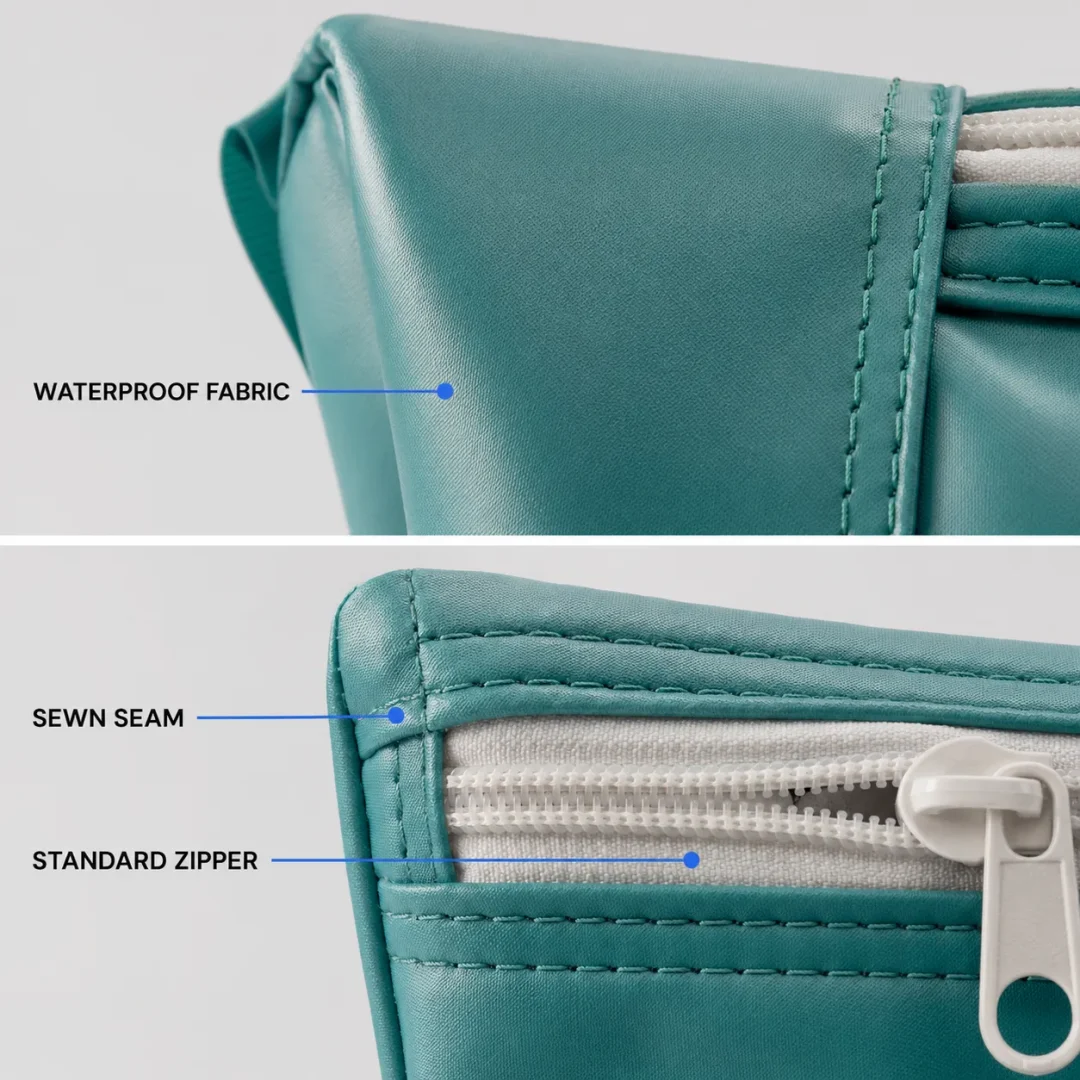
The finished bag’s performance depends on four parts:
| Component | Почему это важно |
|---|---|
| Main material | Determines whether moisture can pass through the bag body |
| Seams | Stitching creates needle holes unless seams are taped or sealed |
| Застежка | An ordinary zipper can allow water to escape |
| Construction details | Handles, labels and pocket joins may create leakage points |
A PUL, PVC or TPU-laminated fabric may be waterproof on its own. Once it is cut and sewn, however, the needle perforations can create paths for moisture.
Therefore:
Waterproof fabric does not automatically create a waterproof finished bag.
A standard sewn wet bag is usually suitable for damp clothing that has been wrung out. If the intended contents are dripping heavily or may release free liquid, stronger construction may be necessary, such as seam sealing, welded panels or a specialized waterproof closure.
The same rule applies to toiletry bags. A “waterproof lining” may stop shampoo from soaking into the outer fabric, but liquid could still escape through the zipper or stitched edges.
Can You Use a Wet Bag as a Toiletry Bag?
Yes. A small wet bag can be a practical toiletry pouch when moisture containment is more important than organization.
It works particularly well for:
- Shampoo and body-wash bottles
- Солнцезащитный крем
- Travel-size liquids
- Shower accessories
- Products packed inside checked luggage
- Toiletries carried to the gym or pool
Its main advantage is simplicity. The interior is usually easy to wipe, and the flexible shape takes up little space.
However, a wet bag may not keep bottles upright or separate small grooming tools. Users who carry several products may find themselves searching through one crowded compartment.
A useful packing approach is to place leak-prone liquids in a small wet bag and carry that pouch inside a larger toiletry organizer. This provides an additional moisture barrier without giving up the compartments of the main bag.
For air travel, the wet bag itself does not determine whether liquids can pass through security. Travelers still need to follow the applicable liquid limits and container requirements. For U.S. departures, refer to the current TSA liquids rule.
Can You Use a Toiletry Bag as a Wet Bag?
Sometimes—but a water-resistant lining alone is not enough to guarantee good results.
A simple polyester toiletry pouch with a coated interior may hold a damp washcloth or lightly wet swimsuit for a short time. A structured toiletry case with absorbent padding, cardboard reinforcement or multiple internal layers is a poor choice.
Before using a toiletry bag for wet items, check whether:
- The interior is fully lined with a moisture-resistant material
- Moisture can reach exposed seam allowances
- The exterior absorbs water
- The zipper and seams can contain light leakage
- The bag can be opened sufficiently for drying
- The structure can tolerate repeated cleaning
If the bag cannot dry completely, trapped moisture may create unpleasant odors or mildew. A dedicated wet bag is more suitable for frequent swimming, gym or daycare use.
What Is a Wet-Dry Toiletry Bag?
A wet-dry toiletry bag combines the two categories by providing separate areas for dry products and moisture-prone items.
A typical design might include:
- A structured main compartment for bottles and grooming items
- A coated or laminated pocket for damp accessories
- Mesh pockets for dry tools
- A hanging hook for bathroom or locker use
- A separate zipper for the wet section
This hybrid works well for:
Gym Users
The dry section holds deodorant, skincare and grooming products, while the wet compartment holds a shower sponge, damp washcloth or small swimsuit.
Swimmers
Clean accessories, sunscreen and goggles can remain separate from wet swimwear after use.
Frequent Travelers
The main area organizes toiletries, while the coated pocket contains leaking bottles or damp items that have not dried before checkout.
Parents
Dry personal-care products can be separated from used baby clothing or reusable hygiene items.
The design must provide real separation, not just an extra fabric pocket. A mesh divider improves visibility but will not stop moisture. A waterproof divider can offer stronger isolation, but its seams and attachment points also need to be considered.
Какую выбрать?
The right choice depends on what creates the greater problem: wet contents or disorganized products.
| Situation | Recommended Bag |
|---|---|
| Carrying a wet swimsuit after swimming | Wet bag |
| Packing skincare and hygiene products | Туалетная сумка |
| Transporting cloth diapers or soiled baby clothes | Wet bag |
| Organizing full-size bottles for a long trip | Structured toiletry bag |
| Using toiletries in a bathroom with little counter space | Hanging toiletry bag |
| Separating liquid bottles inside luggage | Small wet bag or waterproof pouch |
| Carrying shower items and wet clothing to the gym | Wet-dry bag |
| Protecting electronics during kayaking | Dry bag, not a standard wet bag |
| Creating a hotel or airline amenity kit | Compact toiletry pouch |
You may need both if your routine includes several types of contents. A toiletry bag can organize the daily essentials, while a compact wet bag manages damp textiles or high-risk liquids.
Choosing Materials for Each Bag
Material names can overlap between the two categories, but they may be used differently.
| Материал | Wet Bag Application | Toiletry Bag Application |
|---|---|---|
| PUL | Flexible, washable moisture barrier | Lightweight inner wet pocket |
| TPU-laminated polyester | Soft wet-item containment | Waterproof or clear compartments |
| Coated polyester or nylon | Gym, swim and travel wet bags | Lightweight travel toiletry bags |
| ПВХ | Wipe-clean wet pouch | Clear cosmetic and toiletry case |
| EVA or PEVA | Moisture-resistant pouch or lining | Soft, wipeable toiletry bag |
| PU кожи | Usually unsuitable for frequently wet contents | Premium toiletry and grooming bags |
| Canvas or cotton | Requires a separate waterproof lining | Lifestyle and promotional toiletry bags |
| RPET polyester | Suitable with an appropriate coating | Travel and sustainability-focused collections |
For a wet bag, buyers should evaluate the material together with its seams and closure. For a toiletry bag, the exterior appearance, internal organization and lining can be selected separately.
What Brands Should Consider Before Customizing Either Bag
A product should be developed around a defined use case rather than simply being labelled “waterproof.”
For a custom wet bag, the key question is how wet the contents will actually be. A bag for wrung-out swimwear does not need the same structure as one intended to contain reusable diapers or heavily soaked equipment.
The specification should clarify:
- Предполагаемое содержимое
- Degree of expected moisture
- Single or wet-dry compartment layout
- Cleaning frequency
- Required size and carrying method
- Sewn, sealed or welded construction
- Expected level of leak resistance
For a custom toiletry bag, the starting point should be the product routine. Bottle height, number of items, hanging use and retail positioning will determine whether the bag needs elastic holders, mesh pockets, a wide opening or a reinforced shape.
The specification should clarify:
- Travel-size or full-size bottles
- Countertop or hanging use
- Number of product categories
- Level of spill protection
- Preferred exterior appearance
- Target retail or promotional market
- Logo and packaging requirements
If the project is closer to a beauty organizer than a wet-item carrier, our guide to cosmetic bags vs toiletry bags provides a more relevant comparison.
Окончательный вердикт
A wet bag and a toiletry bag may share water-resistant fabrics and zippered constructions, but their priorities are different.
A wet bag is designed to isolate damp, sweaty or soiled items. It normally has a simpler, more washable interior and focuses on keeping moisture away from surrounding belongings.
A toiletry bag is designed to organize personal-care products. It prioritizes access, bottle storage and compartments, with water-resistant lining serving mainly as protection against spills.
A wet bag can replace a toiletry pouch when the user carries only a few liquid products. A toiletry bag should not replace a wet bag unless its materials and construction are suitable for direct contact with damp contents.
For travel, gym and swim collections that need both functions, a properly designed wet-dry toiletry bag may be the best solution. The important step is to define what must stay organized, what may become wet and how much moisture the finished bag is realistically expected to contain.
INITI manufactures custom toiletry bags and travel organizers for beauty, travel, hospitality, fitness and promotional programs. Materials, dimensions, wet-dry compartments, lining, closures and branding can be developed according to the product’s actual use.
Часто задаваемые вопросы
Is a wet bag the same as a wash bag?
Not always. A wet bag normally holds damp or soiled items. In the UK and some other markets, “wash bag” commonly refers to a toiletry bag that holds personal hygiene products.
Will a wet bag hold a dripping swimsuit?
A standard sewn wet bag is better suited to a swimsuit that has been wrung out. Dripping items may leak through the zipper or seams unless the bag uses a stronger waterproof construction.
Do toiletry bags need to be waterproof?
Most toiletry bags do not need to withstand submersion. A water-resistant exterior and wipe-clean lining are normally sufficient for bathroom moisture and minor bottle leaks.
Can a wet bag contain shampoo leaks?
It can provide useful secondary containment, but performance depends on the seams and zipper. For high-risk liquids, use tightly closed bottles and do not rely on the pouch as the only seal.
What is the best bag for swimming and shower products?
A two-compartment wet-dry bag is generally the most practical. One compartment can hold sunscreen, shower products and clean accessories, while the other isolates wet swimwear.
How should a wet bag be dried?
Empty it promptly, wipe or rinse it according to the care instructions and leave it fully open to air dry. Avoid storing damp contents inside for long periods.
 Russian
 English
 French
 German
 Japanese
 Arabic
 Thai
 Vietnamese
 Spanish
 Portuguese