
A $2.99 cotton bag. No advertising. No influencer deal. No launch event. And yet, in early 2024, people were lining up outside Trader Joe’s stores before opening time, employees were enforcing per-customer purchase limits, and the same bag was being listed on eBay for $500.
This is the story of how a grocery store tote became one of the most talked-about retail products of the past two years — and what it actually tells us about why some ordinary objects become cultural phenomena.
It Started With a Bag No One Was Supposed to Notice
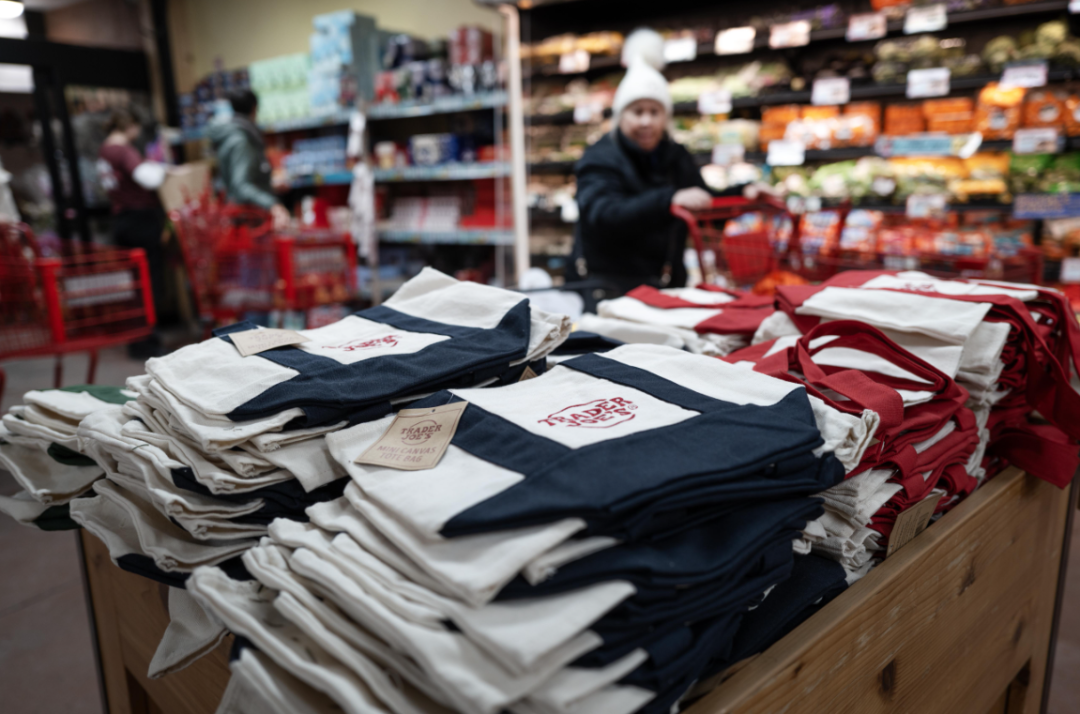
Trader Joe’s didn’t plan a product launch. There was no teaser campaign, no countdown, no limited-edition announcement. In early 2024, the mini canvas tote bags simply appeared on store shelves — small, brightly colored, priced at $2.99 each — as a quiet addition to the chain’s existing lineup of reusable bags.
What happened next caught the company entirely off guard.
“The mini canvas tote bags certainly sold more quickly than we anticipated,” Trader Joe’s spokesperson Nakia Rohde told USA TODAY in March 2024. “Before we had the opportunity to promote them in any way, customers across the country found them at their neighborhood Trader Joe’s.”
Within days, TikTok videos of in-store buying frenzies were racking up millions of views. Employees were forced to limit how many bags each customer could purchase. Stores sold out. The resale market activated almost immediately — listings appeared on eBay and Facebook Marketplace for ten, twenty, sometimes fifty times the retail price, with some pairs of bags listed at $49.99 to $69.95, and individual bags fetching as much as $500 from buyers who had missed the drop.
By the time Trader Joe’s was ready to say anything publicly, the story had already written itself.
The Drop Formula: How Scarcity Became the Engine
What turned a one-time sellout into a sustained, multi-year phenomenon was Trader Joe’s decision — whether deliberate or accidental — to keep releasing new versions in limited quantities, on an unpredictable schedule.
The timeline tells the story clearly:
- Early 2024: Original mini canvas totes launch in bright primary colors. Immediate sellout. Viral chaos.
- September 2024: New colorway drop. In-store foot traffic spikes significantly.
- 2025: Pastel versions release. When Trader Joe’s dropped pastel-handled mini totes on April 8, 2025, in-store visits jumped 21.2% compared to the year-to-date Tuesday average, according to location intelligence firm Placer.ai — outpacing even the September 2024 release by 13.7%.
- February 2026: Trader Joe’s confirms the totes will return again, same price, same designs.
- May 20, 2026: Six new summer designs launch nationwide at $3.99 — brightly colored with a silhouette of a Trader Joe’s store and palm trees, in a new insulated format with zipper top and reinforced handles.
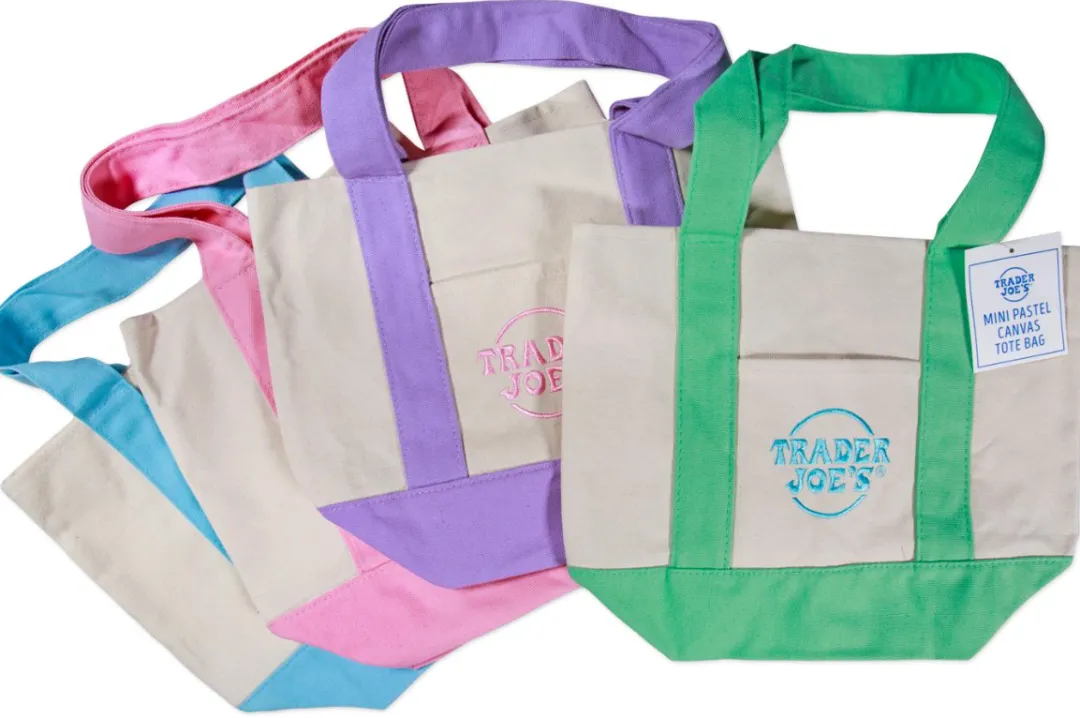
Each drop followed the same pattern: limited supply, no firm restock date, official website language that reads like a soft warning — “pick up a Tote while you can — supplies are limited.”
This is the architecture of scarcity marketing, executed with a consistency that suggests Trader Joe’s understood exactly what they were doing, even if the first drop was genuinely unplanned. The unpredictability of the drops is itself part of the mechanism. When customers don’t know when the next version is coming, checking the store becomes a habit. And habits drive foot traffic.
The resale market reinforced the cycle. When buyers discovered they could flip a $2.99 bag for $50 or more, it created a new category of motivated shopper — people who weren’t Trader Joe’s regulars but started visiting regularly on the chance of catching a drop. The tote had become, functionally, a sneaker.
TikTok Did the Marketing. Trader Joe’s Spent Nothing.
Trader Joe’s is a genuinely unusual company by the standards of major American grocery retail. It has no loyalty program. It has no official TikTok account actively publishing content. It does minimal traditional advertising. It doesn’t sell online.
All of this, counterintuitively, made the tote bag phenomenon more powerful — not less.
When a brand has no official social media presence pushing a product, every piece of content about that product comes from real people with real opinions. There’s no sponsored post to scroll past, no algorithm-optimized brand video to distrust. There’s just a person in line at a Trader Joe’s, filming on their phone, genuinely excited — or genuinely bewildered — by what they’re seeing.
That authenticity is nearly impossible to manufacture, and nearly impossible to buy. According to Numerator, which surveyed over 1,000 verified mini tote buyers, 54% said the viral nature of the bag influenced their decision to purchase — with 21% calling it a major factor. Among Gen Z buyers specifically, that number climbed to 68%. Among Millennials, 58%.
The content loop that drove this looked roughly like this:
- Shopper stumbles across totes in store, films reaction, posts to TikTok
- Video generates views; followers experience FOMO
- FOMO drives store visits from people who weren’t planning to shop
- New visitors either find bags and film their own reaction, or find empty shelves and film that — which generates its own wave of content
- Repeat
The empty-shelf video is an underrated part of this cycle. A sold-out product is not a failed product on social media — it’s proof of desirability. Every video of a bare Trader Joe’s rack was, functionally, free advertising.
Most buyers first heard about the totes by seeing them in a store (46%), followed by social media (29%) and word-of-mouth (26%). The physical discovery still leads — but social media is what converted curiosity into urgency, and urgency into lines out the door.

It’s Not Just a Bag — It’s a Membership Card
To understand why the Trader Joe’s tote specifically went viral — and not just any grocery bag — you have to understand what Trader Joe’s means to a particular slice of American consumer culture.
Trader Joe’s occupies a specific cultural position: it’s affordable enough to shop at regularly, but curated enough to feel like a deliberate choice. Its stores are smaller and more idiosyncratic than conventional supermarkets. Its product lineup changes seasonally, with cult favorites appearing and disappearing. Shopping at Trader Joe’s has, for many of its customers, a mild but real element of identity expression — I’m the kind of person who shops here.
The tote bag made that identity portable and visible.
Carrying a Trader Joe’s mini tote outside the store — to the gym, on the subway, to a coffee shop — is a small but legible signal. It says something about taste, about frugality worn lightly, about being plugged into a certain current of cultural awareness. It functions, in the language of sociology, as a tribal marker.
Placer.ai’s research supports this reading directly. In April 2025, Trader Joe’s saw notably higher penetration among “Educated Urbanites” and “Young Professionals” compared to the wider grocery industry — two consumer segments that Placer describes as “heavily clued into viral product trends.” These are not passive shoppers. They are people who notice what other people are carrying, who participate in cultural conversations, and who make purchases partly as acts of self-expression.
At $2.99, the barrier to that act of self-expression is essentially zero. That price point doesn’t just make the bag accessible — it removes the entire deliberation process. There is no version of this story where someone thinks carefully about whether a $2.99 Trader Joe’s tote is worth buying. The decision is made in seconds, which means the only remaining question is whether you can find one.
The Numbers Behind the Frenzy
By 2025, the Trader Joe’s mini tote had crossed from viral moment into documented retail phenomenon.
Numerator’s research found that 9.6% of Trader Joe’s shoppers — representing 3.4% of total U.S. households — purchased a mini tote bag in 2025 alone. This figure spans the classic mini totes, insulated versions, Halloween editions, and the pastel series. Mini tote buyers were measurably more engaged at the retailer than typical Trader Joe’s shoppers, suggesting that the bag was functioning as a conversion and retention tool, not just a novelty.
The April 2025 pastel drop produced the clearest data point: a 21.2% spike in foot traffic on launch day versus the year-to-date Tuesday average. For context, a 5% traffic lift from a single product would be considered a strong promotional outcome in conventional grocery retail. 21% from a $2.99 bag with no paid media is, by any measure, extraordinary.
The resale market continued in parallel. The secondary market for Trader Joe’s totes — on eBay, Facebook Marketplace, Mercari, and through individual sellers on TikTok — demonstrated sustained demand between official drops, with prices consistently multiples above retail. Some buyers went further, customizing bags with embroidery, hand-painted designs, and charms, then reselling the modified versions — a level of consumer creative investment that very few branded products ever inspire.
By February 2026, Trader Joe’s confirmed future drops would continue. In May 2026, the newest summer editions — insulated, zipper-topped, $3.99 — were announced with the now-familiar caveat: limited time only.
What Made This Work (And What It Actually Takes to Replicate It)
The Trader Joe’s tote story is frequently cited as proof that “any brand can go viral if the product is good enough.” That reading is too simple — and slightly misleading for anyone trying to draw practical conclusions from it.
What actually made this work was a specific convergence of factors, most of which Trader Joe’s had been building for years before the first mini tote appeared on a shelf:
A pre-existing cult following. Trader Joe’s didn’t build its fanbase with the tote bag. It built the fanbase over decades of product curation, store culture, and deliberate quirkiness. The tote was a match dropped into a room that was already full of kindling.
A price point that eliminated friction. At $2.99, the purchase decision bypasses rational evaluation entirely. Nobody calculates ROI on a $2.99 impulse buy. The low price also made the bag feel like a discovery rather than a purchase — something you found, not something you chose.
Scarcity that felt accidental, not manufactured. The first sellout genuinely surprised Trader Joe’s. That authenticity — the sense that the company was as caught off guard as the customers — made the frenzy feel organic rather than orchestrated. Even as subsequent drops became more deliberate, the unpredictable timing preserved enough uncertainty to keep the behavior loop running.
A design with social legibility. The bags are small, colorful, and immediately recognizable as Trader Joe’s — even from across a coffee shop. They read clearly in a TikTok frame. They’re visually interesting enough to film, simple enough to style, and distinctive enough to identify at a glance. Good design, in this context, means design that works as content.
No official narrative competing with the organic one. Because Trader Joe’s wasn’t actively marketing the bags, there was no brand voice telling people how to feel about them. The cultural meaning of the tote was constructed entirely by the people who bought it, carried it, filmed it, and wrote about it. That meaning was therefore theirs — which made them far more committed to it than they would have been to any meaning a marketing team had assigned.
None of this is a formula. But it does suggest that the brands most likely to produce their own version of this moment are the ones willing to make something genuinely distinctive, price it accessibly, hold back on over-explaining it, and let their existing community do the rest.
A tote bag that becomes a cultural object doesn’t start as a marketing campaign. It starts as a product someone actually wants to carry — and then it gets out of the way.
At Initipacking, we work with brands to design and produce bolsas de tote personalizadas built for exactly this kind of impact — distinctive enough to get noticed, well-made enough to last, and flexible enough to support limited-edition drops, seasonal releases, or large-scale campaigns. Get in touch to talk through your project.

 Portuguese
 English
 French
 German
 Japanese
 Arabic
 Thai
 Vietnamese
 Russian
 Spanish