
Se você procurar por uma bolsa de tênis e uma bolsa de sapatos online, pode encontrar muitos produtos que parecem quase idênticos. Ambas podem conter calçados, separar solas sujas das roupas, e facilitar o empacotamento dos sapatos. Então, elas são realmente diferentes?
A resposta curta é que uma bolsa de sapatos é a categoria de produto mais ampla, enquanto uma bolsa de tênis geralmente é uma bolsa de sapatos projetada com base no tamanho, formato, ventilação ou necessidades de transporte de tênis..
No entanto, esses termos não seguem um padrão universal da indústria. Algumas marcas usam “bolsa de tênis” para um simples pouch de um par, enquanto outras o utilizam para um estojo de viagem estruturado que comporta vários pares. O nome por si só, portanto, não conta tudo sobre o produto.
A comparação mais útil é baseada nas dimensões da bolsa, construção, capacidade, materiais e uso pretendido.
O Que é uma Bolsa de Sapatos?
Uma bolsa de sapato é um saco, estojo ou organizador projetado para armazenar e separar calçados. Seu principal objetivo geralmente é evitar que os sapatos transfiram poeira, sujeira ou marcas de arranhões para roupas e outros itens embalados.
As bolsas de sapato são usadas em vários ambientes diferentes:
- Empacotando sapatos em uma mala
- Organizando calçados em casa
- Protecting shoes from dust and surface scratches
- Separating gym shoes from clean clothing
- Packaging footwear for retail
- Providing reusable packaging for shoe brands
Because “shoe bag” is a broad term, the construction can range from a thin drawstring pouch to a structured zippered case.
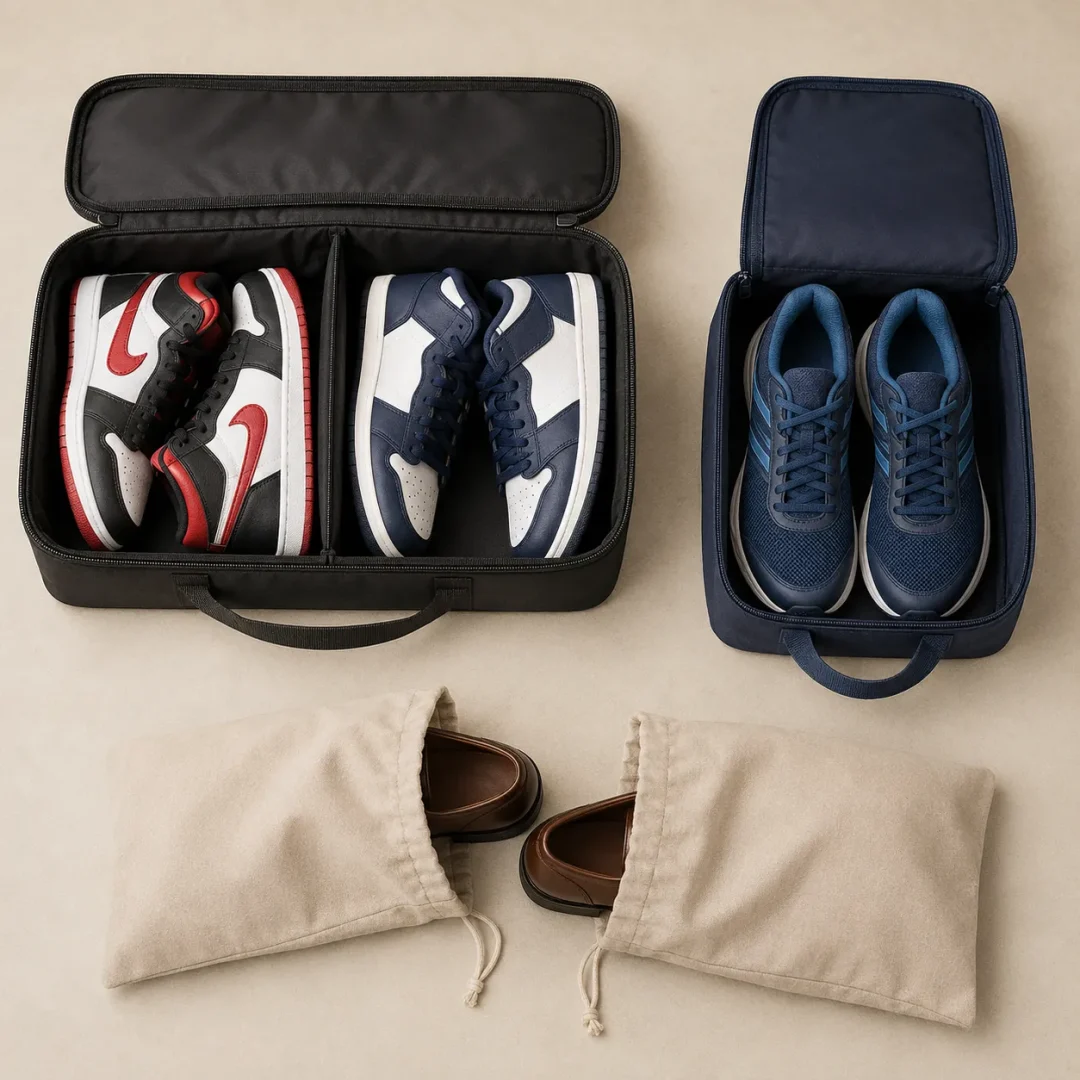
Tipos Comuns de Bolsas de Sapatos
Different shoe bags are designed to solve different problems.
Drawstring shoe bags are lightweight and easy to produce. They are frequently used for footwear packaging, hotel amenities, promotions, and closet storage.
Zippered travel shoe bags provide a more secure closure and are convenient for packing shoes in a suitcase. Some include carrying handles, transparent panels, or internal dividers.
Shoe dust bags are usually made from soft fabric and focus on protecting the shoe surface during storage. They are commonly used for formal shoes, heels, leather footwear, and branded retail packaging.
Golf shoe bags often have a handle, ventilation panels, and a more structured shape to accommodate sports footwear.
Shoe washing bags are designed for machine washing rather than ordinary travel. They usually require durable mesh, reinforced seams, and a secure zipper that can withstand movement during a wash cycle.
These products may all be called shoe bags, but they are not necessarily interchangeable.
O Que é uma Bolsa de Tênis?
A sneaker bag is generally a shoe bag developed with athletic shoes, trainers, basketball shoes, or lifestyle sneakers in mind.
Compared with a basic shoe pouch, it may provide:
- More internal height for high-top sneakers
- Extra depth for thick soles
- A wider zippered opening
- Mesh panels or ventilation holes
- A reinforced carrying handle
- A wipe-clean or water-resistant base
- Padding or structure to reduce compression
- Separate compartments for multiple pairs
A lightweight sneaker bag may hold one pair and fit inside a suitcase. A larger sneaker travel bag may look more like a duffle or backpack, with adjustable dividers for two, three, or four pairs.
“Bolsa de Tênis” Não é um Nome de Produto Padronizado
It is important not to treat every sneaker bag as a separate and clearly defined type of luggage.
The term may describe:
- A soft pouch sized for one pair of sneakers
- A zippered travel shoe bag with a handle
- A structured sneaker case with padding
- A multi-pair sneaker duffle with internal dividers
- A mesh bag designed specifically for washing sneakers
This variation explains why two products described as sneaker bags can have completely different dimensions and functions.
Before choosing one, check the actual specifications instead of relying only on the product name.
Bolsa de Tênis vs Bolsa de Sapatos: Principais Diferenças
The following table summarizes how the terms are commonly used in the market.
| Recurso | Sneaker Bag | General Shoe Bag |
|---|---|---|
| Objetivo principal | Carrying and protecting sneakers | General footwear separation, storage, or packaging |
| Typical footwear | Sneakers, trainers, basketball shoes and high-tops | Flats, loafers, dress shoes, sandals and sneakers |
| Construction | Often spacious or structured | Ranges from thin pouches to structured cases |
| Opening | Frequently has a wide zipper opening | Drawstring, zipper, flap, or other closure |
| Ventilation | More commonly included | Depends on the application |
| Capacidade | One pair or several separated pairs | Usually one pair |
| Carrying features | Often includes a handle or shoulder strap | May be designed mainly for packing |
| Shape protection | More likely to include padding or structure | Varies considerably |
| Common users | Travelers, athletes and sneaker collectors | Travelers, households, hotels and footwear brands |
These are common tendencies rather than strict rules. A well-designed general shoe bag may include all the same features as a sneaker bag.
Onde Bolsas de Tênis e Bolsas de Sapatos se Sobrepõem
Despite their different positioning, the two products share many functions.
Both can:
- Keep dirty soles away from clean clothing
- Help organize footwear in luggage
- Reduce contact between pairs of shoes
- Protect shoe surfaces from light scratches
- Make shoes easier to carry or store
- Use polyester, nylon, Oxford fabric, mesh, cotton, or mixed materials
- Be customized with different colors, closures, handles, and logos
In practice, a zippered shoe bag with sufficient depth and ventilation may also be marketed as a sneaker bag. The distinction becomes more meaningful when the product has been designed for bulky, high-top, or multiple pairs of sneakers.
A useful way to understand the relationship is:
A sneaker bag is usually a specialized type of shoe bag, but not every shoe bag is designed for the size and structure of sneakers.
Uma Bolsa de Tênis Protege os Sapatos Melhor?
Not necessarily. Protection depends more on construction than on the name printed in the product listing.
Pouches de Tênis Macios
Soft pouches are lightweight, foldable, and easy to fit around other items in a suitcase. They provide a barrier between shoe soles and clothing but offer limited protection against crushing.
They work well when:
- Luggage space is limited
- The sneakers are flexible
- Dirt separation is the main concern
- The bag must fold flat when empty
Bolsas de Tênis Estruturadas
Structured bags help the storage compartment retain its shape. They are more suitable for chunky sneakers, high-tops, basketball shoes, or shoes that may be damaged by compression.
However, their firmer construction usually takes up more luggage space.
Cases de Tênis Com Almofadas
Padding can provide additional protection against impact and friction. This may be useful for valuable, collectible, or delicate sneakers, but it adds weight and cost.
A padded sneaker case is not always necessary for ordinary travel. For most users, the right balance comes from adequate dimensions, a wide opening, a durable body, and enough structure to prevent severe compression.
Qual Bolsa Funciona Melhor para Diferentes Sapatos?
The shoe type should guide the choice more than the product label.
| Shoe type | More suitable option |
|---|---|
| Running shoes | Breathable zippered shoe or sneaker bag |
| Low-top sneakers | Standard travel shoe bag |
| High-top sneakers | Taller sneaker bag with a wide opening |
| Chunky sneakers | Deep, structured sneaker bag |
| Tênis de basquete | Ventilated bag with sufficient height |
| Dress shoes | Soft-lined or separated shoe bag |
| Golf shoes | Ventilated shoe bag with a reinforced handle |
| Heels | Individual pouches or a divided shoe bag |
| Wet or muddy shoes | Water-resistant, easy-clean shoe bag |
| Multiple sneaker pairs | Sneaker duffle with adjustable dividers |
The same numerical shoe size can still require different bag dimensions. A low-profile casual sneaker and a padded basketball shoe may share a size label but differ significantly in height and overall volume.
Respirabilidade ou Resistência à Água: O Que Importa Mais?
Sneaker bags often promote either breathability or water resistance. These properties solve different problems, so the better option depends on how the shoes will be used and packed.
Quando a Respirabilidade Importa
Breathability is particularly useful for:
- Running shoes after exercise
- Gym and training shoes
- Footwear used in warm weather
- Sneakers that retain sweat and moisture
- Bags used repeatedly throughout the day
Mesh panels allow air to move through the compartment, helping moisture escape instead of remaining trapped inside. This can reduce the conditions that contribute to unpleasant odors.
However, ventilation does not make a dirty or damp shoe automatically fresh. Shoes should still be cleaned when necessary and allowed to dry before being stored for a long period.
A breathable travel mesh shoe bag can be practical for gym, sports, and short-trip use because it combines ventilation with a wide zippered opening and carrying handle.
Quando a Resistência à Água é Importante
A water-resistant body is useful when:
- Shoe soles are dirty or slightly damp
- The bag will be placed beside clean clothing
- The user travels in rainy conditions
- The internal surface needs to be wiped clean
- External splashes could reach the shoes
Water resistance does not always mean the complete bag is waterproof. Zippers, mesh panels, and stitched seams may still allow water to pass through.
Um Único Saco Pode Oferecer Ambos?
Many practical designs combine materials rather than choosing only one property.
For example, a sneaker bag can use:
- Mesh on the top or side for ventilation
- Polyester or nylon for the main body
- A coated bottom panel for easier cleaning
- A lightweight lining to separate shoes from the outer fabric
This hybrid construction is useful when the shoes need airflow but the soles still need to be isolated from the rest of the luggage.
Como Escolher Entre um Saco para Tênis e um Saco para Sapatos
Instead of choosing by name, follow a few practical steps.
1. Comece com os Sapatos
Measure or check the approximate:
- Shoe length
- Maximum width
- Overall height
- Sole thickness
Pay particular attention to padded collars, high-top uppers, and thick outsoles. These features can make a sneaker much bulkier than a dress shoe in the same size.
2. Pense em Como o Saco Será Usado
A simple shoe bag may be enough for closet storage or retail packaging. Frequent travel, gym use, or sneaker events may require a stronger structure and a carrying handle.
Consider whether the bag will be:
- Packed inside a suitcase
- Carried separately
- Used after sports
- Stored in a closet
- Included with retail footwear
- Used for one pair or several pairs
3. Verifique as Dimensões Internas
External measurements do not always represent the usable space. Padding, linings, dividers, and curved corners can reduce internal capacity.
The bag should provide enough room to insert and remove the shoes without forcing the zipper. At the same time, an excessively large compartment may allow shoes to move around and rub against each other.
For high-top or chunky sneakers, internal height and depth are often just as important as length.
4. Compare a Abertura e o Fechamento
The closure affects both convenience and protection.
Drawstring closures are lightweight and suitable for dust protection, simple travel packing, and retail presentation.
Straight zippers create a clean and compact structure but may offer a narrower opening.
U-shaped zippers expose more of the main compartment, making bulky shoes easier to insert.
Dual zippers allow the opening position to be adjusted and can improve access when the bag is tightly packed.
5. Considere os Requisitos de Limpeza
A shoe bag will eventually come into contact with dust, soil, or moisture. Check whether:
- The lining can be wiped clean
- The bag is hand-washable or machine-washable
- The mesh is strong enough for repeated cleaning
- The zipper is protected during washing
- The bag can be opened fully for drying
Do not assume every mesh travel bag is suitable for a washing machine. A shoe washing bag must withstand considerably more movement and impact than a travel organizer.
Erros Comuns ao Comprar um Saco para Sapatos ou Tênis
Escolhendo Apenas pelo Tamanho do Sapato
Shoe size does not account for the upper, padding, sole thickness, or overall shape. Always consider the physical dimensions of the complete shoe.
Assumindo que Todo Saco para Tênis é Estruturado
Some sneaker bags are simply soft fabric pouches. They separate shoes from other belongings but do not prevent compression.
Tratando a Resistência à Água como Impermeabilidade ao Odor
A coated fabric may prevent moisture from passing through, but it can also retain moisture and odors if the bag has no ventilation.
Empacotando Tênis Úmidos por Muito Tempo
Even a breathable bag cannot compensate for storing wet shoes for an extended period. Dry the shoes and the bag as soon as practical.
Confundindo um Saco de Sapato de Viagem com um Saco de Lavagem
Travel bags focus on organization and portability. Washing bags require stronger mesh, reinforced stitching, controlled movement, and a secure closure suitable for a wash cycle.
Ignorando o Tamanho do Saco Vazio
Structured sneaker cases offer more protection but do not compress as easily. Travelers with limited luggage space may prefer a foldable design.
Sacolas de Tênis e Sacos para Sapatos para Marcas
For footwear brands, sports clubs, travel-accessory companies, and promotional buyers, the choice also depends on how the bag fits into the wider product or packaging program.
Quando um Saco Geral para Sapatos Faz Sentido
A general shoe bag is often suitable for:
- Retail footwear packaging
- Hotel and travel kits
- Promotional programs
- E-commerce shoe protection
- Formal shoe storage
- Product lines covering several footwear categories
A simple shoe dust bag can provide reusable packaging without requiring the structure of a dedicated sneaker carrier.
Quando um Design Específico para Tênis é Mais Adequado
A specialized design may be more valuable for:
- Athletic footwear brands
- Running and basketball clubs
- Gyms and fitness programs
- Sneaker retailers
- Streetwear brands
- Sports events
- Travel accessory collections
In these cases, details such as ventilation, internal height, carrying comfort, and abrasion resistance become more important.
Recursos Personalizados a Considerar
When developing custom sneaker bags or shoe bags, buyers can specify:
- Dimensions for low-top, high-top, or oversized shoes
- Single-shoe, single-pair, or multi-pair capacity
- Mesh placement and ventilation area
- Polyester, nylon, Oxford fabric, cotton, or RPET
- Water-resistant coatings or wipe-clean linings
- U-shaped or straight zipper openings
- Removable internal dividers
- Reinforced carrying handles
- Logo printing, embroidery, woven labels, or patches
- Retail inserts, hangtags, and individual packaging
Brands developing a wider luggage or fitness collection can also coordinate the shoe bag with other custom sports bags through matching fabrics, colors, trims, and branding.
Veredito Final: Qual Você Deve Escolher?
Choose a general shoe bag if you mainly need to separate footwear from clothing, protect shoes from dust, or create simple reusable packaging.
Choose a sneaker bag if you regularly carry bulky athletic shoes, high-tops, or sneakers that benefit from more height, ventilation, structure, or carrying support.
For several pairs, look beyond a standard single-pair pouch and consider a sneaker duffle or travel case with adjustable dividers.
Ultimately, the product name is only a starting point. The best choice depends on:
- The size and shape of the shoes
- The number of pairs
- The required level of protection
- Whether ventilation or water resistance matters more
- How the bag will be carried, cleaned, and stored
A sneaker bag is generally a specialized form of shoe bag, but not every shoe bag is designed around the proportions and ventilation needs of sneakers.
Perguntas Frequentes
Uma bolsa de tênis é a mesma que uma bolsa de sapato?
A sneaker bag is usually a type of shoe bag designed or marketed for athletic footwear. The two terms sometimes overlap, so buyers should compare the actual dimensions, construction, and capacity.
Uma bolsa de sapato comum pode acomodar tênis?
Yes, provided that it has enough internal length, width, and height. High-top, basketball, and chunky sneakers may require a deeper or taller design than ordinary shoes.
Quantos pares cabem em uma bolsa de tênis?
Most compact sneaker bags hold one pair. Larger sneaker travel bags or sneaker duffles may hold two to four pairs or more, depending on their dimensions and divider layout.
As bolsas de tênis previnem odores?
Ventilation panels can help moisture escape, but they do not completely prevent odors. Sneakers should be cleaned and dried before long-term storage, and the bag should also be cleaned regularly.
As bolsas de tênis são à prova d'água?
Some are water-resistant, while others prioritize ventilation through mesh panels. Check the body material, zipper, lining, and seam construction instead of relying only on a waterproof product claim.
As marcas podem personalizar bolsas de tênis para diferentes tamanhos de sapato?
Yes. Dimensions, shape, opening, ventilation, materials, dividers, handles, and branding can all be adjusted for different footwear categories and retail programs.

 Portuguese
 English
 French
 German
 Japanese
 Arabic
 Thai
 Vietnamese
 Russian
 Spanish