
A shoe bag should hold your footwear comfortably, close without forcing the shoes together, and fit the space where you plan to carry it. Choosing by shoe size alone is not enough: a slim loafer and a thick basketball shoe can share the same size label while needing very different amounts of room.
For a first comparison, use the S–XL reference chart below. Then check your shoes’ actual outside measurements, how you will arrange the pair, and the bag’s opening. This guide focuses on bags that hold shoes directly. If you want to include a shoe box, measure the complete box separately.
Shoe Bag Size Chart: Small, Medium, Large and Extra Large
The following sizes are suggested starting points for comparing or sampling flat shoe bags. They are not universal industry sizes or guaranteed fit recommendations. Brands may label the same dimensions differently.
All measurements describe the finished bag laid flat, width × height, before filling. Metric measurements are rounded.
| Tamanho de referência | Flat width × height | Footwear to evaluate first | Typical use | What to check |
|---|---|---|---|---|
| S — Small | 10 × 14 in / 25 × 36 cm | Children’s shoes, slim sandals or slippers | Compact travel packing and light storage | Check adult footwear length and whether you are packing one shoe or a pair |
| M — Medium | 12 × 16 in / 30 × 41 cm | A pair of low-profile casual shoes or trainers | Everyday travel and commuting | Wide soles and thick uppers may need more room |
| L — Large | 14 × 18 in / 36 × 46 cm | Larger trainers or some high-top styles | Gym, sports and business trips | Check packed thickness and space below the closure |
| XL — Extra Large | 16 × 20 in / 41 × 51 cm | Bulky footwear or a pair requiring a looser fit | Larger footwear and flexible storage | Extra flat size does not guarantee boot or two-pair capacity |
Use these as sizes to investigate, not as a reason to skip measuring. The table is intended to help you evaluate a pair packed together; individual shoe bags can often be smaller, but still need their own fit check.
A flat bag’s width is not its usable internal width after filling. Some of that fabric wraps around the thickness of the shoes, and the drawstring area uses part of the height.
A shaped zipper bag follows a different measurement system: length × width × height. Check all three dimensions and the opening. Do not compare a 14 × 18-inch flat bag directly with a 14-inch-long shoe case, or assume that similar numbers mean similar capacity.
If you are still deciding between a simple pouch and a more structured sneaker carrier, our Sneaker Bag vs Shoe Bag guide explains the differences.
What Size Shoe Bag Do You Need for Different Activities?
Your activity changes what needs to fit alongside the shoes, how often you access them, and how much surrounding luggage space is available.
| Application | Practical starting approach | Main sizing priority |
|---|---|---|
| Travel and carry-on packing | Evaluate a compact single-pair bag against your footwear | Loaded size inside the suitcase |
| Gym and commuting | Measure your regular training shoes and any intended extras | Easy loading and fit inside your everyday bag |
| Sports and outdoor use | Check bulky soles, high collars and projecting details | Depth and opening clearance |
| Home and seasonal storage | Measure shoes with any shoe trees or protective wrapping | Keeping the intended shoe shape |
| Retail and branded packaging | Sample against the footwear range being packaged | Consistent fit and presentation |
Travel and Carry-On Packing
For a spare pair of shoes, choose the smallest bag that allows comfortable loading and closure. Excess fabric may fold away, but a large structured case can occupy more suitcase space than the footwear needs.
Check the bag after packing, not only when it is empty. If you carry several pairs, separate bags may fit around clothing more easily than one large shoe organizer. A single organizer is convenient when you want everything in one place.
Gym and Everyday Commuting
Start with the training shoes you actually wear. If the bag will also hold socks or a small towel, include those items when checking capacity rather than assuming spare space will remain.
The loaded shoe bag should also fit through the opening of your work tote, backpack or gym bag. A shoe pouch that works well on its own may be awkward inside a narrow commuter bag. If damp clothing needs separate storage, plan a separate compartment or pouch instead of squeezing it around the shoes.
Sports and Outdoor Footwear
Sports footwear may need more space around the sole, heel or ankle. A bag that fits low-profile trainers may be too shallow for basketball shoes, even when both pairs have the same shoe-size label.
Choose the structure around the footwear. A wider opening can improve access without making the whole bag oversized. Tall boots usually need a dedicated boot-bag shape rather than a wider version of a standard shoe pouch.
Home Storage and Seasonal Organization
Measure footwear with the shoe trees, stuffing or wrapping you intend to use. The bag should close without flattening the uppers or bending the heel counter.
A slightly relaxed fit can make repeated access easier. However, bag size alone does not determine whether a storage setup is suitable: footwear should be clean and dry, and the material and storage conditions should suit the shoes.
Retail Packaging and Branded Shoe Bags
Retail packaging needs a balance between easy loading and a tidy appearance. A tight pouch can slow packing and distort the footwear; an excessively loose bag can make the presentation feel unfinished.
Brands covering several footwear shapes may need more than one bag size. Packaging children’s shoes, adult loafers and high-top trainers in one universal pouch should be treated as a proposal to test, not an assumed solution.
How to Measure Your Shoes for a Shoe Bag
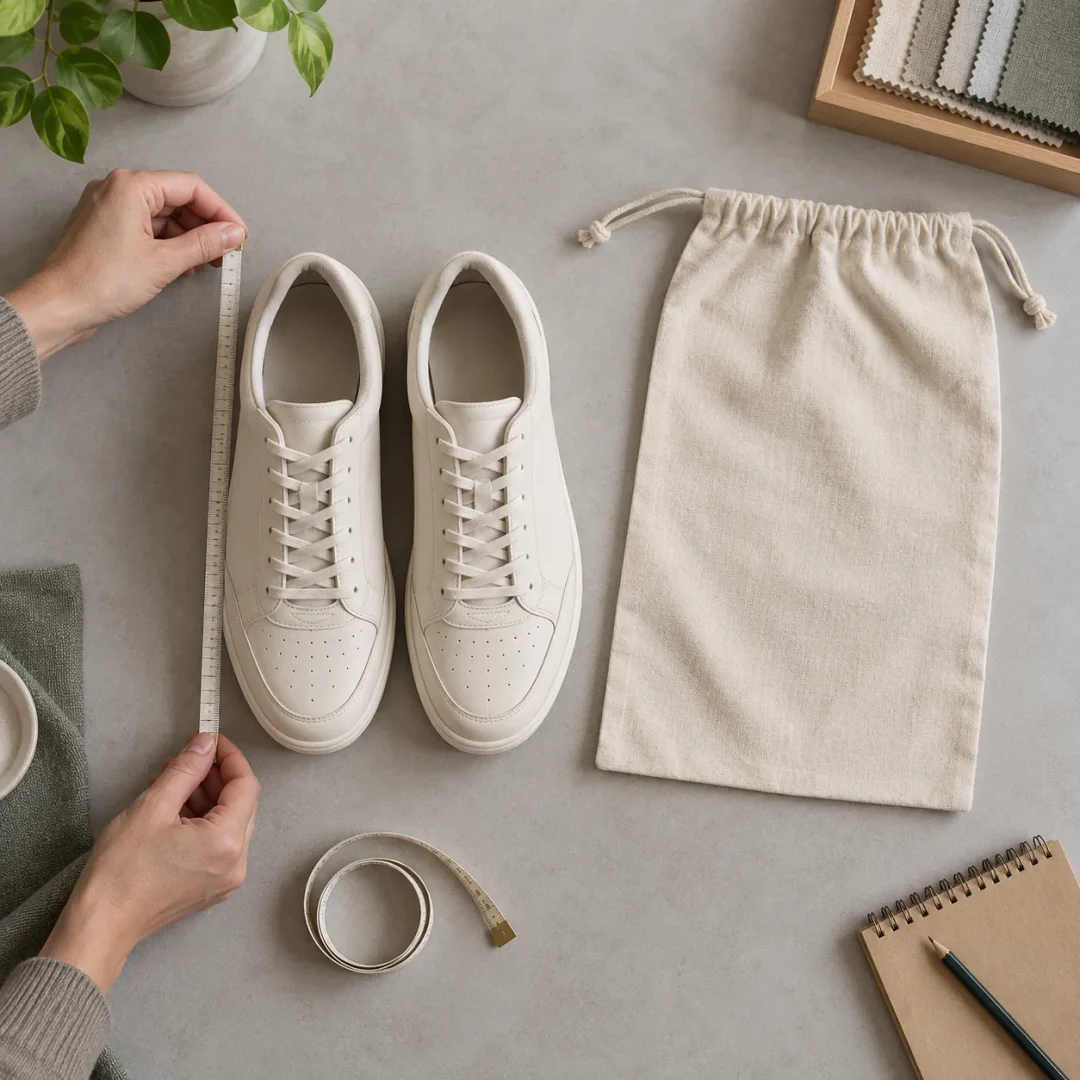
Measure the Shoes, Not Your Feet
Measure the outside of the finished shoe, including the longest part of the outsole, the widest sole section and the highest point of the upper.
A foot-length measurement does not include all of the shoe’s construction. Likewise, a label such as “size 13” is incomplete unless the sizing system is identified. US men’s, US women’s and UK sizes should not be treated as interchangeable, and converting between them still does not give the shoe’s external dimensions.
Arrange the Pair Before Measuring
Place the shoes in the arrangement you expect to use inside the bag. Depending on the footwear, that may be side by side or heel to toe. If you plan to protect each shoe separately, measure each shoe with its wrapping.
Measure the pair as one packed group. Simply doubling a single shoe’s width does not account for the way the shoes overlap, nest or need separation.
Check Packed Length, Width and Height
For a shaped shoe bag, compare the footwear arrangement with the bag’s usable interior dimensions. Check the full shape, particularly where the bag narrows near the ends or zipper.
For a flat pouch, remember that the panels must wrap around the footwear. Do not treat the laid-flat width as a rectangular internal floor. A paper mock-up or inexpensive sample can help establish whether a proposed flat size is practical.
Leave Room for Loading and Closure
Allow enough clearance to insert and remove the shoes without pulling hard on the bag. Include room for any lining, divider and closure area.
There is no single allowance that works for every construction. A flexible unlined drawstring pouch and a padded zipper case need different fit checks.
Quick fit check:
- The shoes go in and come out without catching or force.
- The zipper or drawstring closes normally.
- Uppers, heels and collars are not visibly compressed.
- Seams are not pulled tight around protruding parts.
- The filled bag fits the luggage or storage space you intend to use.
If one of these checks fails, a different opening or deeper structure may solve the problem better than simply choosing the next size up.
Why Similar Shoe Bag Dimensions Can Fit Differently
Flat Bags vs Gusseted Bags
Flat bags have no separately specified depth. As shoes fill the pouch, the fabric spreads around their sides, reducing the width available across the front.
A gusset adds room through the sides or base. This can accommodate thicker footwear more neatly, although the gusset must open where the shoes need space. Increasing flat width is not always equivalent to adding usable depth.
External Dimensions vs Usable Space
Lining, padding, binding and internal partitions take up room. Two bags with matching external dimensions may therefore fit different footwear.
For a divided bag, check each compartment rather than only the complete bag. A generous overall volume is not helpful if the intended pair cannot fit into its assigned section.
Zipper Openings and Drawstring Closures
A short zipper can restrict access even when the body is large enough. Rounded ends and tapered openings can create similar problems.
Drawstring bags need room above the footwear so the fabric can gather. Filling the pouch right to the top may prevent closure.
For an example of a wide-opening construction, our travel mesh shoe bag uses a U-shaped dual-zipper opening. The opening and body dimensions should still be checked together against the target shoes.
Choosing Sizes for Large Shoes, High-Tops and Boots
Unusual footwear shapes deserve a closer fit check rather than an automatic move to “XL.”
| Footwear | Measure carefully | Common mistake |
|---|---|---|
| Large trainers | Full outsole length and widest sole section | Relying on an XL label alone |
| High-tops and basketball shoes | Collar height and packed pair thickness | Checking length but ignoring depth |
| High heels | Heel projection and the pair’s arranged height | Forcing closure against heels or uppers |
| Structured dress shoes | Overall shape with shoe trees, if used | Choosing a tight pouch that presses the leather |
| Boots | Shaft height, sole outline and intended position | Sizing only from the bottom of the boot |
Extra length does not necessarily solve a depth problem. For delicate uppers or projecting heels, individual pouches or a divided structure may work better than placing both shoes tightly together.
A manufacturer’s stated maximum shoe size is useful for screening a particular product. It should not be transferred to another bag with a different shape, opening or internal construction.
One Large Shoe Bag or Two Separate Bags?
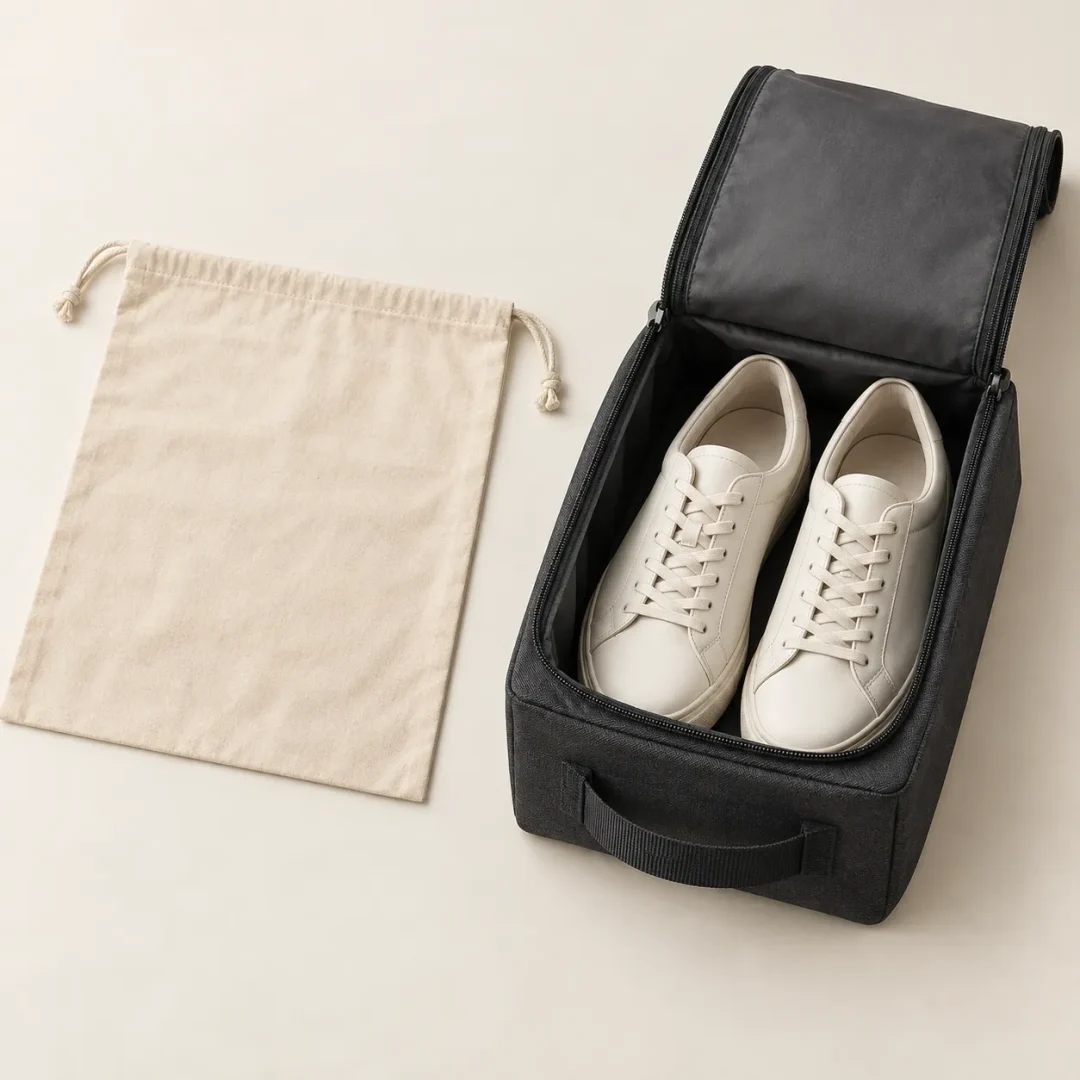
One multi-pair bag keeps footwear together and can be convenient to retrieve from a suitcase. Before choosing it, check the actual shoe combination and how the dividers allocate space.
“One pair of trainers plus sandals” is a different packing requirement from “two pairs of bulky trainers.” A stated two- or three-pair capacity needs that context.
Two single-pair bags offer more flexibility when arranging luggage and separating different footwear. Individual shoe pouches can also help reduce contact between shoe surfaces and make use of narrow spaces, provided each pouch has adequate room.
Choose based on the filled arrangement. A bigger bag does not inherently save space, and multiple smaller bags do not always pack more efficiently.
How to Specify Shoe Bag Sizes for Custom Orders
Define the Footwear and Packing Method
A useful sizing brief includes the target footwear type, actual shoe dimensions, the largest intended test pair, the number of shoes per bag, and the packing arrangement.
Include shoe trees, protective sleeves or retail packaging if they will be present. Photos help communicate the shape, but a representative physical shoe sample allows a more meaningful fit check.
Decide Whether One Size Is Enough
A single size may work for a narrow range of similar footwear. A broader collection may benefit from separate sizes for children’s shoes, adult low-tops and bulkier sports styles.
Do not approve a whole range using only an average-size pair. Test the largest intended footwear and consider whether smaller shoes look excessively loose. Any S/M/L labels should be linked to confirmed finished measurements and a clearly described fit range.
Confirm Finished Measurements and Tolerances
Specify whether the dimensions refer to a flat pouch or a shaped bag. Use a drawing to identify width, height, length and gusset depth, and state whether handles or other extensions are excluded.
Finished dimensions are also different from fabric cutting dimensions. The supplier needs to account for seams and hems during pattern development.
Agree on the measurement method and acceptable manufacturing tolerances before bulk production. A nominal size is incomplete if the buyer and supplier measure it differently.
Approve the Size Through Sample Fitting
Load the sample with the intended footwear and check access, closure, separation and loaded carrying behavior. Review the presentation with both the largest and smaller target shoes.
For cotton or canvas bags intended to be washed, also assess fit after the agreed care process. Dimensional change depends on the fabric and finishing; a universal shrinkage percentage should not replace sample testing.
Approve customer-facing claims such as “fits two pairs” or a maximum shoe size only after checking the stated footwear conditions.
If shoe bags will form part of a broader collection, consider their loaded dimensions alongside your other travel accessories. Consistent sizing should support the way customers pack the products together.
Perguntas Frequentes
What is a standard shoe bag size?
There is no single size that applies to every shoe bag. A flat pouch around 12 × 16 inches is one starting point to evaluate for low-profile adult footwear, while bulky shoes may need a larger or deeper construction. Confirm the actual pair and closure fit.
What size shoe bag fits US men’s size 13 shoes?
Check the specific shoes’ outside measurements and the bag maker’s fit guidance. The US men’s size 13 label alone does not establish the necessary pouch dimensions, especially for high-tops, wide soles or boots.
Is a large shoe bag big enough for two pairs?
Not necessarily. “Large” may describe a bag intended for one bulky pair. For two pairs, evaluate the complete arrangement, compartment dimensions and closing space.
Should I size up when buying a shoe bag?
Size up when the current bag compresses the footwear or cannot close normally. First check whether the problem is length, depth or access: a different bag shape may be more useful than a larger version of the same design.
Do shoes with a box need a different bag size?
Yes. Measure the complete box rather than the shoes inside it. A rigid box requires enough room around its corners and through the opening, so direct-to-shoe pouch recommendations should not be reused without checking.
Start with the reference chart, then measure and test the fit. For a custom project, share the intended footwear, quantity per bag and packing method so the final dimensions can be confirmed on a sample before production.
 Portuguese
 English
 French
 German
 Japanese
 Arabic
 Thai
 Vietnamese
 Russian
 Spanish