
Yes — but whether your travel bag actually makes it onto the plane without incident depends on three things: the bag type, its dimensions when fully packed, and the specific airline you’re flying.
Many travelers arrive at the gate confident their bag qualifies as carry-on, only to find a gate agent pointing at the metal sizing frame with bad news. In 2026, this scenario is more common than ever. Airlines are deploying automated bag-scanning systems at boarding gates and enforcing size limits more consistently than at any point in the past decade. The rules themselves haven’t changed — the enforcement has.
This guide covers everything you need to know before you travel: the difference between a carry-on and a personal item, size rules for major airlines worldwide, how different bag types perform in real-world carry-on situations, the security restrictions that apply, and practical packing tips to make carry-on travel work for any trip length.
Carry-On vs Personal Item: Know the Difference First
Before deciding whether your travel bag qualifies as carry-on, it helps to understand that most airlines allow every passenger to bring two separate bags into the cabin — and they are not the same thing.
Carry-on bag: Stored in the overhead bin above your seat. Larger of the two allowed items. Must fit within the airline’s published carry-on dimensions, typically around 22 × 14 × 9 inches on major US carriers.
Personal item: Stored under the seat in front of you. Smaller than a carry-on. Can be a backpack, laptop bag, tote, purse, or small duffel — provided it fits under the seat. Typical dimensions are around 18 × 14 × 8 inches, though this varies by airline.
| Tipo | Stored | Typical Size (US Major Airlines) | Usually Free? |
|---|---|---|---|
| Carry-on | Overhead bin | 22 × 14 × 9 in (56 × 36 × 23 cm) | Yes — most major airlines |
| Personal item | Under seat in front | 18 × 14 × 8 in (45 × 35 × 20 cm) | Yes — almost all airlines |
The critical point for budget airline travelers: carriers like Spirit, Frontier, Ryanair, and EasyJet typically only include a personal item in the base fare. A carry-on bag for the overhead bin requires an additional fee — which can run $40–$75 or more if added at the gate rather than online.
Your travel bag can serve as either one. Which category it falls into depends entirely on its size when fully packed.
Airline Carry-On Size Rules: What You Need to Know in 2026
There is no single global standard for carry-on luggage — every airline sets its own rules. However, a de facto standard has emerged for most US domestic travel.
The most widely used carry-on size limit: 22 × 14 × 9 inches (56 × 36 × 23 cm), including wheels, handles, and any external pockets or hardware.
Key 2026 enforcement update: Airlines are measuring bags more consistently than before, using metal sizer frames at boarding gates and, in some airports, automated scanning systems. Expansion zippers left open, overstuffed bags that push past their frame, and handles that extend beyond standard dimensions are all now being caught. Always measure your bag in its fully packed state — not its empty or manufacturer-labeled dimensions.
Major US Domestic Airlines — Carry-On Policies
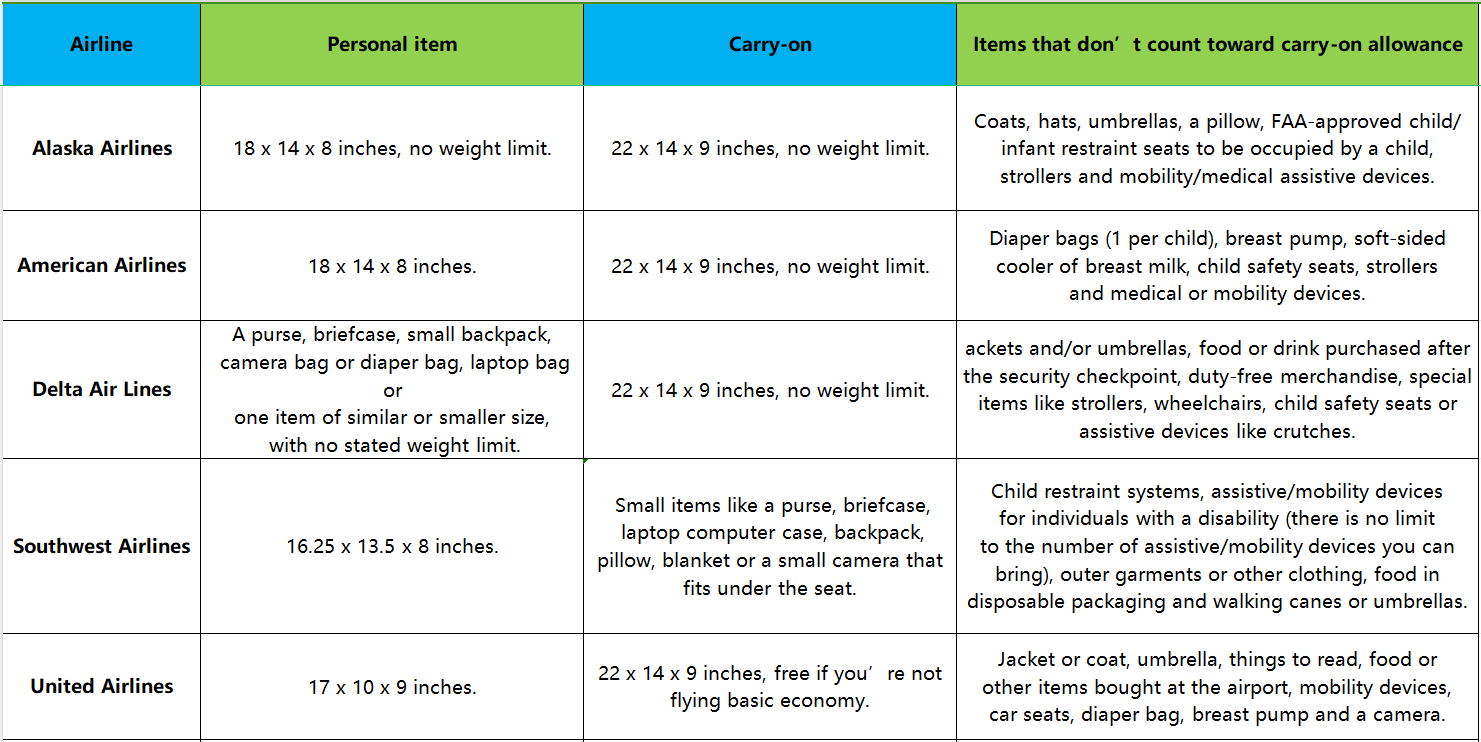
This table should appear here, covering airlines including American Airlines, Delta, United, Southwest, JetBlue, Alaska Airlines, and Hawaiian Airlines — with carry-on dimensions, personal item dimensions, weight limits (if any), and carry-on fee information.
Key takeaways from major US domestic airlines:
- American, Delta, United, JetBlue, and Alaska all use the same 22 × 14 × 9 inch carry-on standard
- Southwest allows a slightly larger 24 × 16 × 10 inch carry-on — the most generous of major US carriers
- Most major US domestic carriers do not enforce a weight limit on carry-ons for domestic flights, but passengers must be able to lift the bag into the overhead bin unassisted
- Measurements always include wheels, handles, and protruding pockets
Budget US Domestic Airlines — Carry-On Policies
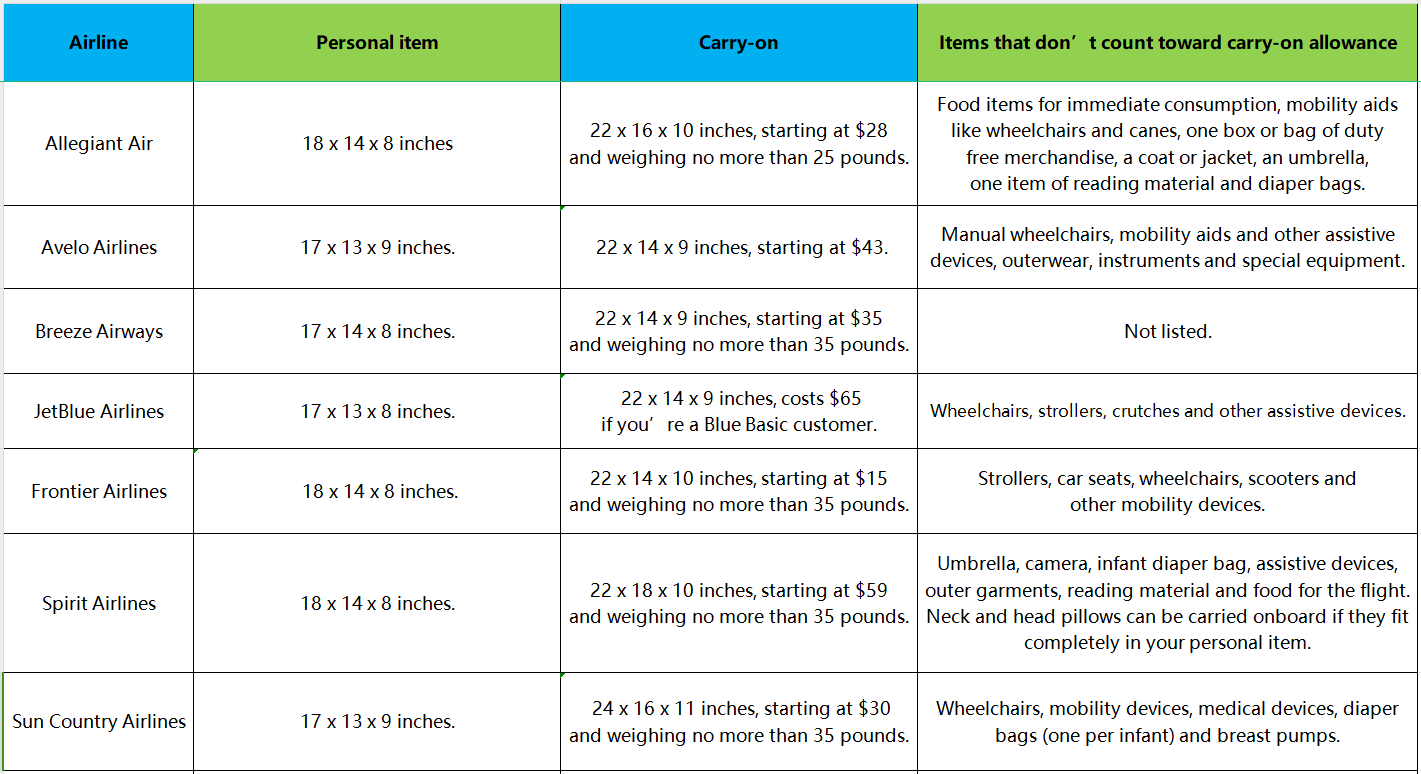
This table should appear here, covering airlines including Spirit, Frontier, Allegiant, Sun Country, and Breeze — with carry-on dimensions, personal item dimensions, overhead bin fee structure, and what is included in base fare.
Key takeaways from budget US domestic airlines:
- Budget carriers typically include only a personal item (under-seat bag) in the base ticket price
- A carry-on for the overhead bin requires a separate fee — usually $35–$75 if purchased in advance, significantly more if added at the gate
- Spirit’s free personal item must fit in dimensions around 18 × 14 × 8 inches — the same as the personal item limit on major carriers
- Always add bags during booking, not at the gate — gate fees are consistently the most expensive option
- Budget airlines are where the most carry-on disputes and gate-check incidents occur; know your airline’s exact rules before you pack
Major International Airlines — Carry-On Policies

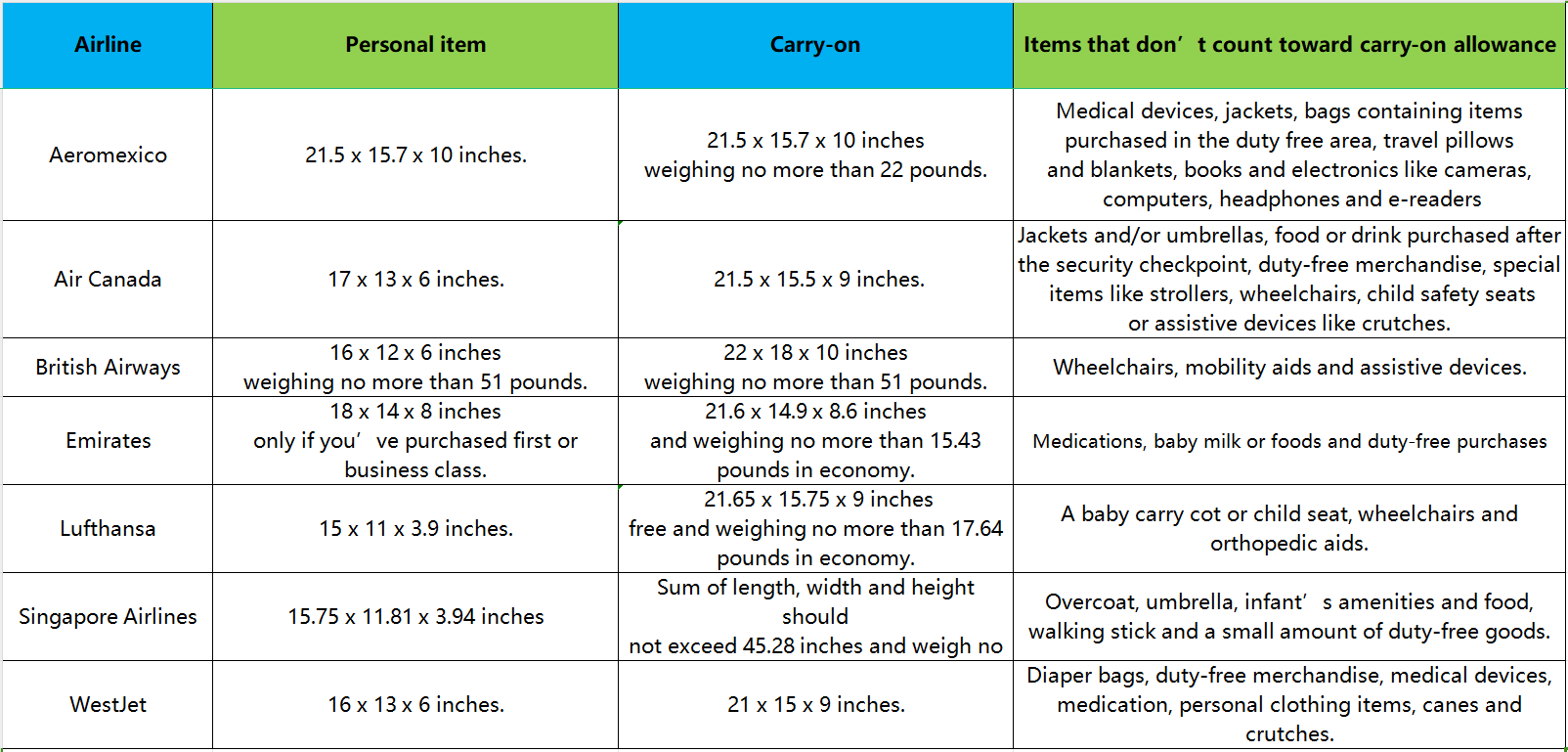
This table should appear here, covering airlines including Emirates, Lufthansa, British Airways, Air France, Qatar Airways, Singapore Airlines, Cathay Pacific, AirAsia, and Qantas — with carry-on dimensions, weight limits, personal item dimensions, and cabin class differences where applicable.
Key takeaways from international airlines:
- International carriers are significantly more likely to enforce weight limits on carry-on bags — typically 7 kg (15 lbs) to 10 kg (22 lbs) for economy class
- Asian and European budget carriers (AirAsia, Ryanair, EasyJet, Wizz Air) have some of the most restrictive and actively enforced carry-on policies globally
- Cabin class matters: business and first class passengers on most international carriers receive higher carry-on weight allowances
- Dimensions are often slightly smaller than US domestic standards — a bag that clears US domestic flights may not clear a European short-haul connection
- Always verify carry-on policy for every airline on a multi-carrier itinerary — the most restrictive airline on the route is the one that matters
Before every trip: Check the carry-on policy directly on your airline’s official baggage page. Policies can change, and the rules for your specific route (domestic vs international, economy vs premium) may differ from the general published standard.
Which Types of Travel Bags Work Best as Carry-On?
The size rule applies equally to every bag type — but in practice, different bags have very different success rates at the gate. Here is how the main travel bag categories perform in real-world carry-on situations.
Mochilas
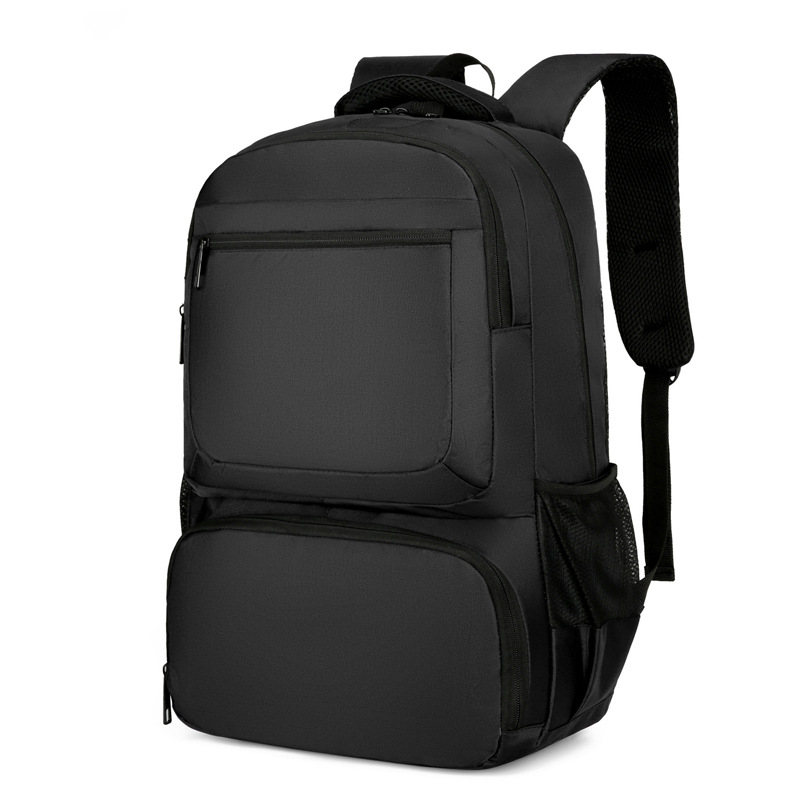
Backpacks are among the most carry-on-friendly bag types available. Their soft construction allows them to compress slightly when overhead bins are crowded, and their lack of rigid external structure means they can often fit into spaces where a hard-shell case cannot. The absence of wheels and a telescoping handle also means no protruding hardware to push the bag over size limits.
Melhor para: Short trips, light travel, travelers who want hands-free movement through the airport.
Watch out for: Large hiking or outdoor backpacks (40L+) almost certainly exceed carry-on dimensions. For carry-on travel, choose a purpose-designed travel backpack in the 25–35L range. Confirm that when fully packed, the bag fits within 22 × 14 × 9 inches — the soft structure that makes backpacks flexible also makes them easy to overpack past compliance.
Rolling Duffel Bags and Soft-Sided Wheeled Travel Bags
Rolling duffel bags offer carry-on-sized capacity with the mobility of wheels. Their soft exterior provides more flexibility than hard-shell cases, making them better at adapting to a crowded overhead bin.
Melhor para: Weekend trips and short business travel where rolling ease matters but overhead bin flexibility is needed.
Watch out for: Wheels and telescoping handles count toward dimensions. A bag that measures 22 inches to the top of the fabric may measure 24+ inches with the handle extended. Always measure the bag fully packed, handle retracted, with wheels included. Soft duffel bags without wheels offer even greater compressibility — when a bin is nearly full, a floppy duffel will find a gap that a rigid roller cannot.
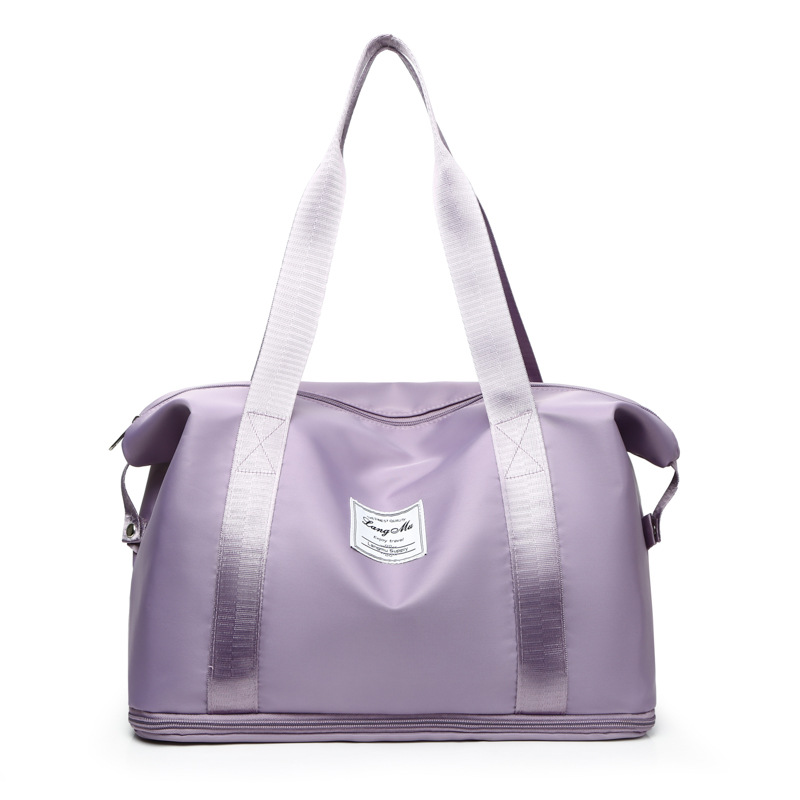
Standard Soft-Sided Duffel Bags
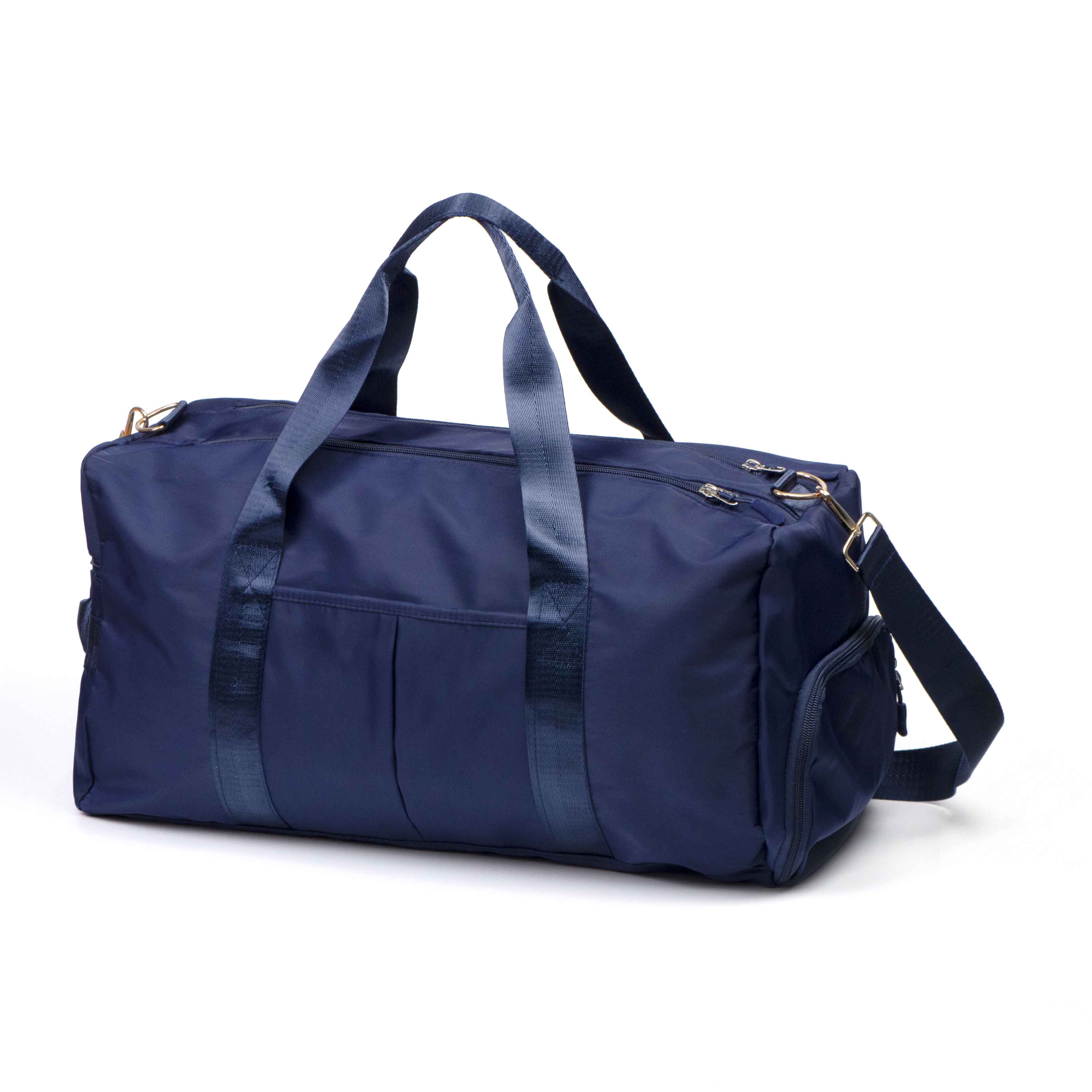
Unstructured soft duffel bags are arguably the most overhead-bin-friendly format available. With no rigid frame, wheels, or fixed structure, they can be oriented in any direction and compressed to fit gaps that no other bag type can access.
Melhor para: Travelers on full flights, frequent flyers who board late, anyone prioritizing flexibility over organization.
Watch out for: No wheels makes airport navigation more demanding on longer transit routes. Limited internal organization means contents shift and can be harder to access. For organized packers, packing cubes inside a soft duffel restore structure without sacrificing the bag’s compressibility advantage.
Bolsas Tote
Large tote bags typically function best as personal items rather than carry-on bags. Their unstructured format makes them comfortable under the seat in front of you, and their open-top design provides fast in-flight access to essentials.
Melhor para: Secondary bag (personal item) alongside a carry-on. Day trips, shopping, and light-use scenarios.
Watch out for: An overfilled tote that spills over the dimensions for a personal item will be redirected to the overhead bin — where it will take up space disproportionate to its structural capacity. If using a tote as a personal item, pack it to a shape that fits cleanly under the seat.
Hard-Shell Suitcases
Hard-shell suitcases offer the best protection for fragile contents and the most organized packing experience. They are also the most unforgiving format in terms of carry-on compliance.
Melhor para: Travelers with fragile items, business travelers who need wrinkle-free clothes, anyone who consistently packs the same items and knows their bag will fit.
Watch out for: Expansion zippers — the extra 1–2 inches they add can turn a compliant bag into an oversized one. Hard shells cannot be compressed to fit a tight overhead bin gap. Overpacked hard-shell cases also place maximum stress on zippers, which is one of the most common causes of luggage failure. If traveling on a budget airline or an aircraft with smaller overhead bins (regional jets, turboprops), a hard-shell case may be the most likely bag to get gate-checked.
Bag Type Comparison
| Tipo de Bolsa | Carry-On Viability | Compressibility | Internal Organization | Melhor Caso de Uso |
|---|---|---|---|---|
| Backpack (25–35L) | Alto | Alto | Médio | Short trips, light travel |
| Rolling duffel | Alto | Medium-High | Médio | Weekend, short business travel |
| Soft duffel (no wheels) | Alto | Very high | Baixo | Full flights, flexible travel |
| Bolsa Tote | Medium (personal item) | Médio | Baixo | Secondary bag, day trips |
| Hard-shell suitcase | Médio | Baixo | Alto | Fragile items, organized packers |
The Real Advantages of Carrying On a Travel Bag
1. Skip Baggage Claim — Save Significant Time
The average domestic baggage claim wait is 20–40 minutes. On international flights with customs and additional carousel delays, this can extend considerably. Carry-on travelers bypass the entire process and walk directly out of the airport. Over the course of a year of regular travel, this adds up to hours saved.
2. Eliminate the Risk of Lost or Damaged Luggage
Checked bags are processed through automated sorting systems, transferred between aircraft on multi-leg itineraries, and handled by numerous people before they reach you. Bags are lost, delayed, and damaged. Carry-on luggage stays with you throughout the journey — from security to seat to destination. For trips where you cannot afford to be without your belongings (a wedding, a client meeting, a same-day arrival with a morning commitment), carry-on is the only reliable option.
3. Avoid Checked Bag Fees
Checked bag fees on US budget carriers start at $35–$45 for the first bag and increase rapidly. On international routes, fees can be significantly higher. A traveler who checks one bag on 10 round trips a year at a budget carrier is spending $700–$900 annually just on bag fees. A carry-on-compliant travel bag eliminates that cost entirely.
4. Access Your Belongings During the Flight
Medication, headphones, a laptop, reading material, a neck pillow, snacks — anything you need during a long flight is only accessible if it is in your carry-on bag. Checked luggage is unavailable from the moment you hand it over to the moment it appears on the carousel. For travelers with medical needs or anyone on a long-haul flight, in-flight access to belongings is a practical requirement, not a preference.
5. Flexibility Across Bag Types
Unlike the rigid format of a checked suitcase, the carry-on category accommodates backpacks, rolling bags, duffel bags, and structured travel cases. Travelers can select the format that best suits their trip type, packing style, and personal preference — all within the same size envelope.
The Limitations You Should Know Before You Go
1. Size and Weight Limits Are Non-Negotiable at the Gate
In 2026, airlines are enforcing carry-on size limits more consistently than before, using sizer frames and automated scanning at gates. If your bag does not fit the sizer, it will be gate-checked. Depending on the airline and whether you have already paid for a checked bag, this may be free or it may cost $50–$100 or more.
What to do: Measure your bag fully packed — not empty. Include wheels, handles, and any protruding pockets in the measurement. Choose a bag that is genuinely compliant rather than a bag that is borderline and relies on lenient enforcement.
2. Overhead Bin Space Is First-Come, First-Served
On full flights, overhead bin space fills up before boarding is complete. Passengers who board later — in lower priority boarding groups or who arrive at the gate late — may find no space above their seat and be required to check their bag at the door.
What to do: Choose a soft-sided bag that can compress into smaller spaces. Board as early as your ticket allows. On airlines with assigned overhead bin space (a growing feature on some carriers), reserve bin space during booking.
3. TSA Liquid Rules Apply — No Exceptions
All carry-on bags pass through TSA security screening, which enforces the 3-1-1 liquid rule regardless of bag type or traveler status.
- Each liquid, gel, or aerosol container must be 3.4 oz (100ml) or less
- All liquid containers must fit in one clear, resealable quart-sized (approximately 1 liter) bag
- Each passenger is limited to one such bag
- The liquid bag must be removed from your carry-on and placed separately in the security bin
Medications, baby formula, and breast milk are exempt from the 100ml limit but must be declared to security officers. Powders over 12 oz may also require separate screening.
What to do: Pack liquids in travel-size containers. Consider solid alternatives (solid shampoo bars, solid deodorant) for longer trips to eliminate liquid restrictions entirely. Use TSA’s “What Can I Bring?” tool for any item you are unsure about before packing.
4. Capacity Has a Ceiling
Most carry-on bags are sized for 3–5 days of travel. Extended trips, outdoor adventures, or travel requiring formal attire are harder to manage within carry-on limits. A 22 × 14 × 9 inch bag holds approximately 35–45 liters — sufficient for a week of travel with disciplined packing, but not for every trip.
What to do: Use packing cubes to compress clothing and maximize usable volume. Pack versatile pieces that can be worn multiple times in different combinations. Consider doing laundry on trips of 7+ days rather than packing additional clothing.
5. Personal Items Under the Seat Reduce Legroom
If you are traveling with both a carry-on (in the overhead bin) and a personal item (under the seat), the under-seat bag will occupy space that would otherwise be available for your feet and legs. On long-haul flights, reduced legroom is a genuine comfort issue.
What to do: Choose a personal item that is flat enough to fit fully under the seat without restricting foot placement. On flights where you have stored your carry-on overhead, consider keeping only what you need during the flight in your personal item — you do not need to fill it to capacity.
TSA Security Rules for Carry-On Bags
Understanding what can and cannot go in a carry-on bag saves time at security and prevents the frustration of having items confiscated.
The 3-1-1 Liquid Rule
| Rule Element | Limit |
|---|---|
| Individual container size | 3.4 oz / 100ml maximum |
| Total liquid bag size | 1 quart (approx. 1 liter), clear and resealable |
| Bags allowed per person | 1 |
| Required action at security | Remove from bag and place in separate bin |
Electronics
- Laptops and large electronics must be removed from your bag and placed in a separate bin for screening (unless you have TSA PreCheck)
- Power banks and spare lithium batteries must travel in carry-on bags — they are prohibited in checked luggage
- Lithium batteries under 100Wh are permitted without restriction; 100–160Wh requires airline approval; over 160Wh is prohibited in carry-on and checked bags
Common Items That Cannot Go in Carry-On Bags
- Liquids, gels, or aerosols in containers over 100ml (even if partially used)
- Sharp objects including knives, box cutters, and scissors with blades over 4 inches
- Firearms and ammunition (must be declared and travel in checked luggage only)
- Flammable materials, including certain lighters beyond the one-per-passenger limit
- Fresh fruits, vegetables, and certain food items when crossing international borders (varies by destination country)
Useful resource: TSA’s “What Can I Bring?” search tool at tsa.gov allows you to check any item before packing.
Packing Tips to Maximize Your Carry-On
Getting the most out of carry-on travel is largely a packing problem. These practices make it consistently achievable.
Use packing cubes. Packing cubes compress clothing and keep items organized inside a soft bag. They also make it easy to remove and replace items at security without disrupting the entire bag. Well-used packing cubes can increase usable bag volume by 20–30% compared to unpacked loose clothing.
Roll, don’t fold. Rolling clothing tightly reduces wrinkles and creates more efficient use of irregular internal bag space. Rolled items can be packed along the sides and into corners that folded stacks cannot reach.
Wear your heaviest items on the plane. Heavy boots, a thick jacket, or bulky knitwear worn during travel do not count toward your bag’s weight or dimensions. This single habit has the biggest impact on carry-on feasibility for cold-weather or outdoor trips.
Pack a versatile wardrobe, not a complete one. Five pieces that mix and match into ten outfits pack smaller than ten individual outfits. Neutral colors, lightweight fabrics, and multi-purpose items reduce total volume substantially.
Measure your bag fully packed before leaving home. The most common carry-on mistake is measuring an empty bag and assuming it will be compliant when full. Pack the bag as you intend to travel, then measure it with a tape measure — including wheels, handles, and any external pockets. If it is close to the limit, remove items until it is clearly within compliance.
Put in-flight essentials at the top or in an exterior pocket. Passport, boarding pass, headphones, phone charger, medication, and anything you will need during the flight should be accessible without unpacking the main compartment. This speeds up security screening and reduces the disruption of reaching into the overhead bin during the flight.
Measure your bag’s packed dimensions against every airline on your itinerary. If your trip involves a connection on a different carrier — especially a regional partner or budget airline — the most restrictive allowance on the route is the one that matters. A bag that clears your long-haul carrier may be rejected by the regional connector.
Perguntas Frequentes
Can any bag be used as a carry-on?
Any bag can be used as a carry-on provided it fits within the airline’s published size and weight limits when fully packed. This includes backpacks, duffel bags, rolling suitcases, structured travel bags, and tote bags. The bag type matters less than whether it meets the dimensions — typically 22 × 14 × 9 inches for most major US airlines, including all wheels, handles, and external pockets in the measurement.
What happens if my travel bag is too big for carry-on?
If your bag exceeds the airline’s carry-on size limit, gate agents will require you to check it. Timing and airline policy determine the cost: some airlines gate-check the bag for free, others charge the standard checked bag fee, and some — particularly budget carriers — charge a gate fee that can be significantly higher than the advance-purchase price. Avoid this by confirming your bag is compliant before you leave home.
Is a backpack a carry-on or a personal item?
It depends on the size. A travel backpack sized at 22 × 14 × 9 inches or below qualifies as a carry-on and goes in the overhead bin. A smaller daypack or laptop bag that fits within the personal item dimensions (approximately 18 × 14 × 8 inches) goes under the seat. Most airlines allow one carry-on and one personal item per passenger, so a traveler with both sizes of bag can use both allowances simultaneously.
Do soft bags have an advantage over hard-shell suitcases as carry-ons?
Yes, in practical terms. Soft-sided bags can compress slightly to fit into a full overhead bin where a hard-shell case cannot be forced. They are also less likely to stress their zipper under overpacking conditions — hard shells transfer all overpacking pressure directly to the zipper, which is a common failure point. The trade-off is lower protection for fragile contents.
Can I bring a duffel bag as a carry-on?
Yes. A duffel bag qualifies as carry-on luggage if it fits within the airline’s size limits when fully packed — typically 22 × 14 × 9 inches including handles. Soft duffel bags are particularly effective carry-ons because their flexible, unstructured construction adapts to available bin space. Always measure the bag fully packed, as soft bags are easy to overpack past compliance.
Do carry-on rules differ for international flights?
Yes, significantly. International airlines — particularly in Asia, Europe, and the Middle East — are more likely to enforce weight limits on carry-on bags, typically 7–10 kg (15–22 lbs) for economy passengers. Dimensions may also be slightly more restrictive than US domestic standards. If your itinerary includes international segments, check the carry-on policy for every airline involved, not just the long-haul carrier.
Conclusão
A travel bag can absolutely be used as carry-on luggage — and for most trips of up to a week, it is the smarter, faster, and more cost-effective option. The key is knowing the rules before you pack, choosing a bag that genuinely fits within your airline’s limits, and packing to the standard you intend to travel — not to the standard of an empty bag sitting on a shelf.
The differences between airlines are real and consequential. A bag that flies free on a major US carrier may require a $75 add-on fee on a budget airline. A bag that clears domestic security may be rejected on a European connection. The two minutes it takes to check your airline’s official baggage policy before every trip is the most reliable way to avoid a gate-side surprise.
Carry-on travel rewards preparation. Pack smart, measure fully, know your airline, and your travel bag will get you where you are going — without the wait, the fees, or the uncertainty of checked luggage.
Looking for carry-on-friendly travel bags? Initipacking offers custom travel bags, backpacks, and duffel bags designed to meet standard airline carry-on dimensions — available for wholesale, branded, and promotional orders. [Contact us for a free quotation.]
Tags Quentes:Sacola de compras China, fornecedores, fabricantes, fábrica, atacado, a granel, à venda,ideias de sacolas tote,sacolas de lona para armazenamento,sacola de algodão, sacola rpet, sacolas personalizadas para roupas,sacolas de lona com cordão,sacola térmica para almoço,sacola de maquiagem à venda,Sacola de compras e supermercado,Acessórios de praia,Bolsa Tote de Juta/Cânhamo/Saco de Papel,Bolsa Tote de Veludo Cotelê,Mala de viagem,Bolsa de linho,Sacola de papel



 Portuguese
 English
 French
 German
 Japanese
 Arabic
 Thai
 Vietnamese
 Russian
 Spanish