
Introdução
Book bag and backpack get used as interchangeable terms in everyday conversation, but from a sourcing and manufacturing perspective, they aren’t really synonyms. They represent two different levels of structural complexity — and mislabeling one for the other at the inquiry stage is a common, costly mistake. A buyer who specifies “book bag” expecting padded straps and a laptop sleeve, or who specifies “backpack” and receives an unstructured single-compartment tote, ends up with samples that don’t match the brief, wasted revision cycles, or — worse — a bulk shipment that doesn’t perform the way end users expect.
This guide breaks down what actually separates a book bag from a backpack at the construction level, where the terms overlap, what to specify in an RFQ, and how to verify what you’re actually being quoted before committing to bulk production.
What Is a Book Bag?
It’s worth being precise here, because “book bag” isn’t actually a fixed construction type the way “backpack” is — it’s a use-case label that gets attached to several different base bag shapes. Merriam-Webster’s own definition is broad on purpose: a bag or sack, often with a handle or strap, used for holding books. In practice, that covers:
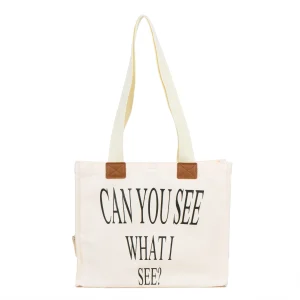
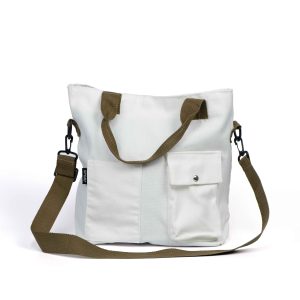
- Tote-style book bags — carried by handle, no shoulder strap at all
- Satchel-style book bags — a single cross-body strap with a flap closure
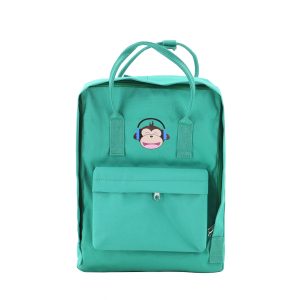
- Simplified backpack-style book bags — two basic straps and one main compartment, the most common modern default
This guide focuses on the third version for the construction comparison below, since that’s the form most often set side by side with a backpack in sourcing conversations — but the distinction matters in practice. If a buyer specifies “book bag” without naming the base construction, a factory could just as reasonably quote a handle-carried tote as a simplified two-strap design, and both would be a correct read of the brief.
In its backpack-adjacent form, a book bag is typically a soft-sided carrier with minimal internal framing:
- One main compartment, possibly with a small front pocket — and little to no further internal organization
- No rigid back panel
- Thin, non-padded straps or basic handles rather than a full harness system
- Lighter-weight materials, commonly canvas, polyester, or nylon in roughly the 200D–600D denier range
The design brief behind a book bag prioritizes low unit cost and strong printability over long-term ergonomic support. That makes it a good fit for event giveaways, library loaner programs, or supplementary carriers — but it isn’t built to hold up under sustained heavy loads.
What Is a Backpack?
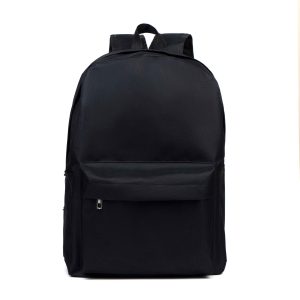
A backpack includes structural elements specifically designed for weight distribution. Standard construction features include:
- Padded, adjustable shoulder straps, often bar-tacked at stress points
- A reinforced back panel — sometimes with airflow channels for breathability
- Multiple organized compartments, frequently including a dedicated laptop or tablet sleeve
- Heavier base fabrics, typically starting around 600D polyester or higher, often with a PU or TPU coating for water resistance
- More durable hardware — zippers in the heavier gauge ranges are common on backpacks built for daily use
This level of construction requires more sewing operations, longer assembly time, and stricter QC checkpoints (seam strength, strap attachment integrity) than a book bag — which is exactly why backpacks cost more to produce and take longer to sample.
Book Bag vs Backpack: Why This Isn’t Really a One-Line Difference
Most comparisons reduce this to “one strap vs. two straps,” but that’s only the most visible layer of a difference that actually runs three levels deep:
- Carry mechanism — “backpack” always means a two-shoulder harness worn on the back. “Book bag” doesn’t pin down a carry mechanism at all — it could be a handle, a single cross-body strap, or a simplified two-strap harness, depending on which base construction the term is attached to
- Structural complexity — whether the bag has a reinforced back panel, multiple compartments, and load-bearing construction, or just a simple single-pocket shape
- Market positioning — book bags tend to sit in the budget, promotional, or younger-student segment; backpacks span everything from budget school bags to premium travel and technical gear
Here’s the detail that matters most for sourcing decisions: most book bags sold today, when they do take a backpack-adjacent shape, are technically simplified backpacks — two straps and some basic structure — but the reverse isn’t true. A heavy-duty travel or laptop backpack is never accurately described as a “book bag.” The label has stuck around culturally even as the products evolved, and because it spans multiple base constructions rather than one, a spec sheet that only says “book bag” or “backpack” without further detail leaves real room for mismatched expectations between buyer and factory.
Structural and Functional Comparison Table
Use this as a quick reference during vendor discussions, to make sure quotations match actual construction rather than just a marketing label. As above, this table reflects the simplified-backpack form of a book bag — if you’re sourcing a tote-style or satchel-style book bag instead, confirm the base construction separately before using this table to compare quotes.
| Recurso | Book Bag | Mochila | How to Verify on Sample |
|---|---|---|---|
| Load capacity | Light, occasional carry | Moderate to heavy, daily carry | Request the supplier’s internal load-test documentation |
| Strap construction | Thin webbing, no padding | Padded, adjustable, reinforced at stress points | Inspect strap attachment stitching density on the physical sample |
| Back panel | Unstructured fabric | Padded or contoured, often with an internal board or foam insert | Check the tech pack and feel the sample for an internal insert |
| Compartments | One main compartment, 0–1 small pocket | Multiple, often including a laptop sleeve or organizer | Review the tech pack diagram for pocket count and placement |
| Typical fabric weight | Roughly 200D–600D | Roughly 600D–1200D+ | Verify denier and coating against a lab test report, not just the spec sheet claim |
| Customization area | Large, flat, uninterrupted front panel | Varies — seams, zippers, and padding can limit the usable print zone | Request a printable-area template before approving artwork |
| Primary cost driver | Fabric and printing | Labor, hardware, and padding materials | Compare FOB quotes against a detailed bill of materials, not just the unit price |
Material and Fabric Trade-Offs
Material choice affects both perceived quality and how long the bag actually lasts in the field — and choosing the wrong fabric for the intended use is one of the most common sources of post-delivery disputes.
For light-duty book bags: 210D or 420D polyester offers reasonable durability at low cost, and the smooth surface takes screen printing and heat transfer well. It isn’t built for daily abrasion, though — if the bag needs to carry sharp-edged textbooks or electronics regularly, step up to at least 600D with a PU backing to avoid premature wear.
For performance backpacks: Higher-denier base fabrics combined with a protective coating perform best for daily student or professional use. 900D polyester with a PVC backing offers strong tear resistance and water resistance; Cordura® nylon goes further on abrasion resistance but at a noticeably higher cost. For sustainability-driven programs, recycled PET (rPET) fabric now matches virgin polyester performance in many grades — just confirm dye-lot consistency, since recycled feedstock can introduce more batch-to-batch color variation. If water resistance is part of the value proposition, ask for the hydrostatic head rating; a figure in the neighborhood of 1500mm is often cited as a baseline for light rain protection, with higher ratings for genuinely wet conditions.
Always request a swatch card showing the actual hand-feel and colorfastness rating before committing to bulk production — supplier-stated denier and coating claims should be confirmed against a lab test, not taken at face value.
Comfort and Ergonomics: The Real Differentiator for Daily Use
A single-strap book bag puts the entire load on one shoulder. For light, short-duration carrying that’s a non-issue — but as load and wear time increase, single-strap carrying gets uncomfortable and can encourage poor posture. A two-strap backpack with a padded back panel distributes weight across both shoulders and the back, which is why it stays the more comfortable option whenever the end use involves daily carrying or anything beyond a light load.
For buyers, that translates into a fairly clean rule of thumb: if the end-use scenario involves daily wear and anything beyond a light load, a backpack structure is close to the only sensible choice — it isn’t really a matter of personal preference at that point.
Customization and Branding: Matching Decoration Method to Bag Structure
Branding effectiveness depends on the product’s physical structure, not just the artwork. What prints cleanly on a flat book bag panel can fail on a contoured backpack surface — and the reverse mismatch happens just as often.
Print area planning. Book bags offer large, uninterrupted front panels that work well for big logos or full-color graphics — screen printing, direct-to-garment digital printing, and heat transfer all perform reliably here. Backpacks are trickier: curved surfaces, seam lines, zippers, and padding create uneven printing zones. Embroidery tends to suit backpacks better because it holds up dimensionally on textured, non-flat fabric. If large-format printing is essential on a backpack, specify a dedicated flat print panel in the tech pack — don’t assume the existing pattern will accommodate it.
Decoration durability. Match the decoration method to how the bag will actually be used and washed. Heat-transfer graphics can crack over repeated laundering on flexible backpack fabrics. Plastisol ink holds up well on cotton-canvas book bags but feels stiff on lightweight synthetics. Sublimation works well on white or light-colored polyester book bags but isn’t an option on dark-colored fabric or natural fibers. Whatever method you land on, request a wash-test result for that exact decoration method on the exact substrate before approving bulk production — not just a general claim that it “holds up well.”
Regional Naming: Why “Book Bag” and “Backpack” Mean Different Things to Different Buyers
This is a detail that matters specifically for brands building private-label listings for international markets — it has nothing to do with the physical product, but it affects how your listing actually performs.
- “Book bag” is a regional, largely North American term — especially common in parts of the U.S. Northeast and Midwest — used colloquially for a student’s school bag, regardless of whether the actual product has one strap or two.
- “Backpack” is the standard term in international trade, OEM/ODM sourcing, and most markets outside North America.
For a private-label brand selling into North American school-supply or campus retail channels, using “book bag” in listings and marketing copy may match how the end customer actually searches and talks about the product. For broader retail, international, or B2B channels, “backpack” remains the safer default term. Decide this deliberately rather than defaulting to whichever term feels familiar — it affects both search visibility and how naturally the copy reads to the target buyer.
Cost Drivers and Order Volume Considerations
Total acquisition cost extends beyond the unit price, and structural complexity is the main reason backpacks and book bags sit at different points on the cost and volume-flexibility spectrum.
Why backpacks carry higher base costs. Backpacks require more labor-intensive assembly — strap padding insertion, back-panel lamination, zipper installation across multiple compartments, hardware attachment — and each additional feature adds sewing stations and QC checkpoints. Because of this setup complexity, factories generally need higher order volumes to make a backpack program economical, and sample charges tend to run higher too, given the more involved pattern-making. Rush orders carry a bigger premium here, since resequencing a more complex production line is more disruptive.
Book bag economics. Simpler construction means fewer components, less supply-chain risk, and generally more volume flexibility than backpacks. Printing tends to dominate the unit cost rather than construction, so consolidating colors or using stock body colors is usually the more effective lever for reducing expense — more so than trying to push volume down further.
Exact minimums and pricing tiers vary by factory, denier, and customization complexity, so it’s worth getting these confirmed directly for your specific specification rather than assuming a number — reach out to our team with your target use case and rough quantity range and we’ll give you an accurate range for your program.
Best Applications for Book Bags
Book bag construction makes the most sense for:
- Budget or promotional giveaway programs
- Younger-student school programs with light loads
- Short-term or campaign-driven products where lifespan expectations are lower
Best Applications for Backpacks
Backpack construction is the better fit for:
- Daily commuting and everyday carry
- Laptop and electronics protection
- Travel and outdoor use
- Mid-range to premium private-label collections
If your program falls into any of these categories, it’s worth starting from a dedicated backpack product line rather than a simplified book-bag construction. You can browse our wholesale backpack catalog — covering travel, school, hiking, and promotional backpack programs — for OEM/ODM options.
Sourcing and QC Checklist
Use this checklist at two points: when comparing supplier quotes, and again during pre-production sample review.
Before comparing quotes, confirm every supplier is quoting the same specification:
- If the inquiry uses the term “book bag,” confirm the actual base construction — tote-style (handle, no shoulder strap), satchel-style (single cross-body strap), or simplified backpack-style — since the term alone doesn’t determine this
- A written spec sheet covering bag dimensions, material composition, fabric weight, handle construction, print method, packing method, carton size, and sample approval steps
- Whether the quoted fabric weight matches the approved sample — denier and GSM claims should be confirmed, not assumed
- How the handle or strap is constructed — stitched, heat-sealed, cross-stitched, or reinforced with binding
- How color matching will be controlled across the bag fabric and the printed logo
- Clear documentation for any recycled, organic, biodegradable, or compostable claims — for rPET content specifically, ask for GRS or OEKO-TEX Standard 100 certification with a transaction certificate tied to your specific batch, not just a general claim
- Carton packing method, folded size, and shipping volume, before comparing final landed cost
During pre-production sample review, before approving bulk production:
- Check that strap attachment points are bar-tack reinforced and confirm the stitch density meets your agreed spec
- Confirm zippers meet the agreed gauge and request the supplier’s pull/cycle test results for zipper and strap attachment points
- Measure actual compartment dimensions against tech pack tolerances
- For any water-resistance claim, test by spraying the assembled sample and checking for penetration, and request the hydrostatic head test report for the coated fabric
- Check print alignment relative to seams and edges across multiple samples, not just one
- Validate fabric weight and composition against a third-party lab certificate — for coated fabrics, this should test mass per unit area and hydrostatic pressure resistance under the relevant textile testing methods
- Open a sealed sample bag and check for any lingering chemical odor after airing
- Confirm the packaging method protects printed areas during transit compression
Document findings with photos and get written confirmation from the supplier before moving from sample to bulk production.
Book Bag vs Backpack: Which One Should You Source?
| If You Need | Recommended Choice |
|---|---|
| Light, low-cost promotional item | Book Bag |
| Single-shoulder casual carry | Book Bag |
| Daily heavy-load commuting | Mochila |
| Laptop / electronics protection | Mochila |
| Travel or outdoor use | Mochila |
| Premium private-label positioning | Mochila |
| Budget school-channel program | Book Bag or basic Backpack |
| Sourcing from a wholesale OEM/ODM manufacturer | Start with our Backpack range |
FAQ
Is a book bag the same as a backpack? Not exactly, and not always in the way people assume. “Book bag” is a use-case label, not a fixed construction — it gets attached to handle-carried totes and single-strap satchels just as often as to a simplified two-strap design. When a book bag does take a backpack-adjacent shape, it’s essentially a simplified backpack with two straps and minimal structure, but a heavy-duty travel or laptop backpack would never accurately be called a book bag. Because the term covers more than one base construction, it’s worth confirming the actual shape with your supplier rather than assuming “book bag” means a simplified backpack by default.
Why do backpacks typically require larger order volumes than book bags? Backpacks involve more labor-intensive assembly — padding insertion, back-panel lamination, multi-compartment zipper installation, hardware attachment — and that setup complexity generally pushes minimums and sample costs higher than for a simple, single-compartment book bag. Exact minimums vary by factory and specification, so it’s worth confirming directly for your program rather than assuming a figure.
Can I convert a book bag design into a backpack later without new tooling? No. These are fundamentally different patterns requiring separate grading, cutting dies, and assembly steps. Adding straps or padding onto an existing book bag pattern compromises the structural integrity the new design would need, and effectively requires redevelopment from scratch. If backpack-level expansion is likely down the line, it’s worth planning for it as a distinct SKU from the outset rather than trying to retrofit a book bag pattern later.
How do I verify a supplier’s fabric denier and coating claims? Don’t rely on the spec sheet declaration alone. Ask for third-party lab testing of fabric mass per unit area and, for coated fabrics, hydrostatic pressure resistance — these are standard textile testing methods, not specialty requests. For recycled-content (rPET) claims specifically, ask for GRS or OEKO-TEX Standard 100 certification with a transaction certificate tied to your batch, and spot-check incoming goods against the approved sample to catch unauthorized material substitution.
Which category is better for school programs? Backpacks are generally the better choice for daily student use because of the ergonomic support and durability under sustained textbook loads. Book bags work better for supplemental purposes — library book transport, special event distribution, or programs where the bag is a secondary item rather than a daily-carry product. For younger student programs, chest straps and reflective trim are worth considering for safety; for older students, size the laptop compartment against current device dimensions.
Is a backpack more durable than a book bag? Generally yes, but it comes down to fabric denier, coating, and construction rather than the label itself. A backpack built with higher-denier fabric, reinforced seams, and stronger hardware will outlast a basic book bag under the same daily-use conditions.
Conclusão
Book bag and backpack aren’t interchangeable specs — they represent different levels of structural complexity, comfort engineering, and cost. The decision shouldn’t come down to which word feels right; it comes down to matching carry mechanism, fabric and coating, and assembly complexity to how the bag will actually be used, and verifying those specifications on a physical sample before bulk production rather than taking a spec sheet claim at face value.
If your program calls for backpack-level durability and comfort, you can explore our wholesale backpack— covering travel, school, hiking, and promotional backpacks with full OEM/ODM customization — or reach out to our team with your specific use case and we’ll help you scope the right construction, materials, and order plan.
 Portuguese
 English
 French
 German
 Japanese
 Arabic
 Thai
 Vietnamese
 Russian
 Spanish