
Yes, you can print detailed logos on jute bags—but the result will not always look exactly like the same logo printed on paper, coated fabric, or a smooth cotton tote.
The biggest limitation is often not the printing equipment. It is the surface of the jute itself.
Jute is made from relatively coarse natural fibers woven into a visibly textured fabric. The gaps between yarns, uneven fiber thickness, and natural surface variations can interrupt thin lines, soften sharp edges, and reduce the readability of very small text.
That does not mean a complex logo cannot be used on a jute bag. It means the logo design, print size, jute weave, printing method, and colors all need to work together.
For a simple one-color company logo, screen printing may be all you need. For a multicolor design with gradients or fine details, a transfer process or a smoother jute construction may produce a better result.
This guide explains what level of logo detail is realistic on jute bags and how to choose the right material and printing process.
Why Is Fine-Detail Printing Difficult on Jute?
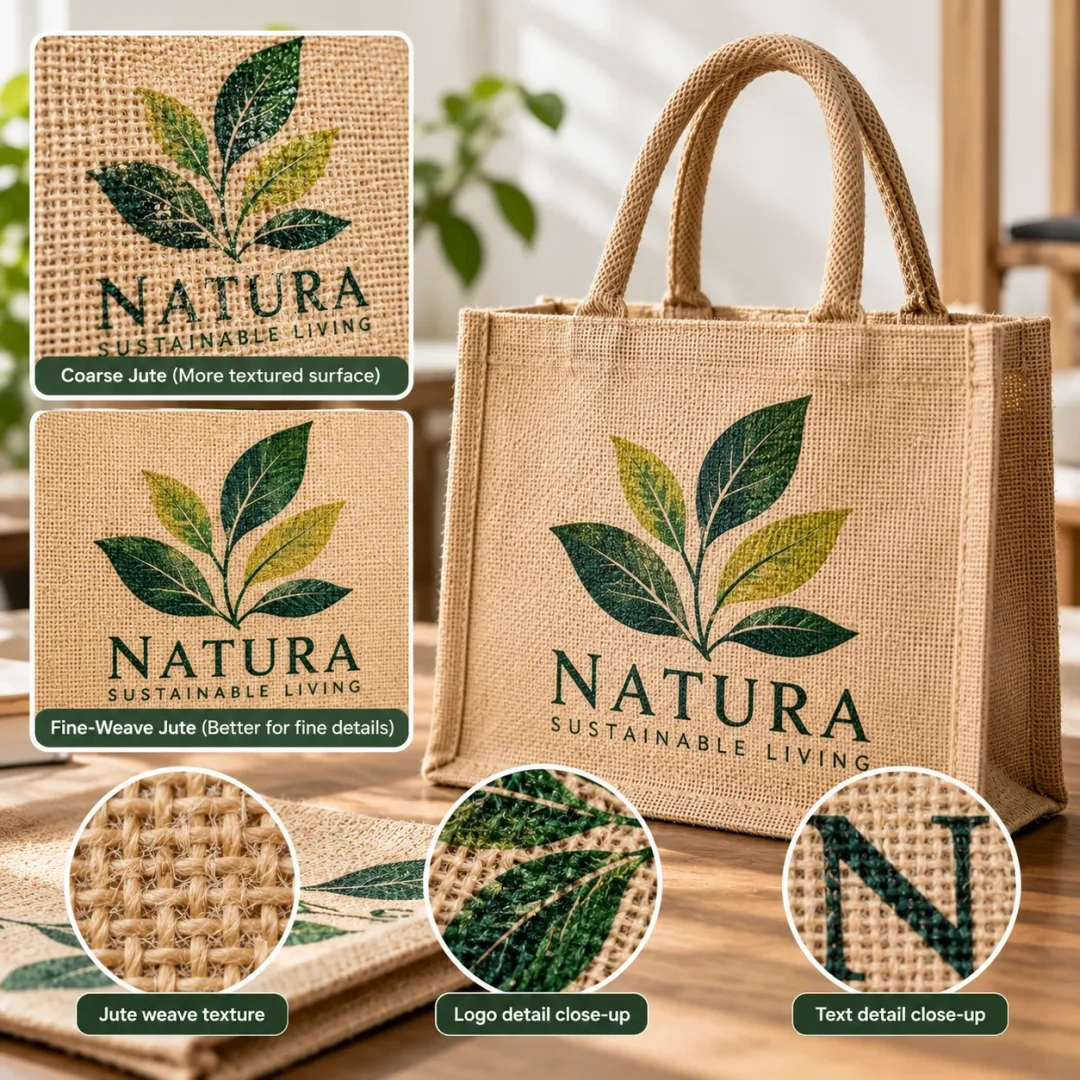
Before choosing a printing method, it helps to understand the surface you are printing on.
Jute Has a Coarse, Uneven Surface
Compared with cotton canvas or polyester, natural jute usually has a much more pronounced weave.
Look closely at a jute bag and you can see individual yarns and small gaps between them. Ink applied to this surface does not land on one continuous, perfectly flat layer.
This becomes particularly noticeable with:
- very thin outlines;
- small lettering;
- closely spaced design elements;
- intricate illustrations;
- fine patterns; and
- small negative spaces within a logo.
A thick line may cross several jute yarns and remain visually continuous. A very thin line, however, may fall partly into the spaces between yarns. From a normal viewing distance, that line can appear broken or irregular.
This is why simply supplying a high-resolution logo file does not guarantee a high-detail print.
The fabric itself can become the resolution limit.
Small Text Loses Definition More Easily
Small lettering is one of the most common problems when printing corporate logos on jute.
Imagine a logo consisting of a large brand name with a much smaller tagline underneath it. The main brand name may reproduce clearly, while the tagline becomes difficult to read.
The problem becomes more noticeable when the font has:
- thin strokes;
- narrow spaces between letters;
- small counters inside letters such as A, B, O, P, or R; or
- delicate serif details.
Increasing the overall print size can sometimes solve the problem without changing the actual logo design.
Natural Jute Color Influences Printed Colors
Natural jute is not a neutral white printing surface. Its tan or brown background influences how printed colors appear.
Dark and high-contrast colors generally remain easier to distinguish. Pale or low-contrast colors may appear less vivid than they do on a digital artwork file.
Color performance also depends on the ink system and whether an opaque base layer is required.
This becomes especially important when a brand has strict color requirements. A Pantone reference can help communicate the intended color, but the appearance should still be checked on the actual jute material.
How Detailed Can a Logo Be on a Jute Bag?
There is no universal answer such as “jute can print lines down to X mm.”
The practical limit varies with the fabric construction, printing process, ink, artwork, and print size.
A better approach is to look at the type of design.
Designs That Usually Print Well
Jute bags are particularly suitable for logos containing:
- bold company names;
- large text;
- solid-color graphics;
- thick outlines;
- simple icons;
- geometric shapes;
- large negative spaces; and
- one- or two-color branding.
These designs work well because minor variations in the fabric surface are much less noticeable.
Designs That May Need Adjustment
More testing may be necessary for:
- thin outlines;
- smaller text;
- detailed line drawings;
- closely spaced elements;
- logos with several small colors;
- fine repeating patterns; and
- artwork requiring precise color registration.
These designs are not automatically unsuitable for jute. Sometimes simply increasing the logo size or selecting a finer weave is enough.
Designs That Are Difficult on Coarse Raw Jute
The most challenging artwork includes:
- hairline details;
- very small text;
- subtle gradients;
- detailed halftones;
- photographic images;
- highly intricate illustrations; and
- designs containing many tiny negative spaces.
If these details are essential to the brand identity, changing the printing process alone may not solve the problem. The jute material may also need to change.
Print Size Matters More Than Many Buyers Expect
Consider the same detailed logo printed at two different widths.
At 4 cm wide, small letters and thin lines may become difficult to reproduce.
At 15 cm wide, the same elements become physically larger and may print clearly.
For this reason, when assessing artwork for production, the question should not simply be:
“Can this logo be printed on jute?”
A more useful question is:
“Can this logo be reproduced clearly at the required size on this particular jute fabric?”
Best Printing Methods for Detailed Logos on Jute Bags
Different printing methods handle detail differently, but there is no single method that is best for every jute bag.
| Printing Method | Detail Capability | Best Suited For | Main Limitation |
|---|---|---|---|
| Screen Printing | Medium | Bold logos, text and solid colors | Very fine details and gradients |
| Heat Transfer | High | Multicolor and detailed artwork | Rough weave can affect the transferred surface |
| Digital Printing | High on suitable surfaces | Complex graphics and gradients | Raw jute texture can limit the final resolution |
| Embroidery | Medium | Premium logos and simple graphics | Tiny lettering and intricate details |
| Printed/Woven Label or Patch | High | Complex branding requiring a clean surface | Adds a separate component to the bag |
Screen Printing
Screen printing is one of the most widely used methods for custom jute bags.
Ink is pushed through a prepared mesh screen onto the bag. Separate screens are normally used for different colors.
Its main advantages on jute include good ink coverage, durability, scalability for bulk production, and compatibility with relatively rough textile surfaces.
It works especially well for:
- company logos;
- event branding;
- retail graphics;
- large lettering;
- solid-color artwork; and
- simple promotional designs.
However, screen printing should not automatically be considered a high-resolution solution.
Very thin strokes can become irregular when they cross the coarse jute weave. Small spaces can fill with ink, while gradients and photographic artwork require additional techniques such as halftones and are more difficult to control on a textured surface.
For many commercial jute bags, the best screen-printed artwork is not necessarily the simplest logo—it is the artwork that has been prepared specifically for the fabric.
Heat Transfer
Heat transfer can reproduce more complex graphics because the image is first prepared on a transfer material and then applied to the bag using heat and pressure.
It can be useful for:
- multicolor logos;
- gradients;
- detailed illustrations;
- small graphic elements; and
- designs that would otherwise require many screen-printing colors.
However, there is an important limitation.
Heat transfer relies on good contact between the transfer layer and the substrate. An extremely coarse or open jute weave does not provide the same smooth contact surface as polyester or tightly woven cotton.
The transferred graphic may therefore follow the texture underneath, and compatibility should be tested before bulk production.
Digital Printing
Digital printing is often associated with detailed, full-color graphics, but the term can be misleading when discussing jute.
A digital printer may be capable of extremely high resolution, but that resolution does not automatically transfer to a coarse textile surface.
On suitable, smoother materials, digital processes can reproduce:
- multiple colors;
- complex illustrations;
- fine graphics;
- gradients; and
- photographic elements.
On coarse raw jute, however, the visible weave can still reduce the apparent sharpness of the image.
Digital printing therefore tends to make more sense when combined with a fine-weave, coated, laminated, blended, or otherwise print-friendly surface.
Embroidery
Embroidery creates a very different visual effect from printing.
Instead of applying ink, the design is stitched into the material with thread. It can create a premium, tactile appearance and may work well for relatively simple logos.
However, embroidery is not automatically better for fine details.
Tiny letters, narrow spaces, delicate lines, and complex illustrations can be difficult to reproduce with thread. Dense embroidery can also affect the structure of lightweight or loosely woven jute.
It is better viewed as a branding option for a particular aesthetic rather than a substitute for high-resolution printing.
Printed Labels, Woven Labels, and Patches
If a logo contains details that simply cannot be reproduced reliably on raw jute, it does not always need to be simplified.
Another solution is to place the branding on a separate, smoother component.
For example:
- a printed cotton patch;
- a woven brand label;
- a printed fabric label; or
- a dedicated smooth front panel.
This allows the bag to retain the natural appearance of jute while giving the logo a more controlled surface.
For brands with strict visual guidelines, this can sometimes be more effective than forcing an unsuitable printing process onto coarse jute.
Which Jute Fabrics Hold Fine Details Best?
“Jute” describes the fiber, but not every jute fabric has the same surface.
The construction of the material can make a significant difference to print quality.
Coarse or Raw Jute
Traditional coarse jute has a pronounced natural texture and relatively open weave.
It is ideal when the desired appearance is rustic and natural, but it provides the least forgiving surface for very fine graphics.
Bold logos usually perform much better than intricate artwork.
Fine-Weave Jute
A tighter weave reduces the size of the visible gaps between yarns and creates a more consistent printing area.
If two bags use jute but one has a noticeably tighter construction, the finer fabric will generally provide better conditions for small elements and cleaner edges.
Juco
Juco blends jute with cotton.
The cotton component can produce a finer and smoother fabric while maintaining much of the natural appearance associated with jute.
For projects where both a natural material aesthetic and relatively detailed branding are important, juco can be worth considering.
Laminated Jute
Some jute bags use lamination for additional structure, protection, or a different surface finish.
Depending on the bag construction and which surface is being printed, lamination or coating can create different printing possibilities.
However, the printing method must be compatible with the specific laminated surface.
Quick Comparison
| Material | Surface Texture | Fine-Detail Potential | Typical Visual Character |
|---|---|---|---|
| Coarse Raw Jute | Very textured | Low–Medium | Rustic and natural |
| Fine-Weave Jute | Moderately textured | Medium–High | Natural but cleaner |
| Juco | Smoother | High | Refined natural textile |
| Suitable Laminated/Coated Jute | More controlled surface | High with compatible process | Structured/commercial |
If maintaining intricate logo details is a priority, changing the fabric specification can sometimes improve the result more than simply changing the printing method.
What Determines the Final Print Quality?
A successful jute bag print is the result of several factors working together.
1. Jute Weave
A tighter, more uniform weave gives the artwork a more continuous surface.
2. Logo Complexity
Bold shapes tolerate surface irregularities better than thin lines, small type, and intricate patterns.
3. Print Size
Increasing the logo size also increases the physical size of its smallest elements.
This can dramatically improve readability.
4. Printing Method
Screen printing, transfer processes, digital methods, and embroidery each reproduce artwork differently.
The method should be selected according to the artwork and material—not simply according to which technology has the highest theoretical resolution.
5. Ink and Color
Ink coverage, opacity, curing, and the contrast between the logo and bag all affect the final appearance.
6. Production Setup
Screen mesh, pressure, artwork separation, registration, temperature, curing conditions, and other production settings can influence the result.
This is why two suppliers using the same general “screen printing” process can still produce noticeably different results.
How to Prepare a Detailed Logo for Jute Bag Printing
Good artwork preparation can often solve problems before production begins.
Use Vector Artwork Whenever Possible
For logo printing, vector files are preferable because they can be resized without losing image quality.
Common formats include:
- AI;
- EPS;
- SVG; and
- vector PDF.
A low-resolution JPG copied from a website may already contain blurred edges before it reaches the printing stage.
Check Thin Lines and Small Text
Look at the smallest elements of the artwork, not just the overall logo.
Ask:
- Are any lines extremely thin?
- Is there a small tagline?
- Are letters tightly spaced?
- Are there tiny gaps that must remain open?
- Does the design depend on fine outlines?
These are often the first elements to change during printing.
Increase the Logo Size When Possible
If the design cannot be altered, increasing its physical size may be the easiest solution.
This is particularly useful for logos containing a small tagline or fine graphic details.
Simplify a Print Version of the Logo
Some brands maintain different versions of the same logo for different applications.
A detailed master logo might be used digitally, while a simplified version is used for embroidery, engraving, or printing on textured materials.
Possible adjustments include:
- thickening very thin strokes;
- enlarging small text;
- increasing spacing;
- removing extremely small decorative elements; or
- reducing unnecessary color complexity.
The objective is not to redesign the brand. It is to preserve the logo’s visual identity under the limitations of the material.
Provide Color References
For color-sensitive branding, provide Pantone or other recognized color references when available.
Keep in mind that the same ink color can look different on natural jute than on white paper or a computer screen.
A physical sample remains the best way to evaluate the result.
Which Printing Method Should You Choose for Your Logo?
Rather than choosing a printing technique first, start with the artwork.
Simple One-Color Company Logo
Typical choice: Screen printing
A bold one-color logo is one of the easiest and most economical designs to reproduce on jute.
Two- or Three-Color Logo With Clear Shapes
Typical choice: Screen printing
Screen printing can still work very well, provided the individual colors and design elements are suitable for registration on the selected jute.
Multicolor Logo With Fine Details
Possible choice: Heat transfer or another suitable full-color process
A transfer process may retain more small graphic elements than conventional spot-color screen printing, although the jute surface still needs to be tested.
Logo With Gradients
Possible choice: Transfer or compatible digital process
Gradients are more challenging with conventional spot-color screen printing and may require halftones. Full-color processes can often reproduce them more naturally.
Small Premium Logo
Possible choice: Fine-weave jute, juco, embroidery, or label
The best option depends on whether the priority is sharpness, texture, or a premium tactile appearance.
Highly Detailed Illustration
Possible choice: Smoother fabric, printed panel, label, or suitable transfer/digital process
If every small detail must remain visible, raw coarse jute may simply be the wrong printing surface.
That is a material decision, not a printing failure.
What If Your Logo Is Too Detailed for Jute?
If a print test shows that important details are disappearing, there are several ways to improve the result.
Simplify the artwork. Remove or enlarge elements that are too small to reproduce reliably.
Increase the print area. A larger logo gives fine elements more physical space.
Choose a finer jute construction. A tighter weave provides a more continuous printing surface.
Consider juco. It can offer a smoother surface while retaining a natural textile appearance.
Change the printing method. A transfer or compatible digital process may suit complex color artwork better than conventional screen printing.
Add a separate branding area. A smooth fabric panel, printed patch, or label can preserve intricate branding without giving up the jute bag itself.
The right solution depends on which part of the specification is flexible: the artwork, bag material, print size, or branding method.
Why Should You Test a Sample Before Bulk Production?
A digital mockup is useful for checking logo placement, scale, and general appearance.
It cannot accurately reproduce the physical texture of jute.
On a computer screen, the artwork is displayed on a perfectly flat surface. On the actual bag, the ink or transfer interacts with individual fibers, weave gaps, color variations, seams, and surface irregularities.
For a detailed logo, a pre-production sample can help verify:
- small text readability;
- line definition;
- color appearance;
- ink coverage;
- color registration;
- print position;
- transfer adhesion; and
- overall visual balance.
This becomes increasingly important as the artwork becomes more complex.
If the branding is critical to the project, it is better to identify a problematic 2 mm design element during sampling than after thousands of bags have been produced.
Frequently Asked Questions
Can You Print Small Text on Jute Bags?
Yes, but there is no single minimum font size that applies to every jute bag.
Readability depends on the font, stroke thickness, printing method, jute weave, ink, and final print size.
Very small or thin text should be tested before bulk production.
Can You Print a Full-Color Logo on a Jute Bag?
Yes. Full-color artwork can be applied using suitable transfer or digital processes.
However, a full-color printing method does not remove the texture of the underlying jute. For highly detailed graphics, a finer or smoother material may provide better results.
Can You Print Gradients on Jute?
Yes, but the appropriate method matters.
Screen printing may reproduce gradients using halftones, while certain transfer or digital processes can handle continuous color transitions more naturally.
Coarse jute can still reduce the apparent smoothness of the result.
Can You Print a Photograph on a Jute Bag?
It is technically possible with suitable full-color processes, but coarse raw jute is not an ideal surface when photographic clarity is the priority.
Fine facial details, subtle tonal changes, and small image elements can be affected by the fabric texture.
A smoother substrate or separate printable panel may be preferable.
Is Screen Printing or Heat Transfer Better for Jute Bags?
Neither is universally better.
Screen printing is often well suited to bold logos, solid colors, larger quantities, and straightforward branding.
Heat transfer can be useful for more complex, multicolor graphics, but its suitability depends on the jute surface and transfer system.
The artwork and fabric should determine the choice.
Why Does My Logo Look Rough When Printed on Jute?
The visible texture may come from the jute rather than from a low-resolution artwork file.
Ink follows the surface of the yarns and crosses small gaps in the weave, so perfectly smooth edges are more difficult to achieve than on paper or tightly woven fabric.
Using a finer weave, increasing the design size, or modifying very thin elements can improve the result.
Final Thoughts
Detailed logos can be printed on jute bags, but the question is not simply whether a printer has enough resolution.
The final result depends on the combination of:
logo complexity + print size + jute weave + printing method + color and ink + production setup.
For bold corporate logos and solid graphics, conventional screen printing often provides a practical combination of appearance, durability, and production efficiency.
For intricate multicolor artwork, gradients, or very fine details, it may be necessary to use a different printing process, select finer jute or juco, increase the print size, or create a smoother branding area.
Most importantly, evaluate the artwork on the actual bag material.
A logo that looks perfect on a digital mockup may behave differently when it meets natural jute fibers. Testing the combination of artwork, material, size, and printing method before bulk production is the most reliable way to achieve a result that remains recognizable, readable, and consistent with the intended brand appearance.
 English
 French
 German
 Japanese
 Arabic
 Thai
 Vietnamese
 Russian
 Spanish
 Portuguese