
Neoprene bags can be a good choice when you want a soft, flexible bag with some built-in cushioning. They are used for everyday totes, laptop sleeves, lunch bags, bottle carriers and small organisers. However, the same padded construction can add bulk, limit ventilation and require more attention to care than the product’s appearance suggests.
The useful question is whether those characteristics suit what you carry and how you use the bag. A close-fitting laptop sleeve, an open beach tote and a lunch carrier do not need the same kind of protection or structure. Calling all three lightweight, waterproof and easy to clean overlooks the details that decide their performance.
This guide examines the advantages and disadvantages of neoprene bags, the conditions behind each benefit, and the practical checks that help you choose a suitable product. It also explains the points brands should confirm when developing a custom design, without assuming every buyer needs a complete laboratory specification.
Neoprene Bags: Pros and Cons at a Glance
A typical fabric-faced neoprene bag uses a rubber foam core bonded to textile on one or both sides. The foam contributes softness, flexibility and cushioning; the face fabric affects appearance, touch, decoration and surface wear. The seams, handles, lining and closure turn that material into a usable bag.
Neoprene properly refers to chloroprene rubber, as reflected in the US National Library of Medicine’s material definition. In commercial bag categories, suppliers may also offer SBR-based foam or blends under similar descriptions. These are not identical compositions. For a deeper explanation of the material and product types, the related article What Is a Neoprene Bag? covers the construction in detail.
For this article, the focus is how a fabric-faced foam bag behaves in use. Its main advantages and trade-offs can be summarised as follows:
| Potential advantage | When it is useful | The trade-off to check |
|---|---|---|
| Softness and light cushioning | A soft barrier around devices, bottles or personal items | Protection depends on fit and construction; it is not a drop-proof guarantee |
| Flexibility | Fitted sleeves and comfortable, softer bag bodies | Flexibility does not provide a rigid base or establish carrying capacity |
| Water resistance at the material level | Incidental moisture exposure in an appropriate design | Fabric faces, seams, zippers and openings can still become wet or admit water |
| Insulating properties | Lunch carriers and bottle holders | Temperature performance depends on the complete design and use conditions |
| Colour and decoration options | Branded products and coordinated bag collections | The process must suit the actual fabric face and laminate |
| Potential for repeated use | Everyday products designed for their intended load | Surface wear, care and construction affect service life |
These are possibilities to evaluate, rather than promises attached to every neoprene product. A benefit matters only if it solves a real need, and a limitation may be manageable through the right design.
Before choosing, consider three questions. What will be carried? What exposure will the bag face? Which performance expectations are essential? Those questions provide a better starting point than choosing by softness, appearance or a thickness number alone.
What Are the Advantages of Neoprene Bags?
1. A Soft Feel and Built-In Cushioning
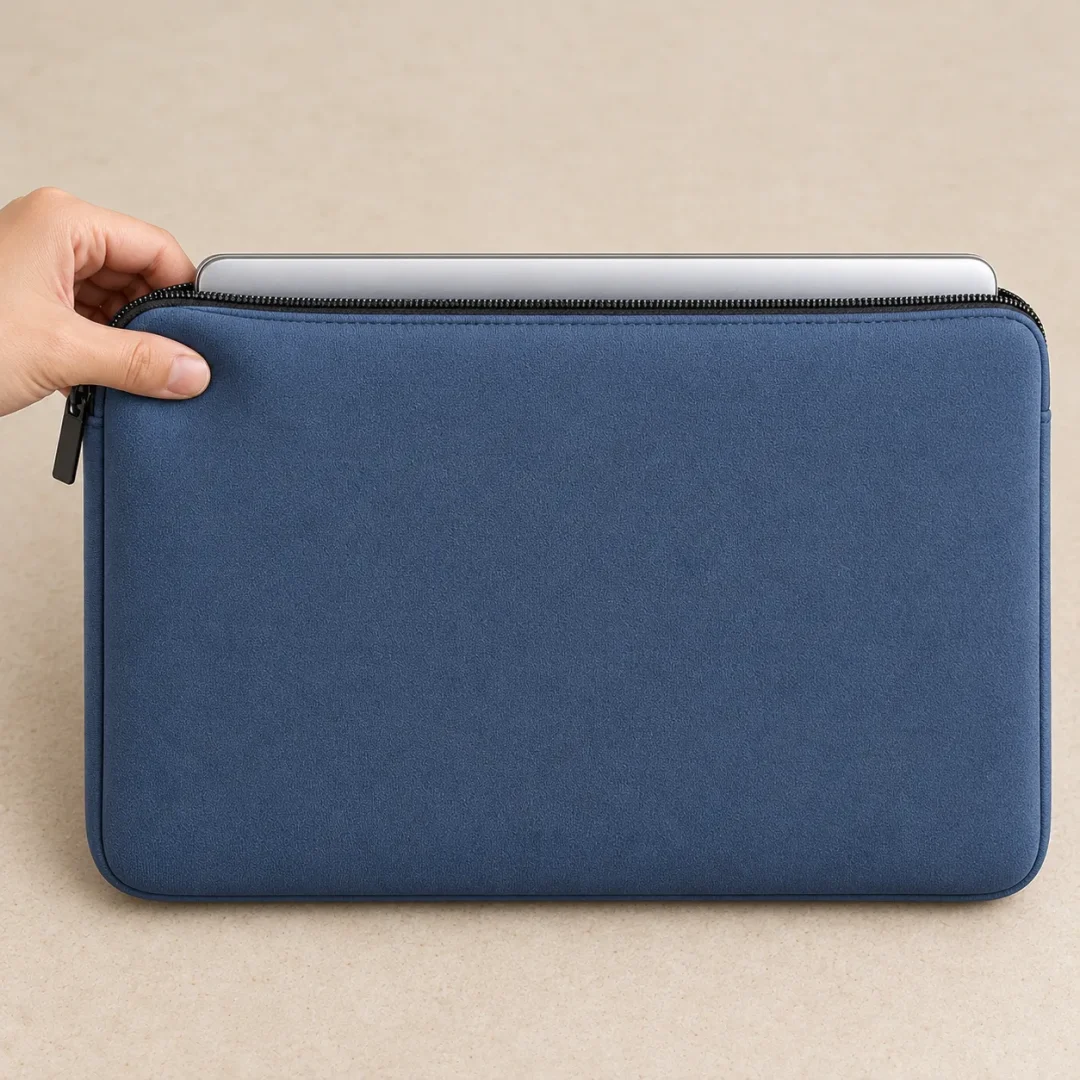
The padded feel is one of the clearest reasons to consider neoprene. Rather than relying only on a thin textile shell, a foam panel already contains a layer that can compress under contact. This can be useful around a laptop, bottle or small accessory, or where the bag rests against the user.
In a protective sleeve, the combination of a soft inner face and cushioning helps create a buffer between the item and surrounding objects. In a bottle carrier, a fitted panel can reduce direct contact with other belongings. In a tote or crossbody bag, the soft body may feel comfortable during casual carrying.
The important limit is that cushioning does not establish a particular level of impact protection. A foam panel has a finite ability to compress, and the contents may still experience an impact through a corner, opening or hard component. The correct fit, coverage and construction all matter.
Cushioning Is Different from Structural Support
Cushioning describes how the material responds to pressure or contact. Structural support describes how the bag holds its shape and carries a load. A material can feel well padded while providing little support to the bottom of a large tote.
For example, a sleeve may benefit from being flexible enough to fit inside another bag. A grocery tote needs handles and a base that behave well under its intended contents. The same material can be considered for both, but it will not solve both jobs without suitable design.
This distinction also helps interpret sample feedback. If a tote sags, the next step may be to review its base, panel geometry or reinforcement. Simply increasing foam thickness may add weight without resolving the load path. If a sleeve feels inadequately protected, the fit and corner coverage may need attention before a different core is selected.
What This Benefit Means for Different Contents
| Contents | Where cushioning can help | What still needs checking |
|---|---|---|
| Laptop or tablet | Soft contact and minor everyday bumps inside another bag | Device dimensions, corner coverage, zipper contact and any required impact protection |
| Bottle | A soft contact layer around the container | Fit, bottom support, carrying method and separation between multiple bottles |
| Small accessories | Protection from rubbing against surrounding items | Internal seams, organisation and hard components |
| Everyday mixed contents | A softer carrying experience | Base shape, handles and load distribution |
Pressing a sample with your fingers can tell you something about feel and recovery. It cannot prove that an electronic device will survive a drop or that a bottle will not break. If protection is central to the product, define the expected exposure and evaluate the complete design accordingly.
2. Flexibility for Different Shapes and Uses
A neoprene panel can bend, and some fabric-faced constructions also stretch. This makes the material relevant to fitted sleeves, curved bottle holders and softer bag bodies. It can accommodate movement without feeling like a rigid shell.
The amount and direction of stretch depend on the foam and textile faces together. A face fabric can restrict an otherwise flexible core. A lining, reinforced edge or zipper can further limit how the finished bag moves. It is therefore more useful to assess the actual bag than infer its behaviour from a loose swatch.
For an everyday tote, a flexible body may be convenient when carrying a varied set of objects. For a sleeve, a modest amount of give may help with insertion. Neither case means the bag should be stretched beyond the size it was designed to hold.
Flexibility Does Not Mean Unlimited Capacity
An overfilled bag may place pressure on the seams, zipper and handle attachments. Contents can also distort the shape or create concentrated contact against the surface. A product that accepts one extra item in a demonstration does not necessarily tolerate repeated overloading.
For a device sleeve, usable internal dimensions are more important than the diagonal screen size printed on the listing. For a lunch bag, check the container through the actual opening. For a bottle carrier, consider the bottle’s shoulder and base as well as its diameter.
Flexibility is also separate from compact folding. Some designs flatten readily; others have thick edges, a firm bottom or accessories that resist folding. A bag may be soft in the hand but still take significant space in luggage.
Where a Flexible Design Adds Value
This advantage is strongest when the contents benefit from a closer fit or the user prefers a soft body. It is less important when the main requirement is a rigid shape, a fixed internal layout or minimum packed volume.
For custom development, test the sample with the intended contents and carrying method. Check whether the opening remains accessible and whether the bag becomes awkward when loaded. The value of flexibility is its effect on usability, rather than stretch as an isolated material feature.
3. Water Resistance for Everyday Exposure
Closed-cell rubber foam can resist water penetration through its body. This can be useful in a bag that may face incidental splashes or contact with damp surfaces. However, the foam core is only one part of the product.
The textile faces can become wet, and the complete bag may have needle holes, zipper openings, exposed edges or an open top. Perforated panels and strip-woven bodies introduce additional openings. Water resistance at one layer therefore does not establish that the contents stay dry.
The benefit should be described in terms of the intended exposure. A casual bag used around a pool may need different protection from a sleeve carried during sustained rain. A bag intended to contain wet clothing needs to prevent leakage from inside, which is another design question.
If your main requirement is separating damp clothing from toiletries or dry belongings, our guide to wet bags vs toiletry bags explains how those different purposes affect bag selection.
Material, Panel and Finished Bag Are Different Test Objects
A loose foam sample can show the material’s behaviour. A laminated panel includes the faces and bond. A finished bag includes the seams, attachments, closure and opening. A result for the first should not be transferred automatically to the third.
Seeing water bead on a face fabric is not a waterproof test. Likewise, a few drops placed across a seam do not establish rain protection under all conditions. These observations can be informative, but they have a limited scope.
When water protection is a key requirement, assess the complete product under relevant conditions. Specify the exposure, orientation and duration as appropriate. An open tote and an enclosed pouch should not receive identical wording merely because they share a panel material.
| Use condition | Relevant design questions | What should not be assumed |
|---|---|---|
| Incidental splashes | How does the surface wet, and where are the openings? | That every item inside remains dry |
| Carrying in rain | What happens at seams, closure and attachment points? | That brief splash resistance establishes prolonged rain protection |
| Holding wet contents | Can liquid escape through the lining, seams or top? | That a beach bag is a leakproof wet bag |
| Immersion | Is the complete assembly designed and tested for the exposure? | That a closed-cell core alone establishes waterproof performance |
These are questions, not a formal three-level rating system. Seam tape, bonding or a protected closure may be useful in a particular design, but the presence of one feature does not guarantee the finished result.
When This Advantage Is Meaningful
For an everyday bag, water resistance may provide reassurance against limited exposure. It is not a reason to ignore openings or leave sensitive items unprotected. For a brand, the benefit is strongest when the product description accurately matches what the actual design can handle.
There is also a trade-off: a less permeable body can make ventilation more difficult. Keeping external moisture out and allowing damp contents to dry are related but different needs. They should both be considered when the bag will hold swimwear or sports kit.
4. Insulating Properties for Lunch Bags and Bottle Carriers
Gas cells in rubber foam can slow heat transfer. Yamamoto’s material information describes the relationship between its closed-cell structure and insulation. This explains why neoprene constructions are used for lunch carriers, drink sleeves and bottle holders. Insulation can help reduce the rate at which contents move towards the surrounding temperature.
It does not actively cool or heat them. A drink sleeve starts with the temperature of the drink placed inside. A lunch bag’s result also depends on the food containers, opening, closure, internal space and any cold source used.
The same product can perform differently in a shaded room and in a hot outdoor setting. Starting temperature, quantity of contents and how often it is opened matter. For this reason, a duration without its conditions is not a reliable basis for choosing or marketing the product.
Why Thickness Alone Cannot Predict a Duration
Increasing insulation thickness can affect thermal resistance, but it also changes size, mass and assembly. A thick panel with an open top may lose heat through the opening. A slimmer enclosed design may serve a different, limited use effectively.
Density, foam structure and other layers also influence the material system. The finished product should be evaluated as a whole rather than assigned a duration from a generic thickness chart.
For a buyer, ask what conditions a published figure represents. For a custom product, agree on the conditions that matter to its intended use. The claim should refer to the actual design and contents, not a result borrowed from another lunch bag or a wetsuit material.
Insulation and Cleaning Are Separate Requirements
A lunch carrier can have useful insulation while still being difficult to clean around corners. It can accommodate an ice pack while allowing condensation to remain inside. These issues do not cancel the material’s thermal contribution, but they affect whether the product works well every day.
Check the lining, access and drying requirements alongside thermal expectations. A bottle holder also needs the right fit and carrying support. Insulation is one reason to choose the material, rather than an explanation for the whole product’s usefulness.
5. Colour, Printing and Custom Design Options
Fabric-faced neoprene offers scope for different colours, textures, graphics and bag shapes. This makes it relevant to branded accessories, coordinated collections and promotional products where the surface feel is part of the appeal.
The visible surface is usually the textile face, rather than bare rubber foam. Its fibre, texture, finish and base colour influence how decoration works. Changing the face fabric while keeping the same foam can change both the feel and printed appearance.
A simple logo, a large graphic and an all-over pattern create different production requirements. Artwork that looks clear on a flat swatch may behave differently across a curved panel or a seam. Decoration should be approved at the scale and position intended for production.
Match the Method to the Actual Surface
| Decoration method | What to evaluate | Possible issue to check |
|---|---|---|
| Screen printing | Ink system, face fabric, artwork and panel movement | Adhesion, definition or cracking under appropriate flexing |
| Sublimation | A compatible polyester face, base colour and heat response | Colour change, show-through or effects on the laminate |
| Heat transfer | Surface compatibility, application conditions and flexibility | Lifting, texture changes or panel distortion |
| Embroidery | Face support, backing, needle penetration and tension | Puckering, compressed foam or loss of detail |
| Applied patch or label | Attachment method, edge treatment and placement | Lifting, discomfort or local stress |
There is no universal rule that a particular method works at one foam thickness and fails at another. Thickness affects processing, but equipment, fabric, artwork and support also matter. Fixed statements such as printing becomes unstable below one number or embroidery always sinks above another need evidence for the exact construction.
Heat-based processes require checking the complete laminate, not only whether the face can receive the graphic. Embroidery should also be trialled rather than presented as automatically suitable. The useful step is a decoration sample on the intended production material.
Consider the Bag When Loaded
A tote’s front panel can bend when filled, and a bottle carrier becomes curved around its contents. A design that is centred on an empty flat panel may not look centred during use. Review both states when branding is important.
For all-over printing, discuss the joins and expected pattern alignment. For a small logo, check its distance from seams, pockets and binding. For a light-coloured surface, consider whether the intended graphic and material make marks particularly visible.
Customisation is an advantage when it produces a useful and consistent product. It is less valuable if it requires an unsuitable process or a design that cannot be reproduced reliably. The approved sample should identify the face fabric and decoration, not just show a digital rendering.
For brands developing a product range, explore our custom neoprene bags to review available bag types and customisation options before defining the sample brief.
What Are the Disadvantages of Neoprene Bags?
1. Thickness Can Add Weight and Bulk
A foam panel occupies more volume than a thin unpadded textile panel of the same area. Depending on the construction, it can also contribute more mass. This may be worthwhile for softness and cushioning, but less helpful when compact packing or the lowest empty weight is the priority.
The effect is more noticeable across a large bag than in a small accessory. Extra material area, lining, handles, pockets and hardware all contribute to the finished weight. A useful comparison therefore considers the complete bag at a similar size and functional level.
It is misleading to say that every neoprene bag is heavier than every woven bag. A heavily reinforced woven design can be heavier than a simple foam pouch. The practical disadvantage is the possibility of additional bulk and mass for a particular design, rather than a universal ranking.
Three Different Weight Measurements
| Measurement | What it describes | When it is useful |
|---|---|---|
| Face fabric weight | The textile mass per unit area | Understanding a material construction or substitution |
| Composite sheet weight | The combined mass of foam, faces and bond per unit area | Comparing identified laminated sheets |
| Finished bag weight | The mass of the complete empty product | Comparing carrying convenience and packed products |
For someone choosing a single bag, finished weight is usually the most relevant starting point. For a brand developing a product, sheet and face information can help explain why two samples differ. Not every consumer needs all three figures.
Published bag weights also need context. A number attached to a small pouch cannot be compared meaningfully with one attached to a large tote. Dimensions, compartments and accessories explain part of the difference.
Check Packed Volume as Well as Carrying Weight
A bag can feel manageable in the hand while taking considerable space when stored or shipped. Thick binding, a firm base and large handles can make it less convenient to flatten. Folding may also conflict with the product’s care instructions.
For travel, try placing the empty bag where you intend to store it. For bulk orders, evaluate representative packing and how the product looks after unpacking. Reducing the carton volume should not leave persistent creases or put stress on the laminate and hardware.
This does not mean the material is unsuitable for travel. It means that a padded carryall and a pocket-sized spare shopping bag serve different needs. Choose the degree of padding and support that the intended use justifies.
2. Limited Breathability Can Affect Damp Contents
A continuous closed-cell foam panel does not provide the open airflow of a ventilated fabric structure. This can matter when the bag is held against the body in warm conditions or when damp items are stored inside.
However, the complete bag’s ventilation depends on more than the core. An open top, perforations, mesh panels and lining layout can change air movement. Limited breathability should be discussed in relation to the actual design rather than as a statement that no moisture can ever leave any neoprene bag.
The difference between external moisture resistance and internal drying is important. A shell that reduces water entry can still hold moisture introduced by a wet towel, spill or ice pack. Textile faces and linings can become wet even if the foam core has low water uptake.
Where Moisture Can Remain
| Moisture source | Where it may remain | What to consider |
|---|---|---|
| External rain or splashes | Fabric face, seams, lining or accessible openings | Exposure requirements and drying after use |
| Wet swimwear or sports kit | Interior surfaces and enclosed pockets | Separate storage where appropriate and prompt emptying |
| Condensation from a cold source | Inner face, base and adjacent contents | Container layout, lining and drying access |
| Food or drink spills | Textile, lining, corners and joins | Product-approved cleaning and complete drying |
Leaving damp contents enclosed can contribute to unwanted odours or mildew under suitable conditions. That is a use and care problem to address, rather than a claim that neoprene itself always absorbs or always rejects every liquid.
Design Features Can Improve Ventilation
Perforations and mesh can create routes for air movement, but they also reduce continuous coverage. A lining described as moisture-wicking may redistribute moisture; it does not automatically remove it from a closed bag. The whole design still needs somewhere for moisture to go.
A separate wet compartment can help organise damp items and protect other contents, but it is not a complete drying solution. Empty it after use and follow the care requirements. If leak containment is required, that compartment needs its own suitable construction.
For gym and pool use, choose according to the real routine. A bag carried home promptly and then emptied faces a different situation from one left closed with wet kit all day. The material’s suitability depends partly on how it will be used.
3. A Soft Body May Need Extra Support
Neoprene can feel substantial because it is thick, but thickness is not the same as a rigid frame. A large bag may droop, bulge or lose a preferred outline when filled unless the base and attachment points are designed for the load.
This is not automatically a defect. Some users prefer a relaxed shape. Others need the bag to remain upright, protect a fixed layout or distribute heavier contents. The design should reflect that expectation.
Handle construction is particularly important. The load must transfer from the handle or strap into the bag body. A padded surface does not establish the strength of that connection, and an attractive seam is not necessarily evidence of an appropriate carrying capacity.
Review the Load Path
For a tote, look at the handle attachments, side seams and base. For a bottle carrier, look at bottom support and separation. For a backpack, consider how the straps connect to the body and whether the back panel supports the intended contents.
A base board, reinforcement, lining or material combination can improve support. These additions also change weight, flexibility, cleaning and cost. They should be part of the product specification and sample review rather than an afterthought.
If the brief requires a rigid shape or demanding load-bearing performance, evaluate whether a full neoprene body is useful. A hybrid design may use the material only where cushioning or soft contact matters. A different overall construction may also suit the brief better.
It is too broad to declare every heavy-load application unsuitable for neoprene. The more precise point is that foam softness alone cannot provide the required support. The complete design must carry the intended load, and its performance needs to be checked accordingly.
4. Fabric Faces and Laminated Layers Can Wear
The foam is only one part of durability. A neoprene bag can develop visible wear at the fabric face, bond, seam or hardware before the core appears damaged. The relevant question is which component is exposed to which type of use.
Pilling and snagging relate primarily to the textile face. Fabric separation concerns the bond or damage to the assembly. Flattened areas can involve compression behaviour. Loose handles or a sticking zipper raise construction and accessory questions.
These are possible wear modes, not a fixed sequence that every bag follows. Their appearance alone may not identify one cause, and their timing should not be predicted from a generic material label.
| Visible change | Component or condition to investigate | Useful development check |
|---|---|---|
| Pilling or fuzz | Face fabric and repeated rubbing | Relevant surface assessment on the production laminate |
| Snags | Textile construction and contact with rough or sharp objects | Surface suitability for the intended use |
| Fading or colour transfer | Colour system, finish and exposure | Appropriate colourfastness evaluation |
| Fabric lifting or bubbles | Bond, processing, flexing or care damage | Lamination behaviour under relevant conditions |
| Persistent flattened areas | Foam response and sustained compression | Recovery and packing review |
| Seam or handle damage | Attachment design, stitching and loading | Finished construction under representative load |
| Hardware failure | Component, fit and operation | Function and cycling appropriate to the product |
Why the Face Fabric Matters
Two bags made with similar foam can have different surface wear because the faces differ. Fibre, knit or weave, finish and colour are relevant. Specifying only the core and thickness leaves much of the visible user experience undefined.
A surface that feels soft in a swatch may show rubbing where it contacts clothing or the underside of a desk. A light colour may reveal marks more clearly than a dark one. These are practical choices to evaluate, not reasons to assume a rougher or darker fabric is always better.
For a custom product, review representative contact areas on the finished sample. If a particular abrasion or colourfastness requirement matters, state it and confirm the relevant method. Descriptions such as scratch-proof or permanently colourfast should not replace evidence.
Lamination and Seams Need Their Own Review
The bond must suit the bending and care expected in use. A clean-looking initial sample can still require evaluation after appropriate flexing or washing. Changing the adhesive or process can matter even when the face and foam remain visually similar.
Seams also need the right stitch, tension and reinforcement. More stitches are not automatically stronger, because closely spaced needle holes can weaken some foam assemblies. The goal is a seam suitable for the material and load, not the maximum stitch count.
Warranty exclusions do not prove that a wear issue will occur or that it is acceptable in every product. They describe a brand’s coverage terms. Product suitability should be judged against the intended use and agreed quality requirements, rather than inferred from warranty wording.
5. Care May Be Less Simple Than Expected
Some neoprene products are washable, but cleaning instructions differ because complete constructions differ. The fabric face, laminate, print, lining, support and hardware may all influence the approved method.
Machine washing should not be assumed from the material name. Equally, one brand’s prohibition does not prove that all neoprene products must never be machine washed. The product-specific instruction is the useful answer.
For example, BUILT explains that its products have different washing requirements and directs users to the guidance for the particular item. Other brands specify hand washing for their own designs. These are instructions for identified products, rather than competing universal rules about the rubber polymer.
Stains and Dye Transfer
The textile surface can show stains or colour transfer. Light colours may make these marks more visible. Dark clothing, especially materials that release dye under contact, can affect a lighter bag surface.
Local cleaning can also leave a visible boundary on some fabrics. A water ring does not mean every neoprene bag needs full immersion, just as a successful wipe on one product does not establish a universal cleaning method. Follow the instructions for the actual finish and assembly.
If no guidance is available, ask before soaking, scrubbing or applying a chemical treatment. Aggressive stain removal can create a second problem. The appropriate response depends on the stain and product, not simply the material category.
Heat, Drying and Storage
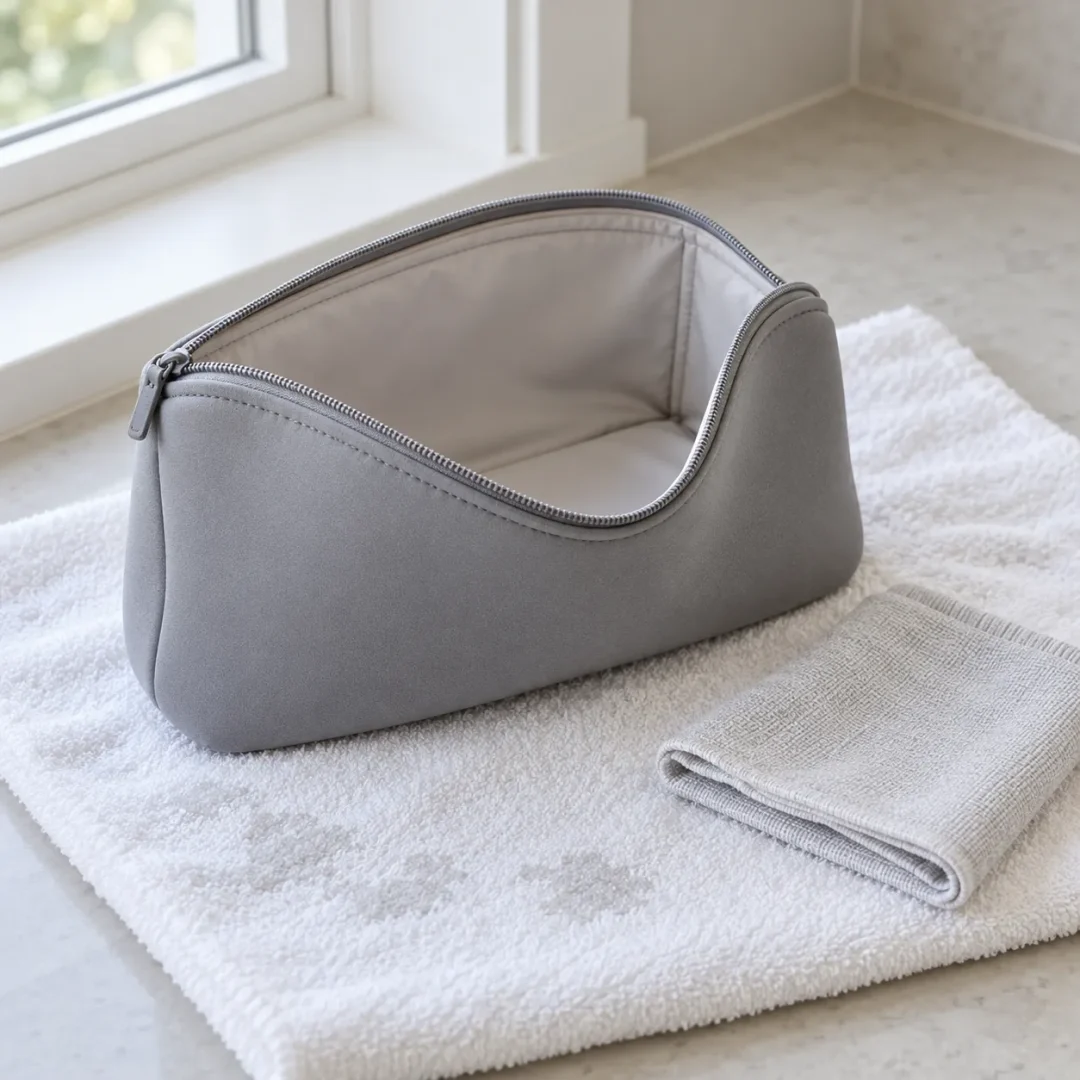
Heat can affect shape, colour, bond or accessories, depending on the construction and conditions. Do not use ironing, steaming or tumble drying as a general recommendation. A technique specifically approved by a brand for its own bag should not be transferred automatically to another design.
Dry the bag completely before storing it. Open pockets as appropriate, and use the position recommended for the product. A supported position can be important for a soft bag when wet. Avoid storage that puts prolonged pressure on the body or strains the hardware.
| Care question | What to confirm | Why a general rule is insufficient |
|---|---|---|
| Can it be machine washed? | The instruction for the exact bag | Hardware, support and laminate can differ |
| Can a mark be spot cleaned? | Suitable method for the face and finish | Some surfaces may develop water rings |
| Can it be soaked? | Compatibility of all components | A washable face does not establish that the full bag tolerates immersion |
| Can heat remove creases? | Explicit product-specific guidance | Foam, adhesive, print and accessories may respond differently |
| Can it be folded for storage? | Design and storage instructions | Flexibility does not establish resistance to prolonged compression |
Easy care is a real advantage only when the approved method fits the user’s routine. For a frequently used lunch bag, cleaning access can be as important as appearance. For a gift item, clear care instructions help the recipient use it as intended.
6. New-Material Odour Can Be a Concern
A new bag may have an odour associated with the foam, bonding materials, finishes, accessories or packaging. Its presence and intensity vary. Smell alone cannot identify the source, prove the composition or establish whether the product meets relevant requirements.
It is therefore unhelpful to promise that every good-quality bag is odourless, or to dismiss every noticeable smell as normal. Both positions overlook differences between products and users’ expectations.
Appropriate airing may reduce some new-product odours, but it is not a guaranteed solution. There is no universal number of days after which every neoprene bag should lose its smell. Strong or persistent odour should be raised with the supplier or brand.
What Buyers Can Do
Before committing to a product, check the finished sample in a way that reflects how it will arrive and be used. A sample aired openly for weeks may not represent one freshly unpacked from a sealed retail package. Packing and storage conditions are part of that first impression.
For a custom order, discuss expectations early. If odour is an important acceptance item, agree on a practical assessment, sample conditions and what action follows an unacceptable result. Ask which material and process controls support the requirement.
Do not treat an odour check as a substitute for material documentation or any relevant chemical testing. These answer different questions. A product can smell mild and still require evidence for a specific claim; a noticeable odour does not reveal a particular chemical result by itself.
Odour can also develop during use if spills or damp contents are left enclosed. That is different from a new-product smell and requires attention to cleaning, drying and the storage routine. Avoid merging the two into one fixed property of neoprene.
7. Cost Needs a Like-for-Like Comparison
The price of a neoprene bag reflects the complete design and commercial terms. Material composition, foam properties, faces, pattern, accessories, decoration and assembly can all affect the quotation. Retail branding and distribution add another layer.
A claim that neoprene bags cost a fixed percentage more than other bags is not useful without a defined comparison. Size, features, quantity and price basis need to be comparable. A basic pouch and a lined multi-pocket carryall are different products even if both use the same category name.
The practical drawback is that the construction may be more than a project needs or can justify. Built-in padding can add value, but it is less relevant when the brief prioritises a low-cost, thin, compact giveaway.
Separate Factory, Distribution and Retail Prices
| Price basis | What needs to be clear | A comparison to avoid |
|---|---|---|
| Factory quotation | Design, quantity, decoration, packing and delivery terms | Comparing it directly with a retail shelf price |
| Decoration or feature addition | Exact process, artwork and component | Treating unlike features as identical surcharges |
| Promotional distribution price | Quantity, decoration, service and fulfilment scope | Comparing it with an undecorated factory unit price |
| Retail price | Brand, product features and sales context | Using it to infer raw material or manufacturing cost |
FOB is a delivery term, not simply a synonym for factory-gate price. A quote using that basis should identify the agreed port and scope. Other quoted bases should likewise be clarified before comparing totals.
What Moves the Cost?
Core and face selection affect material cost and processing. Panel size and layout affect consumption and cutting yield. Pockets, linings and closures add components and assembly. Decoration requires preparation and approval. Special performance expectations may need additional construction and evaluation.
Quantity by colour or design also matters. A total order divided among several versions can create different material and production requirements from one continuous run. Packing can be a meaningful part of a small accessory’s cost, particularly when presentation or individual retail packaging is required.
These variables do not have fixed increments across suppliers. Compare complete designs and ask what the quote includes. A low price is not automatically a poor product; it may describe a simpler brief. The important question is whether it meets the requirement you actually have.
8. Sustainability Claims Need More Than Reusability
A neoprene bag can be used repeatedly, but reuse does not establish biodegradability, recyclability or a lower total environmental impact than another product. Those are separate questions.
A laminated bag may contain rubber, one or more textile faces, adhesive, lining and accessories. Recovering those materials can be difficult, and local collection systems may not accept the product. A theoretical recycling route is not the same as an accessible route for the person disposing of the bag.
The useful disadvantage to acknowledge is the complexity of its end-of-life options and the need for specific evidence behind environmental claims. Avoid a blanket statement that every neoprene product is impossible to recycle, or that every recycled-content certification route is automatically unavailable. The exact material, scheme and supplied evidence must be examined.
Be Precise About What Is Recycled
A recycled polyester face is different from recycled content in the rubber core. A recycled lining is different again. An environmental description should identify the component and percentage it concerns, rather than extend one component’s claim to the whole bag.
If a certification is offered, check its scope and connection to the supplied material or product. The name of a scheme alone does not establish that all components are covered. Likewise, a general supplier certificate is not automatically evidence for a particular bag.
| Claim | What it should explain | What should not be inferred |
|---|---|---|
| Recycled content | Component, amount and supporting documentation | That every part of the bag is recycled |
| Recyclable | Relevant route, conditions and availability | That ordinary household collection accepts it |
| Biodegradable | Applicable evidence and stated conditions | That a reusable synthetic-rubber bag biodegrades readily |
| Alternative feedstock | Exact material and documented scope | That a different input automatically proves lower overall impact |
| Designed for repeated use | Intended durability and use conditions | That reuse alone establishes environmental superiority |
Durability Is Relevant, but Not the Whole Assessment
A product that lasts longer and is actually used can reduce replacement frequency in some circumstances. That is a useful consideration, but it does not independently establish the environmental result across production, use and disposal.
If end-of-life or a specific recycled-content target is central to the project, start with that requirement and assess the complete construction. A soft feel or an eco label should not override a documented material constraint.
For ordinary product copy, the most defensible approach is to state verifiable features. Explain which components contain recycled content, how the bag is intended to be used and what disposal guidance is available. Avoid making broad environmental promises from the name neoprene alone.
When Are Neoprene Bags a Good Choice?
The previous sections explain the material’s profile. This section applies it to the requirements that make a bag useful. The point is not to rank every bag category, but to show which questions matter for each use.
When Softness and Light Cushioning Matter
A fitted sleeve or organiser can make good use of a soft fabric-faced foam panel. It can provide contact protection and light buffering inside another bag without requiring a rigid case.
Check the actual item and the surrounding carrying system. A laptop sleeve needs the right fit and corners. A cable pouch needs an opening and layout that suit the accessories. A bottle holder needs to support the bottle securely rather than merely surround it with padding.
If the brief requires a defined impact performance, assess that requirement separately. A comfortable foam surface is an advantage, but it is not evidence for a drop rating.
When a Flexible Everyday Bag Fits the Routine
For casual everyday carrying, a softer tote or pouch may offer the feel and appearance the user wants. The material is most useful when the bag does not need to maintain a rigid outline and the load matches its construction.
A neoprene beach bag is one example of this softer tote format. When developing a similar design, consider capacity, handle length, closure and small-item organisation alongside the material itself.
Review handle comfort, access and organisation with the bag filled. A roomy main compartment may need a pocket or removable pouch for small items. A closure can improve containment, but also changes access and the way the top behaves.
For a brand collection, a consistent surface and coordinated accessories can be valuable. A matching pouch may complement a tote, while a different shape serves another use. The design should still follow the contents rather than force every product into the same construction.
When Insulation Is One Part of the Brief
Lunch carriers and bottle sleeves can use the foam’s insulating properties. They also need fit, handling and cleaning details that suit the daily routine.
If a user simply wants to slow temperature change during a limited journey, a suitable design may be convenient. If the brief requires a particular temperature profile over a long period, evaluate the finished system, including any cold source and relevant conditions. Do not reject or approve it solely by material name.
The more specific the expectation, the more specific the evidence needs to be. A general statement that a bag is insulated is different from a measured duration under defined conditions.
When Might a Neoprene Bag Be Less Suitable?
When Minimum Weight and Packed Volume Are Priorities
A thick composite body may be unnecessary when the main need is a spare bag that packs into a very small space. Padding, base support and substantial hardware can work against that goal.
The relevant comparison is the complete product. If a neoprene design still meets the packed-volume requirement, it may remain suitable. If it needs extra compression or repeated tight folding that its care guidance discourages, another construction may be more practical.
When Rigidity or Demanding Loads Matter Most
A full foam body may need substantial support to maintain shape or carry a demanding load. The extra components can reduce the advantage of choosing it for softness.
Start by identifying the load and carrying method. A rigid internal layout, sharp contents or frequent heavy carrying may require different reinforcement. The right decision can be a supported neoprene design, a hybrid or another material system, depending on the brief.
When Damp Contents Remain Enclosed
A closed bag that holds wet sports kit for an extended period needs careful attention to ventilation, separation and drying. A continuous foam body may not support that routine without added features.
A dedicated wet compartment can help separate contents, but it still needs emptying and cleaning. Where drying and airflow are the primary goals, consider how the entire design lets moisture escape.
When Immersion or Leak Containment Is Essential
Ordinary seams and openings should not be assumed to keep water out or in. If a bag must function in immersion or contain liquid leakage, those requirements should drive the assembly and test.
Neoprene may be one component of an appropriate system, but a standard sewn product should not be chosen on the basis of a waterproof adjective. The intended water exposure is the key decision.
When a Strict Environmental or Cost Target Leads the Project
If the project requires a particular recycling route, certified content or budget, assess those requirements early. A bag can be attractive and functional while still missing a commercial or environmental target.
Do not postpone the question until branding approval. Changing the main material late can alter feel, shape and graphics. The target and supporting evidence belong in the initial selection process.
Consider Using Neoprene Only Where It Adds Value
Choosing neoprene does not have to mean making the whole bag from it. A design can use it in a bottle holder, protective sleeve, internal component or soft-contact area while using another construction elsewhere.
This approach may retain cushioning where needed while limiting unnecessary bulk. It introduces its own attachment and compatibility details, so the interfaces still need review. The decision should follow the function of each component rather than a preference for one material across the entire product.
A Practical Decision Matrix
| Intended use | Potential value of neoprene | Decisive checks |
|---|---|---|
| Laptop or tablet sleeve | Soft contact and light cushioning | Fit, corners, closure contact and required protection |
| Casual tote | Flexible body and padded feel | Loaded shape, handle comfort, base and finished weight |
| Beach or pool bag | Suitable material behaviour and soft carrying | Structure, sand access, wet-item separation and care |
| Gym organiser | Soft organisation for selected items | Ventilation, damp contents, cleaning and storage routine |
| Lunch carrier | Insulating contribution | Container fit, closure, lining, care and thermal requirements |
| Bottle or wine carrier | Fitted contact layer and some cushioning | Bottle shape, base, handles and separators |
| Promotional product | Distinctive feel and decoration options | Budget, usefulness, branding sample and packing |
| Rigid or heavily loaded bag | Possible cushioning component | Full support system and representative load evaluation |
| Highly compact spare bag | Flexibility in some designs | Actual packed volume and folding requirements |
| Product with a defined environmental target | Potential only where the construction meets the target | Component declarations, evidence and available disposal route |
The table deliberately avoids unconditional verdicts. Bag type alone does not determine suitability. Two totes can have very different loads, support requirements and carrying routines, while two lunch bags can have very different temperature expectations.
How to Choose a Neoprene Bag That Fits Your Needs
Start with the Contents and Carrying Method
List what the bag needs to hold and how it will be carried. Dimensions matter, but so do access and the arrangement of contents. A bag can have enough nominal capacity while making a particular item difficult to insert or remove.
Consider carrying duration and environment. Short hand carrying, an all-day shoulder bag and a sleeve inside luggage place different demands on the design. A comfortable empty bag may become awkward when full.
Then decide which benefits justify the construction. If cushioning is important, inspect fit and coverage. If insulation matters, ask about the complete system. If a soft branded appearance is the priority, confirm that the weight and care requirements are acceptable.
Check the Material and Finished Details
For an individual purchase, inspect usable size, seams, closure, handle connection and care information. For a custom project, record the material composition and production reference as well.
CR refers to chloroprene rubber; SBR is a different rubber system; blend labels need clarification. A name such as SCR should be understood in the supplier’s actual declaration rather than treated as a universal grade. These distinctions matter when a material requirement or performance expectation depends on them.
Thickness should also have a defined basis. Ask whether it refers to the core or the complete laminate. Foam is compressible, so the method and pressure used in measurement can influence the reading. Use a suitable agreed basis for comparisons rather than combine unrelated numbers.
Density, hardness and compression response answer different questions. A higher-density description does not automatically prove a better bag. The face fabrics, base and seams may explain more about the sample’s feel or shape than one core measurement alone.
Evaluate the Sample with Representative Contents
For a tote, observe the base and handles under the intended load. For a sleeve, use the actual device dimensions. For a lunch bag, insert the container and any intended cold pack. For a carrier, check the bottle shape and carrying stability.
Open and close it while loaded. Check whether items press against hardware, whether pockets remain accessible and whether the design changes shape in a way that affects the user or logo placement.
Do not use a casual home check to support a formal performance claim. A finger press, water drop or brief loaded carry can reveal usability questions, but it does not establish a drop rating, waterproof result or carrying capacity. Stronger claims need evaluation appropriate to the intended conditions.
Confirm Care, Branding and Any Essential Claim
Read the care requirements before choosing, especially if frequent washing is expected. Check that the method is realistic for the user and compatible with the complete bag.
For branding, approve the artwork on the production face and laminate at the intended size. Review it on the loaded product where shape changes matter. If colour, flexibility or care performance is important, include those observations in the approval.
For water, thermal, load or environmental requirements, agree on what evidence is relevant. A material sheet, a panel result and a finished-product result have different scopes. Use each for the question it can actually answer.
Sample Checks for Buyers and Brands
The useful part of a detailed specification is that it resolves decisions. A consumer does not need to request every material measurement, and a brand does not need to test every possible property. Select the checks that match the product and claims.
| Check | Choosing a bag for personal use | Developing a custom product |
|---|---|---|
| Intended contents | Try the actual items or confirm usable dimensions | Record contents, dimensions and expected load |
| Material identity | Look for clear, consistent product information | Identify core, faces and important components |
| Thickness and feel | Assess whether padding and bulk suit the need | Agree on thickness basis and approved material reference |
| Base and support | Check loaded shape and carrying comfort | Specify support and review load-bearing construction |
| Seams and edges | Look for neat joins and comfortable contact | Agree on assembly and inspect relevant stress areas |
| Closure and hardware | Operate it with the bag loaded | Check function, fit and relevant component requirements |
| Surface | Consider texture, colour and marks | Evaluate the production face for intended wear and decoration |
| Odour | Raise strong or persistent concerns with the brand | Agree on representative sample assessment if important |
| Water expectations | Understand the stated limits | Match finished construction and evidence to the intended claim |
| Cleaning | Read the product-specific instructions | Confirm care on the complete assembly |
| Branding | Check the visible result | Approve production-material decoration and placement |
| Environmental claims | Look for a specific explanation | Confirm component scope and supporting evidence |
An exposed foam edge is not automatically unacceptable. Some products intentionally use exposed edges or cut strips. The relevant questions are comfort, appearance and behaviour in the intended use. Binding is one possible finish, rather than a universal quality requirement.
Likewise, a neat seam does not rate the whole bag. Load capacity concerns the complete carrying system. Material abrasion, handle attachment and closure function should not be presented as interchangeable results.
For production, keep an approved reference and record important changes. Substituting a similar-looking face, core or adhesive can alter the user experience. Review proposed changes against the actual requirement rather than assume the same category label means the same product.
How to Judge Performance Numbers and Marketing Claims
Numbers can be useful when they have a defined scope. A thickness, empty weight or insulation duration can help compare products, but only if you understand what was measured and under which conditions.
This is especially important for neoprene bags because material-level information is often used to describe finished products. The correction is to ask what object and condition the number represents, rather than discard all numerical information.
| Published claim | Missing context to check | A more useful question |
|---|---|---|
| Waterproof | Exposure, duration and complete assembly | What water conditions was this exact bag evaluated for? |
| Keeps contents cold for a stated time | Starting temperature, environment, load and cold source | Under which conditions was the duration measured? |
| A stated foam thickness | Core or composite basis and method | What does this measurement include? |
| A stated empty weight | Size, compartments, supports and accessories | What complete design was weighed? |
| A high flex-cycle count | Test object, method, conditions and failure definition | Does the result apply to this material or finished product? |
| Recycled or recyclable | Component, amount, evidence and route | Which part does the claim cover and how can it be verified? |
Avoid interpreting a percentage as a waterproof rating unless the supplier clearly explains the recognised measurement it represents. A closed-cell proportion or another material statistic cannot simply become a percentage of finished-bag waterproofness.
The same applies to protection and lifetime. A flex result does not directly predict years of bag use; a core property does not establish zipper life. Numbers are most useful when they answer the actual product question and remain attached to their conditions.
For most everyday purchases, clear product information and a realistic sample review will resolve the main decision. For a brand making a specific claim, supporting evidence needs to match that claim. The level of evaluation should follow the promise, rather than turn every simple bag into an unnecessarily complicated project.
Frequently Asked Questions
Are Neoprene Bags Heavy?
Not all of them. Foam thickness and material area can add mass and bulk, but the finished weight also includes lining, supports, pockets and hardware. Compare complete bags of a similar size and function. For everyday carrying, the empty weight and comfort when loaded are more useful than an isolated material-weight figure.
Are Neoprene Bags Waterproof?
They are not automatically waterproof. The foam core can resist water through its body, while textile faces, openings, seams and closures still affect the complete bag. If immersion or strict protection from rain is required, check that the particular design is intended and evaluated for it. A water-resistant description is not a submersion guarantee.
Are Neoprene Bags Breathable?
A continuous closed-cell foam panel has limited airflow compared with an open ventilated structure. The complete bag may nevertheless include perforations, mesh or an open top that changes ventilation. For wet or sweaty contents, assess the design and drying routine rather than assume the material will let them dry while enclosed.
Do Neoprene Bags Lose Their Shape?
They can change shape with loading, prolonged compression, wear or unsuitable care. The extent depends on the material and support system. A relaxed soft tote and a reinforced bag have different expectations. Follow storage instructions and review the loaded shape before choosing a product that needs to remain upright or maintain a fixed outline.
Do Neoprene Bags Pill or Snag?
The textile faces can pill or snag depending on their construction and contact in use. Those surface changes are distinct from foam damage or delamination. For a custom design, evaluate the actual face fabric and intended contact conditions. The word neoprene alone does not establish surface abrasion performance.
Are Neoprene Bags Easy to Clean?
Some are convenient to clean, but the method depends on the complete product. Fabric faces, prints, lining and hardware can affect the instructions. Some surfaces may develop water rings after local cleaning. Check the guidance before treating a stain and ask the supplier if no suitable method is given.
Can You Machine Wash a Neoprene Bag?
Only when the product’s own instructions permit it. Different designs have different requirements, and a general hand-wash or machine-wash rule cannot cover them all. Hardware, reinforcement, print and laminate need to be considered alongside the foam. Follow the stated washing and drying method for the exact bag.
Why Does a New Neoprene Bag Smell?
The odour may involve the foam, bonding materials, textile finishes, accessories or packing conditions. Its source cannot be established from smell alone. Follow the brand’s guidance and raise a strong or persistent odour with them. Airing may help some products, but a fixed disappearance time should not be assumed.
Can Neoprene Bags Keep Food Cold?
The foam can contribute insulation, but the finished result depends on construction and use. Closure, starting temperature, ambient conditions, contents and any cold source all matter. Check the conditions behind a published duration. An insulated carrying bag is not active refrigeration, and insulation alone does not establish suitable food-storage conditions.
Are Neoprene Bags Suitable for Heavy Loads?
Only when the complete design is suitable for the intended load. Softness and padding do not provide a rigid base or prove handle strength. Reinforcement, supports and attachments may be needed. Check the loaded product, and use appropriate evidence where a carrying capacity will be claimed.
Can Neoprene Bags Be Printed or Embroidered?
Many can be decorated, but the exact face fabric, laminate and artwork determine the suitable process. Sublimation needs a compatible surface; heat processes need laminate evaluation; embroidery needs support and tension checks. There is no universal foam thickness that guarantees a method will work. Approve the decoration on the intended production construction.
Are Neoprene Bags Eco-Friendly?
That cannot be established from the material name or repeated use alone. Ask what specific feature the claim refers to, which component it covers and what evidence supports it. Recycled content, biodegradability and practical recyclability are separate issues. A durable bag may still have limited end-of-life options.
Are Neoprene Bags Worth It for Everyday Use?
They can be worthwhile when a soft body, some cushioning and the particular design fit your routine. They may be less convenient when minimum bulk, rapid drying or rigid support are more important. Assess the contents, carrying comfort, care requirements and complete construction together rather than choose from a general list of material advantages.
Conclusion
Neoprene bags offer a useful combination of softness, flexibility, cushioning and insulating potential. Their value is strongest when those characteristics solve an actual carrying or protection need and the finished design supports it.
The main trade-offs are possible extra weight and bulk, limited ventilation, support requirements and care of the fabric-faced laminate. Cost and environmental claims need their own assessment rather than being inferred from a premium feel or long-life description.
Choose according to the contents and routine, then check the whole bag. For a custom product, keep the material, construction and branding tied to an approved sample. A clear match between function and design is more useful than treating neoprene as universally good or bad.

 English
 French
 German
 Japanese
 Arabic
 Thai
 Vietnamese
 Russian
 Spanish
 Portuguese