
A drawstring bag is a bag that opens and closes by pulling a cord, string or ribbon threaded around its opening. Pulling the cord gathers the top; loosening it allows the opening to spread again. The same mechanism appears on small gift pouches, shoe bags, laundry sacks and lightweight backpacks.
The closure defines the category. Size, material and carrying method can vary considerably. On a typical drawstring backpack, the cords also serve as shoulder straps. On a packaging pouch or dust bag, they may only close the opening.
This guide explains how drawstring bags work, the main formats available, and what to check when choosing one for everyday use, product packaging or a custom bulk order.
ドローストリングバッグとは?
Most fabric drawstring bags have a channel, also called a casing, sewn near the top edge. A cord runs through this channel and exits through openings at one or both sides. Some designs route the cord through eyelets instead.
The body is usually flexible, allowing it to gather as the cord is pulled. A basic bag may have one main compartment, while more developed designs can include a lining, pockets, gussets or separate carrying straps.
A drawstring closure does not exclude other features. A bag can have a drawstring main opening and a zippered front pocket, for example. Equally, a drawstring pouch does not have to be unlined, rectangular or limited to a particular size.
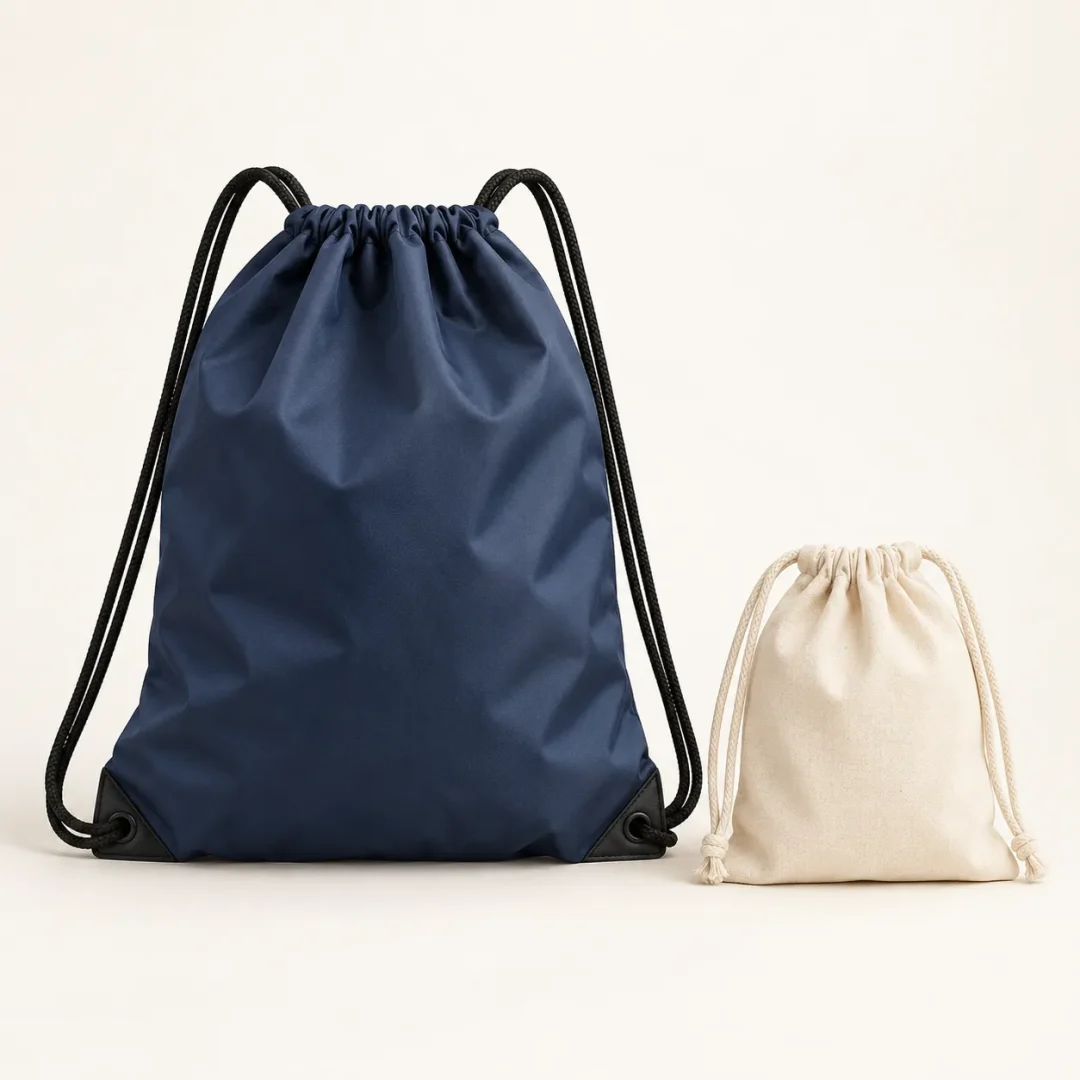
The Main Parts of a Drawstring Bag
| Part | What it does | 確認すべき事項 |
|---|---|---|
| Top channel or eyelets | Guides the cord around the opening | Smooth movement, neat finishing and enough space for the selected cord |
| Drawcord | Gathers the opening; may also act as straps | Material, thickness, friction, comfort and resistance to fraying |
| Cord ends and hardware | Finishes or holds the cord | Knots, cord locks, tips and other fittings should suit the use |
| Bag body | Holds the contents | Finished dimensions, fabric, lining and pocket arrangement |
| Base and attachment points | Supports the contents and carrying forces | Seam construction, gussets and reinforcement where needed |
These parts need to work together. A thick cord in a narrow channel can be difficult to pull. A stiff fabric may resist gathering. A strong body fabric does not compensate for a weak cord attachment.
Single and Double Drawstrings
A single-drawstring design uses one cord routed around the opening. Depending on the arrangement, a cord lock, tie or friction in the casing helps hold the gathered position.
A double-drawstring pouch typically has two cords routed from opposite sides. Pulling the exposed loops away from each other gathers the top. This is common in gift packaging and storage pouches because it provides an easy opening and closing action.
Neither arrangement guarantees a sealed or locked opening. Closure performance also depends on the fabric, routing, cord and hardware.
How Backpack Cords Work
On a typical drawstring backpack, the cords run through the top channel and attach near the lower corners. The long loops become shoulder straps, while pulling them gathers the mouth of the bag.
The lower attachments are important because they carry part of the load. Sewn loops, reinforced patches and supported eyelets are different ways to build these points. The appropriate construction depends on the fabric and expected contents.
Short cords on a gift pouch should not automatically be used as handles. If a bag needs to be carried by its drawstrings, that requirement should be included in the design and sample evaluation.
Drawstring Bag, Cinch Bag, Pouch and Stuff Sack: What Is the Difference?
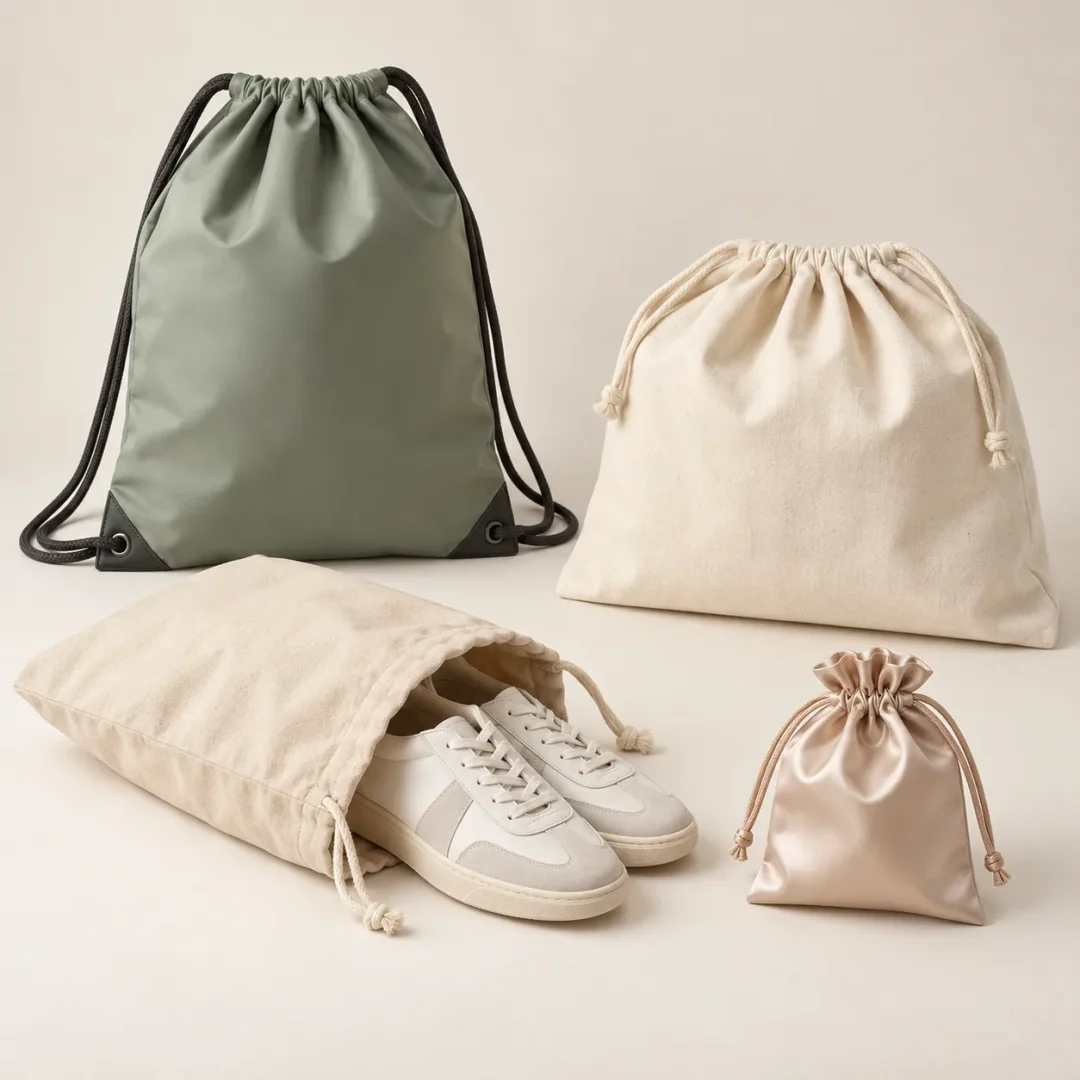
Suppliers and retailers sometimes use overlapping names. The distinctions below help describe the intended product without treating trade names as strict technical standards.
| Term | Usual meaning | What to clarify |
|---|---|---|
| 巾着袋 | Broad category of bags with a cord-gathered opening | Format, dimensions and intended use |
| Cinch bag or cinch sack | Often a lightweight drawstring backpack | Whether the cords are straps; reinforcement is not guaranteed by the name |
| Drawstring pouch | A pouch for gifts, products or storage | Lining, fabric and usable internal space |
| String bag | May mean a net shopping bag or, informally, a cord-strap backpack | Confirm the actual structure with a photo |
| Stuff sack | A sack used to organize or pack clothing and outdoor gear | Closure type, base shape and level of water protection |
| Dust bag | A protective storage cover for products such as handbags and shoes | Fabric suitability and coverage; not all dust bags use drawstrings |
| Laundry bag | A bag for collecting, transporting or washing laundry | Storage and machine-washing designs serve different purposes |
| ダッフルバッグ | A larger carrying format, commonly with handles and a shoulder strap | Main closure and body shape; some sack-style duffels use drawstrings |
A reference photo is especially useful when ordering internationally. A request for a “string bag” could describe two very different products, and the name “cinch sack” does not specify fabric weight, pockets or load capacity.
What Are the Main Types of Drawstring Bags?
Structure and application are two separate ways to classify these bags. A flat or gusseted pouch describes construction; a shoe bag or gift bag describes use. These categories can overlap.
1. Drawstring Backpacks and Gym Sacks
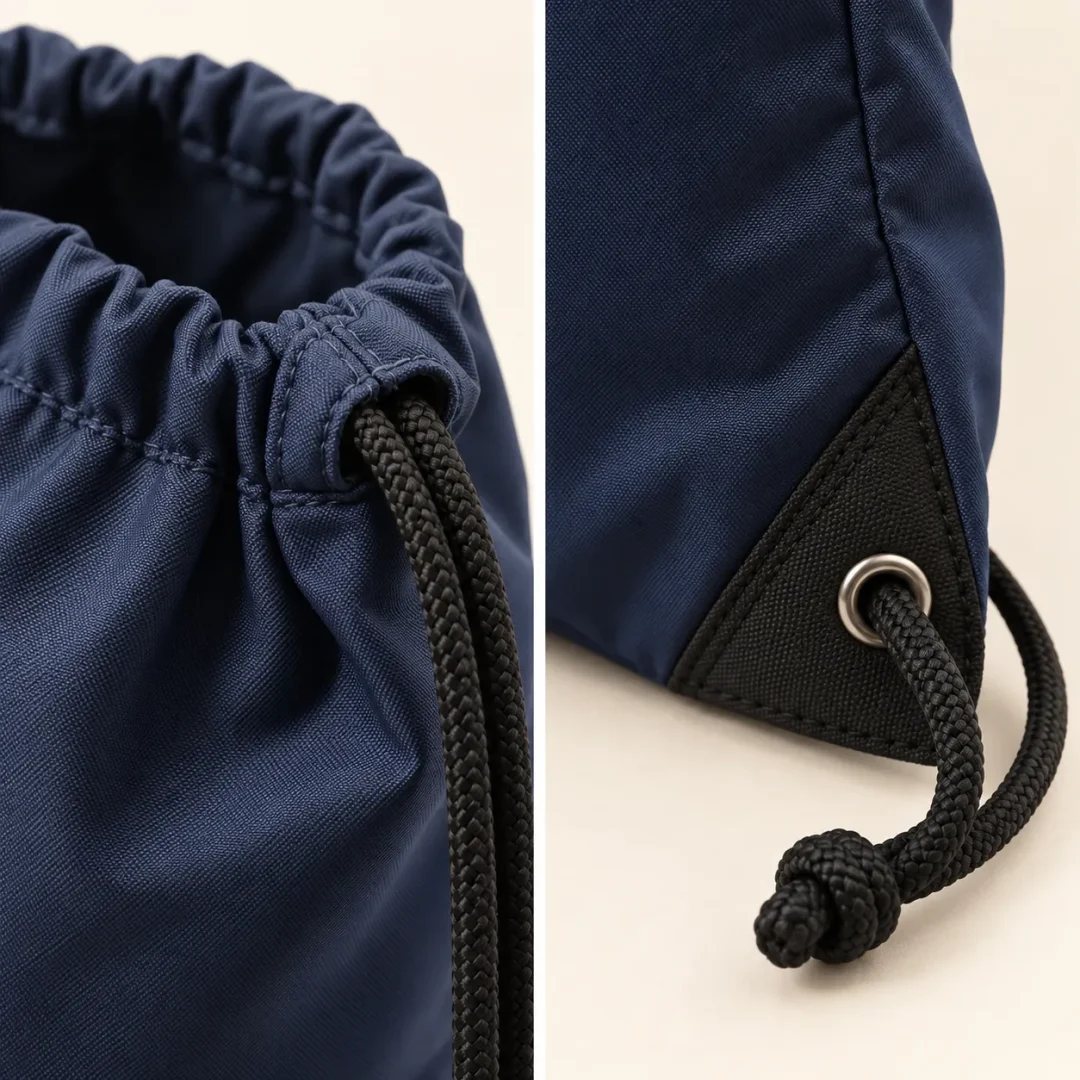
The familiar backpack style has a top opening and cord straps anchored near the bottom. Basic versions pack flat and are useful for a change of clothing, a towel, shoes and other light essentials.
More developed versions can include zip pockets, lining, mesh sections or separate wider straps. Choose these features around the contents and carrying time. A simple cord-strap bag is less supportive than a backpack with padded straps and a structured back panel when carrying dense, heavy items.
2. Flat Drawstring Pouches
Flat pouches work for accessories, gifts, cables and individual products. Their simple body is easy to store when empty, but its shape changes as the contents become thicker.
For boxed products, check the packed depth as well as length and width. A pouch that looks wide enough when laid flat may become tight around a box and leave insufficient fabric to close.
3. Gusseted Drawstring Bags
A gusset adds fabric at the sides, base or both, creating room for bulkier contents. This can be useful for bottles, product sets and storage items.
A gusset does not guarantee that the bag will stand upright. That also depends on the base shape, fabric stiffness and contents. Specify the gusset arrangement clearly rather than adding a depth measurement without identifying where it applies.
4. Drawstring Dust and Shoe Bags
Dust bags cover handbags, shoes and accessories during storage or transport. They need a suitable fit and an inner surface appropriate for the item being protected.
私たちの cotton dust bags for handbags illustrate one packaging format. A soft fabric cover can help reduce contact with dust and other objects, but it does not automatically provide cushioning or a moisture barrier.
Shoe bags separate footwear from clothing inside luggage or sports bags. Some hold a pair together; others are sized for one shoe. Sole width, upper thickness and packing arrangement all affect the required dimensions.
5. Gift and Jewelry Pouches
Small drawstring pouches are used for jewelry, cosmetics, accessories and gifts. Cotton, satin, velvet and organza provide different textures and presentation effects.
Softness should be assessed on the surface that touches the product. Lining, seams, labels and decorative hardware can also affect suitability. For delicate or high-value items, test the complete pouch with the actual product instead of choosing by fabric name alone.
6. Drawstring Cosmetic Bags
Some cosmetic bags are upright pouches; others open into a broad, circular mat and gather into a pouch for carrying. They share a drawstring mechanism but have different patterns, measurements and packing behavior.
Consider whether the user needs upright storage, a wide opening, small internal pockets or a washable lining. A drawstring cosmetic bag is not automatically leakproof, even if its fabric is coated.
7. Laundry and Storage Sacks
Larger sacks hold clothing, bedding, toys or other soft goods. Mesh allows visibility and airflow; opaque fabrics keep contents out of sight.
A laundry collection sack is not necessarily suitable for use inside a washing machine. Machine-washing bags need a compatible fabric and a closure arrangement suited to washing. Likewise, a breathable mesh sack will not contain water from wet clothing.
8. Outdoor Stuff Sacks and Seasonal Gift Sacks
Outdoor stuff sacks organize clothing, sleeping equipment and other gear. They may use a shaped base and lightweight fabrics to fit their intended contents. A drawstring stuff sack is not necessarily a compression sack or dry bag: compression straps and water-protection features are additional requirements.
Seasonal sacks, including Santa sacks, use the same closure on a larger gift-packaging format. The size should fit the complete gift set and allow the mouth to gather. Larger dimensions do not establish carrying strength by themselves.
What Are Drawstring Bags Made Of?
Material selection affects hand feel, appearance, strength, printing and care. It is useful to separate three levels of specification:
- Fiber material: cotton, polyester, nylon or another fiber composition.
- Fabric construction or type: canvas, plain weave, ripstop, Oxford, mesh, satin or velvet.
- Finish and added layers: coating, water-repellent treatment, lamination or lining.
For example, “polyester ripstop with a coating” describes a fiber, a construction and a finish. “Cotton canvas” combines a fiber with a fabric type. Organic cotton describes a sourcing attribute, while RPET usually refers to recycled polyester; neither term specifies the complete bag construction.
| Fabric option | Common reasons to consider it | Details to verify |
|---|---|---|
| Lightweight cotton fabric | Soft pouches, dust bags and reusable product packaging | Weight, weave, opacity, shrinkage and color transfer |
| コットン・キャンバス | A more substantial feel for carrying, storage or gift packaging | Stiffness, gathering action, seams and intended load |
| ポリエステル生地 | Promotional backpacks, sports bags and travel organizers | Yarn specification, construction, finish and print compatibility |
| ナイロン生地 | Lightweight carrying bags and outdoor organizers | Fabric structure, finish, seam construction and actual performance |
| Non-woven polypropylene | Simple packaging and promotional designs | Fabric weight, joining method and resistance to repeated pulling |
| メッシュ | Ventilated laundry, produce and storage bags | Opening size, snagging, strength and visibility of contents |
| サテンかベルベット | Smooth or plush presentation for gifts and accessories | Fiber composition, lining, surface durability and decoration method |
| オーガンザ | Sheer presentation for small gifts | Transparency, seam finishing and suitability for the product weight |
| Linen or linen blends | Textured packaging and storage designs | Exact blend, softness, wrinkles and branding appearance |
| Tyvek or other specialty sheet materials | A distinctive texture or specific packaging requirement | Material grade, fabrication method, fold behavior and printing process |
There is no universal ranking that makes one material best for all applications. A reinforced cotton canvas backpack can be suitable for carrying, while a lightweight nylon pouch may be intended only for organization. Finished performance comes from the material and construction together.
Understanding GSM, Ounces, Denier and T Specifications
These units describe different properties and should not be treated as interchangeable strength grades.
| 仕様 | What it describes | How to use it |
|---|---|---|
| GSM, or g/m² | Fabric mass per square meter | Compare fabric weights while also checking composition and construction |
| oz/yd² | Fabric mass per square yard | An alternative weight unit; confirm that a supplier’s “oz” means oz/yd² |
| Denier, or D | Yarn linear density: grams per 9,000 meters | Describes the yarn, not finished fabric weight or bag load capacity |
| T designation, such as 210T | A supplier’s fabric-density designation, commonly associated with thread count | Ask for the full fabric specification; it is not equivalent to 210D |
For fabric-weight conversion, 1 oz/yd² is approximately 33.9 GSM. Therefore, 6 oz/yd² is approximately 203 GSM and 10 oz/yd² is approximately 339 GSM. These are unit conversions, not performance recommendations.
Denier cannot be converted directly to GSM without additional information about the fabric construction. Nor does a particular GSM or denier guarantee that a bag will last one event, one school year or several years. Seams, abrasion, load, cleaning and frequency of use all affect service life.
Coatings, Linings and Water Resistance
A coating or finish can change water resistance, stiffness and decoration compatibility. A lining may improve the interior finish or separate compartments, but adding one does not automatically create a sealed barrier.
Water-resistant fabric does not make a waterproof drawstring bag. Water can enter through stitched seams and the gathered opening. A suitable finish may help with limited splash exposure, but the required performance should be assessed on the complete bag.
If the job requires keeping contents dry under demanding conditions, select a bag with an appropriate closure, seam treatment and tested level of protection. Roll-top dry bags are a different format, and their protection also depends on design and correct use.
Printing should be checked against the actual printing surface. A coating on the inside does not automatically rule out screen printing on the outside, and coating alone is not a reason to prescribe heat transfer. Ink adhesion, heat tolerance and color migration need to be evaluated for the selected fabric and process.
Drawstring Bag Sizes: Reference Dimensions and How to Measure
There is no single industry standard size. Names such as small, standard and extra large vary between suppliers, so an order should include numerical finished dimensions.
The examples below are starting dimensions to investigate, not INITI sales-frequency data, universal standards or guarantees that a particular product will fit. Dimensions are finished external width × height when laid flat unless another measurement system is agreed.
| 書式 | Example flat dimensions | What to check first |
|---|---|---|
| Small gift or jewelry pouch | 10 × 15 cm, approximately 4 × 6 in | Product or box thickness, lining and closure clearance |
| Accessory or cosmetic pouch | 20 × 25 cm, approximately 8 × 10 in | Complete contents and space above them for gathering |
| Shoe or product-storage bag | 30 × 40 cm, approximately 12 × 16 in | Packed width, length and thickness; one item or a pair |
| Lightweight drawstring backpack | 34 × 40 cm, approximately 13 × 16 in | Contents, wearer fit and cord length |
| Larger carrying or storage bag | 40 × 50 cm, approximately 16 × 20 in | Bulk, carrying comfort and attachment construction |
| Laundry or seasonal storage sack | 50 × 70 cm, approximately 20 × 28 in | Full contents, opening access and lifting method |
Imperial dimensions are rounded. Use one agreed measurement system for production rather than treating the rounded conversions as exact equivalents.
Flat Size Is Not the Same as Capacity
A flat bag has little depth when empty. When it is filled, part of its width wraps around the thickness of the contents, and some height is needed for the top to gather.
Consequently, two bags with the same flat dimensions may have different usable space if one has a gusset, shaped base or different closure position. A liter capacity cannot be calculated reliably from width × height alone.
If capacity in liters matters, agree a measurement method for the finished bag. If product fit matters, a sample packed with the actual contents is usually more useful than a nominal capacity figure.
How to Check the Right Size
- Measure the packed contents. Include retail boxes, protective wrapping and the combined arrangement of multiple items. For a pair of shoes, measure the pair as it will be packed.
- Check thickness as well as length and width. A flat panel must wrap around depth; a gusset changes that geometry.
- Leave room for the closure. The top channel and gathered fabric need space above the contents. The allowance depends on the pattern, fabric and desired closing action.
- Check the opening. The item needs to pass through the mouth comfortably, even if the body is large enough to hold it.
- Evaluate carrying fit where applicable. Check strap reach, bag position and comfort with the intended load.
- Confirm on a filled sample. Check insertion, closure, dimensions and logo visibility before approving production.
Adding a fixed amount to the product measurements is not a reliable rule for every bag. A soft clothing bundle, a rigid box and bulky footwear need different allowances. Our shoe bag size guide explains this fit issue for footwear.
Cord length also needs its own evaluation. It depends on the routing, attachment positions, opening size, tying allowance and intended wearer. A pouch cord and a backpack strap cannot be specified with the same simple multiplier.
How Are Drawstring Bags Constructed?
A typical sewn fabric bag involves pattern development, cutting, body and channel sewing, cord threading, finishing and inspection. Linings, pockets, gussets and decoration add steps, and the sequence varies with the design.
Printing may be applied to panels before assembly, especially where a large area or seam-adjacent artwork is involved. Cord threading often follows channel construction. Some non-woven and film-based bags use different joining processes, so one sewing sequence does not describe every drawstring bag.
Construction Details That Affect Performance
| 詳細 | Why it matters | Useful sample check |
|---|---|---|
| Channel dimensions and finish | Affects cord movement and gathering | Open and close repeatedly; check for snagging |
| Seam type and allowance | Helps hold panels together under stress | Inspect seam consistency and evaluate the intended load |
| Lower cord attachments | Transfers force on backpack styles | Examine reinforcement and pull under agreed conditions |
| Cord and end finish | Affects comfort and fraying | Check feel, slipping and exposed ends |
| Gusset or base shape | Affects packing space and how the bag sits | Fill with the actual contents |
| Lining and pockets | Adds organization or interior coverage | Check access, edges and attachment quality |
Bartacks, reinforced patches and box-X stitching can be useful at suitable attachment points. They are design options rather than universal requirements, and their effectiveness depends on placement, fabric and workmanship.
Where to Look for Wear or Failure
On a backpack, inspect lower cord attachments, corner fabric, side seams and the top channel. On a small pouch, inspect cord exits, seam edges and any point that rubs against the product. Mesh and sheer fabrics need particular attention to snagging and seam stability.
There is no universal safe load for drawstring bags. Specify the expected contents and discuss a finished-sample check, including load, duration and repeated use where relevant. A printed load claim should be supported by testing for that design.
What Are Drawstring Bags Used For?
Gym, Sports and Short Outings
A lightweight backpack can carry clothing, shoes, a towel and a few essentials without the bulk of a structured sports bag. Reinforcement and cord comfort become more important as load and carrying time increase.
For a laptop, heavy books or delicate equipment, suitable padding and support may matter more than packability. A basic cord-strap bag should not be selected solely because the items fit inside it.
Travel and Everyday Organization
Pouches separate footwear, cables, accessories and clothing inside luggage. Different colors or labels can help users identify contents quickly.
For damp swimwear or products that may leak, use a design intended for moisture containment. An ordinary drawstring pouch, or a zippered pouch without suitable sealing, is not necessarily leakproof.
Product Packaging and Gifts
Drawstring pouches can present a product and remain useful for storage after opening. For brands, important details include fabric feel, product fit, gathering appearance and logo placement.
A neatly filled sample is the best way to judge presentation. Excessively tight packaging can make the closure awkward; an oversized pouch can make a small product look poorly matched.
Promotions, Events and Merchandise
Drawstring backpacks and pouches can be used for sports events, exhibitions, welcome kits and branded gifts. Simple designs often have relatively few components and can store flat, but actual cost depends on the specification and order.
A useful bag can encourage reuse. That benefit should not be presented as a guaranteed number of brand impressions or as proof that drawstring bags are always the cheapest promotional item.
Laundry, Home Storage and Seasonal Gifting
Larger sacks organize soft goods, while mesh versions allow airflow and visibility. Seasonal gift sacks provide room for presents and reusable presentation.
Choose the fabric and closure around whether contents will be dry, damp, carried or stored. A sack intended to sit in a wardrobe has different requirements from one lifted repeatedly with a full load.
Printing and Customization Options
Customization can include fabric, finished dimensions, colors, cord, gusset, lining, pockets, labels and packaging. Logo application should be selected around the actual substrate, artwork and expected care.
| 方法 | Often considered for | What needs confirmation |
|---|---|---|
| スクリーン印刷 | Spot-color logos on suitable cotton, polyester and non-woven fabrics | Ink system, adhesion, color count, coverage and curing conditions |
| 熱伝導 | Detailed or multicolor artwork on compatible fabrics | Heat tolerance, film or transfer type, feel and adhesion |
| Digital textile printing | Detailed artwork where a suitable ink and process are available | Fiber compatibility, pretreatment and finishing; “digital” is not one universal method |
| Dye sublimation | Full-color artwork on suitable polyester substrates | Polyester content, base color and process conditions |
| 刺繍 | Logos on fabrics that can support the stitches | Stitch density, backing, size and possible puckering |
| Woven labels or patches | Branding details on suitable attachment areas | Construction, edges, attachment and contact with the contents |
These methods do not share one fixed durability ranking. Results depend on the selected process, material, workmanship and care. For mesh, a separate fabric panel, label or patch may be more practical than printing directly across the openings.
Artwork and Placement
Supply vector artwork where possible, with text outlined and the intended print dimensions stated. Color references help communicate the target, but color approval should account for the fabric and decoration process.
For photographic artwork, provide enough resolution at the final output size; around 300 dpi is a common starting point, subject to the printer’s requirements. Embroidery needs an approved stitch interpretation rather than assuming a vector image transfers unchanged into stitches.
Keep important artwork clear of the drawstring channel, seams and pocket edges. Evaluate placement on the filled bag as well as the flat panel, because gathering and folds can reduce the visible area.
What Affects the Cost of Custom Drawstring Bags?
A useful quotation describes a specific finished bag. Broad prices based only on “cotton pouch” or “polyester drawstring backpack” can hide differences in fabric, construction, decoration and packaging.
| Cost factor | Why it can change the quotation |
|---|---|
| Fabric and finish | Composition, weight, grade, color and treatment affect material sourcing |
| Finished dimensions and pattern | Size, gussets and cutting layout affect consumption and production |
| Cord and hardware | Cord type, length, locks, tips and attachment details vary |
| Lining, pockets and reinforcement | Adds materials and operations |
| ロゴ申請 | Artwork size, color count, positions, process and preparation matter |
| 数量 | Setup and procurement are distributed across the order |
| 梱包 | Individual wrapping, labels, cards and cartons add requirements |
| Delivery terms and destination | Determines which transport and other charges are included |
| Schedule | Material availability and production capacity affect feasibility |
A recycled fabric does not have a fixed percentage premium over virgin fabric. Coating, lining and logo costs likewise should not be treated as standard add-ons across all bag formats.
A Budget Calculation Framework
For planning, separate the components:
Goods subtotal = confirmed finished-bag unit price × order quantity
Project budget = goods subtotal + separately quoted setup or sampling + packing not already included + applicable freight, duties and taxes
This framework is for calculation reference only. Actual prices must be based on the selected custom bag format, materials, dimensions, artwork, quantity and agreed delivery terms. Check what is included in the unit price before adding other charges; setup or packing may already be included.
No fixed dollar ranges or worked order totals are provided here because they could be mistaken for a current quotation. To compare suppliers fairly, send the same specifications and request the same delivery basis.
MOQ and Production Schedule
INITI’s usual starting quantity for custom bag inquiries is 1,000ピース. The applicable minimum should be confirmed for the selected fabric, bag format and decoration requirements.
As an initial planning reference, sampling is approximately 7 days, and bulk production is approximately 25 days after sample approval. The actual schedule depends on material availability, order specifications, quantity and production arrangements. Shipping time is additional.
For event orders, give the required arrival date and destination early. Material selection, sample review and production need to be planned together with transportation.
How to Choose the Right Drawstring Bag
Begin with the use rather than a preferred fabric name. The following questions turn a broad idea into a workable specification:
- What goes inside? Measure the largest packed item or complete kit, including boxes and protective wrapping.
- Will the bag be carried, packaged or stored? Identify whether cords need to act as straps and where the load will be supported.
- How often will it be used? Discuss expected wear and care rather than assigning a lifespan from GSM alone.
- What protection is needed? Separate dust coverage, scratch reduction, cushioning and water protection.
- What should the branding look like? Match the artwork and method to the fabric, visible panel and care requirements.
- What is the agreed budget and quotation basis? Include packing and delivery assumptions when comparing costs.
- When must it arrive? Work backward through shipping, production and sample approval.
INITI supplies カスタム巾着袋 for packaging, promotional and storage projects. A reference photo, packed product dimensions, quantity and logo artwork provide a useful starting point for discussing options.
Care and Washing
Follow the care instructions for the finished bag. Fabric, coating, lining, decoration and hardware can require different treatment, even when two bags use the same main fiber.
| Bag or fabric type | Care considerations |
|---|---|
| Cotton and canvas | Shrinkage and color transfer may occur; confirm whether washing is permitted and whether dimensional stability matters |
| Nylon and polyester | Coatings and prints can limit cleaning methods; check the specified water temperature and drying method |
| Coated or laminated constructions | Gentle surface cleaning may be appropriate; avoid assuming every coating tolerates detergent or abrasion |
| メッシュ | Avoid snagging on hooks or rough fasteners; machine washing requires approval for the complete construction |
| Satin, velvet and organza | Cleaning depends on fiber, finish and trim; gentle spot cleaning may suit some designs |
| Printed or embroidered bags | Follow decoration-specific instructions and avoid direct ironing over heat-sensitive artwork |
Empty and dry the bag before storage. Check seams, cord exits and attachments for wear, and stop using a carrying bag if those points are damaged.
For custom orders, communicate the intended cleaning method during sampling. If washing is part of the use, evaluate appearance, dimensions and functionality after the agreed cleaning process.
よくある質問
Is every drawstring bag a backpack?
No. The name describes the closure. Only designs with suitable straps or cord attachments are intended to be worn as backpacks. Gift pouches, dust bags and laundry sacks can also use drawstrings.
Is a cinch bag different from a drawstring bag?
The names often overlap. Cinch bag commonly refers to the backpack style, but it does not guarantee reinforced corners, water-resistant fabric or a particular load rating. Confirm the actual construction.
Is a drawstring bag better than a zipper bag?
It depends on the contents. A drawstring design can gather around soft goods and open with a simple pull. A zipper can provide more complete closure for small loose items. Neither closure alone establishes security or leakproof performance, and cost depends on the complete specification.
巾着袋は防水ですか?
Not by default. A coated fabric may resist water, while seams and the gathered opening still allow entry. Choose a design tested for the protection required rather than relying on a nylon or polyester label.
ドローストリングバッグにはどれくらいの重さが入りますか?
There is no universal safe load. Fabric, seams, cords, attachment points and carrying conditions all matter. Specify the intended load and evaluate the finished design under agreed conditions before making a performance claim.
What size do I need?
Use the packed contents, thickness and closing space to establish the dimensions. Flat width and height do not directly indicate liters or usable depth. Test a filled sample, especially for rigid boxes, footwear and multi-item kits.
Can drawstring bags have pockets and lining?
Yes. Designs can include inner or outer pockets, lining, gussets and additional straps. A drawstring main closure can also coexist with zippered pockets or other fastening details.
Can a logo be added?
Yes, using a method compatible with the selected fabric and artwork. Printing, transfer, embroidery, labels and patches are options to evaluate. A decoration sample helps confirm placement, appearance and performance.
Are drawstring bags eco-friendly?
They can be reused, but environmental performance depends on materials, production, service life, actual reuse and disposal. Recycled or organic claims need documentation applicable to the supplied product. Reusability alone does not establish a fixed reduction in environmental impact.
What should I send for a custom quotation?
Send the intended use, reference photo, finished dimensions or packed product measurements, fabric preference, logo, quantity, packing requirements, destination and required arrival date. Specify whether the cords will be used for carrying and whether any performance or care requirement applies.
Choosing a Bag That Fits Its Purpose
A drawstring bag uses a cord-gathered opening, but that mechanism supports many different formats. A gym backpack, soft dust bag and gift pouch share a closure while solving different problems.
Choose the format first, then develop the fabric, dimensions, cord and construction around the contents. A filled sample and a clear specification provide a stronger basis for a custom order than broad product names, assumed capacity or generic price ranges.
 Japanese
 English
 French
 German
 Arabic
 Thai
 Vietnamese
 Russian
 Spanish
 Portuguese