
一部の人々は、水筒とタオルを持ってジムに行きます。他の人々は、トレーニングシューズ、着替え、シャワー用品、リフティングベルト、ニースリーブ、ラップトップを入れるスペースが必要です。これらの二人のユーザーは、同じバッグを必要としません—たとえ両方の製品が「ジムバッグ」として販売されていても。“
正しい ジムバッグ は、最もポケットが多いものではありません。通常の荷物に合わせ、実際に分ける必要があるアイテムを分け、完全にパッキングされた際に快適であるものです。.
選ぶための実用的な方法は、次の6つのことを順に考慮することです:
- あなたのワークアウトと日常のルート
- 普段持ち歩くもの
- 最も適したバッグスタイル
- 本当に必要なコンパートメント
- 素材と裏地
- バッグが実際の荷物の下でどのように機能するか
このガイドは、ユーザーとバッグ構造の観点から各決定を説明します。また、同じ決定がどのように実行可能な製品仕様に変換できるかをブランド、ジム、スポーツプログラムに示します。.
あなたのワークアウトと日常のルートから始める
Before comparing fabrics or pocket counts, think about what happens before, during and after your workout. A bag used for a 45-minute class has a different job from one carried from the office to the gym and then home on public transport.
短時間のジム訪問
For a short session, you may only need a water bottle, towel, phone, keys and a few small accessories. A drawstring bag, small backpack or lightweight tote can be enough.
In this situation, a large duffel with a fixed shoe tunnel and several internal dividers may add bulk without adding useful capacity. A simple opening, an accessible valuables pocket and a comfortable way to carry the bag often matter more.
筋力トレーニングと器具が多いワークアウト
Strength training can quickly increase the packing load. Depending on the session, the bag may need to hold:
- Training shoes
- A lifting belt
- Knee sleeves and wrist wraps
- Straps or resistance bands
- A shaker bottle
- A towel and change of clothes
A wide-opening duffel is often practical because rigid or bulky equipment is easier to place horizontally. A larger gym backpack can also work, especially when the user travels by bicycle or public transport.
For this type of use, a stable bottom, reinforced carry points and enough uninterrupted main-compartment space may be more valuable than many small pockets. If a lifting belt is regularly carried, an external strap or a main opening wide enough to accommodate it can solve a real packing problem.
仕事からジムへの通勤
A commuter bag may have to protect office items as well as carry workout gear. Common priorities include:
- A padded laptop compartment
- Separation between clean clothes and used workout clothing
- Comfortable carrying on longer journeys
- Quick access to a transit card, phone or keys
- An appearance that works outside the gym
A gym backpack, structured tote or convertible duffel-to-backpack design can suit this route. The right choice depends partly on transport. Backpack straps distribute the load better when walking, cycling or standing on a train, while a duffel provides easier access to clothing and shoes.
水泳、ヨガ、チームスポーツ
Some activities create very specific storage needs.
For swimming, an easy-to-clean lining and a separate wet-item solution are more important than a shoe compartment. For yoga or Pilates, a mat strap or exterior sleeve may be more useful than a large main compartment. Team-sport bags may need extra capacity, player identification and a large, consistent logo area. Outdoor training can make water resistance, reflective details and accessible exterior storage more relevant.
| Use scenario | Typical load | Suitable styles | Priority features |
|---|---|---|---|
| Quick workout | Bottle, towel and small accessories | Drawstring bag, small backpack or tote | Low weight and quick access |
| Strength training | Shoes, belt, supports and clothing | Duffel or larger gym backpack | Wide opening, stable base and reinforcement |
| Work-to-gym commute | Laptop, workwear and training gear | Backpack, structured tote or convertible duffel | Laptop protection and clean/used separation |
| Swimming | Swimwear, towel and toiletries | Duffel or tote | Easy-clean lining and wet-item storage |
| Yoga or Pilates | Mat, towel, bottle and light clothing | Tote or backpack | Mat attachment and simple organization |
| Team or event use | Uniform, equipment and personal items | Duffel, backpack or drawstring bag | Capacity, identification and branding area |
体のサイズによるのではなく、持ち運ぶものによって容量を選ぶ
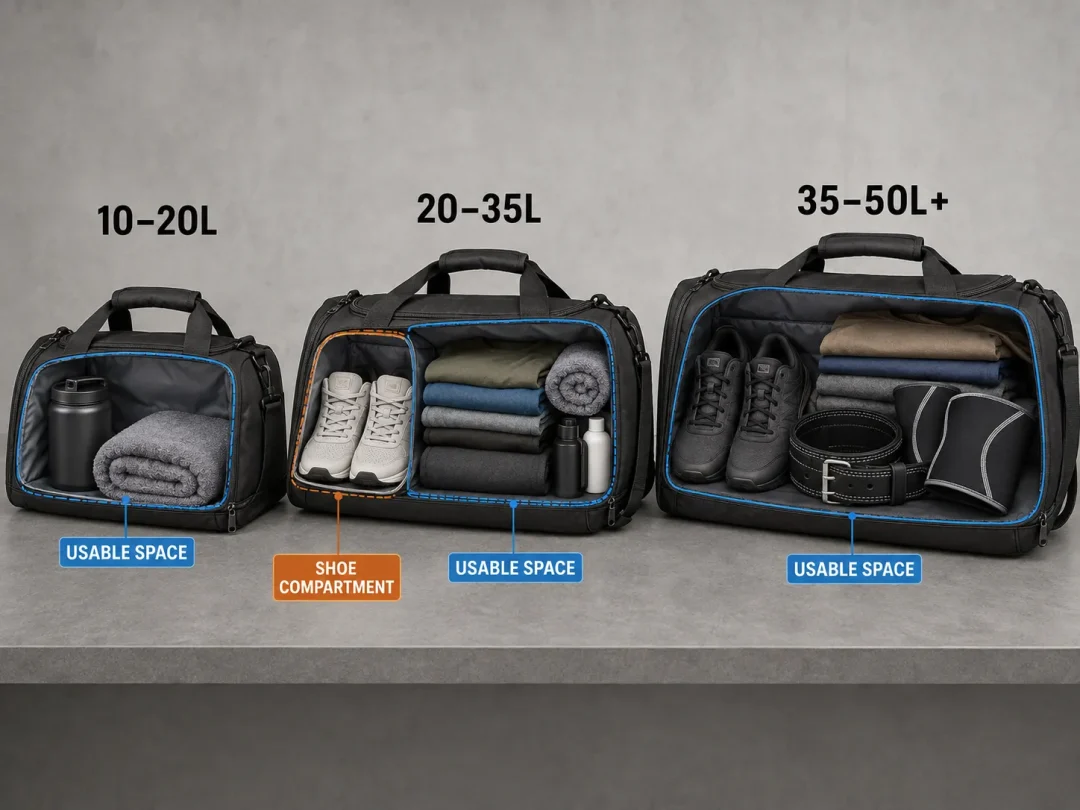
Height alone does not determine the right gym bag size. Two people of the same height may carry completely different loads. Start with a realistic packing list, then allow a little extra space so the bag does not need to be forced closed after every session.
小型ジムバッグ:約10〜20リットル
This range works for light training, short classes and users who arrive already dressed for exercise. It can usually accommodate a bottle, compact towel, phone, keys and a small amount of clothing.
A small bag is easier to store and carry, but it becomes restrictive if shoes or shower items are later added.
中型ジムバッグ:約20〜35リットル
This is a useful everyday range for many gym users. Depending on the shape and internal construction, it can hold training clothes, a towel, toiletries, a bottle and a pair of shoes.
However, stated volume is not the same as usable main-compartment space. A padded laptop sleeve, thick lining or shoe tunnel can take up a significant part of the interior.
大型ジムバッグ:約35〜50リットル以上
Larger bags suit equipment-heavy training, team sports, users who shower and change at the gym, or bags that also serve for short trips. They provide flexibility, but over-sizing has costs: the bag is heavier, easier to overpack and less convenient in a crowded locker room or on public transport.
Capacity should therefore be checked alongside dimensions and layout. Two 30-liter bags can pack very differently when one has a rectangular opening and open main compartment while the other contains a fixed shoe tunnel, padded dividers and a narrow top opening.
Before choosing, also check whether the bag will fit inside your normal gym locker and whether its external dimensions suit any travel restrictions that apply to your route.
For a custom project, do not approve capacity from a calculation alone. Suppliers may calculate liters from the bag’s maximum external dimensions, even though curved panels, padding and internal compartments reduce usable space. Ask how the stated volume was calculated, define acceptable dimensional tolerances in the specification and perform a physical fill test with representative items. Packed dimensions also affect carton size and freight efficiency, so an unnecessarily deep or rigid design can increase logistics costs without improving everyday usability.
適切なジムバッグスタイルを選ぶ
“Gym bag” describes a use, not one fixed construction. Duffels, backpacks, totes, drawstring bags and convertible designs can all work, but each handles packing and carrying differently.
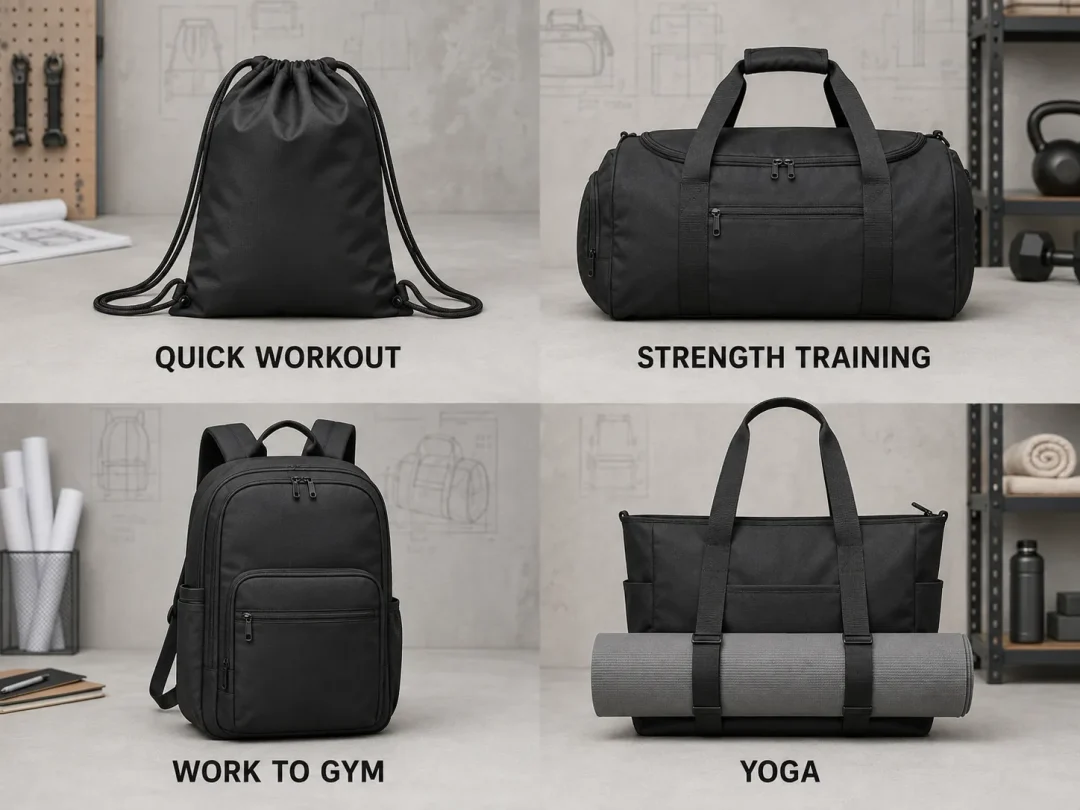
ダッフルバッグ
A duffel provides a large opening and makes it easy to arrange shoes, clothing and bulky equipment. The main space is usually efficient because fewer internal structures interrupt it.
The trade-off appears when the bag is full. Carrying a heavy duffel on one shoulder can become uncomfortable, and a large soft-sided design may feel awkward during a crowded commute. If organization matters, a few well-positioned pockets are usually more effective than dividing the entire main compartment.
ジムバックパック
A backpack distributes weight across both shoulders and keeps the hands free. It is a strong option for cycling, walking and public transport, and it can incorporate a protected laptop sleeve more naturally than many duffels.
The limitation is access. A tall, narrow main compartment can make items at the bottom harder to reach. A shoe compartment built into the base may also reduce the usable space above it. A clamshell or wide-zip opening can improve access, but it changes the construction and cost.
Gym Tote
A gym tote works well for yoga, Pilates, light workouts and work-to-gym routines. Its open shape makes clothing and smaller equipment easy to see, and a structured version can look appropriate in an office or retail setting.
It is less suitable for very heavy equipment or long periods of one-shoulder carrying. Handle length, handle width and the way the handles are attached become especially important when the tote is expected to hold more than light clothing.
ドローストリングジムバッグ
Drawstring bags are lightweight, compact and cost-efficient. They are frequently used for schools, races, sports programs, gym membership kits and promotional campaigns.
Their simplicity is also their limit. Thin cords can become uncomfortable under weight, and the unstructured interior does not protect electronics or organize bulky gear. For a more durable version, reinforced cord channels, stronger bottom corners and a practical fabric weight matter more than adding decorative features.
コンバーチブルジムバッグ
A convertible gym bag can switch between duffel and backpack carrying. This flexibility is useful for users whose route changes during the day.
It also introduces more components: additional straps, buckles, attachment points and a method for storing straps when they are not in use. These features increase weight and cost, so the conversion system should be tested in both modes rather than treated as an automatic upgrade.
パッキングの問題を解決する場合にのみコンパートメントを追加する
Extra compartments can look impressive in a product description, but each divider takes up space and adds material, sewing operations and weight. Begin with the items that must be separated, then keep the remaining main compartment as flexible as possible.
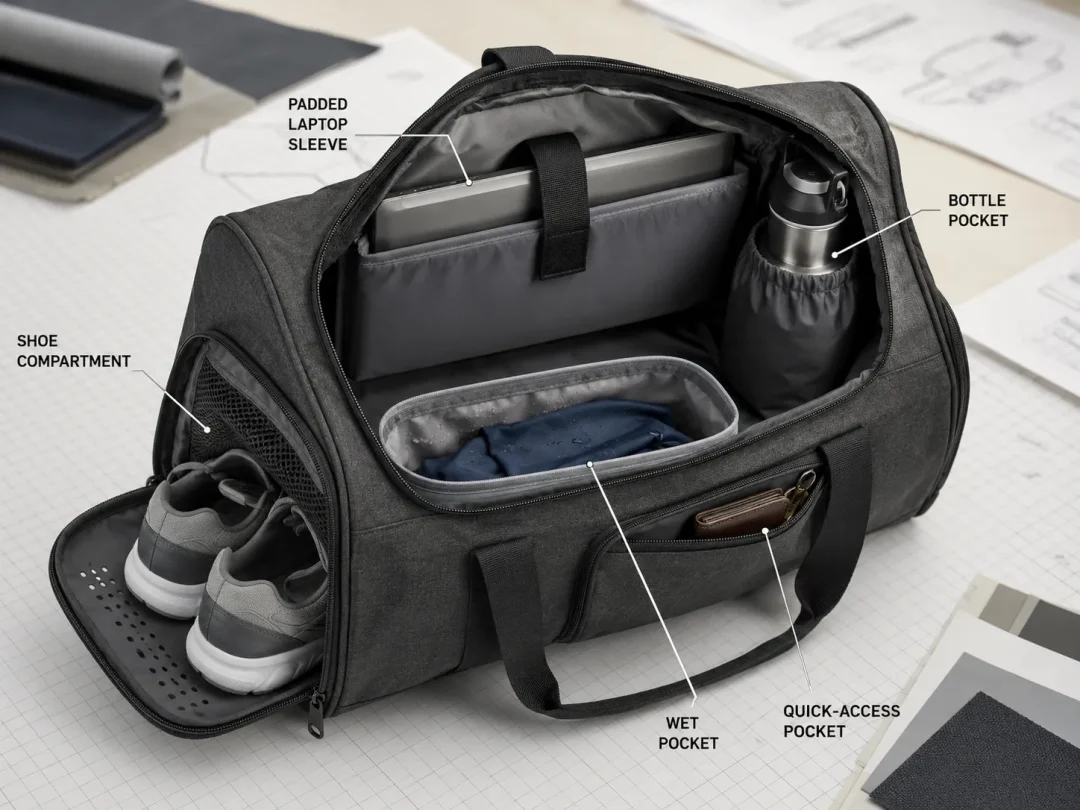
靴用コンパートメントは必要か?
A shoe compartment is useful when the user changes footwear for most sessions. It keeps shoe soles away from clothing and makes the packing routine more predictable.
It is not essential for everyone. If shoes are only carried occasionally, a removable shoe pouch may preserve more usable space. If shoes are never carried, a fixed compartment can become an empty tunnel that compresses the main compartment.
The construction also matters. Some shoe compartments project outside the bag, while others extend into the main body. An internal tunnel looks tidy from the outside but consumes interior volume when filled. Ventilation eyelets or mesh panels can improve airflow, but they do not eliminate odor without regular cleaning and drying.
For a custom bag, the compartment should be tested with the intended shoe size. A design that fits a compact trainer may not accommodate a larger basketball shoe or lifting shoe.
ウェットポケット対撥水ライニング
These terms are often confused.
A coated lining may resist moisture long enough to be wiped clean, but that does not automatically make a compartment leakproof. A separate wet pocket provides better isolation, yet water can still pass through ordinary stitched seams or an unprotected zipper.
If the pocket only needs to hold a damp towel or used clothing for the journey home, a coated and easy-to-clean lining may be adequate. If it needs to contain dripping swimwear, the bag may require a more specialized construction, such as welded material, sealed seams or a separate waterproof pouch.
The required performance should be defined clearly. “Water-resistant” and “leakproof” are not interchangeable specifications.
ノートパソコン、水筒、貴重品ポケット
A laptop sleeve is valuable for commuters, but it should include suitable padding and ideally keep the device slightly above the bottom of the bag. Otherwise, the laptop can take the impact when the bag is placed on the floor.
A bottle pocket needs to match the expected bottle diameter and height. An elastic opening can improve retention, but the bottle must also remain stable when the main compartment is full.
Phones, keys, access cards and earbuds are used frequently, so a small external pocket is often more practical than several internal pockets. Too many small compartments make the bag harder to manufacture, reduce the flexible storage area and may still fail to fit the items users actually carry.
ジムバッグ素材をパフォーマンスで比較する
Material selection affects weight, appearance, abrasion resistance, cleaning and cost. The fiber name alone does not tell the whole story. Fabric density, yarn size, weave, coating, backing and finishing can all change how a material performs.
| 素材 | 主な利点 | Limitations | Common direction |
| ポリエステル | Stable cost, good color options and practical abrasion resistance | Standard polyester is not automatically waterproof | Everyday gym bags and promotional programs |
| ナイロン | Lightweight, tough and available in a range of hand feels | Usually costs more than comparable polyester | Commuter, lightweight and higher-positioned bags |
| オックスフォード生地 | Can provide structure and good wear resistance | “Oxford” describes a fabric style; fiber content and specification still need confirmation | Duffels, sports bags and outdoor-inspired products |
| キャンバス | Natural-looking surface and strong lifestyle appeal | Heavier and slower to dry when wet | Gym totes and casual retail collections |
| RPET polyester | Can support recycled-material requirements when properly documented | The material name alone does not prove the environmental impact of the whole product | Programs requiring verified recycled content |
Terms such as “600D polyester” are useful starting points, but denier alone does not predict the life of a bag. It describes yarn mass, not finished-fabric strength. Two fabrics with the same denier can differ in weave density, backing, coating weight, tear resistance, abrasion performance and hand feel. Buyers should therefore approve a physical swatch and record the complete fabric specification rather than relying on a short material name.
撥水性は防水性を意味しない
Ordinary polyester or nylon should not be described as waterproof simply because it is synthetic. The actual level of protection depends on the complete construction, including:
- Fabric density and weave
- PU, PVC or TPU coating
- Seam construction
- Zippers and openings
- Lining and internal barriers
A coated outer fabric may resist light rain while water still enters through a zipper or stitched seam. Full waterproof performance requires a more coordinated construction and should be tested against a defined standard or use condition.
For many daily gym bags, practical water resistance and an easy-to-clean interior are more useful—and more realistic—than a broad waterproof claim.
If water resistance is a selling point, define the intended exposure before requesting a test. A surface spray test, a hydrostatic-pressure test and a leak test for a finished wet pocket measure different things. The method and pass criteria should match the claim made to the customer; a coated fabric result alone does not prove that the assembled bag or pocket is waterproof.
清掃のしやすさは生地の強度と同じくらい重要
Gym bags regularly encounter sweat, moisture, floors and used clothing. A very strong fabric can still make a poor gym bag if the interior is difficult to wipe, air or dry.
Consider whether the lining can be cleaned without being pulled out of shape, whether the main opening allows air to circulate and whether dirt will become trapped around internal seams. Dark linings may hide marks, but a slightly lighter interior makes small items and stains easier to see.
Odor control depends largely on user habits: emptying the bag, removing wet items, cleaning the interior and allowing it to dry. A ventilation panel can help, but it cannot replace those steps.
リサイクル素材と低影響素材の主張には証拠が必要
RPET can be a suitable option when a project requires verified recycled content, but “made from recycled polyester” should not be treated as proof that the complete bag is environmentally preferable in every respect. Coatings, linings, foam, webbing, thread, zippers and packaging may have different compositions and supply chains.
For business buyers, the practical questions are:
- Which components contain recycled material?
- What percentage is claimed?
- Is the supplier’s certification current and applicable to the material and transaction?
- Can the required transaction documentation be provided?
- Are the proposed marketing claims permitted in the destination market?
Standards such as the Global Recycled Standard can support chain-of-custody and recycled-content verification, but a certificate should be checked for scope and validity rather than used as a general sustainability guarantee.
実際の荷重で快適さと構造を確認する
A gym bag can look balanced when empty and behave very differently when filled. The most useful test is not how it hangs in a product photo, but how its handles, straps, base and opening perform with the intended load inside.
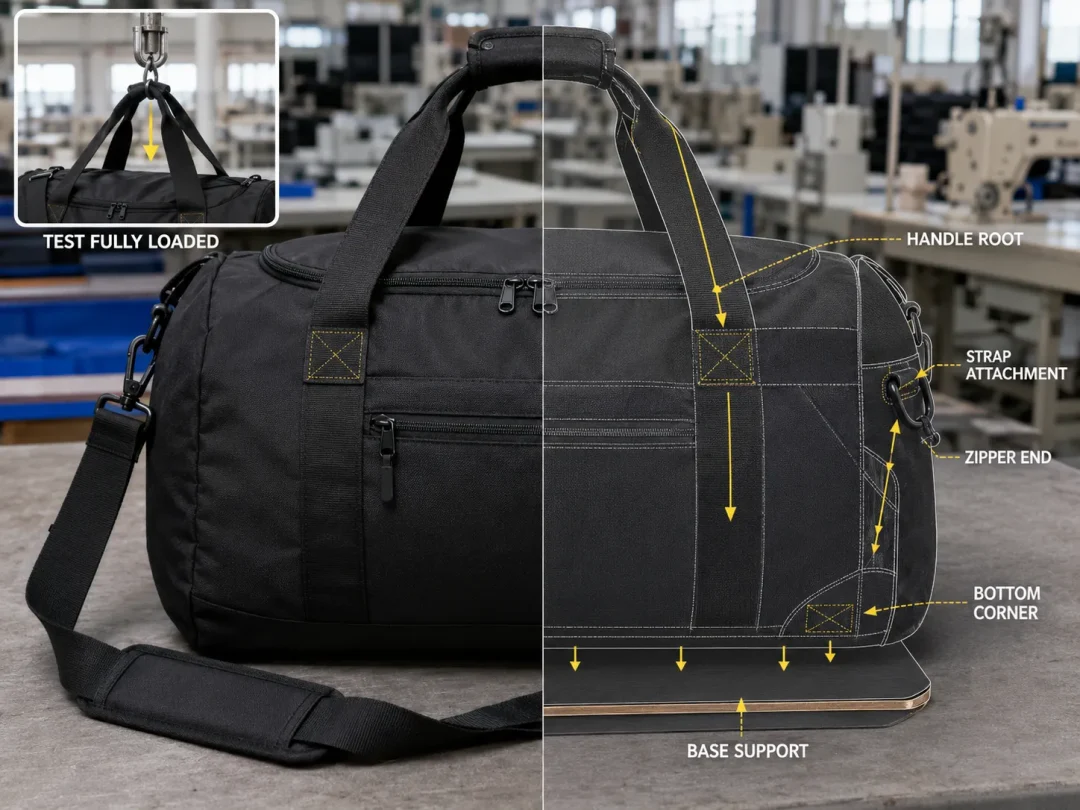
ハンドルとショルダーストラップ
For hand-carry handles, check whether the two sides can be brought together comfortably and whether the handle width suits the expected weight. A padded handle wrap can improve comfort, but it should close securely without becoming bulky.
For shoulder straps, consider:
- Strap width
- Adjustment range
- Whether the shoulder pad stays in place
- Hardware size and strength
- The location of each attachment point
A narrow strap may be acceptable for a light drawstring bag but uncomfortable on a 35-liter duffel. The strap connection must also transfer the load into a reinforced area rather than pull against one small section of outer fabric.
強化ポイント
The highest-risk areas are usually the places where forces change direction or several material layers meet. These include:
- Handle bases
- Shoulder-strap attachments
- Zipper ends
- Seams connecting a shoe tunnel to the main compartment
- Bottom corners
- D-rings and hooks for removable straps
Reinforcement can involve box-and-cross stitching, bar tacks, backing fabric or webbing that continues farther into the bag body. The appropriate method depends on the load, material and visual design. More visible stitching is not automatically stronger if it is poorly placed or unsupported underneath.
ファスナー、ハードウェア、および底構造
A metal zipper is not automatically a higher-quality choice for a gym bag. Nylon coil zippers are flexible and work well around curved openings. Molded plastic zippers create a bolder visual effect and can suit sportier designs. Metal zippers add weight and may be less suitable for some soft, frequently flexed constructions.
Whichever type is used, check the zipper size, slider movement, puller, stitching and how smoothly it passes corners. The two ends of the opening should be reinforced because users often pull hardest at those points.
The base also deserves attention. A second layer of abrasion-resistant fabric can suit an everyday soft bag. A removable board creates a flatter, more stable bottom. Feet can reduce direct surface contact on a structured product, but they add hardware and are not useful on every design.
実用的なジムバッグ選びチェックリスト
Use this checklist before buying a gym bag or approving a new design:
- List what you carry during a normal—not exceptional—workout.
- Decide whether shoes and shower items travel in the bag regularly.
- Consider your route: car, walking, cycling or public transport.
- Choose the bag style that works with that route and load.
- Select capacity based on packed items, not body size alone.
- Add only the compartments that solve a recurring problem.
- Check the outer fabric, coating, lining and cleaning method.
- Try the handles and shoulder straps with the bag fully loaded.
- Inspect the bottom, zipper ends and all load-bearing seams.
- Make sure the bag can be emptied, cleaned and dried easily.
ブランド、ジム、またはスポーツプログラムのためのジムバッグの選び方
When a gym bag is developed for a fitness brand, club, retailer or promotional program, the same selection questions become product specifications. The process should begin with the target user—not with a fabric swatch or logo method.
特徴を選ぶ前にターゲットユーザーを定義する
First decide who will receive or buy the bag and how it will be used.
Is it a lightweight member welcome gift, a retail product for commuters, a team bag or a durable training duffel? Will users carry it daily or only to occasional events? What do they normally pack? What price position and visual style should the product support?
A promotional drawstring bag and a premium commuter gym backpack can both be appropriate products. Problems arise when features from one category are added to the other without a clear reason.
ユーザーニーズを仕様に変換する
Broad requests such as “make it multifunctional” are difficult to sample consistently. Each need should be translated into a measurable feature or construction decision.
| User need | Product specification to consider |
| Going from work to the gym | Padded laptop sleeve, clean/used separation and a restrained exterior design |
| Carrying strength equipment | Wide main opening, reinforced base and space for shoes or a belt |
| Swimming | Easy-clean lining and a defined wet-item solution |
| Event or membership giveaway | Simplified compartments, large logo area and controlled material use |
| Team program | Player identification, consistent color matching and practical capacity |
| Premium retail product | Custom hardware, lining, labels, refined edge finishing and packaging details |
Dimensions should be linked to actual contents. A shoe compartment should be checked with the intended shoe size. A laptop sleeve should be based on device dimensions. A bottle pocket should specify bottle diameter, and strap length should be confirmed against the planned carrying method.
This is more reliable than copying the external dimensions of an existing bag and adding features afterward.
生産前に物理サンプルをレビューする
A complete sample reveals interactions that are difficult to judge from drawings alone. During sample review, check:
- Whether all target items fit without forcing the zipper
- How much main-compartment space remains when the shoe pocket is full
- Whether a wet pocket provides the expected level of containment
- How the handles and straps sit when the bag is loaded
- Whether the base collapses or twists
- Whether zippers move smoothly around corners
- Whether hardware rotates, opens or presses uncomfortably against the body
- Whether the logo remains flat and visible after packing
- Whether colors, materials, lining and trims match the approved specification
The sample should be tested in the way the finished bag will actually be used. A few minutes of inspection on a table cannot replace carrying, opening, packing and repacking it with a realistic load.
見積もり前に建設およびテスト要件を定義する
Quotations are difficult to compare when each supplier is interpreting the product differently. A useful specification should identify not only dimensions and fabric names, but also the details that affect construction and cost:
- Finished dimensions and tolerances
- Main fabric, lining, backing and coating
- Webbing width and strap adjustment range
- Zipper type, size and puller
- Buckles, hooks, D-rings and other hardware
- Reinforcement methods at load-bearing points
- Compartment dimensions and intended contents
- Logo method, size, position and color standard
- Target load and any required performance tests
- Packaging, labeling and destination-market requirements
Avoid prescribing a construction rule without relating it to the material and load. For example, a specific stitch count, thread type or bar-tack pattern is not automatically correct for every fabric. The goal is a tested seam that withstands the intended use without cutting, puckering or weakening the material.
工場がこの種類のバッグを製造できるかどうかを評価する
A supplier may have experience with simple promotional totes but limited experience with structured, load-bearing gym bags. Before placing a production order, review comparable samples and ask how the factory will control the features that create the greatest risk in your design.
Useful checks include:
- Examples of bags with similar materials, straps, compartments and load requirements
- Equipment and processes for cutting, reinforcement and any welded or seam-sealed sections
- How incoming materials, in-process sewing and finished goods are inspected
- How approved samples, color standards and component specifications are controlled during production
- Whether required material, social-compliance or quality-system documents are current and relevant to the actual production site
- Whether the factory can support destination-market testing when the buyer or retailer requires it
Certificates can support due diligence, but they do not replace product-specific sampling and inspection. For a first order or a technically complex design, pre-production confirmation and independent in-line or pre-shipment inspection may be appropriate.
サンプル開発を使用して、コミュニケーションと構造の両方をテストする
Sampling reveals more than sewing quality. It also shows whether the supplier records revisions accurately, flags conflicting requirements and explains the cost or performance consequences of a change.
Keep comments version-controlled and measurable. Replace instructions such as “make the strap stronger” with a defined strap width, material, attachment construction and target load. When a revision is issued, ask the supplier to confirm each change before producing the next sample. This reduces the risk of an approved detail disappearing between prototype and mass production.
購入者のためのジムバッグ評価チェックリスト
Use this second-stage checklist when comparing samples or finalizing a production specification:
- Capacity and dimensions: Fill the bag with representative items and measure it against the agreed tolerances.
- Compartment interaction: Check the remaining main-space volume when the shoe or wet compartment is full.
- Load-bearing construction: Inspect handle bases, shoulder-strap anchors, D-rings, bottom corners and zipper ends.
- Carrying comfort: Walk with the intended load and test every carrying mode and adjustment range.
- Zippers and hardware: Operate them with the bag full, especially around corners and under tension.
- Moisture performance: Test the outer fabric or wet pocket against the specific claim being made.
- Cleaning and ventilation: Confirm that the interior can be reached, wiped and dried after use.
- ブランディング: Check color, placement, registration and appearance when the bag is packed—not only when it is flat.
- Material traceability: Match fabric, lining, webbing and hardware to the approved swatches and specification.
- Packaging and compliance: Confirm labels, warnings, barcodes, carton markings and any retailer or market requirements.
最終推奨
For light training, prioritize low weight, a simple opening and easy carrying. For equipment-heavy workouts, prioritize usable capacity, a wide opening, base stability and reinforced load points. For commuting, pay closer attention to weight distribution, laptop protection, clean/used separation and exterior appearance.
The same principle applies to custom development: begin with the user, route and packing list. Once those are clear, bag style, capacity, compartments and materials can be selected with much less guesswork.
If you are developing a gym bag for a fitness brand, club, retailer or promotional program, イニシ can help turn your target use, packing list and price position into a workable bag specification and complete sample.
よくある質問
日常的なワークアウトに最適なジムバッグのサイズはどれですか?
For many users, approximately 20–35 liters is a practical everyday range. The right size still depends on whether you carry shoes, a towel, shower items, workwear or training equipment. Check usable interior space as well as stated volume because fixed compartments and padding reduce capacity.
ジムバッグにシューコンパートメントは必要ですか?
It is useful if you change shoes during most gym visits. If you carry shoes only occasionally, a removable shoe pouch may be more flexible. A fixed shoe tunnel can reduce main-compartment space even when it is not needed.
ジムバッグに最適な素材はどれですか?
There is no single best material. Polyester offers a practical balance of cost, color and durability; nylon can provide lower weight and good toughness; Oxford constructions can add structure; and canvas suits lifestyle-focused designs. Compare the complete fabric specification, coating and lining rather than relying only on the material name.
ジムバックパックはダッフルバッグよりも良いですか?
A backpack is often better for walking, cycling and public transport because it distributes weight across both shoulders. A duffel usually offers easier access and more flexible space for clothing, shoes and bulky equipment. Your load and travel route should decide which is better.
Can a gym bag also be used as a carry-on?
Many medium duffels and backpacks can serve both purposes, but eligibility depends on the bag’s external dimensions and the airline’s current rules. Measure the bag when packed, since a soft-sided gym bag can expand beyond its nominal dimensions.
How do you test a custom gym bag sample?
Pack it with the intended items, then carry it using every handle and strap. Check space loss from filled compartments, zipper movement, base stability, seam stress, hardware, comfort and logo appearance. Also confirm materials, colors, measurements and the expected water-resistance or wet-pocket performance before mass production.
 Japanese
 English
 French
 German
 Arabic
 Thai
 Vietnamese
 Russian
 Spanish
 Portuguese