
When you order custom bags, an HS code can seem like a small detail to add to the shipping documents. It becomes much more important when your supplier and customs broker suggest different codes—or when the duty estimate changes after you have already agreed on a selling price.
Many reusable shopping, travel and insulated bags are examined under heading 4202, and 4202.92 is a relevant six-digit starting point for certain bags with textile or plastic-sheeting outer surfaces. However, neither code covers every product called a bag. Packaging sacks, disposable plastic carriers and paper bags have separate classification routes.
The useful question is therefore not simply “What is the HS code for bags?” It is “Which tariff description matches this finished bag, and what information supports that choice?”
This guide focuses on the products custom bag buyers actually source: cotton and canvas totes, non-woven and PP woven shoppers, drawstring bags, cosmetic pouches, garment bags and coolers. It explains what to check before requesting a code, how to resolve common ambiguities, and how to prepare a useful file for your customs broker.
Jump to: classification logic · materials and coatings · bag-type examples · broker specification · U.S. base rates · cost calculation
What Does a Bag HS Code Tell You?
An HS code identifies a category of traded goods within the Harmonized System. Its international classification runs to six digits; individual customs territories add subdivisions for their own declarations and tariffs.
| Level | Example | What it tells you |
|---|---|---|
| Chapter | 42 | Broad classification family |
| Heading | 4202 | A group of bags, cases and similar containers |
| HS subheading | 4202.92 | A narrower category within that heading |
| National or regional classification | Additional digits | The local subdivision required for the relevant declaration |
For U.S. imports, the relevant system is the HTSUS, with ten-digit reporting numbers. Schedule B is the U.S. export system; it is not the code system a Chinese supplier uses for its own exports. Trade.gov explains these distinctions.
The six-digit framework is harmonized, but that does not make a supplier’s classification automatically binding in another country. Differences can arise from national subdivisions, the product information reviewed, or how customs applies the rules.
For a quotation, a proposed six-digit code may help start a discussion. Before shipment, the importer needs the classification appropriate to the destination and the actual goods being entered.
Start with the Bag’s Function, Then Narrow the Code
A practical classification review asks three questions in sequence:
- What finished article is this? A shopping carrier, handbag, travel container, protective cover or sack for packing goods?
- What is its relevant material and construction? Consider the outer surface, fiber composition, coatings, lining and functional features.
- Which destination-country subdivision applies? Read the full tariff hierarchy and relevant notes before selecting the final number.
This sequence organizes your research; it does not replace the legal interpretation rules. A customs classification must follow the tariff wording and applicable notes, rather than whichever product description sounds closest.
The main headings to investigate
| Classification route | When it becomes relevant | What buyers should establish |
|---|---|---|
| 4202 | Carrying bags, cases and similar containers | The actual type of container and its outer surface |
| 6305 | Textile sacks and bags of a kind used for packing goods | Whether the article serves the packing function described by this heading |
| 6307 | Other made-up textile articles not more specifically covered | Why a more specific provision does not apply |
| 3923 | Plastic articles for conveying or packing goods, including certain bags | Plastic construction and packaging function; applicable exclusions |
| 4819 | Paper or paperboard packing containers, including bags | Paper construction and relevant dimensions |
These routes come from the official provisions for Chapter 42, Chapter 63, Chapter 39 and Chapter 48. They are alternatives to investigate, not interchangeable codes.
For example, “packaging” in a purchase order may mean a printed retail tote, a simple protective pouch, or an industrial shipping sack. Record the actual article and how it is used before assuming all three belong to a packaging heading.
Likewise, “reusable” is not a universal classification test. It is useful evidence of design, but a reusable article still has to satisfy the relevant heading. A textile packing sack can be used more than once; that fact alone does not make it a shopping bag. Similarly, branding, low price or simple stitching does not independently determine a heading.
Why the wording of heading 4202 matters
Heading 4202 has two parts. The first names containers such as suitcases and certain fitted cases without the same material limitation as the second. The second includes shopping and travel bags and requires the specified materials or coverings. Matching the bag’s function is therefore only part of establishing that the heading applies. Source: HMRC’s explanation of heading 4202.
For a buyer, the practical consequence is simple: provide the whole construction, including backing and coverings, before moving to the narrower outer-surface question. “What the bag is made of” and “what forms its exterior” are related questions, but they are not always identical.
When plastic carriers are excluded
Chapter 42 Note 3(A)(a) directs plastic-sheet bags with handles that are not designed for prolonged use away from 4202 and into 3923. The material, handles and design-for-use conditions must be considered together. Passing this particular exclusion test does not, by itself, establish that every other requirement of 4202 is satisfied. Source: WCO Chapter 42 notes.
Do not use a single GSM or thickness threshold as a worldwide test of prolonged use. Instead, document the actual body construction, seams, handle attachment and intended service. Those facts support the review; a printed “reusable” claim cannot replace them.
An unlaminated non-woven polypropylene fabric is not simply plastic sheeting because its fibers are made from a polymer. Record the material’s physical form. The same distinction matters for recycled polyester fabric and plastic film made from recycled resin.
What is the difference between 4202.22 and 4202.92?
Within heading 4202, 4202.22 concerns handbags with textile or plastic-sheeting outer surfaces, while 4202.92 concerns the “other” container branch with those outer surfaces. The distinction starts with the type of article, not just the fabric. Source: WCO Chapter 42.
A supplier’s catalog may call a large grocery shopper a “handbag” simply because it has handles. That wording does not settle its tariff identity. Give your broker dimensions, photographs and a realistic description of what it carries so that the correct branch can be evaluated.
Neither “tote” nor “large” gives an automatic answer. Canadian guidance expressly recognizes that handbags can be smaller or larger and discusses totes in that context. It is a useful reminder to check the importing country’s interpretation rather than inventing a universal size cutoff. Source: CBSA Memorandum D10-15-29.
For example, describe a structured personal bag with compartments for a wallet, phone and keys differently from a broad grocery carrier. Provide the same objective details even when your marketing department calls both products “totes.”
How to Describe Materials Without Creating Classification Confusion

“Canvas,” “Oxford,” “RPET” and “waterproof” describe different aspects of a material. None provides a complete specification on its own.
For sourcing purposes, separate four pieces of information: fiber or polymer, fabric construction, exterior treatment, and interior layers.
| Supplier description | Information to request | Example of a clearer specification |
|---|---|---|
| Canvas | Fiber percentages and any coating | 100% cotton woven canvas; no exterior coating |
| 600D Oxford | Fiber type and coating location | 600D polyester woven fabric; PU coating on the reverse |
| Non-woven | Polymer and any lamination | Spunbond polypropylene fabric; no film laminate |
| RPET | Recycled material composition and fabric form | Woven recycled polyester fabric; uncoated exterior |
| PU material | Surface layer and backing | PU-coated polyester backing; coating exposed on exterior |
| Felt | Fiber composition | Needle-punched polyester felt |
| Laminated PP | Base construction and film position | Woven PP base with BOPP film on the outside |
These are illustrative specifications. Use the actual manufacturer’s material data rather than copying an example into an invoice.
Outer surface is different from lining
For containers where the tariff subdivision depends on outer surface, the relevant question is what forms the outside of the finished article. A polyester bag does not become a plastic-surface bag merely because it contains a PEVA lining.
HMRC’s guidance explains the role of the visible exterior and the treatment of certain plastic coatings or coverings. A fabric backing alone does not establish that the exterior should be treated as textile. See the official outer-surface guidance.
For a coated or laminated bag, provide a close-up of the exterior and a labeled material swatch. Describe which face is exposed after sewing. A photograph of a fabric roll without identifying its face and reverse can create more confusion than it resolves.
For mixed exteriors, such as jute panels combined with canvas panels, show the complete layout. Do not instruct the broker to choose whichever material weighs the most without first checking the rule that applies.
Coated canvas: compare the construction before comparing the duty
Two bags can use the same cotton base cloth but present different exterior surfaces. Compare these proposed constructions during sampling:
| Design option | What the specification should identify | Question for the classification review |
|---|---|---|
| Uncoated canvas | Cotton composition and exposed woven face | Does the finished article meet the relevant cotton-textile provision? |
| Canvas with a reverse-side coating | Coating material, position and exterior appearance | Is the exterior still textile, and does any other provision affect the result? |
| Canvas laminated on the outside | Exposed film, substrate and coverage | Should the exterior be treated as plastic sheeting under the applicable rules? |
| Fabric with a water-repellent treatment | Treatment method and resulting surface | What material actually forms the exterior after treatment? |
The U.S. rule specifically considers whether, and to what extent, textile or plastic makes up the exterior of a coated or laminated article. It is not enough to ask whether a colleague thinks the bag “looks plastic.” Source: HTSUS Chapter 42, Additional U.S. Note 2.
Use photographs to communicate the design, then provide the finished sample or swatch when the boundary is uncertain. An interior photograph should identify the lining separately from the reverse of the outer fabric.
The purchasing decision should compare the complete options: performance, unit price, expected life, printing requirements and the duty resulting from each reviewed construction. A coating may be the right choice. What matters is costing the actual coated product before approving it.
How Common Custom Bag Types Should Be Reviewed
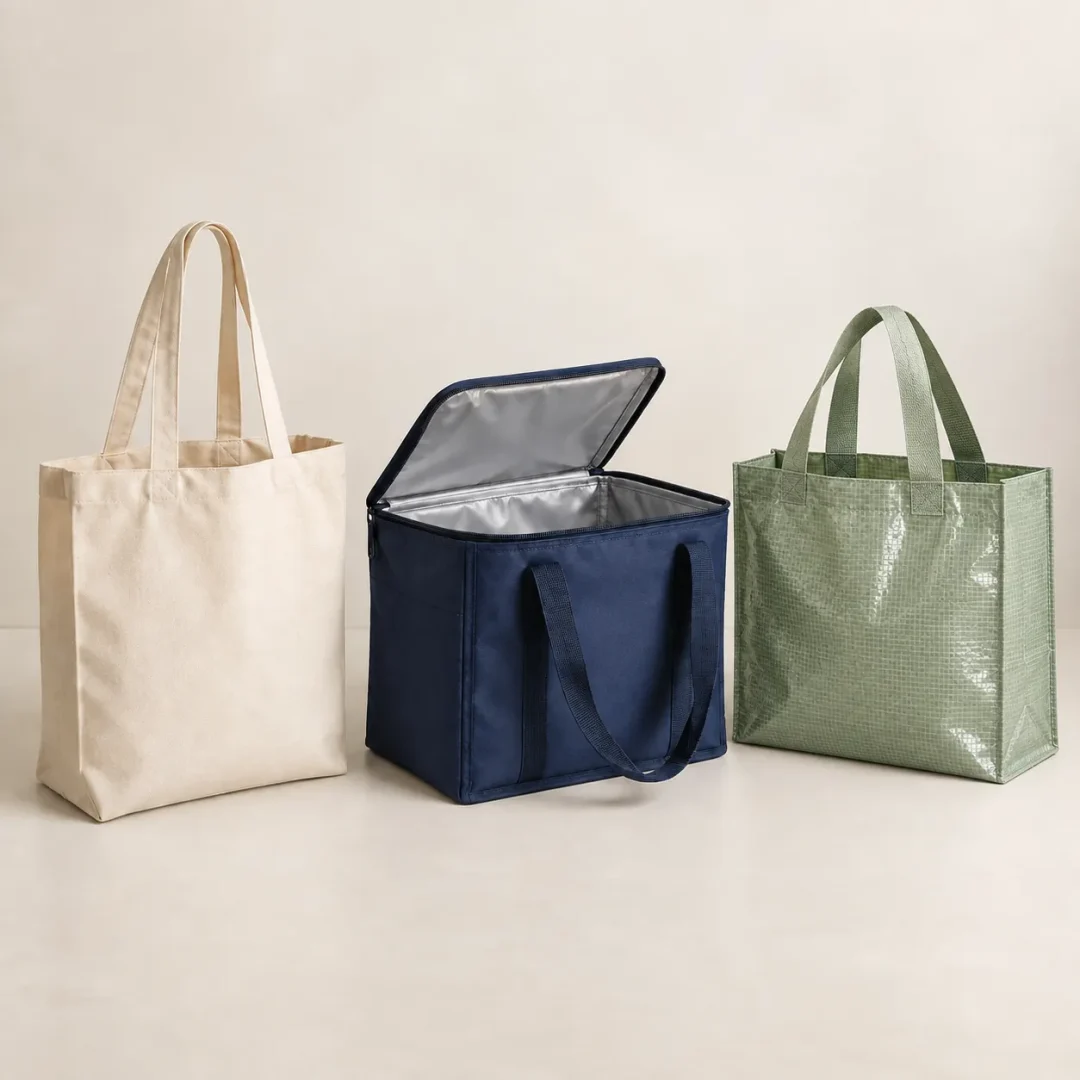
The examples below show how to make a classification request useful. They are product-review scenarios, not customs rulings for a particular shipment.
Bag type and material: a practical reference table
Use this table to choose the question to investigate, then read the relevant example below. The 4202.92 references assume a qualifying article with a textile or plastic-sheeting exterior; they do not cover every material or product sold under the listed names.
| Product and construction | Starting point for research | Detail that can change the answer |
|---|---|---|
| Cotton or polyester shopping tote | 4202; investigate 4202.92 | Whether it is a shopping carrier or a handbag; exposed surface |
| Textile handbag | 4202.22 | Fiber composition and the applicable national subdivision |
| Textile backpack or soft travel duffel | 4202.92 | Backpack/travel construction and relevant national branches |
| Non-woven PP shopper | Assess carrying function under 4202 | Fabric versus film, lamination and construction |
| Laminated woven PP shopper | Assess carrying function and exposed surface | Difference from a sack designed for packing goods |
| Insulated food or beverage carrier | 4202.92; inspect the insulated-bag branch | Insulation, exterior and whether another function governs |
| Textile cosmetic or toiletry organizer | Assess container function under 4202 | Personal-use organizer versus simple product packaging |
| Travel garment carrier | Assess transport function under 4202 | Carrying construction versus a hanging protective cover |
| Drawstring shoe or dust pouch | Review the relevant textile or plastic provisions | Protective pouch versus constructed travel container |
| Packing cube or storage organizer | Review the complete article and applicable provisions | Travel organization, construction and function; a handle alone is insufficient |
| Textile packing sack | 6305 | Fiber or strip material, construction and packing function |
The code families follow the official heading texts cited above; the review questions are a practical way to organize your specification. They are not additional legal tests.
Cotton and canvas tote bags
For custom tote bags, explain whether the item is designed as a shopping carrier, everyday personal bag, promotional giveaway or another kind of article. “Promotional” describes the commercial program; the underlying bag still needs a physical description.
Consider this specification:
Reusable shopping tote, 100% cotton canvas, 38 × 40 × 12 cm, open top, two sewn handles, one internal pocket, no lining or exterior coating, printed logo; imported empty.
This gives the broker enough information to begin comparing carrying-bag provisions. By contrast, “cotton promotional item” leaves both the finished article and its function unclear.
Do not treat every variation as a new classification automatically. An artwork change is a different question from adding an exposed plastic laminate or redesigning the bag for another function. Ask for a review of changes that affect the facts on which the original classification was based.
For blends, request the fiber percentages. For recycled cotton, confirm whether the fabric also contains polyester or another fiber. The sustainability name should supplement the material specification, not replace it.
Non-woven and PP woven shopping bags
“PP bag” can refer to several constructions. A soft non-woven shopper, a laminated woven shopping tote, and a sack for transporting bulk goods may share polypropylene as a raw material while requiring different reviews.
Describe the construction explicitly:
- Non-woven shopper: bonded fabric, handle construction, closure, reinforcement and intended carrying use.
- Laminated woven shopper: woven base, exposed film, seams, handles and intended repeated use.
- Packing sack: contents it is designed to pack, filling and closure method, and handling during transport.
For qualifying packing sacks made from polyethylene or polypropylene strip, 6305.33 is a relevant research reference. It is not a generic code for all woven PP shopping bags. See the packing-sack subdivisions in Chapter 63.
A useful question for your supplier is: “Is this the same construction as the product behind your proposed code?” That is more revealing than asking whether the factory has exported “PP bags” before.
Insulated cooler bags
For custom cooler bags, supply the layer structure and explain the thermal function. Heading 4202 expressly includes insulated bags for food or beverages. Source: WCO Chapter 42.
An effective description might be:
Soft-sided insulated food and beverage carrier; polyester woven exterior; 5 mm PE foam insulation; PEVA interior lining; zip closure and webbing handles; no active cooling equipment; imported empty.
This tells the reviewer what each component does. The exterior provides the shell, the foam provides insulation, and the lining forms the inner compartment.
Avoid reducing a large grocery cooler to “lunch bag” if that is not its actual format. Include dimensions and intended contents. Also identify unusual components, such as electrical cooling equipment, rather than assuming the classification of an ordinary passive cooler remains suitable.
Garment bags and garment covers
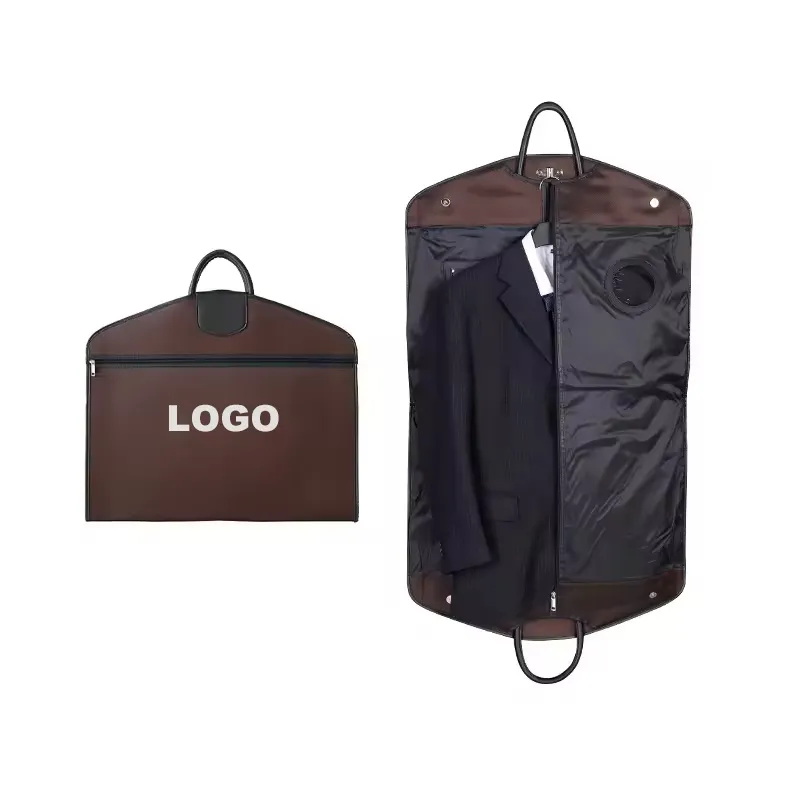
A travel garment carrier and a lightweight hanging cover solve different problems. For garment bags, photograph the product both hanging open and folded into its carrying position, if it has one.
The UK guidance identifies durable garment carriers with carrying handles and zip closures as products within heading 4202. This supports examining their transport function, but does not establish the code for every garment cover. Source: HMRC guidance.
For a simple cover, explain whether it hangs over a garment, whether it has independent carrying features, and whether its job is mainly protection during storage. Ask the broker to compare the relevant cover and textile provisions rather than inheriting the travel carrier’s code.
A description such as “garment bag for storage and travel” can hide this distinction. Describe the actual design instead of listing every possible marketing use.
Drawstring bags, dust bags and shoe pouches
“Drawstring” identifies a closure. It does not explain whether the product is worn as a backpack, protects a shoe, holds a retail item or serves as a packing sack.
For a drawstring backpack, show how the cords attach and function as shoulder straps. For a dust pouch, identify what it protects and whether it has an independent carrying function. For a shoe bag, show whether it is a simple sleeve or a constructed travel organizer.
The UK guidance specifically directs textile drawstring shoe bags to Chapter 63, illustrating why a drawstring closure is not enough to place a product in heading 4202. Source: HMRC exclusions.
Do not automatically apply that example to every shoe organizer either. A fitted travel case should be evaluated on its own construction.
Cosmetic bags and toiletry organizers
For a cosmetic bag, explain how the product organizes and carries toiletries or makeup. Show the open interior, compartments, closure and exterior material.
Compare the information available in these descriptions:
Cosmetic bag, pink, printed.
Soft zippered toiletry organizer, polyester exterior, washable lining, two internal compartments, 24 × 15 × 10 cm, supplied empty for repeated personal use.
The second description makes a classification review much more productive. Color and branding can remain in the commercial specification, but they should not displace the construction details.
If the pouch is imported filled with cosmetics, tell the broker exactly what is inside and how everything is packaged and sold. The review must consider the goods as imported; a code used for empty bags does not answer how a filled assortment should be declared.
Paper bags and disposable plastic carriers
An ordinary paper packing bag should be examined within the paper-container provisions. Under heading 4819, the distinction between 4819.30 and 4819.40 includes whether the base width reaches 40 cm. This is an example where a specific dimension, rather than simply “large” or “small,” matters. Source: Chapter 48.
Plastic packing bags have their own provisions under heading 3923, including distinctions by polymer. Chapter 39 also excludes containers that belong in heading 4202. Consequently, “made from plastic” alone is not a complete classification decision. Source: WCO Chapter 39.
Packing cubes and travel organizers
For a packing cube, show the zipped compartment, mesh panels, compression system if present, and how the article is used inside luggage. Explain whether it organizes clothing during travel or serves a different storage or packing purpose.
Do not apply a shortcut such as “with a handle means 4202; without a handle means 6307.” A grab loop may help users lift the cube, but it does not independently establish the heading. Likewise, adding a zipper or a compression feature should be documented without assuming it necessarily changes the classification.
If you sell a coordinated set, identify each piece, its material and function, and whether the pieces are packaged together for retail sale. This lets the broker review both the articles and the way they are presented at import.
How to Check the Code in the Importing Country
Once the product is clearly documented, check the destination’s official tariff. Search tools help locate possibilities, but read the hierarchy above the result: a line labeled “other” only makes sense within its parent categories.
| Destination | Official starting point | What to do next |
|---|---|---|
| United States | USITC HTS | Review the full import reporting number, relevant notes and applicable measures |
| European Union | Combined Nomenclature and TARIC | Follow the CN classification into the relevant TARIC measures |
| Great Britain | UK classification guidance and tariff links | Use the appropriate UK tariff and complete the commodity-code review |
| Other destinations | The importing country’s customs authority | Verify local subdivisions and entry-date requirements |
The EU’s CN uses eight-digit codes. TARIC brings together the tariff and other relevant trade measures, but does not provide national VAT or excise rates. This matters when estimating the full cost of importation. Sources: European Commission CN and TARIC.
How to use a previous classification ruling
For U.S. research, CBP’s CROSS database contains classification rulings. Trade.gov identifies it as a useful resource for difficult classification questions. Source: Trade.gov.
Compare the facts before copying a result. Record the ruling reference and date, then check the described function, exterior, dimensions and construction against your sample. Ask your broker whether the ruling remains applicable and whether later changes affect the analysis.
If your product differs on a fact that drove the decision, flag the difference explicitly. “Similar appearance” is a weaker basis than “same construction, same exposed surface and same carrying function.”
For an unresolved recurring program, ask about obtaining a formal classification decision in the destination country before the first bulk shipment. Use the country’s applicable process rather than assuming a decision from another customs territory transfers automatically.
For Great Britain, HMRC’s Advance Tariff Ruling process provides a formal route. Assess the need against the uncertainty, repeat-order volume and commercial impact. A small order can still merit specialist review if the classification is genuinely unclear; a large order does not automatically require a new ruling if the position is already well established.
What to Send Your Broker: A Complete Bag Specification
The most useful classification file connects the proposed code to an identifiable product version. Send the following information together so that the reviewer does not need to reconstruct the bag from separate emails.
| Field | Illustrative entry |
|---|---|
| SKU and revision | CT-01, approved sample revision B |
| Finished article | Reusable shopping tote |
| Dimensions | 38 cm wide × 40 cm high × 12 cm gusset |
| Exterior | 100% cotton woven canvas; no exterior coating |
| Lining and insulation | None |
| Construction | Open top, two webbing handles, one internal pocket |
| Intended use | Repeated carrying of groceries and everyday purchases |
| Condition at import | Empty finished bags, packed in export cartons |
| Origin and destination | China; United States |
| Shipment timing | Expected entry month, updated when confirmed |
| Supporting evidence | Front, side and interior photos; material specification; sample if needed |
| Supplier’s proposed code | Actual code supplied, with the country/system identified |
| Review requested | Destination classification and applicable duty measures |
For coated fabrics, add a swatch and layer diagram. For a cooler, add insulation and lining details. For mixed products, prepare one record per construction rather than a single sheet saying “assorted bags.”
Ask for the review result in a form you can retain: the code, a short explanation, the specifications reviewed and the date. This creates a useful reference for repeat orders and design changes.
Agree who supplies and checks each piece of information
The factory should confirm what it manufactured: materials, layer structure, dimensions and construction. The buyer should explain the destination, intended use and imported presentation. The importer and its customs adviser should arrange the destination classification and valuation review, using an official decision where appropriate.
If a quotation includes delivery with duties paid, identify who will act as importer and what duty assumptions the price includes. A commercial delivery arrangement should not leave either party guessing whose classification was used.
For the purchase order, add a practical specification-control requirement:
Production must match approved sample [reference/revision] and the attached material specification. Notify the buyer before changing fiber composition, exterior coating or lamination, lining, insulation or carrying construction. Obtain written approval before using a substitute material.
This connects the customs review to the production order. A broker can review a sample accurately and still end up with the wrong facts if the factory later substitutes a material without updating the specification.
What if the supplier and broker disagree?
First check whether they are actually disagreeing. Two full codes can differ because one is an export code and the other is an import code.
If the disagreement concerns the heading or six-digit subheading, send both parties the same approved specification and ask which feature supports each choice. Typical points to clarify include a travel function, a packaging function, an exposed laminate or the distinction between a handbag and a shopping carrier.
If that does not resolve it, have the importer seek a documented classification review. Do not select the lower-duty code as a compromise. The issue is which provision describes the goods.
Turning the Specification into a Commercial Invoice Description
A technical sheet can be detailed; an invoice description should be concise while still identifying the merchandise. Use the same SKU and construction facts across both documents.
Descriptions do not need to be word-for-word identical across marketing pages, packing lists and customs records. They should be factually consistent. A short retail product name and a detailed invoice description can both be accurate; contradictory fiber or coating information needs correction.
| Avoid | More useful description |
|---|---|
| Promotional bags | Empty reusable cotton canvas shopping totes, uncoated exterior, two handles, printed, SKU CT-01 |
| Polyester products | Empty insulated food and beverage bags, polyester exterior, PE foam insulation, PEVA lining, SKU CB-02 |
| Garment bags | Empty foldable polyester travel garment carriers, zip closure and carrying handles, SKU GB-03 |
| PP bags | Empty reusable woven PP shopping totes, exterior BOPP laminate, sewn handles, SKU PP-04 |
Use these as drafting patterns, not fixed wording for every product. Add the actual dimensions and composition where needed, along with the transaction details required for the shipment.
During the review stage, label an unconfirmed supplier code as proposed. For final documents, coordinate the required code fields with the importer and broker; unresolved draft information should not quietly become the final declaration.
If a shipment contains several bag constructions, preserve separate product lines and supporting records. Do not average different materials into a description such as “mixed fabric bags.”
What Do Bag HS Codes Mean for U.S. Import Duty?
Different products within the same six-digit HS family can have different U.S. base rates. The examples below were checked against HTSUS 2026 Revision 19 on September 21, 2026. They show Column 1 General rates only, before any applicable additional duties, relief, taxes or customs fees.
| U.S. tariff reference | Product scope, summarized | Base rate |
|---|---|---|
| 4202.92.1500 | Qualifying cotton travel, sports and similar bags with textile exterior, not pile or tufted construction | 6.3% |
| 4202.92.3120 | Man-made-fiber backpacks in the textile-surface travel/sports branch | 17.6% |
| 4202.92.3131 | Other man-made-fiber bags in that same branch | 17.6% |
| 4202.22.4500 | Cotton handbags in the relevant non-pile/non-tufted textile branch | 6.3% |
| 4202.22.1500 | Handbags with plastic-sheeting exterior | 16% |
| 4202.92.0807 | Man-made-fiber insulated food or beverage bags in the applicable textile branch | 7% |
Source: official USITC Chapter 42, pages 42-8, 42-9, 42-14 and 42-15.
Two comparisons make the table useful. First, cotton and polyester can differ at the national subdivision level even when the six-digit family is shared. Second, an insulated food carrier has a dedicated branch: the ordinary travel-bag rate should not be applied to it simply because both products use polyester.
Also keep product groups separate when comparing surfaces. The 16% entry above concerns handbags. It is not a general rate for every coated tote, backpack or cooler. Read all parent descriptions before selecting a rate from a search result.
Additional tariffs require their own check
For China-origin goods, a costing review must separately establish which additional measures and exclusions apply to the chosen code. Ask the broker to list the ordinary classification, any required Chapter 99 reporting provisions, effective dates and supporting exclusion details.
For example, USTR’s July 2026 action concerning forced-labor import prohibitions includes additional tariffs and product exemptions. That makes the exemption review part of the calculation, rather than a footnote to a universal rate for “bags from China.” Source: USTR announcement.
A headline percentage should never be presented as a shipment-ready total while its product coverage is still assumed. Record the date and exact specification behind each cost estimate, particularly when sample approval and bulk entry are months apart.
How to Calculate the Landed Cost of a Bag Order
A tariff code identifies a product category; it does not by itself produce a complete landed cost. A useful estimate also records origin, expected entry date, the valuation basis, applicable trade measures and the costs included in the supplier’s quotation.
The EU TARIC system, for example, includes tariff preferences and trade-defence measures alongside ordinary duties. A headline duty rate is therefore only one part of the review. Source: European Commission TARIC.
Worked example: 5,000 cotton shopping totes
Assume a hypothetical order of 5,000 bags at USD 3.20 each. For this illustration only, assume the broker has confirmed 4202.92.1500 and a customs value of USD 16,000. Freight and insurance cost USD 1,800; other logistics and clearance charges cost USD 600. These cost inputs are invented, not a freight quotation.
| Cost component | Calculation | Amount |
|---|---|---|
| Goods | 5,000 × USD 3.20 | USD 16,000 |
| Ordinary duty only | USD 16,000 × 6.3% | USD 1,008 |
| Freight and insurance | Assumed | USD 1,800 |
| Other logistics and clearance | Assumed | USD 600 |
| Subtotal before additional duties, taxes and any unlisted fees | Sum of the above | USD 19,408 |
| Subtotal per bag | USD 19,408 ÷ 5,000 | USD 3.8816 |
That subtotal is not the final landed cost of a China-origin shipment. It deliberately leaves additional duties open until their applicability has been checked.
If, purely as a mathematical example, the broker identified additional percentage duties totaling 25% on the same USD 16,000 base, they would add USD 4,000, or USD 0.80 per bag. The revised subtotal would be USD 23,408, or approximately USD 4.68 per bag. The assumed 25% is not a statement of the current total additional duty on this product.
Compare materials without mixing product categories
On the same hypothetical USD 16,000 customs value, a qualifying man-made-fiber travel/sports bag at a 17.6% ordinary rate would incur USD 2,816 in ordinary duty. Compared with USD 1,008 at 6.3%, the difference is USD 1,808, or about USD 0.36 across 5,000 bags.
This isolates the base-duty difference. A real sourcing comparison must also update the factory price, weight, freight and any different applicable measures. It should not compare a cotton shopping bag against the plastic-handbag rate merely because both products have handles.
In your costing sheet, keep product cost, logistics, duties, taxes and clearance charges in separate fields. Mark whether each is included in the quoted shipping terms. Have the broker establish the customs value rather than assuming it always equals the factory invoice or a landed-price quotation.
Model each destination separately
Build separate U.S., EU and UK cost sheets. Reuse the physical specification, but verify each destination’s classification, customs value and charges. Do not calculate all three markets from the same invoice-value base without checking local valuation rules.
For VAT markets, keep import VAT visible as a cash-flow line and confirm its accounting treatment for your business. Treating all VAT as recoverable—or all VAT as a permanent cost—can distort the comparison.
Do Samples and Small Orders Need Classification Too?
Use a clear product description and the appropriate declaration information for samples as well as production orders. A bag sent free of charge still needs a defensible customs value; “sample” describes why it is being shipped, not what it is made of.
For U.S.-bound non-postal shipments, CBP’s June 2026 rule indefinitely suspended the general USD 800 de minimis exemption. A low declared value should therefore not be treated as an automatic duty exemption. Source: Federal Register rule.
That does not establish that every sample in every situation must bear the same charges. Have the carrier or broker check whether a specific sample provision, temporary import procedure or other relief applies and what conditions it requires.
For sampling budgets, request the freight, clearance and estimated import charges together. Consolidating approval samples may reduce handling costs, but the saving depends on the carrier and entry arrangement.
Label samples by SKU and revision. If the final production bag changes material or construction, document the change rather than forcing the production paperwork to repeat an outdated sample description.
When to Review Classification During a Custom Bag Order
At quotation: Share the destination and preliminary specification. Obtain an initial classification and cost estimate before committing to a resale price.
At sample approval: Confirm the actual materials and construction. A sample with an exterior laminate may differ from the uncoated fabric described in the first quotation.
Before shipment: Reconcile the approved sample, invoice descriptions, quantities and tariff review. Ask the broker to check the provisions and measures applicable to the expected entry.
For repeat orders: Compare the new product revision with the reviewed version. Keep the previous reasoning, but check whether a material, function, destination or tariff change requires another review.
For example, changing only the artwork can be recorded as such. Switching from cotton to a cotton-polyester blend, introducing an exposed film, or converting a basic shopper into an insulated food carrier deserves a more explicit check. The question is whether the change affects a classification criterion, not whether the factory considers it a minor production adjustment.
Questions Buyers Often Ask
Is there one HS code for all cotton bags?
No. “Cotton” identifies material, while the finished article might be a shopping tote, protective pouch or packing sack. State the function and construction first, then use the cotton composition to complete the relevant material review.
Does adding a logo change the HS code?
A logo alone usually does not explain a different product category. Record ordinary printing as part of the specification, but distinguish it from a change to the exposed material, construction or use. If the decoration changes more than appearance, include it in the review.
Can I use one code for every color and size?
Possibly, if all variants satisfy the same provision. Do not assume that size never matters: paper bag subdivisions, for example, include a base-width distinction. Maintain a variant list so the broker can identify which differences are relevant.
Does “eco-friendly” or “recycled” identify the classification?
Those labels are not a complete tariff description. Specify the actual material and finished construction. A recycled-content claim may be commercially important, but the reviewer still needs to know whether the exterior is woven polyester, cotton blend, plastic sheeting or another material.
Can I reuse the code from my last shipment?
Use the previous review as a reference, then verify that the current product and destination match and that the code remains valid. A successful earlier clearance is not a substitute for retaining the facts and reasoning behind the classification.
What should I do if the bags are imported with other goods inside?
Provide a list of the contents, individual values, packaging arrangement and intended sale format. Ask the broker to review the imported presentation. Do not assume that an empty-bag classification answers the treatment of a filled kit or retail assortment.
Preparing Your Next Custom Bag Order
Before asking for an HS code, put the approved bag specification, exterior material details, intended use and import destination into one clear brief. That gives your supplier and broker a common product to evaluate and helps you connect the classification to a realistic cost estimate.
When discussing a custom bag project with INITI, include your destination market and ask for the material and construction information your broker needs. Confirm the final destination-country classification before completing the shipping documents, and retain the reviewed specification for future orders.

 English
 French
 German
 Japanese
 Arabic
 Thai
 Vietnamese
 Russian
 Spanish
 Portuguese