
There’s a question we get from almost every new inquiry: “What’s your MOQ?”
The honest answer is that it depends on the bag. But the short answer — the number that we use as a starting point for every conversation — is 500/1000 units.
Below 500, the math of custom manufacturing doesn’t work. Not because we’re trying to be difficult. Because once you add up the cutting setup, the screen charges, the sewing line changeover, the quality control, and the export logistics, producing 300 custom canvas bags costs nearly as much as producing 500 — and the per-unit price at 300 is high enough that most buyers walk away anyway.
But 500 is just the floor. Some bags can be produced efficiently at 500. Others — the ones with custom-dyed fabric, complex construction, or premium components — don’t make sense below 1,000 or even 2,000 units. The difference isn’t the factory’s policy. It’s the bag itself.
This guide explains how MOQ is actually formed inside a bag factory. It will show you why some canvas tote bags can be produced at 500 pieces, why others require 1,000, 3,000, or 5,000 to start, and — most importantly — how experienced buyers structure their orders to bring MOQ down without sacrificing customization.
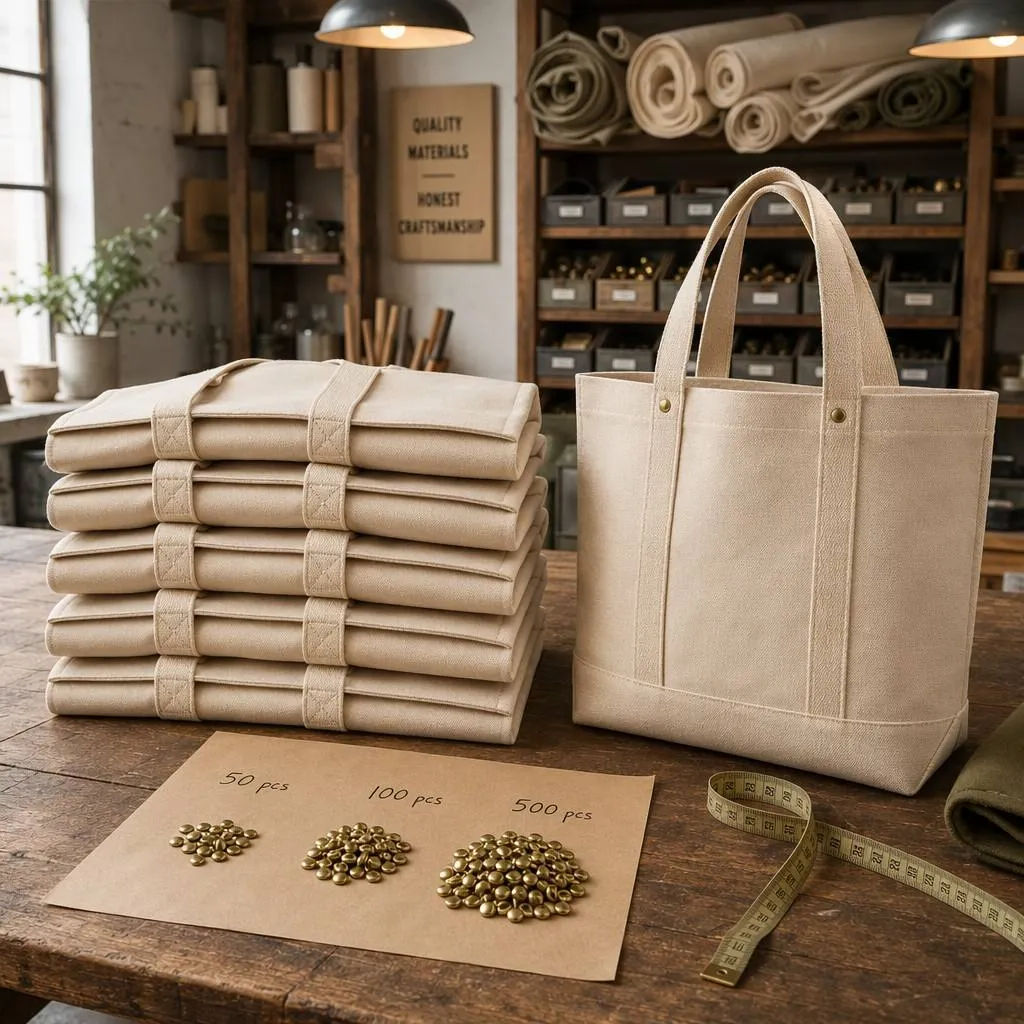
What Does MOQ Mean for Custom Canvas Tote Bags?
MOQ (Minimum Order Quantity) is the smallest quantity a manufacturer will accept for a specific product configuration. But the key insight most buyers miss is this:
MOQ ≠ Factory policy. MOQ = Manufacturing economics.
Every custom canvas tote bag passes through six manufacturing stages, and each stage has its own minimum starting cost:
Fabric Sourcing
      ↓
Printing Setup
      ↓
Cutting
      ↓
Sewing
      ↓
Packaging
      ↓
Shipping
At each of these steps, there is a fixed cost that does not scale down with quantity. A fabric supplier will not sell you 50 meters of custom-dyed organic cotton. A screen printer must still make the screens whether you print 100 bags or 10,000. A sewing line still needs to be re-tooled for a new pattern regardless of run length.
MOQ exists because these fixed costs need to be absorbed across enough units to make the project economically viable — for both the factory and the buyer. Below that threshold, the per-unit cost becomes prohibitive, and the order is not worth producing.
Why Most Canvas Tote Bags Start at Around 500 Pieces
The 500-piece figure is not a marketing number. It is the point at which most standard canvas tote bag configurations reach a workable balance across all six manufacturing stages. Here is why.
Fabric Purchasing Requirements
Fabric mills operate at industrial scale. They do not cut and sell fabric in small quantities the way a retail fabric store does.
- Roll-format canvas is typically sold in minimum quantities of 300–500 meters per color per weight.
- Custom-dyed fabric (a specific Pantone match) usually requires a 500–1,000 meter minimum from the dye house.
- Organic cotton canvas carries an even higher fabric MOQ because certified GOTS material is produced in smaller mill runs.
- Recycled canvas / rPET blends may require 1,000+ meters due to limited supplier availability.
A 500-piece order of 12 oz canvas totes uses roughly 250–300 meters of fabric. That fits comfortably inside a standard fabric roll purchase — which is why 500 pieces is the natural entry point for most projects.
Printing Setup Costs
Printing is often the single largest driver of MOQ, especially for screen printing.
At 100 pieces, the setup cost per bag can equal or exceed the bag itself. At 500 pieces, setup gets distributed thin enough to be economically viable. The more colors in your logo, the higher the MOQ typically climbs.
Cutting Efficiency
Bag cutting is done in stacked layers — typically 30–80 layers of fabric cut simultaneously with an industrial die or automated cutter. The fabric is arranged in a “cutting layout” (called nesting) that maximizes yield from each roll.
- At 50 pieces: Cutting yield is poor. Large offcuts are wasted. Per-unit fabric cost rises 15–30%.
- At 100 pieces: Slight improvement but still inefficient.
- At 300+ pieces: Cutting layouts can be optimized across multiple fabric widths.
- At 500+ pieces: Near-optimal yield. Waste falls to industry-standard levels (typically 4–8%).
Sewing Line Efficiency
A sewing line is not a single machine — it is a coordinated sequence of specialized workstations, each performing one operation (handle attachment, side seam, bottom fold, top hem, etc.).
- Line changeover between products takes 2–4 hours and requires re-training workers on the new stitch pattern.
- Learning curve: The first 50–100 units of any new style are slower and produce more defects as workers adapt.
- Below 300 pieces, the entire order can be finished before the line reaches full efficiency.
A 500-piece run gives the line enough volume to justify the changeover and reach steady-state productivity. Larger orders (1,000+) benefit from full learning-curve maturity, which is why per-unit costs continue to drop at higher volumes.
Packaging Materials
Every “custom” packaging element carries its own MOQ:
If your order specifies custom-printed retail packaging, the packaging MOQ often becomes the binding constraint — not the bag itself. This is a common blind spot for first-time buyers.
Why Some Canvas Bags Need Higher MOQs
Not every canvas tote bag can be produced at 500 pieces. Certain material and design choices push the MOQ meaningfully higher because they trigger additional supplier minimums or specialized production runs.
The pattern is clear: every additional custom element compounds the MOQ. A “basic” canvas tote with a one-color logo may run at 500 pieces. A “premium retail” canvas tote with organic cotton, embroidered logo, leather patch, and custom hangtag can easily require 3,000+ pieces.
Factors That Can Reduce MOQ
MOQ is not always as fixed as it first appears. Experienced buyers know that certain choices at the specification stage can meaningfully lower the entry threshold — often without compromising the finished product’s brand quality.
- Choose stock fabric colors — Natural, black, and navy are usually held in inventory; custom Pantone dyes require higher MOQ
- Use single-color printing — Reduces screen count, setup time, and ink minimums
- Stick to standard bag sizes — Common tote dimensions (like 14″x16″, 15″x16″) use pre-existing cutting patterns
- Skip custom accessories — Standard cotton or polyester webbing handles cost less and have no accessory MOQ
- Consider shared production runs — Some factories combine multiple buyers’ orders on the same fabric to lower everyone’s MOQ
- Use simple packaging — Poly bag + standard export carton, no custom hangtag
- Ask about factory inventory / stock programs — Some factories keep pre-made blanks that only require printing
- Use digital printing for small runs — Skips the screen-making setup fee entirely (though per-unit cost is higher)
The consulting takeaway: MOQ is often negotiable in structure, not in number. If your factory says “MOQ is 1,000,” ask what would need to change for it to become 500. Frequently the answer is one specification adjustment away.
MOQ Comparison by Customization Level
The table below reflects common ranges across the custom canvas tote bag industry. Exact figures vary by factory, region, and material availability, but the relative scale is consistent.
These ranges reflect typical industry practice. Working with a factory that has flexible in-house capabilities can shift the threshold on either side.
Can You Order Less Than 500 Canvas Tote Bags?
Yes — but the conditions have to align, and the per-unit price will typically be significantly higher. Sub-500 orders are usually feasible only when one or more of the following is true:
- Fabric is already in stock at the factory (no separate mill purchase required)
- Existing screens are reusable (the printing setup is already amortized)
- Digital or transfer printing is used (no screen setup at all)
- A pre-existing pattern is used (no new cutting layout)
- The order joins a shared production run with other buyers’ compatible specs
- The buyer accepts a higher unit price to cover fixed costs at a lower volume
For test orders, sample runs, or brand pilot programs, a good factory will often help you find a workable structure. But be clear about the tradeoff: the smaller the order, the higher the per-unit cost — sometimes 2–3x the price at 1,000 pieces.
How MOQ Affects Unit Price
The relationship between MOQ and unit price is not linear. Cost per bag drops sharply from 100 to 1,000 pieces, then flattens gradually from 1,000 to 10,000. Here is the typical curve
Unit Price ($)
   ▲
   │
$4 │●  100 pcs
   │
$3 │  ●  300 pcs
   │
$2 │      ●  500 pcs
   │            ●   1,000 pcs
$1 │                  ●─────●─────●   3,000 → 10,000 pcs
   │
   └────────────────────────────────→
        Order Quantity
The steep drop from 100 to 1,000 pieces reflects the amortization of fixed setup costs. After 1,000, the curve flattens because raw material cost — which is variable, not fixed — becomes the dominant component.
What actually drives the cost reduction at higher volumes is not cheaper materials. It is:
- Setup cost per unit — screen making, machine calibration, sample approvals
- Labor efficiency — sewing lines reach full productivity after the learning curve
- Cutting waste rate — better layouts mean less fabric loss
- Shipping consolidation — full container loads reduce per-unit freight
Understanding this is the key to smart procurement: if you can push your order into the 1,000–3,000 range, you capture most of the available cost savings. Going beyond 3,000 delivers diminishing returns unless you have a clear inventory need.
How Buyers Can Reach MOQ More Easily
Many of our clients arrive with a real quantity need well below the factory MOQ. Rather than walking away, experienced procurement teams restructure the order to meet the threshold. Here are the most effective tactics:
- Combine different logo color variants into one production run — Same bag base, same fabric, just different ink colors. Sometimes counted as one order.
- Consolidate orders across multiple destinations — If you serve US, EU, and APAC markets, combine into one production and split at export.
- Order annual demand in one production cycle — Instead of quarterly reorders that each hit MOQ, place one annual order at a better unit price.
- Use one fabric across multiple SKU designs — Same 10 oz natural canvas can become a tote, a drawstring, and a cosmetic bag. Fabric MOQ is met once, spread across three products.
- Reduce unnecessary accessories — Every leather patch, metal ring, or custom label adds a separate supplier MOQ. Cut what does not add brand value.
- Share cartons across SKUs — Standardize your export packaging so multiple products ship in the same carton design.
- Use standard handle constructions — Custom webbing or oversized handles trigger accessory MOQs; standard cotton handles do not.
These are not compromises on quality. They are structural decisions that let a smaller brand access production capacity that would otherwise be reserved for larger volume buyers.
Common MOQ Misunderstandings
MOQ generates more misinformation than almost any other procurement topic. Here are the five most common misconceptions we encounter — and the reality behind each.
Frequently Asked Questions
Q: Can I order 100 custom canvas tote bags?
A: Yes, in specific conditions — typically with digital printing on stock fabric, using an existing pattern, and accepting a per-unit price 2–3x higher than a 1,000-piece order. For fully custom projects (dyed fabric, multi-color print, custom size), 500 pieces is a more realistic minimum.
Q: Why does printing increase MOQ?
A: Each color in a screen-printed design requires its own screen (typically $30–$60 to make), plus machine calibration and ink minimums. These costs must be absorbed across the run. A one-color design at 500 pieces spreads the setup thin; a four-color design at 500 pieces does not.
Q: Does organic cotton have a higher MOQ?
A: Yes. GOTS-certified organic cotton canvas is produced in smaller mill runs than conventional cotton, and certified fabric suppliers impose higher minimums — typically 1,000+ meters. This translates to a bag MOQ around 1,000 pieces or more.
Q: Can different colors count toward one MOQ?
A: Sometimes. If all color variants use the same fabric base and the same print pattern (with only ink color changing), some factories will combine them into one MOQ. This depends on the factory’s willingness and the specific color count.
Q: Can multiple sizes share one MOQ?
A: Rarely at the bag level, because each size requires a separate cutting layout. However, sizes using the same fabric can share the fabric MOQ — which is often the binding constraint.
Q: Can I mix different logos in one order?
A: If the logos use the same printing method and color count, some factories allow it — with a per-design minimum (often 100–300 pieces per logo) inside a larger overall MOQ.
Q: Can sample costs be deducted from the final order?
A: Many factories refund sample fees against bulk orders above a certain threshold. Always confirm this in writing before paying for samples.
Q: Does packaging affect MOQ?
A: Yes — significantly. Custom retail packaging (hangtags, printed poly bags, branded cartons) often has its own supplier MOQ of 1,000–5,000 pieces. If your bag MOQ is 500 but your packaging MOQ is 2,000, the binding constraint is the packaging.
Q: How long does production take after the MOQ is met?
A: Standard lead time is 20–35 days after sample approval, depending on order size, complexity, and current factory load. Rush production is sometimes possible at a surcharge.
Q: Are MOQs the same for all bag types?
A: No. Canvas tote bags typically have lower MOQs than nylon backpacks, cooler bags, or RPET bags — because canvas fabric is more widely available and the construction is simpler. Complex bag structures (multi-compartment, lined, insulated) usually carry higher MOQs.
Finding the Right MOQ for Your Project
MOQ should not be treated as a fixed gate that either lets you through or blocks you. It is a variable — one that can be optimized through smarter choices about material, printing method, packaging, and production consolidation. The buyers who consistently get the best pricing are not the ones who push hardest against MOQ. They are the ones who understand what drives it and design their order specifications to align with it.
For B2B buyers, the most important question is not “What is your MOQ?” but rather “Given my budget, my expected sales volume, and my brand requirements — what order structure makes economic sense?” That is a conversation, not a number.
If you have a canvas tote bag project in development, the fastest path to an accurate MOQ and quotation is to share three things with your factory partner: target quantity, required customization (fabric, printing, accessories, packaging), and destination market. With those inputs, a good factory can propose a workable structure — often lower than the buyer initially expected.
Contact INITI today with your bag project details. Our team will review your specifications and return a tailored MOQ and pricing proposal within 24 hours.
Published by INITI Packing — a China-based custom bag manufacturer with 16+ years of export experience, operating a 10,000+ ㎡ facility with 250+ staff. Our BSCI, ISO9001, SEDEX, OEKO-TEX, GRS, Disney, and SGS certifications support brands and Amazon sellers worldwide in sourcing responsibly-made canvas totes, RPET shopping bags, cosmetic bags, cooler bags, and more.
A note on numbers: The cost figures and price ranges in this article are market-reference examples intended to illustrate how MOQ logic works. They are not quotes. Actual pricing depends on your bag’s specific dimensions, fabric, components, printing requirements, order quantity, and shipping destination. Every order is priced individually — these numbers exist to show you the math, not to set expectations for a particular bag.
 English
 French
 German
 Japanese
 Arabic
 Thai
 Vietnamese
 Russian
 Spanish
 Portuguese