
Garment bags look simple, but the material choice is anything but. Pick the wrong one, and you’ll hear about it — from customers whose suits arrived musty, whose wedding dresses got creased, or whose retail displays looked cheap instead of premium.
The core decision almost always comes down to this: PEVA or fabric?
PEVA dominates the budget-to-mid-range market with its waterproof clarity and low cost. Fabric — whether cotton, polyester, non-woven, or canvas — appeals to brands that prioritize breathability, premium feel, or sustainability.
But the choice isn’t binary. Different fabrics serve different purposes, and PEVA itself comes in grades from economy film to heavy-duty matte finishes. This guide breaks down every material option for garment bags, with practical procurement guidance for brands, retailers, and manufacturers.
Quick Comparison: PEVA vs Fabric Garment Bags at a Glance
The rest of this guide unpacks what each material actually means for your product, your brand, and your bottom line.
PEVA Garment Bags: The Waterproof Workhorse
What PEVA Brings to Garment Bags
PEVA (Polyethylene Vinyl Acetate) has become the dominant material for garment bags in the $15–40 retail range on Amazon and major B2B platforms. It earned this position for three reasons:
- Complete waterproofing — zero moisture penetration means clothes stay dry in damp closets, during shipping, and in humid climates
- Visual clarity — transparent or frosted PEVA lets customers see the garment without unzipping, which is ideal for retail display and quick wardrobe selection
- Low cost at scale — among waterproof options, PEVA is significantly cheaper than coated fabrics or laminated textiles

PEVA Material Grades for Garment Bags
Not all PEVA garment bags are equal. The thickness and formulation make a substantial difference:
Advantages of PEVA Garment Bags
Waterproof Protection PEVA’s standout feature. It creates an impermeable barrier against moisture, dust, and insects. For garments stored in basements, shipped through humid climates, or displayed in damp retail environments, this protection is unmatched by any uncoated fabric.
Transparency Clear PEVA allows instant visual identification of contents. For consumers with packed closets and for retailers whose inventory sits in storage rooms, this eliminates the need to unzip every bag to find the right garment.
خفيف الوزن PEVA garment bags add almost no weight to shipping. For e-commerce brands where dimensional weight charges matter, this is a measurable cost advantage over heavier fabric alternatives.
Easy Maintenance A damp cloth cleans PEVA in seconds. No washing, no dry cleaning, no special care. For products that will sit in dusty storage or handle frequent handling, this low-maintenance quality directly impacts customer satisfaction.
Chlorine-Free and Phthalate-Free Unlike older PVC garment bags, PEVA contains no chlorine and requires no phthalate plasticizers. This matters for brands selling into EU markets (REACH compliance) and for consumers who have learned to avoid PVC in household products.
Cost-Effective PEVA garment bags typically cost 30–60% less than comparable polyester or cotton bags at the wholesale level. For high-volume promotions, retail packaging, or budget-conscious product lines, this price advantage is decisive.
Disadvantages of PEVA Garment Bags
Zero Breathability This is PEVA’s fundamental trade-off. The same non-porous surface that blocks moisture also blocks airflow. Garments stored in PEVA for extended periods — especially in warm environments — can develop musty odors because trapped humidity has nowhere to escape. This is not a manufacturing defect; it’s an inherent material property.
Moderate Durability PEVA can tear if caught on sharp objects (hanger hooks, zipper teeth, jewelry on garments). Economy-grade PEVA bags, in particular, are prone to seam splitting under the weight of heavy coats or multiple garments. Premium grades mitigate this, but even the best PEVA won’t match the tear strength of polyester or canvas.
Plastic Appearance Let’s be honest: PEVA looks like plastic. Even frosted or matte finishes don’t fully escape this. For luxury brands, this is a non-starter — a $2,000 suit in a PEVA bag sends the wrong signal. For everyday retail and practical storage, it’s perfectly acceptable, but brands that sell on premium aesthetics should look elsewhere.
حساسية الحرارة PEVA begins to soften around 70°C (158°F). It should not be stored near heat sources, left in hot cars, or used in applications involving steam or high-temperature sterilization.
Fabric Garment Bags: A Material-by-Material Breakdown
“Fabric” isn’t one thing. Each material brings a different balance of breathability, durability, cost, and aesthetics.
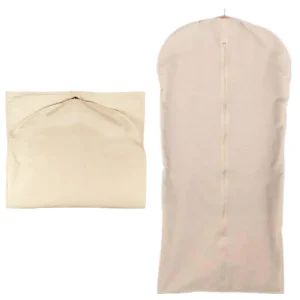
Cotton Garment Bags
Cotton is the traditional choice for high-quality garment storage. It’s what tailors, dry cleaners, and luxury brands have used for decades.
المزايا:
- Superior breathability — cotton’s natural fibers allow continuous air exchange, preventing musty odors and mildew. This is the single biggest reason to choose cotton over PEVA for long-term storage.
- Soft touch — cotton won’t scratch delicate fabrics, embellishments, or leather. It’s the safest material for silk, cashmere, wool suits, and beaded evening wear.
- Natural moisture management — cotton absorbs excess humidity from the air and releases it when conditions dry, acting as a passive humidity regulator. PEVA traps moisture; cotton buffers it.
- Premium perception — consumers strongly associate cotton with quality. A cotton garment bag elevates the perceived value of whatever’s inside.
- Biodegradable — at end of life, cotton decomposes naturally. For sustainability-focused brands, this is a genuine end-of-life advantage over synthetics.
العيوب:
- Not waterproof — cotton absorbs water, which is a liability in damp basements, during shipping in rainy weather, or in flood-prone storage areas.
- Higher cost — organic or high-grade cotton typically costs 2–3x more than PEVA per unit at wholesale.
- Maintenance required — cotton bags need washing to prevent dust buildup, stains, and potential mildew in persistently humid conditions.
- Opaque — you can’t see what’s inside without opening the bag.
Best for: Luxury fashion brands, wedding dress storage, long-term archival storage, boutiques emphasizing natural materials.
Polyester Garment Bags
Polyester has emerged as the go-to fabric for travel garment bags and mid-range storage solutions. It splits the difference between PEVA’s waterproofing and cotton’s breathability.
المزايا:
- High strength-to-weight ratio — polyester resists tearing better than PEVA or cotton, making it ideal for travel bags that get tossed into overhead bins and car trunks
- Water-resistant — while not fully waterproof, polyester sheds light moisture and dries quickly
- Wrinkle-resistant — maintains its shape without ironing; looks presentable after being folded and packed
- Chemical resistance — withstands mild acids, alkalis, and cleaning products
- Cost-effective — typically cheaper than cotton, competitive with mid-grade PEVA
- Printable — accepts dye-sublimation and screen printing well for branded designs

العيوب:
- Lower breathability than cotton — polyester doesn’t match cotton’s air exchange rate, though it’s far better than PEVA
- Petroleum-derived — carries the same fossil-fuel baggage as PEVA from a raw material standpoint
- Can feel synthetic — lower-grade polyester has a plasticky hand feel that some consumers dislike
Best for: Travel garment bags, foldable suit carriers, airline crew bags, mid-market retail packaging.
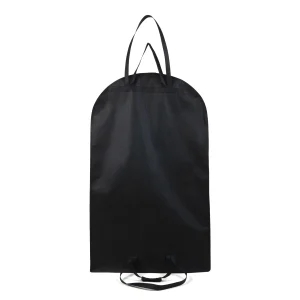
Non-Woven Garment Bags
Non-woven polypropylene (NWPP) is the budget fabric option. It’s made by bonding polypropylene fibers together without weaving, creating a paper-like or fabric-like sheet.
المزايا:
- Lowest cost — cheaper than PEVA, polyester, and cotton at the wholesale level. Often the cheapest garment bag option period.
- خفيف الوزن — comparable to PEVA in weight
- Recyclable in some programs — polypropylene is resin code #5 and accepted by some municipal recycling streams
- Breathable to a degree — more breathable than PEVA, though less than cotton
- Available in colors — easily pigmented for brand colors
العيوب:
- Low durability — non-woven bags tear easily, especially at seams and stress points. They’re not designed for heavy garments or repeated use.
- No water resistance — absorbs moisture readily; unsuitable for damp environments
- Short lifespan — typically a single-season product; not a long-term storage solution
- Cheap appearance — non-woven has a distinctly low-end look that can devalue the contents
Best for: Promotional giveaways, budget retail packaging, short-term event storage, dry cleaner economy bags.
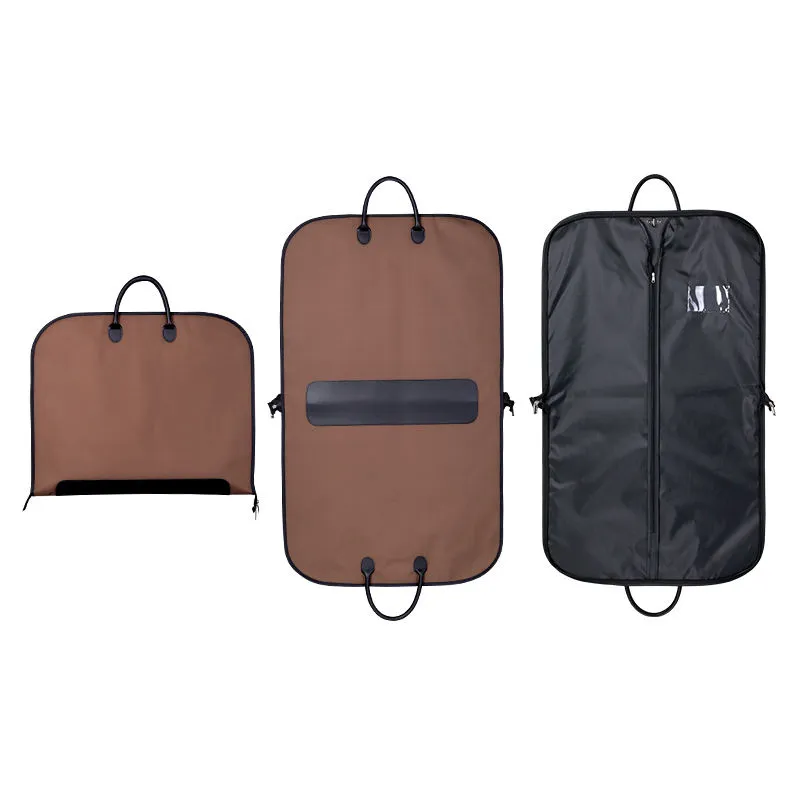
Canvas and Oxford Fabric Garment Bags
These heavy-duty woven fabrics are the premium end of the fabric spectrum. Canvas (cotton or cotton-blend) and Oxford fabric (a weave pattern, typically polyester or nylon) are used for high-end travel bags and premium storage.
المزايا:
- Maximum durability — canvas and Oxford fabric outperform every other option for tear strength, abrasion resistance, and load capacity
- Premium aesthetic — canvas in particular has a rich texture and substantial weight that signals quality
- Breathable — especially cotton canvas, which matches pure cotton’s air exchange properties
- Long lifespan — with proper care, canvas garment bags can last a decade or more
- Branding canvas — canvas accepts embroidery, leather patches, and high-end printing techniques that PEVA cannot
العيوب:
- Expensive — 3–5x the cost of PEVA per unit at wholesale; MOQs are typically higher
- Heavy — adds meaningful weight to shipping; impacts e-commerce freight costs
- Not waterproof — canvas absorbs water; Oxford fabric repels light moisture but can’t match PEVA’s impermeability
- Bulk — canvas bags take up more storage space when not in use
Best for: Luxury travel bags, premium suit carriers, boutique brand packaging, products where the bag is part of the brand experience.
Head-to-Head: The Dimensions That Matter
Waterproofing
PEVA     ████████████████████  Excellent
Polyester ██████████████       Water-resistant
Oxford    ████████████         Water-resistant
Canvas    ██████               Limited (absorbs)
Cotton    ██                   Absorbs moisture
Non-woven ██                   Absorbs moisture
If water protection is your primary requirement — shipping through tropical climates, storing in basements, protecting against spills — PEVA is the clear winner. No uncoated fabric comes close.
Breathability (Mold and Odor Prevention)
Cotton    ████████████████████  Excellent
Canvas    ████████████████████  Excellent
Polyester ██████████████        Good
Non-woven ████████████          Moderate
Oxford    ██████████            Moderate
PEVA      ██                    Very low
For long-term storage, especially of natural fibers (wool, silk, cashmere), breathability is non-negotiable. Cotton and canvas prevent the trapped-humidity problems that PEVA creates in extended storage scenarios.
التحمل
Canvas    ████████████████████  Excellent
Oxford    ████████████████████  Excellent
Polyester ██████████████████    Very good
Cotton    ██████████████        Good
PEVA      ██████████            Moderate
Non-woven ██████                Low
Fabric wins on durability across the board. Even basic polyester outperforms PEVA on tear resistance, and canvas/oxford are in a different league entirely.
Cost (Wholesale, Relative)
Non-woven ████████████████████  Cheapest
PEVA      ██████████████████    Very affordable
Polyester ██████████████        Mid-range
Cotton    ██████████            Higher
Canvas    ██████               Most expensive
Oxford    ██████               Most expensive
Visual Transparency
Only PEVA offers true transparency. This is a unique, non-negotiable advantage for retail display and quick-access home storage. No fabric can match it.
Decision Framework: Which Material for Which Use Case?
By Application
By Garment Type
Sourcing Guide: What to Ask Your Garment Bag Supplier
Whether you’re sourcing PEVA or fabric garment bags, the right questions separate reliable suppliers from the rest.
For PEVA Garment Bags
- What’s the exact thickness? Specify in millimeters, not in vague terms like “standard” or “heavy-duty.” 0.08mm and 0.18mm are very different products.
- Is it 100% PEVA or a blend? Some suppliers blend PVC into PEVA to reduce costs. Request a material composition statement.
- What’s the seam construction? Heat-sealed seams are standard. Ask about seam strength testing for bags that will hold heavy garments.
- What finish options are available? Clear, frosted, matte, colored — confirm your required finish is possible at your target thickness.
- Does the material meet REACH / CPSIA standards? Essential for EU and US market access. Request certificates.
- What’s the odor level? Properly formulated PEVA should be virtually odorless. Request a sample before bulk ordering.
For Fabric Garment Bags
- What’s the GSM (grams per square meter)? This is the standard measure of fabric weight and a proxy for durability. 80–120 GSM is lightweight; 200+ GSM is heavy-duty.
- Cotton: is it organic or conventional? Organic certification (GOTS, OEKO-TEX) matters for sustainability claims. Conventional cotton can be perfectly functional but carries different environmental baggage.
- Polyester: is it virgin or recycled (RPET)? Recycled polyester carries a sustainability premium that many brands value.
- What’s the zipper specification? Zipper failure is the #1 complaint for fabric garment bags. Specify branded zippers (YKK, SBS) and confirm the gauge.
- Are the seams reinforced? Double-stitched or bound seams dramatically extend bag life for heavy garments.
- Is the fabric pre-shrunk? Cotton bags that haven’t been pre-shrunk will change shape after the first wash.
Universal Questions
- MOQ and price breaks: What’s the minimum order, and at what quantities do prices drop meaningfully?
- Sample policy: Can you get a production sample (not just a stock sample) before committing to a bulk order?
- Lead time: What’s the typical production timeline, and how does it vary by order size?
- Customization capabilities: Printing methods available, color matching accuracy, custom sizing, label/tag attachment options.
Frequently Asked Questions
Are PEVA garment bags better than fabric? “Better” depends entirely on your use case. PEVA wins on waterproofing, transparency, and cost. Fabric — especially cotton — wins on breathability, premium feel, and suitability for long-term storage. There is no universal “better.”
Do PEVA garment bags cause mold? PEVA itself doesn’t cause mold, but its lack of breathability can trap humidity inside, which creates conditions where mold can grow on the garment. This is why PEVA is not recommended for long-term storage of natural-fiber clothing in humid environments. Adding silica gel packets helps but doesn’t fully solve the ventilation problem.
Which material is best for storing wedding dresses? Unbleached, undyed cotton muslin is the gold standard for wedding dress preservation. It’s soft enough to protect delicate lace and beadwork, breathable enough to prevent yellowing, and chemically inert — no risk of dye transfer or chemical reaction with the dress fabric.
Are fabric garment bags waterproof? No standard fabric garment bag is fully waterproof. Polyester and Oxford fabric are water-resistant (they shed light moisture), but they will eventually let water through in heavy rain or submersion. PEVA is the only fully waterproof option.
Is PEVA safe for clothing? Yes. PEVA is chlorine-free and phthalate-free, making it safe for direct clothing contact. It will not stain, transfer chemicals, or damage fabrics. The only risk is moisture trapping over long storage periods — a function of breathability, not chemical safety.
How long do PEVA garment bags last? Economy PEVA bags (0.06–0.08mm) are effectively single-use. Standard-grade (0.10–0.15mm) bags last 1–3 years with normal use. Premium PEVA (0.18mm+) can last 3–5 years or more. All PEVA degrades faster with UV exposure and frequent folding/unfolding at the same crease lines.
Which is more eco-friendly: PEVA or cotton? This is genuinely complicated. Cotton is biodegradable and renewable, but conventional cotton farming is water-intensive and pesticide-heavy. PEVA is petroleum-derived and non-biodegradable, but its production avoids the chlorine and phthalate problems of PVC. For a full lifecycle assessment, organic cotton generally has the best environmental profile, followed by recycled polyester (RPET), then PEVA, then conventional cotton, then non-woven PP.
Can I print my logo on PEVA garment bags? Yes. Screen printing and heat transfer are the most common methods for PEVA. The material needs corona treatment for proper ink adhesion — verify that your supplier includes this step. Digital printing on PEVA is possible but less common and typically more expensive at scale.
Conclusion: The Right Material Depends on the Job
The PEVA vs fabric debate has no single winner — and that’s the point. These materials serve fundamentally different functions:
PEVA is for when waterproofing and visibility matter most: retail display, humid climates, budget-conscious lines, and any scenario where “see what’s inside without unzipping” adds real value.
قطن is for when the garment matters more than the bag: luxury storage, delicate fabrics, long-term preservation, and brands whose packaging is part of the product experience.
Polyester is the pragmatic middle ground: durable, water-resistant, travel-ready, and cost-effective enough for mid-market brands.
Non-woven fills the budget slot: giveaways, short-term use, and scenarios where price is the only consideration.
Canvas and Oxford are for premium durability: heavy garments, frequent travel, and brands that want the bag to outlast the clothes.
The brands that get this right don’t pick one material for everything. They match the material to the use case, the price point, and the customer expectation — and they articulate that choice clearly in their product descriptions.
This article was last updated in July 2026. Material availability, pricing, and regulatory requirements vary by region and supplier. Verify specifications, certifications, and samples before committing to bulk orders.

 Arabic
 English
 French
 German
 Japanese
 Thai
 Vietnamese
 Russian
 Spanish
 Portuguese