
Wet bags come in everything from palm-sized pouches to large hanging bags, but size names do not tell the whole story. One brand’s medium may be close to another brand’s large, and two bags with the same height and width may hold different amounts if one has a gusseted bottom.
The most reliable way to choose a wet bag is to start with what you will put inside, how much you need to carry at one time, and whether the bag must fit inside another bag. For most everyday uses, a medium wet bag around 12–16 inches (30–40 cm) wide and high is the most versatile starting point. A smaller bag works for one swimsuit or a few essentials, while towels, family swimwear, travel laundry, and several days of cloth diapers usually require a large bag.
This guide covers reusable zippered wet bags used for damp swimsuits, cloth diapers, gym clothes, toiletries, and dirty laundry. It does not refer to roll-top outdoor dry bags, which are normally sized in liters and designed for a different type of water protection.
Wet Bag Size Chart: A Quick Starting Point
There is no universal industry standard for “mini,” “small,” “medium,” or “large.” Always check the actual dimensions on the product page. The ranges below are practical starting points rather than fixed rules.
| Wet bag size | Approximate dimensions | What it usually holds | Best for |
|---|---|---|---|
| Mini | 7–10 × 6–8 in (18–25 × 15–20 cm) | Reusable wipes, period products, pump parts, or small toiletries | Handbags and compact daily kits |
| Small | 10–12 × 8–10 in (25–30 × 20–25 cm) | One swimsuit, a child’s change of clothes, or 1–2 cloth diapers | Short outings and individual use |
| Medium | 12–16 × 12–16 in (30–40 × 30–40 cm) | Several diapers, a swimsuit and compact towel, or one set of gym clothes | Swimming lessons, daycare, gym, and daily use |
| Large | 16–20 × 20–24 in (40–50 × 50–60 cm) | Family swimwear, several towels, or several days of light laundry | Family outings and travel |
| Hanging / extra-large | 18–22 × 26–30 in (45–55 × 65–75 cm) | A larger cloth diaper rotation or household laundry | Home storage before washing |
These dimensions describe common flat sizes. A bottom gusset, side panels, two compartments, fabric thickness, and the shape of the contents can all change usable capacity.
What Size Wet Bag Do You Need for Swimming?
For one adult or child swimsuit, a small wet bag is usually enough. It keeps the damp suit separate without taking up unnecessary room in a backpack or beach tote. If the swimsuit has thick padding, long sleeves, or extra fabric—as with some modest swimwear or wetsuit-style children’s suits—compare the folded garment with the bag’s actual dimensions before buying.
A medium wet bag is a safer choice for swimming lessons because people rarely carry only a swimsuit. Goggles, a swim cap, a small towel, and a change of underwear quickly increase the load. It also leaves enough space to close the zipper without pressing wet fabric into the opening.
For two people, a large towel, or family swimwear, move up to a large wet bag. Towels are usually the deciding item: even a compact towel occupies much more space when damp than a swimsuit does. If your family carries several full-size towels, consider separating the wet swimwear and towels into two bags rather than forcing everything into one oversized bag.
Remember that a zippered wet bag is intended to contain damp items and minor leaks. It is not automatically suitable for submersion. If you need to keep phones, clothing, or equipment dry while kayaking or boating, read our guide to wet bags vs. dry bags before choosing a product.
What Size Wet Bag Do You Need for Cloth Diapers?
Cloth diaper capacity depends on the diaper system. Slim flats and prefolds take less room than bulky pocket diapers, fitted nighttime diapers, or diapers packed with extra inserts. Treat diaper counts as estimates, not guarantees.
| Situation | Typical load | Suggested wet bag size |
|---|---|---|
| Quick errand | 1–2 diapers plus wipes | Mini or small |
| Half-day outing | 2–4 diapers | Small or medium |
| Full day or daycare | 4–8 diapers plus possible clothing changes | Medium |
| Home storage | Up to a larger wash-day rotation | Large or hanging wet bag |
A small bag works well for a short trip, especially when the clean diapers remain in the diaper bag and only used diapers go into the wet bag. For a full day, a medium bag is more forgiving. It provides room for wipes and a soiled outfit without becoming difficult to fit into a stroller basket or diaper backpack.
For daycare, a two-pocket wet/dry design can be more useful than simply buying a larger single-pocket bag. Clean items stay in one compartment while used diapers or wet clothing go into the water-resistant compartment. However, two compartments share the overall bag volume. A double-pocket medium bag may therefore hold less in each section than a single-pocket bag with the same exterior dimensions.
At home, a hanging or extra-large bag can replace a rigid diaper pail for families who prefer soft, washable storage. Choose a size based on washing frequency. A bag that must hold three days of diapers needs more room than one emptied every day, but it should not be packed so tightly that airflow, handling, and emptying become difficult.
What Size Wet Bag Is Best for Daycare or School?
A medium wet bag is the most flexible choice for daycare, preschool, or school. It can handle a wet outfit, a bib, underwear, and a small towel without being too bulky for a cubby or backpack.
For younger children who may need several changes, a large bag can be useful, but structure matters as much as size. Look for:
- A wide zipper opening that adults can use quickly
- A snap handle for attaching the bag to a hook or stroller
- A label area for the child’s name
- Two compartments if clean and dirty clothing travel together
- Washable materials and well-finished seams
A very large bag is not always better. If it cannot fit into the child’s regular backpack or daycare storage space, it may be less convenient than two medium bags used in rotation.
What Size Wet Bag Do You Need for the Gym?
For a lightweight top, socks, and small accessories, a small or medium wet bag is sufficient. A medium bag is the more versatile choice if you regularly carry leggings, shorts, or an entire set of training clothes.
Choose a large bag if you need to contain a shower towel, swimwear, or several bulky garments. Shoes should usually have their own compartment or shoe bag, because soles introduce dirt and can damage the wet bag’s lining or coating.
A wet bag is not a replacement for an entire gym bag. It works best as an organizer inside a larger sports bag, separating sweaty or damp clothing from electronics, clean garments, and other belongings.
What Size Works for Travel and Dirty Laundry?
For an overnight trip, a medium wet bag can hold underwear, socks, and a light outfit. A large bag is more appropriate for several days of clothing or for a family sharing one laundry bag.
Before choosing the largest option, consider how you prefer to organize luggage. Two medium bags can be more practical than one extra-large bag: one can contain genuinely damp items, while the other holds dry but worn clothing. Separate bags also distribute the load and fit more easily into gaps in a suitcase.
If most of your laundry is dry and needs ventilation rather than moisture containment, a breathable laundry bag may be a better choice. Wet bags are most useful for items that could transfer moisture, odor, sunscreen, or dirt to the rest of your luggage.
What Size Is Best for Toiletries and Small Essentials?
A mini or small wet bag is generally enough for travel-size bottles, cosmetics, reusable period products, or breast-pump accessories. The right choice depends on whether you want a soft washable pouch or a structured organizer with bottle loops and multiple internal pockets.
Although the two products can look similar, a wet bag prioritizes moisture separation, while a toiletry bag usually prioritizes organization and easy access. Our wet bag vs. toiletry bag comparison explains when each design works better.
Keep hygiene categories separate. For example, a bag used for pump parts or feeding accessories should not also be used for soiled diapers, even after washing. A small set of color-coded bags can make this separation easier.
Should You Choose a Larger Wet Bag?
Size up when you regularly carry towels, thick cloth diapers, spare outfits, or loads that change from day to day. Extra room also makes the zipper easier to close and reduces pressure on the seams.
A good rule is to avoid planning for a bag to be completely full. Wet textiles are harder to fold neatly and may become bulkier after use. Leaving roughly 10–20% free space makes loading, closing, and carrying the bag easier.
However, oversizing has disadvantages. A large bag takes up more space inside another bag, small items move around, and a fully loaded bag can become heavy. The best size is the smallest one that handles your normal load comfortably—not the biggest bag available.
Flat, Gusseted, and Double-Pocket Wet Bags Hold Different Amounts
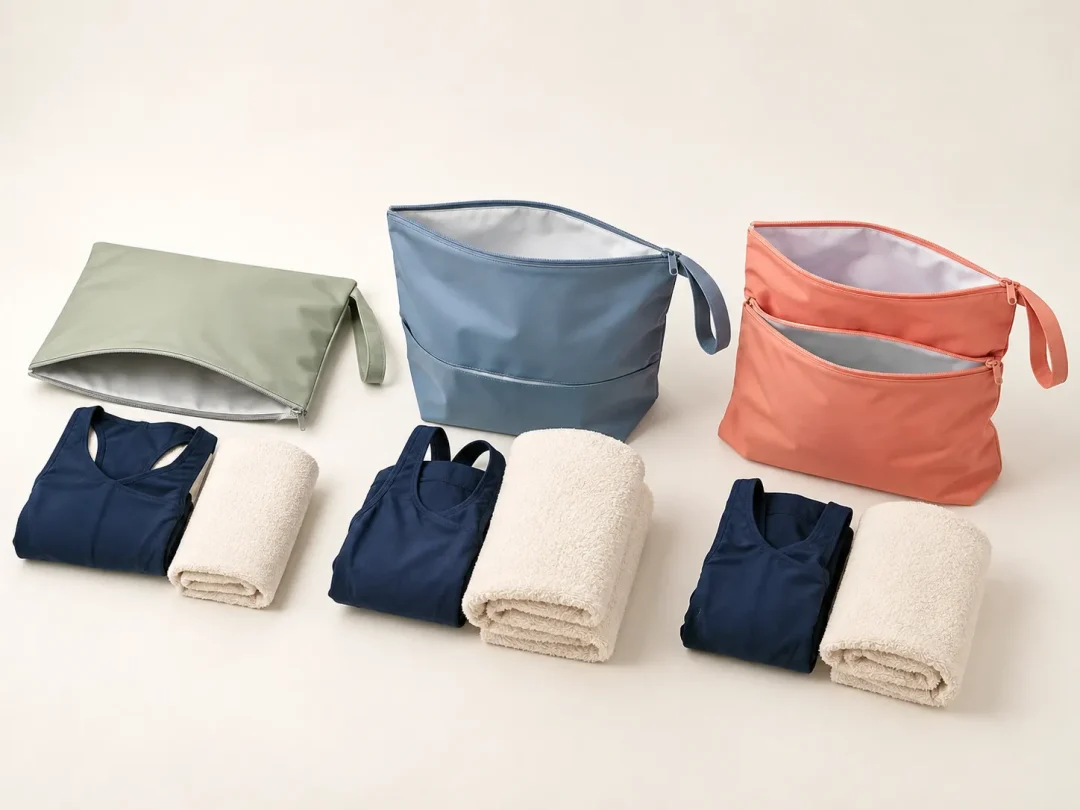
Exterior height and width do not reveal the complete capacity of a soft bag.
Flat wet bags
Flat bags fold compactly and slide easily into backpacks. They work well for swimsuits, wipes, and other items that can lie relatively flat. When bulky items are inserted, part of the bag’s height and width is used to create depth, reducing the usable opening and making the zipper harder to close.
Bottom-gusset wet bags
A bottom gusset expands when filled, allowing the bag to stand more naturally and accommodate folded clothing, diapers, or a rolled towel. A gusseted bag may hold noticeably more than a flat bag with similar front-panel dimensions.
Double-pocket wet bags
Two-pocket designs support wet/dry separation, but the compartments compete for space. They are ideal when organization matters more than maximum single-compartment capacity. A custom double-pocket wet bag can also be developed with different pocket depths depending on whether the primary use is daycare, swimwear, travel, or gym storage.
How to Measure Before You Buy
If you are unsure, a simple packing test is more reliable than choosing by a size name:
- Gather everything you normally need the wet bag to hold.
- Fold or roll the items as you would after actual use—do not compress them unnaturally.
- Measure the width, height, and thickness of the bundle.
- Add approximately 10–20% space for easier loading and zipper closure.
- Compare the result with the bag’s listed dimensions and gusset depth.
- Check that the filled wet bag will still fit inside your diaper bag, gym bag, or suitcase.
Soft bags do not have a perfectly fixed internal volume, so a packing test is more useful than attempting to convert every zippered wet bag into liters.
Do You Need One Wet Bag or Several?
For regular use, two bags are often more practical than one. One can be in use while the other is being washed or dried.
Useful combinations include:
- Mini + medium: Toiletries or small essentials plus daily wet clothing
- Small + medium: Swimming lessons, daycare, or gym use
- Two medium bags: Separate damp items from ordinary dirty laundry while traveling
- Medium + hanging bag: Outings plus home cloth-diaper storage
Cloth-diaper families may prefer two or three outing bags in rotation in addition to a larger home bag. The ideal number depends on laundry frequency and how many places—daycare, car, stroller, or home—you want to keep stocked.
How Brands and Bulk Buyers Should Select Wet Bag Sizes
For retailers, promotional buyers, and private-label brands, choosing a size should begin with the target use rather than an arbitrary dimension. A swimwear brand may need a compact bag for one swimsuit and a larger family version. A baby brand may plan sizes around two diapers, a full daycare load, and home storage. A fitness brand may prioritize a medium bag that fits inside a standard duffel.
One size or a size collection?
| Product strategy | Best suited to | Main advantage | Limitation |
|---|---|---|---|
| One medium size | Promotions and initial market tests | Fewer SKUs and simpler purchasing | Does not cover very small or household loads |
| Small + large | Clearly separated individual and family uses | Easy product differentiation | Misses some everyday middle-ground needs |
| Mini + medium + large | Retail and private-label collections | Covers most consumer scenarios | More inventory and packaging complexity |
| Custom project size | Product kits and specialized applications | Fits the intended contents closely | Requires more testing and development |
Size also affects material yield, zipper length, printable logo area, handle strength, seam reinforcement, packaging volume, and unit cost. Larger bags intended for towels or multiple diapers may need stronger handle attachments than small accessory pouches. Adding a gusset or second compartment changes both capacity and construction.
Before bulk production, test the sample with the actual target contents. Pack the items dry and damp, close the zipper without forcing it, carry the loaded bag by its handle, and check the seams and lining after washing. This reveals more than approving dimensions on a specification sheet alone.
Common Wet Bag Sizing Mistakes
- Assuming every brand uses the same small, medium, and large dimensions
- Choosing by height and width without checking the gusset
- Forgetting how much room a damp towel occupies
- Buying a bag that only closes when tightly packed
- Treating a double-pocket bag as if both pockets have the full exterior capacity
- Comparing a zippered wet bag directly with a roll-top dry bag measured in liters
- Ordering a custom size in bulk before testing it with real contents
So, What Size Wet Bag Should You Choose?
Choose a mini or small wet bag for wipes, toiletries, one swimsuit, or a very short diapering trip. A medium wet bag is the best all-around option for swimming lessons, daycare, several cloth diapers, gym clothing, and overnight travel. Choose a large bag for family swimwear, towels, or several days of laundry, and use a hanging or extra-large bag for household cloth-diaper storage.
When two sizes seem suitable, focus on the actual dimensions and bag construction rather than the size label. If your normal load would fill the smaller bag completely, size up. If you need to separate categories, two medium bags may be more useful than one oversized bag.
Frequently Asked Questions
What is the most useful wet bag size?
A medium bag around 12–16 inches (30–40 cm) wide and high is the most versatile choice for many users. It can handle several cloth diapers, a swimsuit and compact towel, or a set of gym clothes while remaining easy to carry inside another bag.
How many cloth diapers fit in a medium wet bag?
Many medium wet bags hold approximately 4–8 cloth diapers, but the result depends on the bag dimensions, gusset, diaper style, inserts, and whether other items are included. Thick nighttime diapers take more space than flats or prefolds.
Can a small wet bag hold an adult swimsuit?
Usually, yes. A small wet bag around 10–12 inches wide is often sufficient for one adult swimsuit. Choose medium for padded, long-sleeved, or bulky swimwear, or when adding goggles and a towel.
What size wet bag is best for swimming lessons?
A medium wet bag is a practical starting point because it can hold a swimsuit, swim cap, goggles, and a compact towel. Choose large if it must hold a full-size towel or equipment for more than one person.
Is a wet bag measured in liters or inches?
Zippered wet bags are usually described by length and width, sometimes with a gusset depth. Roll-top outdoor dry bags are more commonly measured in liters. The two product categories should not be compared by size label alone.
Is a wet bag the same as a dry bag?
No. A wet bag is designed mainly to contain damp or messy items. A dry bag is designed to keep its contents dry and commonly uses welded seams and a roll-top closure. A standard zippered wet bag should not be assumed to withstand submersion.
Are two medium wet bags better than one large bag?
They can be. Two medium bags make it easier to separate damp clothing from dry dirty laundry, distribute items in luggage, and keep one bag available while the other is being washed. A single large bag is simpler when everything belongs to the same load.

 English
 French
 German
 Japanese
 Arabic
 Thai
 Vietnamese
 Russian
 Spanish
 Portuguese