
When requesting a custom bag quotation, buyers usually define the bag material, size, color and logo first. The handles are often described with only a few words—“long handles,” “cotton straps” or “same-fabric handles.”
That small detail can create surprisingly large differences in the finished bag.
A webbing handle may provide more stable load performance, but its color and texture can look separate from the bag body. A self-fabric handle creates a more unified appearance, yet an inadequately reinforced version may curl, stretch or pull at the attachment points.
So, which option should you choose?
The short answer is:
- Choose webbing handles when consistent strength, efficient production and functional performance are the priorities.
- Choose self-fabric handles when visual continuity, coordinated printing or a simplified material palette matters more.
- For demanding applications, a hybrid structure can combine the appearance of self-fabric with internal webbing reinforcement.
However, handle material alone does not determine performance. Width, construction, attachment method and the strength of the bag body all need to be evaluated together.
If you are still comparing the broader range of handle styles available, start with our guide to different types of bag handles. This article focuses specifically on the differences between webbing and self-fabric constructions.
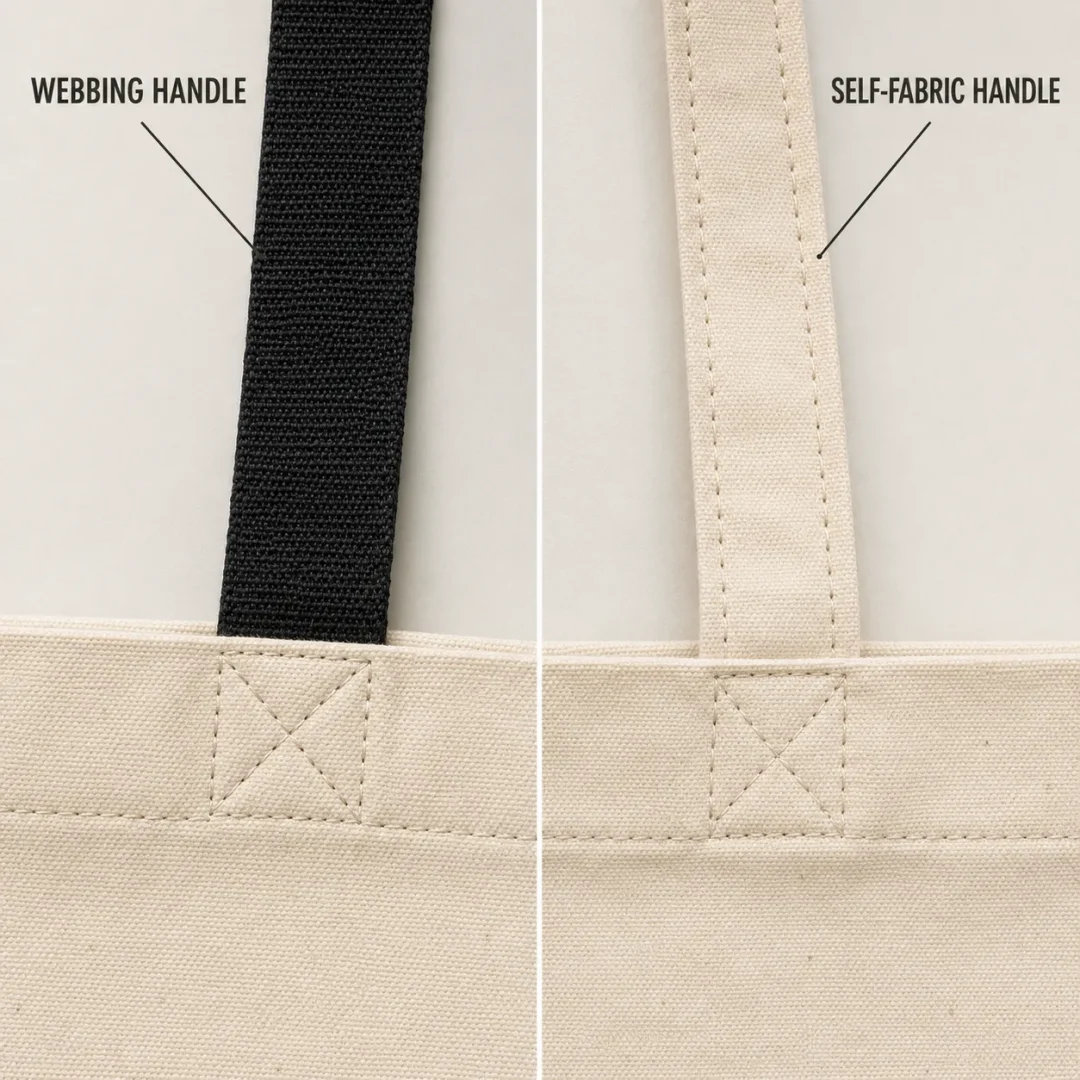
What Are Webbing Handles?
Webbing handles are made from narrow fabric bands woven separately from the bag body. The webbing is supplied in rolls, cut to the required length and sewn onto or into the bag.
“Webbing” describes the structure rather than one specific material. Common options include:
- Cotton webbing
- Polyester webbing
- Nylon webbing
- Polypropylene webbing
- Recycled polyester webbing
- Recycled or blended cotton webbing
These materials do not provide identical strength, texture or appearance.
Cotton webbing generally has a softer, more natural surface that works well with canvas and cotton bags. Polyester and nylon webbing offer good abrasion resistance and dimensional stability, making them common on travel bags, cooler bags and sports bags. Polypropylene webbing is lightweight, moisture-resistant and cost-effective, although its surface may feel rougher or more synthetic.
Webbing can be attached in several ways. It may be sewn inside the top hem, stitched onto the outside of the bag or extended down the bag body toward the base. Depending on the expected load, the attachment points may use multiple rows of stitching, bartacks or a box-X pattern.
The placement matters as much as the webbing itself. Our guide to bag handle attachment methods explains how different sewing structures affect load distribution and the appearance of the finished bag.
What Are Self-Fabric Handles?
Self-fabric handles are cut and sewn from the same fabric—or the same fabric family—as the bag body. Instead of purchasing a separate roll of webbing, the factory converts the bag material into handles.
A self-fabric handle is not necessarily a single strip of cloth. It may be made using several constructions:
- Single-fold fabric handles
- Double-fold handles
- Multi-layer folded handles
- Interfaced or reinforced handles
- Padded handles
- Rolled fabric handles
- Fabric handles with internal webbing
The construction selected depends on the fabric thickness, bag style, target load and desired hand feel.
For example, a lightweight cotton promotional tote may use a narrow folded cotton handle. A heavier canvas bag might require multiple layers or internal reinforcement. A fashion tote could use a rolled handle with padding to create a softer and more dimensional appearance.
Self-fabric handles are commonly produced from cotton, canvas, linen blends, non-woven polypropylene, RPET fabric, polyester, nylon and laminated woven materials.
Webbing Handles vs. Self-Fabric Handles at a Glance
| Comparison | Webbing Handles | Self-Fabric Handles |
|---|---|---|
| Appearance | More distinct, structured and functional | More integrated with the bag body |
| Load stability | Usually consistent and less likely to curl | Depends heavily on fabric, folding and reinforcement |
| Color matching | May show a difference from the bag-body color | Usually easier to coordinate with the bag body |
| Printing | Can be printed or jacquard woven, with some limitations | Can use the same print or surface treatment as the bag |
| Production process | Cut from rolls and attached directly | Requires cutting, folding, positioning and sewing |
| Material cost | Requires an additional trim | May use bag-body fabric but adds processing labor |
| Comfort | Depends on fiber, weave, width and edge finish | Can be widened, padded or shaped for comfort |
| Material consistency | May introduce another fiber type | Can support a single-material design |
| Common applications | Grocery, cooler, sports, travel and reusable bags | Fashion, promotional, printed and retail bags |
This comparison provides a useful starting point, but it should not be treated as an absolute rule. A reinforced self-fabric handle may perform better than lightweight webbing that has been poorly attached.
Which Handle Is Stronger?
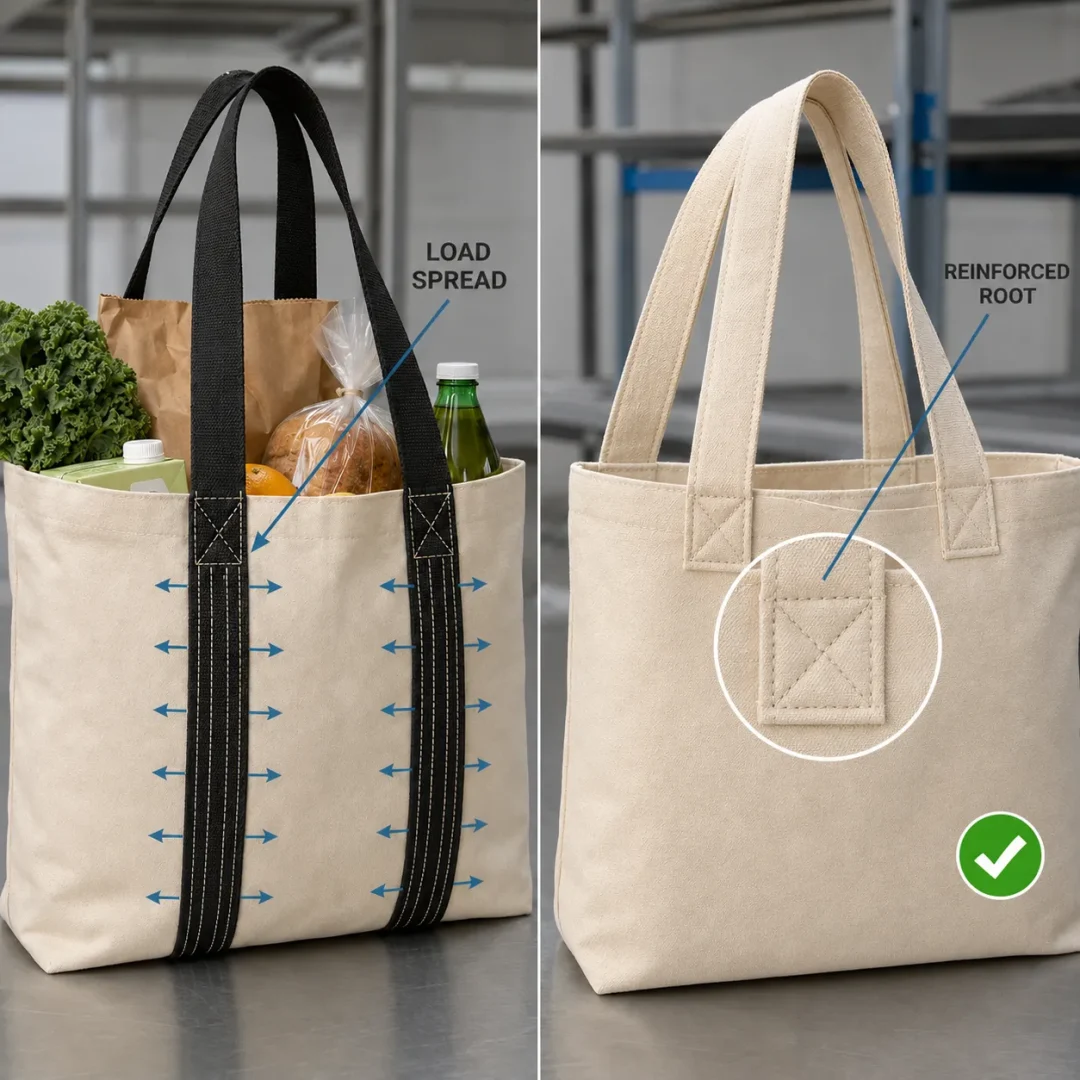
Webbing is normally the safer starting point when stable load performance is required. Its narrow-woven structure is produced specifically to resist tension along its length, and its width and thickness are relatively consistent across a production batch.
Webbing is also less affected by cutting direction. By comparison, a self-fabric handle may stretch or deform differently depending on the fabric weave, cutting direction and number of folded layers.
For heavy-duty bags, the webbing can extend farther down the bag body or continue under the base. This spreads the load across a larger area instead of concentrating it only at the top edge.
However, this does not mean that all webbing handles are strong or that self-fabric handles are only suitable for lightweight bags.
A self-fabric handle can provide reliable performance when it uses:
- A sufficiently dense or heavy bag fabric
- Double-fold or multi-layer construction
- Internal interfacing or reinforcement tape
- Webbing concealed inside the fabric
- Reinforcement patches behind the attachment points
- Multiple rows of stitching or box-X reinforcement
- A suitable handle width for the expected load
The expected contents should therefore be discussed before the sample is made. A cotton tote designed to hold documents has very different requirements from a grocery bag expected to carry bottles or canned products.
The Attachment Point May Fail Before the Handle
In bag testing, the handle itself is not always the first component to fail.
More commonly, we see problems such as:
- Stitching opening at the handle root
- The bag-body fabric tearing around the needle holes
- The top hem deforming under tension
- Laminated material splitting around the attachment area
- Reinforcement layers shifting inside the handle
- Narrow handles curling into a rope-like shape
This is why handle testing should include the complete construction—not just a tensile test on the webbing or fabric strip.
The factory should evaluate how the load transfers from the handle into the bag body. A strong strap sewn onto a weak fabric without reinforcement will not create a strong bag.
Appearance and Branding Differences
The choice between webbing and self-fabric handles is also a visual decision.
When Webbing Becomes Part of the Design
Webbing creates a more independent visual line. Depending on its color and structure, it can make a bag look more functional, sporty or outdoor-oriented.
Brands can customize webbing through:
- Contrasting colors
- Woven stripes
- Jacquard logos
- Screen-printed logos
- Heat-transfer graphics
- Reflective details
- Different weave patterns and surface textures
These options work especially well for gym bags, duffel bags, cooler bags, backpacks and travel products.
However, custom-colored or jacquard webbing may require a separate minimum order quantity. It can also add sampling time because the webbing needs to be developed independently from the bag body.
If standard stock colors are used, buyers should not assume that “black,” “beige” or “navy” webbing will match the bag fabric exactly. The difference in fiber, dyeing process and surface texture can make two nominally identical colors appear different.
Why Self-Fabric Handles Look More Integrated
Self-fabric handles usually create a calmer, more continuous appearance because the bag body and handles share the same texture and color.
They are particularly suitable when:
- The bag uses an all-over print
- The material texture is a central design feature
- The brand wants a minimalist appearance
- The handle should not become a separate visual element
- The project uses an unusual custom-dyed fabric
- The buyer wants to reduce the number of visible materials
For printed bags, self-fabric handles can use the same print as the body. However, this does not automatically mean that the pattern will line up continuously from the bag to the handle.
If exact pattern placement or pattern matching is important, it should be specified during sampling. Precise alignment may require additional cutting control and fabric consumption.
Which Option Costs Less?
There is no universal answer.
Self-fabric handles are sometimes assumed to be cheaper because they do not require separate webbing. In other cases, buyers assume webbing must be cheaper because it is supplied ready-made. Both assumptions overlook the complete production process.
Webbing Adds Material but Can Simplify Production
Webbing requires the factory to purchase and manage an additional trim. Costs may increase if the project requires:
- A custom Pantone color
- A non-standard width or thickness
- A jacquard logo
- Special recycled content
- Certification for a particular fiber
- A low quantity that does not meet the webbing supplier’s minimum
Once the webbing is available, however, production is relatively efficient. The factory can cut it to length, seal or finish the ends and position it for sewing. Its consistent width also helps maintain uniformity across large orders.
Self-Fabric Uses Bag Material but Adds Labor
Self-fabric handles may be cut from the same material as the bag, potentially reducing the number of separately purchased trims.
But the handle still requires processing. Depending on its structure, this may include:
- Cutting long and narrow fabric pieces
- Folding the edges evenly
- Pressing the folds
- Adding interfacing or reinforcement
- Positioning the layers
- Sewing along one or both edges
- Turning or rolling the handle
- Matching printed patterns
Thick canvas can become difficult to sew when folded into multiple layers. Accurate pattern positioning may also increase fabric waste.
As a result, self-fabric is not automatically cheaper, and webbing is not automatically more expensive. The final cost depends on material utilization, labor, handle construction, order quantity and customization requirements.
Which Handle Is More Comfortable?
Comfort depends on more than whether a handle is made from webbing or bag fabric.
The most important variables include:
- Handle width
- Edge texture
- Material flexibility
- Handle thickness
- Load weight
- Carrying duration
- Whether the bag is carried by hand or over the shoulder
A wider handle generally distributes pressure over a larger area. A narrow strap may be acceptable for a lightweight promotional bag but uncomfortable when the same bag is filled with groceries.
Material also affects the experience. Soft cotton webbing usually feels more comfortable against bare skin than coarse polypropylene webbing. Polyester and nylon webbing can provide good flexibility, although the feel varies according to weave density and edge finish.
Self-fabric handles can be made wider or padded, but a thin version may fold inward under load. Once it curls into a narrower shape, its effective contact area becomes smaller and the pressure on the hand or shoulder increases.
Thick folded canvas can feel supportive, yet several layers of fabric and seam allowances may create a hard edge. This is one reason why the handle should be evaluated on a loaded sample, rather than judged only from a flat material swatch.
Handle length also changes how and where the pressure is applied. If you are deciding between hand-carry, shoulder-carry or longer tote straps, see our guide: How Long Should Tote Bag Handles Be?.
Sustainability and Material Consistency
Neither handle type is automatically the more sustainable option.
A self-fabric handle can help reduce the number of different visible materials in the bag. If the body and handles use the same fiber, the material declaration may also be simpler.
However, a self-fabric appearance does not guarantee a mono-material construction. The handle may still contain:
- Polyester sewing thread
- Non-woven interfacing
- Foam padding
- Adhesive layers
- Internal webbing
- Coatings or laminations
Webbing can also fit a sustainability-focused product brief. Available options may include recycled polyester webbing, recycled cotton webbing, organic cotton webbing or webbing made from the same general fiber as the bag body.
When material claims are important, buyers should ask for the fiber composition, recycled-content documentation and applicable certification. Terms such as “eco strap” or “green webbing” are not specific enough for purchasing or compliance purposes.
Durability should also remain part of the assessment. A handle that allows the bag to be reused for a longer period may be more valuable than a visually simple construction that fails prematurely.
Best Handle Choice by Bag Type
| Bag Type | Common Handle Choice | Why |
|---|---|---|
| Promotional cotton tote | Self-fabric or cotton webbing | Selection depends on budget, load and desired appearance |
| Heavy canvas grocery bag | Cotton or polyester webbing | Offers stable performance during repeated carrying |
| Fashion printed tote | Self-fabric | Coordinates with the bag texture and print |
| Non-woven shopping bag | Folded non-woven fabric or PP webbing | Suitable choice depends on bag weight and expected reuse |
| Cooler bag | Polyester or PP webbing | Better suited to moisture and frequent handling |
| Gym or duffel bag | Polyester or nylon webbing | Durable and compatible with functional hardware |
| Jute shopping bag | Cotton webbing or padded jute handle | Helps reduce the rough feeling of exposed jute |
| RPET promotional bag | RPET webbing or self-fabric | Supports a more consistent recycled-material story |
| Retail packaging bag | Self-fabric | Creates a cleaner and more coordinated appearance |
| Heavy utility bag | Webbing extending down the body | Distributes the load beyond the top attachment points |
These are typical choices rather than fixed rules. The same bag type may use a different handle depending on its intended contents, positioning and target price.
When a Hybrid Handle Is the Better Answer
Sometimes the best result does not come from choosing only one material.
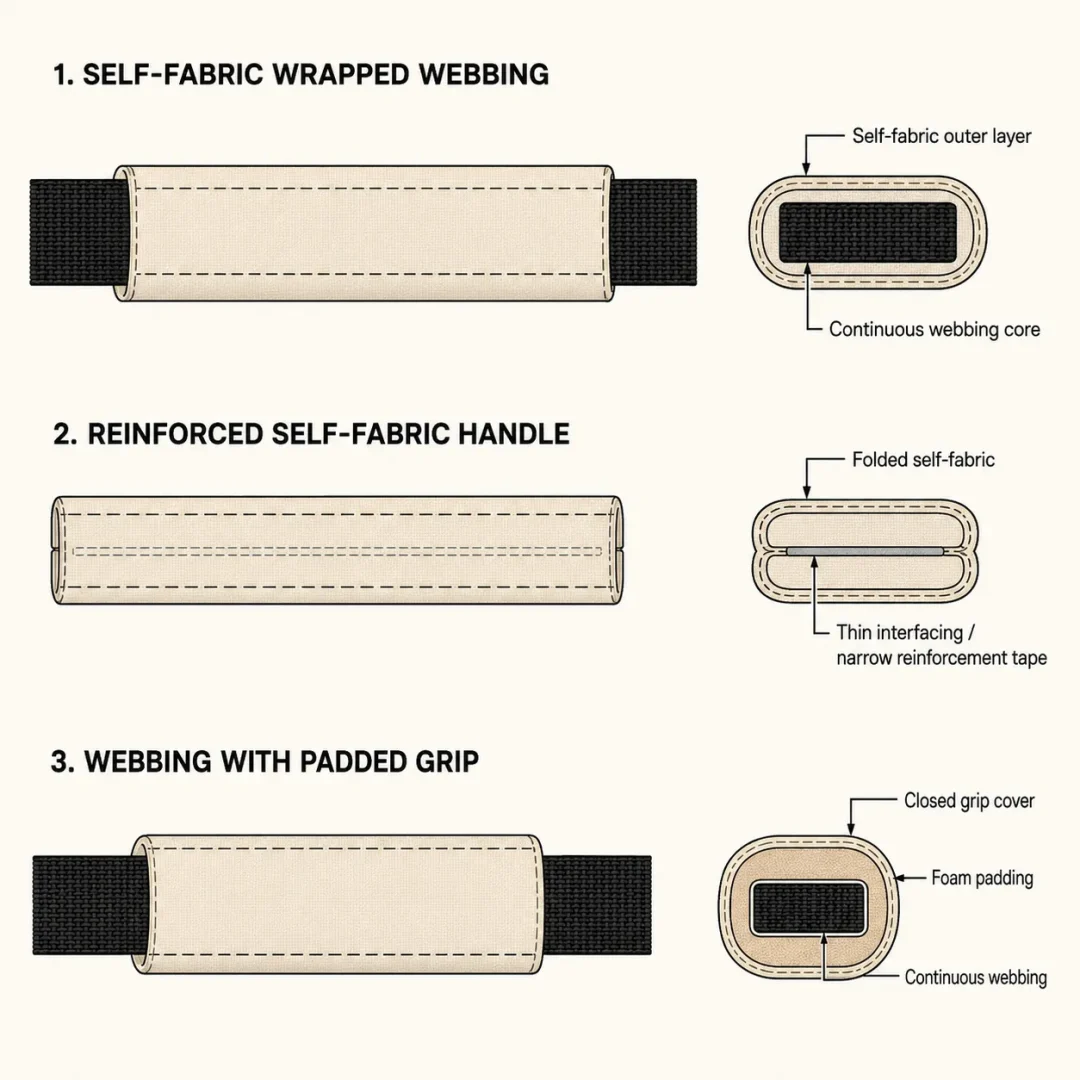
Self-Fabric Wrapped Webbing
In this construction, webbing provides the internal load-bearing structure while the bag fabric covers the outside.
The finished handle retains the visual continuity of self-fabric while gaining the dimensional stability of webbing. It can be useful for fashion totes, heavier canvas bags or projects that require a specific exterior texture.
Reinforced Self-Fabric Handles
A self-fabric handle can contain interfacing, narrow reinforcement tape or concealed webbing. From the outside, it still appears to be made entirely from the bag fabric.
The correct reinforcement needs to be selected carefully. A very stiff insert inside a soft fabric may create visible ridges or make the handle uncomfortable.
Webbing with a Fabric or Padded Grip
A webbing handle can include a fabric wrap, padded shoulder section or separate grip at the main contact point.
This structure is frequently used for travel, sports and cooler bags because it retains the strength of the main webbing while making heavier loads more comfortable to carry.
Hybrid handles add materials and sewing operations, so they are not always suitable for low-cost promotional bags. They are most valuable when the product needs to balance appearance, comfort and carrying performance.
How to Specify Handles When Requesting a Quote
“Long cotton handles” is not enough information for an accurate quotation or sample.
A more complete handle specification should include:
- Handle material and fiber composition
- Handle width
- Finished handle length or handle drop
- Webbing thickness or weight
- Self-fabric folding construction
- Internal reinforcement
- Handle color or Pantone reference
- Logo method and placement
- Attachment position
- Stitching method
- Expected contents or working load
- Washing or cleaning requirements
- Required material certification
For example:
Too vague:
Long cotton handles.
More useful:
3 cm wide natural cotton webbing handles, 65 cm finished length, attached inside the top hem with box-X reinforcement. The bag is expected to carry approximately 8 kg.
For a self-fabric version, the specification might read:
4 cm wide finished handles made from the same 12 oz canvas as the bag body, double-folded with internal reinforcement, 60 cm finished length and sewn inside the top hem with box-X stitching.
These details allow the factory to evaluate material consumption, sewing difficulty, attachment strength and cost before sampling.
Final Decision: Which Handle Should You Choose?
Choose webbing handles when:
- The bag will regularly carry heavier contents
- Consistent dimensions are important across a large order
- The design has a sporty, travel or functional character
- The handles need to extend down the bag body
- The strap will be used with buckles, adjusters or other hardware
- Moisture and abrasion resistance are important
Choose self-fabric handles when:
- The bag body and handles should look visually continuous
- An all-over print or special fabric is central to the design
- The bag needs a clean, minimalist or fashion-oriented appearance
- You want to reduce the number of visible trims
- The expected load is light to moderate
- A custom fabric color would be difficult to match with stock webbing
Consider a hybrid handle when:
- You want the appearance of self-fabric but require greater stability
- The bag will carry more weight than a basic fabric handle can support
- Comfort needs to be improved without changing the main strap
- The product positioning can support the additional material and labor
Webbing is generally the safer default for load stability, while self-fabric offers better visual continuity. Still, a properly reinforced self-fabric handle can outperform poorly specified or poorly attached webbing.
The complete handle system—including material, width, length, reinforcement and attachment method—should therefore be evaluated as one structure.
Frequently Asked Questions
Are webbing handles stronger than self-fabric handles?
Webbing usually provides more consistent tensile performance, but the result depends on its fiber, width, thickness and attachment method. A reinforced multi-layer fabric handle can be stronger than lightweight webbing attached to a weak bag body.
Are self-fabric handles cheaper?
Not necessarily. They may eliminate a separate trim, but they require additional cutting, folding, pressing and sewing. Thick materials, reinforcement and pattern matching can further increase labor and fabric consumption.
Can self-fabric handles be reinforced with webbing?
Yes. Webbing can be concealed inside a self-fabric handle to improve strength and reduce curling while preserving the exterior appearance of the bag material.
Which handle is better for canvas tote bags?
For lightweight fashion or promotional canvas totes, self-fabric handles often provide a coordinated appearance. For grocery bags, work totes or heavier reusable bags, cotton or polyester webbing usually offers more stable performance.
Can logos be added to webbing handles?
Yes. Depending on the material and design, logos can be screen printed, heat transferred or woven into custom jacquard webbing. Each method has different minimum quantities, costs and artwork limitations.
Which option is more sustainable?
The answer depends on the full material composition, recycled or certified content, manufacturing requirements and expected product life. Neither “webbing” nor “self-fabric” alone is enough to determine environmental performance.
Need Help Choosing the Right Handle Construction?
A handle decision should be based on what the finished bag will carry, how it will be used and how the handle connects to the bag—not only on how the material looks in a sample book.
INITI works with brands, promotional-product companies and bag buyers to develop custom handle constructions for tote bags, shopping bags, cooler bags, travel bags and other sewn products.
Send us your bag drawing, reference image or basic specifications. If you are unsure whether webbing, self-fabric or a reinforced hybrid handle is the better option, our team can review the intended load, material, dimensions and branding requirements before sampling.


 English
 French
 German
 Japanese
 Arabic
 Thai
 Vietnamese
 Russian
 Spanish
 Portuguese