
Tote bags can be made from cotton, canvas, jute, polyester, nylon, recycled PET, non-woven polypropylene and several specialty materials. Each option creates a different balance of weight, durability, structure, water resistance, print quality and cost.
For a general-purpose reusable tote, cotton canvas is often the most versatile choice. Polyester or nylon works better when the bag needs to be lightweight, foldable or exposed to moisture. Non-woven polypropylene is commonly used for high-volume promotional projects, while jute and linen suit brands looking for a more natural or distinctive texture.
However, choosing a material by name alone is rarely enough. Two bags both described as “canvas totes” may perform very differently if they use different fibre compositions, fabric weights, weaves, handles or reinforcement methods.
This guide explains the most common tote bag materials, how they compare and what buyers should check before approving a material for production.
Содержание
ПереключитьQuick Comparison of Tote Bag Materials
The following table provides a starting point. Actual performance will also depend on fabric weight, construction, coating, bag size, stitching and handle reinforcement.
| Материал | Structure and feel | Долговечность | Водостойкость | Printability | Relative cost | Общие применения |
|---|---|---|---|---|---|---|
| Хлопок | Soft and flexible | Средний | Low | Excellent | Средний | Promotions, retail packaging and lightweight totes |
| Холст | Thick and structured | Высокий | Low unless treated | Excellent | Средний до высокого | Retail merchandise and reusable everyday bags |
| Джут | Coarse and natural | Средний до высокого | Low | Умеренный | Средний | Grocery bags, gift packaging and natural brands |
| Полиэстер | Smooth and lightweight | Высокий | Good | Excellent with suitable methods | Средний | Foldable, outdoor and full-colour promotional totes |
| Нейлон | Lightweight and strong | Высокий | Good | Good | Средний до высокого | Travel, sports and packable bags |
| RPET | Depends on the fabric construction | Средний до высокого | Varies | Good | Средний до высокого | Recycled-material and sustainability programmes |
| Non-woven PP | Lightweight and sheet-like | Низкий до среднего | Умеренный | Good | Low | Events, exhibitions and mass promotions |
| Woven PP | Strong and structured | Высокий | Good when laminated | Excellent | Низкий до среднего | Grocery and heavy reusable shopping bags |
| Лен | Natural and refined | Средний | Low | Good | Высокий | Lifestyle and premium retail products |
| Фетр | Soft but structured | Средний | Низкий до умеренного | Good | Средний | Gift bags, storage totes and specialty packaging |
This comparison should not be treated as a fixed material ranking. For example, a wide, well-reinforced handle on a medium-weight bag may perform better than a heavy fabric combined with weak stitching.
Understanding Tote Bag Material Terms
Before comparing individual fabrics, it helps to separate three terms that are frequently mixed together: fibre, fabric construction and surface finish.
Fibre composition
Fibre composition describes what the material is made from. Common examples include:
- Хлопок
- Полиэстер
- Нейлон
- Polypropylene
- Джут
- Flax, which is used to make linen
Fabric construction
Fabric construction describes how those fibres are formed into a sheet or textile. Examples include:
- Холст
- Оксфорд
- Ripstop
- Woven polypropylene
- Non-woven polypropylene
- Фетр
This is why cotton and canvas are not strictly opposite materials. Cotton is a fibre, while canvas is a relatively heavy and tightly woven fabric construction. Canvas is commonly made from cotton, but it can also be produced from polyester, recycled fibres or cotton-polyester blends.
Surface treatment
A coating, lamination or other finish may change the performance of the base fabric. Common treatments include:
- PU or PVC coating
- BOPP lamination
- Waxing
- Water-repellent treatment
- Pre-washing or pre-shrinking
- Brushing or softening
When a supplier describes a tote simply as “polyester” or “canvas,” the description may not provide enough information to evaluate the finished product.
Why Fabric Weight Matters
Tote bag fabrics are commonly specified in GSM, ounces or denier, depending on the material.
- GSM means grams per square metre and can be used across many textile types.
- Ounces usually refer to ounces per square yard and are frequently used for cotton canvas.
- Denier describes yarn density and is commonly used for polyester and nylon fabrics.
A heavier fabric will usually feel thicker or more structured within the same material family. However, fabric weight alone does not determine the load capacity of the finished bag.
Actual load performance also depends on:
- Bag dimensions
- Handle material and width
- Handle attachment
- Seam allowance
- Stitch density
- Усиление
- Shape and distribution of the contents
Comparing a 300 GSM cotton canvas directly with a 300 GSM non-woven fabric can therefore be misleading. They have different fibres and construction methods.
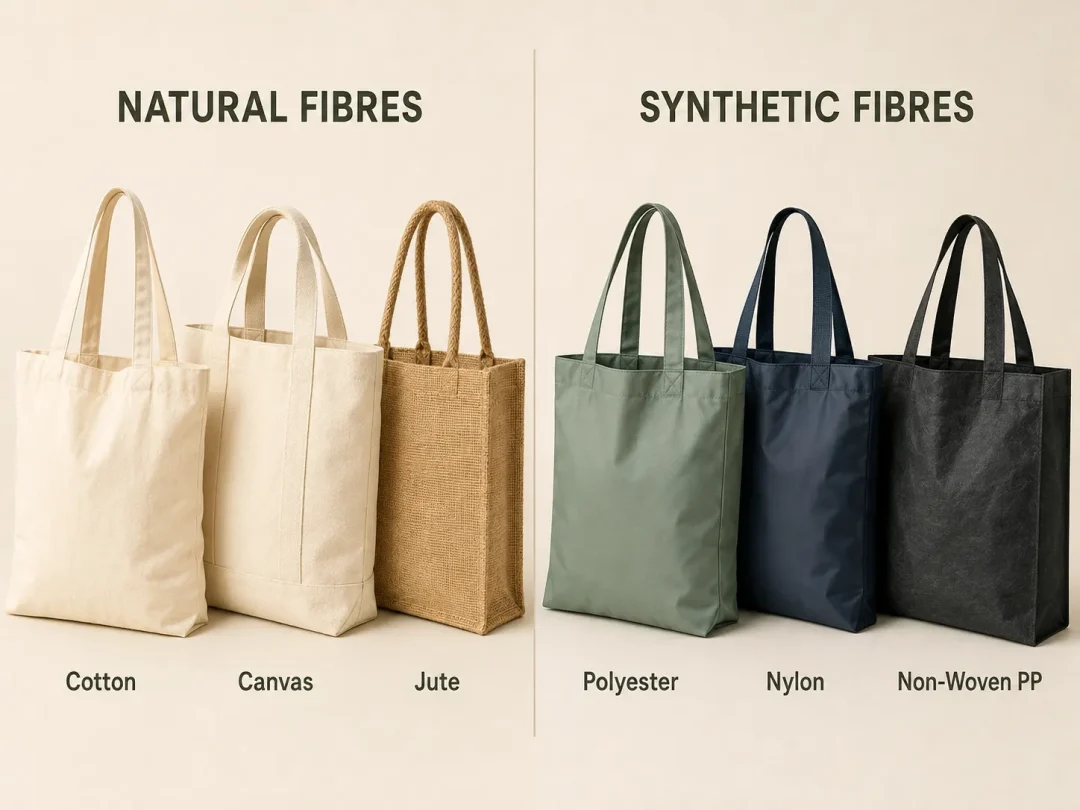
Cotton Tote Bags
Cotton is one of the most familiar tote bag materials. It has a soft, breathable and natural feel, making it suitable for brands that want their packaging or merchandise to feel approachable rather than highly technical.
Lightweight cotton tote bags fold easily and take up relatively little storage space. They are frequently used for exhibitions, bookstores, retail packaging, event giveaways and simple branded merchandise.
Cotton also provides a receptive surface for several decoration methods. Depending on its colour, weight and finish, it may be suitable for:
- Шелкография
- Термопечать
- Direct-to-garment printing
- Embroidery
- Fabric labels
Its limitations are mainly related to structure and moisture. Lightweight cotton may wrinkle, lose shape or feel too thin for a premium retail product. Untreated cotton also absorbs water and may shrink after washing.
Cotton is a sensible option when softness, natural texture and print quality are more important than water resistance or a highly structured appearance.
Cotton is commonly used for:
- Рекламные подарки
- Lightweight shopping bags
- Book and library bags
- Упаковка в розничной торговле
- Lifestyle merchandise
- Drawstring and dust bags
What buyers should confirm
Ask the manufacturer to specify the cotton content, fabric weight, colour treatment and whether the material has been pre-washed or pre-shrunk. If the product will be washed, dimensional stability should be tested on the finished sample rather than assumed from the fabric description.
Канвасные сумки-тоуты
Canvas is one of the most widely used materials for reusable tote bags because it offers a useful balance of durability, structure and printability.
Compared with lightweight cotton fabric, canvas generally uses thicker yarns and a denser weave. The result is a bag that holds its shape more effectively and better supports repeated everyday use.
Canvas is available in different weights. A relatively light canvas can be used for promotional or foldable totes, while heavier constructions are more suitable for structured retail merchandise, book bags and premium branded products.
Increasing fabric weight can improve structure, but it also increases material consumption, shipping weight and sewing difficulty. The heaviest available option is not automatically the best choice.
Canvas may be made from:
- 100% cotton
- Органический хлопок
- Recycled cotton
- Cotton-polyester blends
- Полиэстер
- Other blended fibres
Cotton canvas normally provides a natural hand feel and a good surface for screen printing or embroidery. Polyester canvas is less absorbent and can be more suitable for outdoor use or printing methods that require synthetic fibres.
Untreated cotton canvas should not be described as waterproof. Water resistance requires an appropriate coating, wax treatment, lamination or lining, and the finished bag construction must also be considered.
For a more detailed explanation of weights, weave options and print compatibility, see this guide to canvas material for tote bags.
Canvas is commonly used for:
- Premium retail tote bags
- Корпоративные подарки
- Book bags
- Everyday reusable bags
- Брендированные товары
- Structured shopping bags
Buyers deciding between ordinary cotton and canvas can also review this comparison of cotton vs. canvas tote bags.
Jute Tote Bags
Jute is a plant-based fibre known for its coarse texture and naturally rustic appearance. Unlike smooth cotton or polyester, jute makes the material itself a visible part of the design.
It is frequently chosen by farm shops, food brands, wineries, florists and natural-product businesses. The texture can help a bag communicate an earthy or handcrafted identity without relying entirely on printed graphics.
Jute is relatively stiff, which allows many jute totes to maintain their shape. However, the material does not fold or wash as easily as lightweight cotton. Its textured surface can also make small lettering, fine lines and detailed artwork less clear.
Simple logos generally work better than complex designs. If higher-resolution printing or improved moisture resistance is required, the material may be combined with a lamination, coating or smoother front panel.
Common jute bag constructions include:
- Unlaminated jute
- Laminated jute
- Jute with cotton handles
- Jute with a cotton front pocket
- Jute blended with cotton
- Jute with an internal lining
These added components affect both performance and environmental claims. A bag should not automatically be described as biodegradable or compostable simply because the main body uses jute. Lamination, synthetic thread, linings, printing inks and handles must also be considered.
Jute is commonly used for:
- Farmers’ market bags
- Grocery totes
- Wine bags
- Подарочной упаковки
- Natural food brands
- Rustic event bags
Polyester Tote Bags
Polyester is a versatile synthetic fibre used in foldable shopping bags, beach totes, sports bags and outdoor promotional products.
It absorbs less moisture than cotton and generally resists wrinkling, making it useful when a bag needs to be lightweight, packable or easy to wipe clean. It can also be produced in a wide range of colours, weights, textures and fabric constructions.
Common polyester options include:
- Plain woven polyester
- Оксфордская ткань
- Ripstop fabric
- Brushed polyester
- Coated polyester
- RPET polyester
- Polyester canvas
Polyester works with several printing methods, but the correct method depends on the fabric colour, coating and composition. Sublimation, for example, requires a suitable polyester-rich surface and generally works best on white or light-coloured materials.
Although polyester fibres absorb relatively little water, that does not make every polyester tote waterproof. Water may still pass through the weave, stitching, seams or zipper. A water-resistant bag may be sufficient for outdoor promotions or beach use, while a waterproof application may require coated fabric and sealed seams.
Polyester is commonly used for:
- Foldable shopping bags
- Outdoor event totes
- Sports and gym bags
- Beach bags
- Full-colour promotional bags
- Reusable grocery bags
Nylon Tote Bags
Nylon is valued for its combination of strength, light weight and flexibility. It is often selected for travel, sports and packable bags where the user needs a durable fabric without the bulk of heavy canvas.
Compared with many standard polyester fabrics, nylon can offer a softer and smoother hand feel. It also performs well in applications where abrasion and tearing are concerns.
However, “nylon” and “polyester” are sometimes used loosely in product listings because the finished fabrics can look similar. If composition affects performance, labelling or the buyer’s material policy, it should be confirmed rather than judged from photographs.
Printing and heat treatment should also be tested carefully. Nylon can respond differently to heat, coatings and dyes than polyester.
Nylon is commonly used for:
- Packable travel totes
- Lightweight everyday bags
- Sports bags
- Outdoor accessories
- Premium foldable shopping bags
Nylon can be an excellent functional option, but it usually makes less sense when the project’s priority is a visibly natural texture or an organic material claim.
RPET Tote Bags
RPET stands for recycled polyethylene terephthalate. It is usually made using recycled PET feedstock, which may include post-consumer plastic bottles or other suitable PET waste.
One important distinction is that RPET describes the source of the fibre, not the construction of the final fabric.
RPET can be made into:
- Woven polyester
- Оксфордская ткань
- Ripstop fabric
- Фетр
- Non-woven material
- Polyester canvas
- Webbing
As a result, two RPET tote bags can have entirely different textures, durability and water resistance. One might be a soft foldable shopping bag, while another might be a thick felt tote.
Buyers should therefore avoid specifying only “RPET bag.” A more complete specification might state:
100% recycled polyester woven fabric, 210D, with a water-repellent finish.
If a brand plans to make a verified recycled-content claim, it should request relevant documentation. The Global Recycled Standard and Recycled Claim Standard are administered by Textile Exchange and are used to support chain-of-custody and recycled-content requirements.
The exact certification scope matters. A certificate held by a raw-material supplier does not automatically prove that every stage of a finished bag order is certified.
RPET is commonly used for:
- Corporate sustainability programmes
- Retail merchandise
- Foldable shopping bags
- Reusable grocery bags
- Branded event products
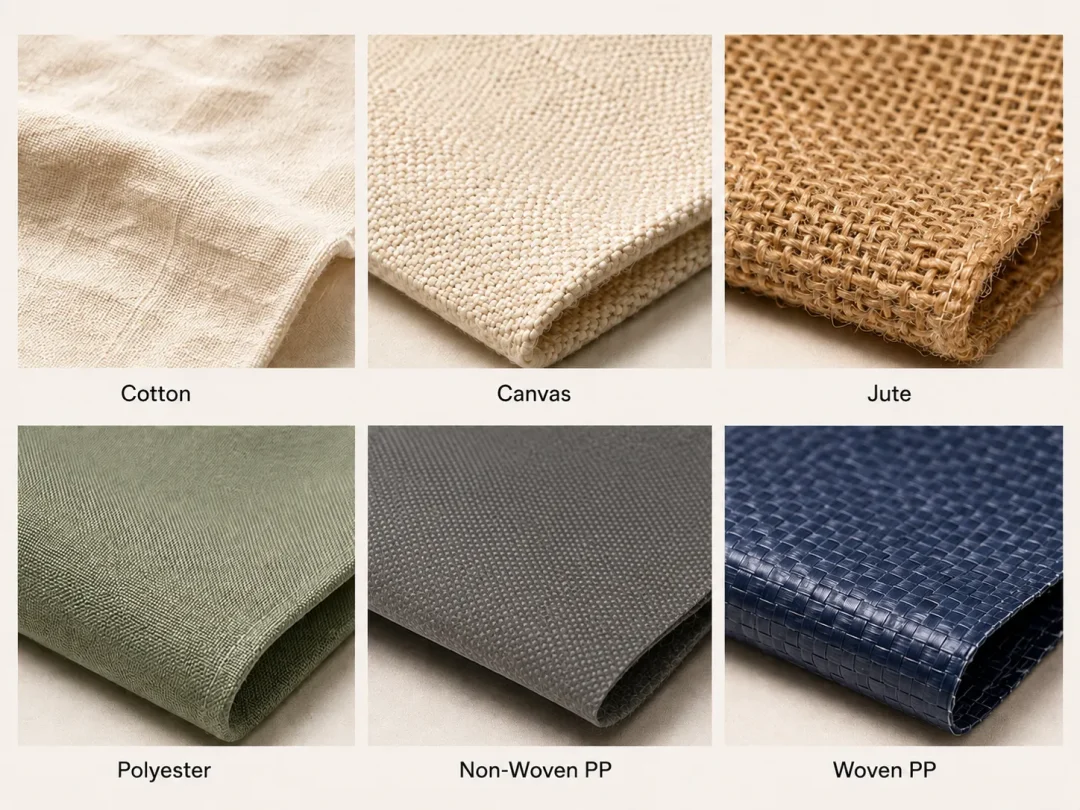
Non-Woven Polypropylene Tote Bags
Non-woven polypropylene, often shortened to non-woven PP, is formed by bonding polypropylene fibres rather than weaving yarns together in the traditional way.
It is lightweight, economical and available in many colours. These qualities make it particularly common for large promotional campaigns, exhibitions, conferences and retail giveaways.
Non-woven PP can be decorated using:
- Шелкография
- Термопечать
- Flexographic printing
- Laminated full-colour printing
The fabric weight is often expressed in GSM. Increasing GSM can create a thicker and more substantial bag, but the finished result still depends on the seam method, handle construction and reinforcement.
Stitch-bonded and heat-sealed bags may look similar but behave differently under repeated use. A wide bag intended for groceries also creates different stresses from a small flat exhibition bag.
Non-woven PP is a plastic-based material. It should not automatically be described as biodegradable. Its practical environmental value usually comes from reducing single-use packaging through repeated use, while actual recyclability depends on the local collection system and whether the bag combines multiple materials.
Non-woven PP is commonly used for:
- Trade-show giveaways
- Conference bags
- Supermarket promotions
- Упаковка в розничной торговле
- High-volume advertising campaigns
Woven PP and Laminated Woven Tote Bags
Woven polypropylene is produced by weaving flat polypropylene tapes into a strong sheet. It is generally more suitable than non-woven PP for repeated shopping, large bag sizes and heavier contents.
The woven structure provides strength while keeping the bag relatively light. A laminated surface can improve moisture resistance, make the bag easier to wipe and create a smoother base for full-colour graphics.
BOPP-laminated woven bags are particularly common in supermarkets and retail programmes because they can reproduce detailed artwork across a large surface.
Compared with cotton or canvas, woven PP has a more functional and synthetic feel. It may not suit a brand looking for a soft textile appearance, but it performs well when durability, graphic impact and repeated grocery use are priorities.
Woven PP is commonly used for:
- Supermarket shopping bags
- Large grocery totes
- Heavy reusable bags
- Promotional retail bags
- Insulated shopping bag exteriors
- Full-colour branded bags
Other Materials Used for Tote Bags
The materials above account for many common tote bag projects, but specialty fabrics can create a more distinctive product.
Лен
Linen is made from flax fibre and has a natural, refined texture. It can feel more elevated than basic cotton while retaining a textile appearance.
It is commonly used for lifestyle products, boutique packaging and premium retail merchandise. Natural slubs and slight variations may be considered part of its character rather than defects, but acceptable appearance standards should still be agreed during sampling.
Hemp
Hemp provides a natural texture and can be used for brands seeking an alternative plant-based fibre. Availability, colour consistency and price may be less predictable than conventional cotton, so sourcing requirements should be confirmed early.
Фетр
Felt can be manufactured from polyester, wool or blended fibres. It does not fray in the same way as woven fabric, making it suitable for clean-cut edges and structured shapes.
Polyester felt is commonly used for gift bags, storage totes, bottle carriers and organisers. Buyers should not assume that all felt is wool or biodegradable.
Кордюр
Corduroy has raised parallel ribs that give a tote a soft, fashion-oriented appearance. It works well for autumn collections, lifestyle merchandise and casual cosmetic or shopping bags.
The direction of the ribs, pile consistency and colour shading should be checked during sampling.
PVC and TPU
PVC and TPU can be used for transparent or water-resistant tote bags. They are commonly found in stadium bags, cosmetic totes, beach bags and product packaging.
Buyers should confirm:
- Material thickness
- Прозрачность
- Flexibility
- Low-temperature performance
- Odour
- Colour tint
- Relevant chemical requirements
A transparent material may look clear in isolation but develop a blue or yellow cast when several layers overlap.
What Is the Best Material for a Tote Bag?
There is no single material that is best for every tote bag, but clear recommendations can be made once the primary use is known.
Best all-round material: cotton canvas
Cotton canvas offers a strong combination of durability, natural appearance, structure and printability. It is suitable for retail merchandise, corporate gifts and reusable everyday totes.
Best for lightweight promotions: cotton or non-woven PP
Lightweight cotton provides a more natural feel, while non-woven PP is generally more economical for high-volume distribution.
Best for heavy grocery use: laminated woven PP
Woven PP performs well for large bags, repeated shopping and detailed full-surface graphics.
Best for foldable totes: polyester or nylon
Both can be made thin and lightweight while retaining useful tear resistance. They also dry faster than cotton.
Best for a natural or rustic appearance: jute
Jute has the strongest visible natural texture, although its coarse surface limits fine printing.
Best for premium natural merchandise: heavy canvas or linen
Heavy canvas creates structure and durability, while linen provides a softer and more refined visual identity.
Best for full-colour graphics: polyester or laminated PP
Polyester can support sublimation when the fabric is suitable. Laminated PP provides a smooth printable surface for detailed commercial graphics.
Best for recycled-material programmes: verified RPET
RPET can support recycled-content goals, but the specific fabric construction and certification documents should be checked.
Choose Tote Bag Material by Use Case
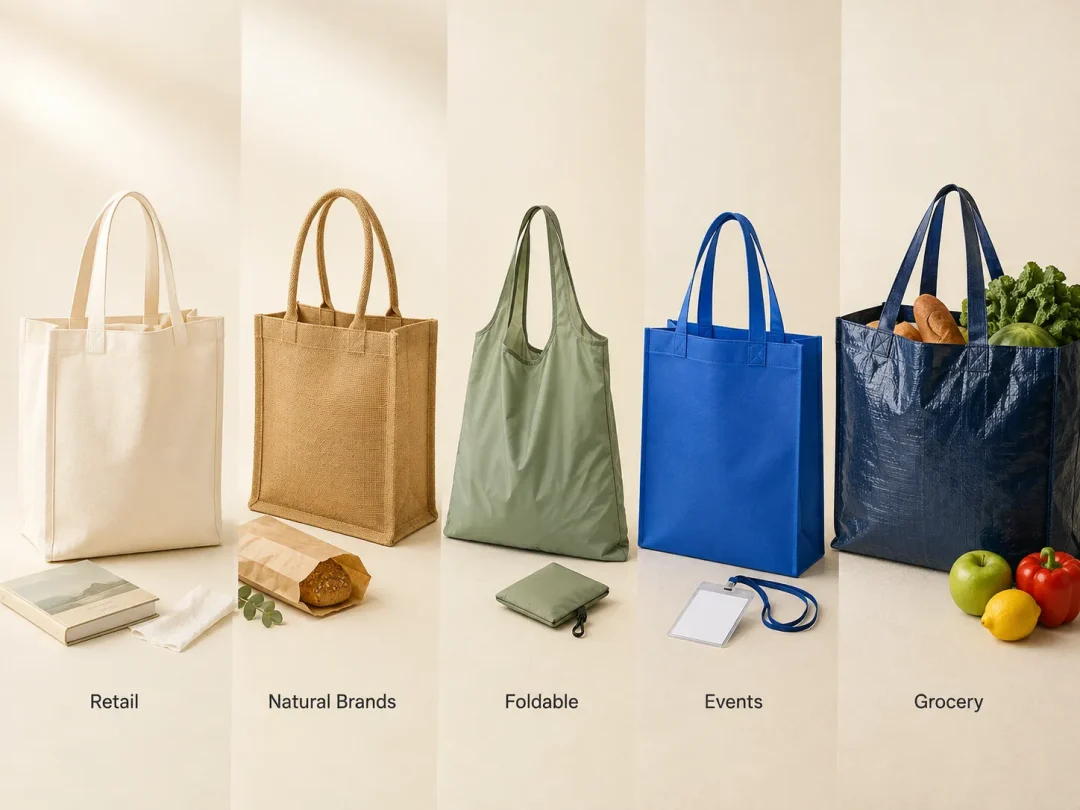
| Заявка. | Рекомендуемый материал | Why it works | Main point to confirm |
|---|---|---|---|
| Trade-show giveaway | Non-woven PP or lightweight cotton | Economical and easy to print | GSM and seam strength |
| Retail merchandise | Холст из хлопка | Durable with a premium textile feel | Fabric weight and shrinkage |
| Grocery shopping | Woven PP, canvas or jute | Suitable for repeated use | Handle reinforcement |
| Сумка для покупок, которую можно сложить | Полиэстер или нейлон | Lightweight and compact | Tear resistance and folded size |
| Outdoor promotion | Coated polyester | Better moisture resistance | Coating and seam construction |
| Eco-focused campaign | Organic cotton, jute or verified RPET | Supports a defined material story | Certification and claim scope |
| Premium gift packaging | Linen, heavy canvas or specialty fabric | Higher perceived value | Colour and finishing consistency |
| Full-colour retail bag | Laminated woven PP or polyester | Supports detailed graphics | Print proof and colour matching |
| Book or library bag | Холст из хлопка | Structured and durable | Handle attachment and bag depth |
A buyer should also consider how long the bag will be carried. A material suitable for moving a retail purchase from a store to a car may not be comfortable or durable enough for a daily commute.
Match the Fabric to Your Logo and Printing Method
A material that performs well as a bag body may not be suitable for every type of artwork.
Шелкография
Screen printing works well for bold logos and limited colour designs. It is commonly used on cotton, canvas, non-woven PP and jute.
Smooth, tightly woven surfaces produce cleaner details. Coarse jute or textured fabrics may require thicker lines and simplified artwork.
Термопечать
Heat transfer can reproduce detailed or multicolour graphics on several textile types. However, temperature, pressure and dwell time must be matched to the material.
Coated fabrics, nylon and some non-woven materials may deform, discolour or lose their finish if the process temperature is unsuitable.
Sublimation
Sublimation is used primarily on polyester-rich materials. The dye becomes part of the fibre rather than sitting as a separate layer on the surface.
It is suitable for full-colour artwork and photographic designs, but it generally works best on white or light-coloured polyester. It is not an appropriate process for ordinary cotton canvas.
Direct-to-garment printing
DTG is most suitable for cotton-rich, relatively smooth fabrics. It can reproduce complex artwork but may require pretreatment and is not always the most economical option for large production runs.
Embroidery
Embroidery creates a dimensional and premium finish. It works best on stable fabrics such as canvas, corduroy and structured polyester.
Lightweight materials may require backing or reinforcement to prevent puckering. Large, dense embroidery can also make a tote bag stiff in the decorated area.
The material and print method should therefore be selected together. Choosing a fabric first and testing the artwork only after bulk material has been ordered creates unnecessary production risk.
How to Evaluate Tote Bag Material Before Bulk Production
Material approval should go beyond selecting a colour swatch. The buyer and manufacturer should define how the complete bag needs to perform.
1. Confirm the exact material composition
Avoid vague specifications such as:
- Eco fabric
- Холст
- Recycled material
- Nylon-like fabric
- Heavy cotton
Ask for a clear description covering fibre composition, fabric construction and any coating or lamination.
2. Confirm weight and construction
Record the relevant GSM, ounces or denier, but review these figures within the same material family. A physical sample is more reliable than comparing isolated specifications from different textiles.
The weave density and surface should also be checked. A tightly woven material may produce sharper printing and better dimensional stability than a looser fabric of similar weight.
3. Check coatings and laminations
Confirm whether the material includes:
- ПУ-обработка
- PVC coating
- BOPP lamination
- Water-repellent treatment
- Internal film
- Other surface treatments
The supplier should also clarify whether the stated finish is on the inside, outside or both sides.
4. Test the actual artwork
A print test should use the final logo size, colours and approximate production method. Check:
- Fine details
- Small text
- Colour accuracy
- Ink coverage
- Adhesion
- Cracking
- Bleeding
- Appearance over seams or texture
A logo that looks good on a digital mock-up may behave very differently on coarse jute or dark canvas.
5. Evaluate the complete bag
The bag body is only one part of the load-bearing structure. Handles and attachment points frequently determine how the product performs in use.
Review:
- Handle width and material
- Stitching pattern
- Reinforcement patches
- Seam allowance
- Bag dimensions
- Bottom and side construction
- Lining
- Застежка
- Expected contents
For more help evaluating this part of the design, see Bag Handle Types Explained и Петли из стропы против ручек из собственного материала.
6. Verify environmental and safety documentation
Different standards verify different aspects of a textile product.
- GOTS applies to certified organic textiles and specified processing stages.
- GRS and RCS relate to recycled content and chain-of-custody requirements.
- OEKO-TEX STANDARD 100 tests textile products for harmful substances.
These certifications are not interchangeable. For example, OEKO-TEX STANDARD 100 does not prove that cotton is organic, while a recycled-content claim requires more than a general material safety test.
Check the certificate holder, certified product scope and validity rather than accepting a logo shown in a catalogue.
7. Approve a pre-production sample
Before bulk production, evaluate a sample using realistic contents and conditions.
Depending on the project, this may include:
- Loading and carrying
- Repeated handle pulling
- Washing or spot cleaning
- Water exposure
- Print rubbing
- Folding and reopening
- Zipper or closure cycling
- Dimension measurement before and after cleaning
The approved sample should become the reference for bulk inspection.
Common Tote Bag Material Selection Mistakes
Treating cotton and canvas as unrelated alternatives
Cotton is a fibre and canvas is a fabric construction. A tote may be made from cotton canvas, polyester canvas or a blend.
Comparing GSM without considering construction
GSM measures weight per area, not completed bag strength. Fibre type, weave, seams and handles must also be evaluated.
Describing every synthetic bag as waterproof
Polyester, nylon and polypropylene resist moisture better than cotton, but water can still pass through the fabric, seams and openings.
Using highly detailed artwork on coarse jute
The material texture may interrupt fine lines and small lettering. The artwork should be simplified or placed on a smoother panel.
Selecting the bag body without evaluating the handles
A heavy fabric can still fail if the handles are narrow, poorly reinforced or attached to an unsupported area.
Making environmental claims from the material name alone
“Organic,” “recycled,” “biodegradable” and “compostable” are not interchangeable descriptions. Each claim requires appropriate material selection and, where applicable, evidence.
Approving only a digital mock-up
A digital rendering cannot show fabric thickness, texture, colour variation, print absorption or handle comfort. Material and pre-production samples remain necessary.
Часто задаваемые вопросы
What materials are tote bags usually made from?
The most common tote bag materials are cotton, canvas, polyester, jute, nylon, non-woven polypropylene and woven polypropylene. RPET, linen, felt and transparent plastics are also used for specific functions or brand styles.
What is the best material for an everyday tote bag?
Cotton canvas is one of the most versatile choices for everyday use because it combines durability, structure, comfort and good printability. Polyester or nylon may be better if the bag must be lightweight, foldable or exposed to moisture.
Is canvas better than cotton for tote bags?
Canvas is generally more structured and durable than lightweight cotton fabric, making it suitable for repeated use and heavier contents. Lightweight cotton is softer, easier to fold and may cost less.
However, canvas is often made from cotton, so the comparison is really between different fabric constructions and weights rather than two completely separate materials.
What is the most durable tote bag material?
There is no universal answer without knowing the fabric specification and bag construction. Heavy canvas, laminated woven PP and suitable polyester or nylon fabrics can all be used for durable totes.
Handle attachment, reinforcement and seam construction are just as important as the body material.
Which tote bag material is waterproof?
Laminated woven PP, coated polyester and PVC or TPU materials are common options when strong moisture protection is required. A truly waterproof finished bag may also need sealed seams and a suitable closure.
Untreated cotton, canvas, linen and jute are not waterproof.
What is the best tote bag material for printing?
Cotton canvas is highly suitable for screen printing and many simple branded designs. Polyester works well for sublimation and full-colour graphics when the fabric meets process requirements. Laminated woven PP is suitable for detailed, full-surface commercial printing.
The best combination depends on artwork complexity, colours, quantity and required finish.
Is RPET better than ordinary polyester?
RPET and virgin polyester can have similar functional characteristics because both are based on PET. The main difference is the source of the raw material.
Actual performance depends on how the fibre is processed and what fabric construction is produced. A recycled-content claim should be supported with suitable documentation when required.
How should I choose fabric weight for a tote bag?
Start with the intended contents, bag size, required structure, frequency of use and target cost. Compare physical samples in a similar construction rather than choosing the highest GSM automatically.
The final decision should be confirmed through a completed, loaded sample.
Окончательная рекомендация
Choosing a tote bag material becomes easier when the decision is made in the right order.
First, define what the bag will carry and how often it will be used. Next, decide whether it needs to be foldable, structured, washable or resistant to moisture. Then select a fabric compatible with the intended logo and decoration method. After the basic function is satisfied, compare cost, appearance and relevant environmental requirements.
Finally, approve the material as part of a complete bag—not as an isolated fabric swatch. Handles, stitching, reinforcement, printing and dimensions all affect whether the finished tote performs as intended.
If you are developing a custom tote bag, share the intended use, size, estimated quantity and artwork with INITI. Our team can help compare suitable materials, printing methods and construction options before sampling.


 Russian
 English
 French
 German
 Japanese
 Arabic
 Thai
 Vietnamese
 Spanish
 Portuguese