
Quick answer: A pouch wristlet is a compact hand- or wrist-carried pouch for cards, keys and other small essentials. A belt bag is larger, worn around the waist or across the body, and offers hands-free storage for a phone, wallet and daily items. Choose a wristlet for minimal carry and a belt bag for greater capacity and mobility.
Pouch wristlets and belt bags both offer a compact alternative to a full-size handbag or backpack, but they solve different carrying problems.
A pouch wristlet is designed for a minimal set of essentials—often cards, cash, keys, earbuds and a few personal items. Its short loop keeps the pouch close to your hand and makes it easy to move between larger bags. A belt bag provides more usable space and an adjustable strap, allowing it to be worn around the waist or across the body for hands-free carrying.
If you only need a few small items for a quick errand, a pouch wristlet may be enough. If your phone is part of your daily carry, or you need both hands free for commuting, travel or walking, a belt bag will usually be the more practical choice. The two can also work together: a small wristlet can act as a removable organizer inside a belt bag.
Pouch Wristlet vs Belt Bag at a Glance
| Comparison | Pouch Wristlet | Belt Bag |
|---|---|---|
| Typical size | Compact | Small to medium |
| Carrying method | Held by hand or worn around the wrist | Worn at the waist, chest or crossbody |
| Hands-free use | Limited | Yes |
| Typical capacity | Cards, cash, keys, earbuds and small personal items | Phone, wallet, keys, sunglasses and other daily essentials |
| Organization | One pouch or several detachable mini pouches | Main compartment with internal or external pockets |
| Best for | Quick errands, minimalist carry and organization inside another bag | Commuting, travel, shopping, walking and active use |
| Key design focus | Pouch combination, wrist loop, rings and detachable hardware | Body shape, strap system, pockets and buckles |
The short answer is simple: choose a pouch wristlet for the smallest possible carry and a belt bag when you need more space and true hands-free use. However, size labels alone do not tell the whole story. Opening width, depth, pocket layout and strap construction can make two similarly sized products perform very differently.
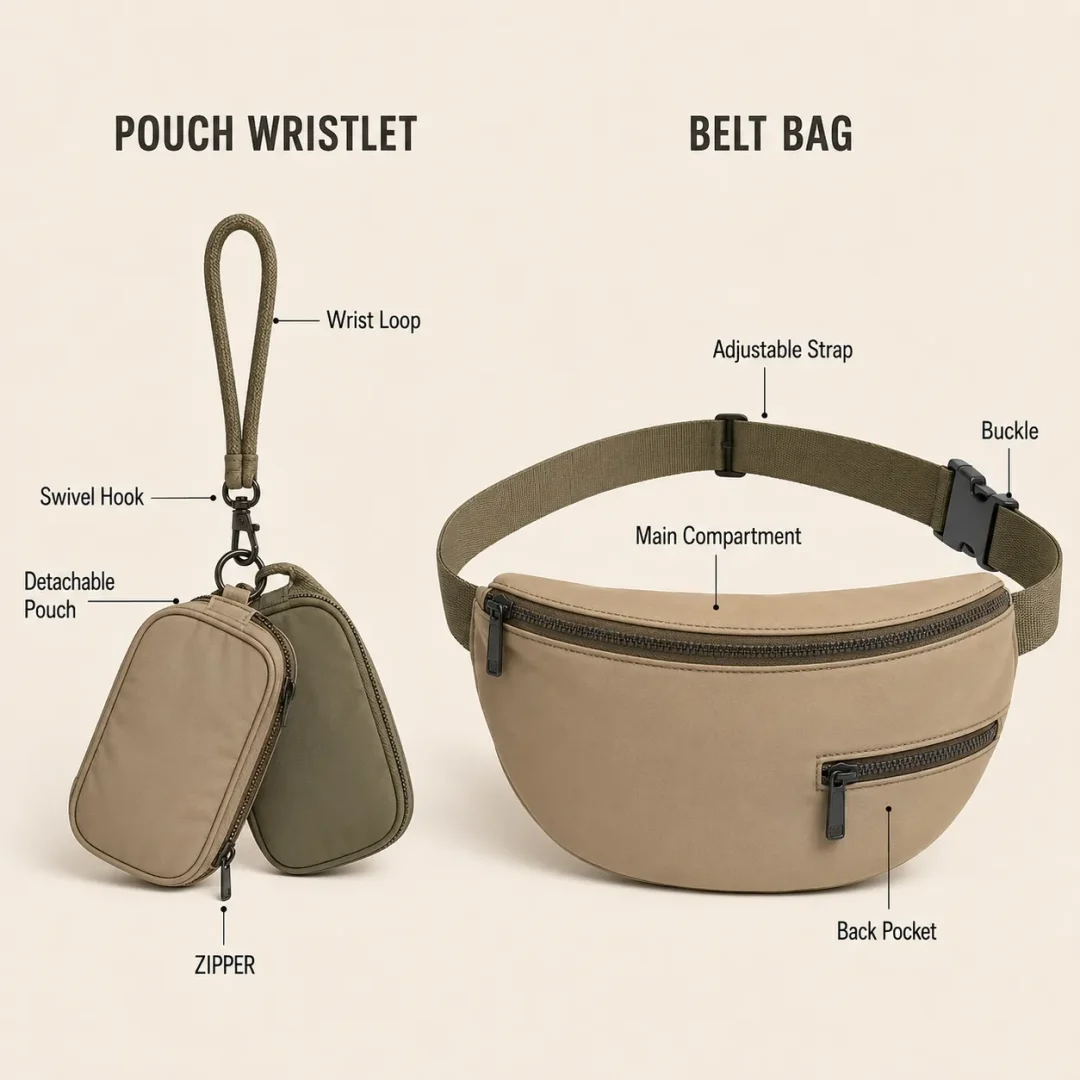
What Is a Pouch Wristlet?
A pouch wristlet is a small pouch fitted with a short strap or loop that can be worn around the wrist. Most designs use a zipper closure, although snaps and other closures are also possible. The body may be a single compartment or a set of two or more detachable pouches connected by a ring or hook.
Unlike a conventional wallet, a basic pouch wristlet does not necessarily include card slots or currency compartments. Unlike a clutch, it is normally smaller and has a dedicated wrist loop. It can be carried on its own for a short trip or used as a removable organizer inside a tote, backpack or belt bag.
Common Pouch Wristlet Designs
- Single zippered pouch: A straightforward design for cards, keys, coins or cosmetics.
- Dual pouch wristlet: Two differently sized pouches connected to one wrist strap, often with detachable rings or hooks.
- Wristlet wallet: A more structured version with card slots, cash compartments or an ID window.
- Detachable pouch and cardholder: Separate components that users can carry together or individually.
- Clear or mixed-material wristlet: A transparent pouch combined with nylon, polyester or coated fabric accents.
- Convertible wristlet: A larger pouch with removable straps or attachment points for alternative carrying methods.
A keychain pouch is usually smaller than a wristlet and intended for one narrow purpose, such as holding coins or earbuds. A clutch is mainly designed to be held in the hand and may not include a wrist strap. These terms are sometimes used loosely in retail listings, so the actual dimensions and construction matter more than the product name.
What Fits in a Pouch Wristlet?
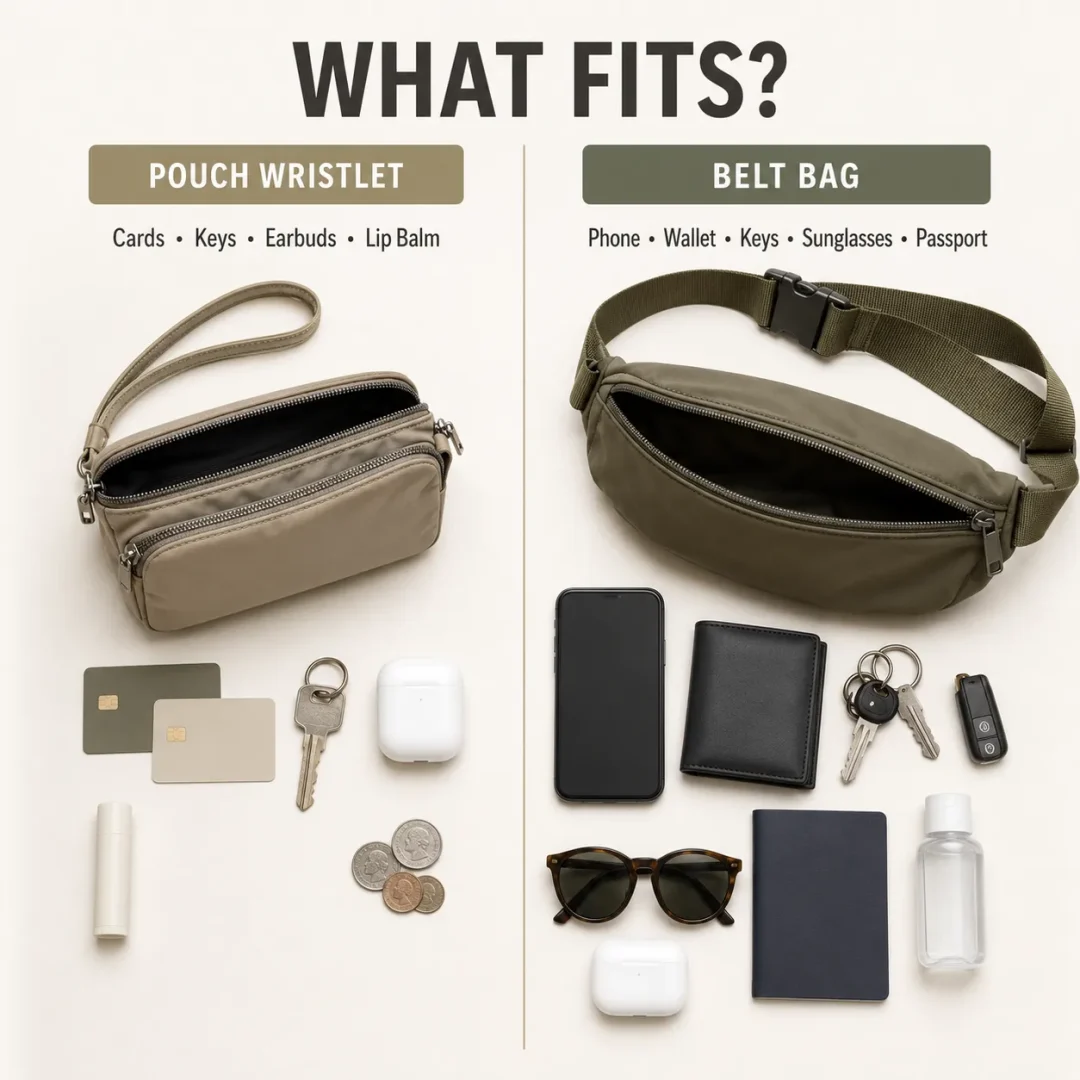
A typical pouch wristlet can carry:
- Credit cards and identification
- Cash and coins
- Keys
- Wireless earbuds
- Lip balm or mini cosmetics
- A small hand sanitizer
Some larger wristlets can hold a smartphone, but this should never be assumed. Dual pouch wristlets and compact round pouches are often too small for a phone. Check the internal length and height as well as the usable zipper opening; a phone may match the stated body dimensions but still be difficult to insert through a short or curved opening.
What Is a Belt Bag?
A belt bag is a small bag with an adjustable strap that can be secured around the waist or worn across the chest or back. Modern designs frequently support both waist and crossbody use, making them more versatile than traditional waist-only styles.
The terms belt bag, waist bag and fanny pack are often used interchangeably. In current fashion and lifestyle collections, “belt bag” commonly refers to a cleaner, more streamlined silhouette that can be worn crossbody. “Fanny pack” may suggest a more traditional waist-worn or sporty design, but there is no universal construction standard separating the two.
Common Belt Bag Designs
- Classic waist bag
- Crossbody belt bag
- Crescent-shaped belt bag
- Mini belt bag
- Multi-pocket utility belt bag
- Sport or outdoor belt bag
What Fits in a Belt Bag?
Depending on its size and structure, a belt bag can carry:
- A smartphone
- A wallet or cardholder
- Keys
- Earbuds
- Sunglasses
- A passport
- Small personal care items
- A folded reusable shopping bag
A compact model of around 1 liter may cover basic everyday essentials, while a model closer to 2 liters can offer more flexibility for travel or longer outings. These figures are useful reference points rather than fixed industry categories. Shape, gusset depth and internal pockets all affect how much of the stated capacity is genuinely usable.
Key Differences Between a Pouch Wristlet and a Belt Bag
Size and Capacity
Pouch wristlets prioritize minimalism. They work well when the goal is to carry only the smallest essentials or keep loose items together inside another bag. Belt bags generally have a wider opening, more depth and enough three-dimensional space for a phone and other daily items.
When comparing products, look beyond external length and height. A flat pouch can appear wide but hold very little once filled. A heavily curved belt bag may also offer less usable space at its tapered ends. Opening size, lining, seams and pocket placement all reduce the internal area available to the user.
Carrying Style
A wristlet is held in the hand or secured around the wrist. The loop helps prevent accidental drops, but the product still occupies one hand or adds weight to the wrist.
A belt bag uses an adjustable strap to anchor the bag to the body. It can often be worn around the waist, over one shoulder or across the torso. This makes it the stronger option for walking, cycling, sightseeing, shopping or any situation in which the wearer needs both hands available.
Organization and Compartments
Dual pouch wristlets create organization through separate removable components. Cards can go in one pouch and keys or cosmetics in another. Users can detach the component they need or transfer the entire set between bags.
Belt bags usually create organization inside a larger body. Common features include slip pockets, mesh dividers, key leashes and back zipper pockets. This fixed layout keeps items in predictable positions but offers less freedom to rearrange the system.
Neither approach is automatically better. Modular pouches are flexible and easy to transfer, while built-in compartments are convenient for users who carry the same set of items every day.
Security
A belt bag worn across the front of the body is generally easier to keep in view than a loose handheld accessory. A zippered back pocket can also place valuables against the wearer. However, a belt bag should not be described as “anti-theft” unless it includes specific security features and has been designed and tested for that claim.
For either product, consider:
- The position and direction of the zipper opening
- Whether the strap or wrist loop is securely reinforced
- Whether detachable hooks can open accidentally
- Whether the buckle can be reached easily by another person
- Whether valuables remain close to the body in crowded places
A wristlet may be secure during a short transaction because it remains attached to the wrist, but it is also easier to set down or misplace when removed.
Comfort and Weight Distribution
A wristlet is comfortable when lightly loaded. Once filled with a phone, a large keyring or other heavy objects, the concentrated weight can pull on the wrist and make the pouch awkward to use.
A belt bag distributes weight across a longer strap and a larger part of the body, making it more suitable for extended wear. Comfort still depends on strap width, adjustability and how closely the bag sits against the body. An overfilled belt bag can bounce while walking or feel bulky when worn across the chest.
Style and Outfit Compatibility
Pouch wristlets often look like compact fashion accessories. Their smaller scale works well for evening use, quick errands or occasions when a full bag feels unnecessary.
Belt bags are more visible and contribute more strongly to an outfit. Nylon and webbing create an athletic or urban look, while smooth coated fabric, PU or leather-like finishes can support a more polished style. A slim crescent silhouette usually feels less tactical than a boxy multi-pocket design.
Accessibility
A wristlet offers fast access to cards, keys and other small items, especially when it uses separate pouches. However, opening it may require both hands.
A belt bag worn at the front allows the user to reach the main compartment without removing the bag. Double zipper pulls, a wide opening and a light-colored lining can improve visibility and access. Poorly positioned pockets or a zipper that opens downward may make an otherwise attractive design frustrating to use.
Pouch Wristlet Pros and Cons
Advantages
- Lightweight and compact
- Easy to place inside a larger bag
- Useful for separating cards, keys and other small items
- Can include detachable and interchangeable pouches
- Convenient for moving essentials between different bags
- Suitable for compact gift sets and promotional accessories
Limitations
- Limited carrying capacity
- Many versions cannot hold a smartphone
- Does not provide fully hands-free carrying
- Becomes uncomfortable when overloaded
- Basic designs may lack card slots or internal organization
Belt Bag Pros and Cons
Advantages
- Greater usable capacity
- Hands-free carrying
- Multiple wearing options
- Suitable for commuting, travel and active use
- More room for functional pockets and dividers
- Keeps frequently used items close to the body
Limitations
- Larger and more noticeable than a wristlet
- Fit depends on the strap’s adjustment range
- Can become bulky or unstable when overfilled
- Narrow straps may be uncomfortable under heavier loads
- Additional straps, buckles, pockets and reinforcements increase construction complexity
Which One Should You Choose?
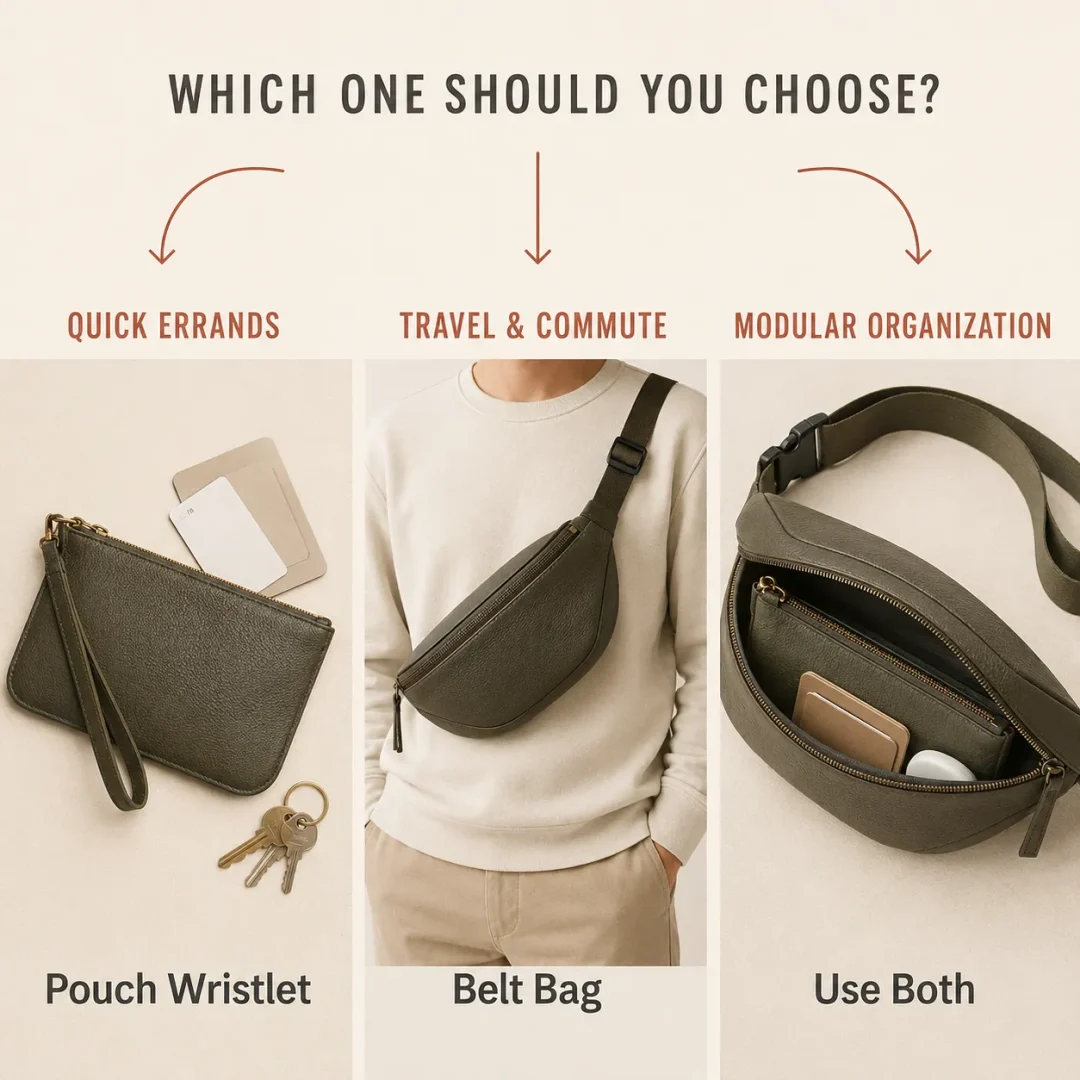
Choose a Pouch Wristlet If You:
- Carry only cards, keys and a few small essentials
- Need something for quick errands or short outings
- Want a removable organizer for a tote or larger handbag
- Prefer a light, compact accessory
- Frequently move the same essentials between different bags
Choose a Belt Bag If You:
- Need to carry a phone, wallet and several other items
- Want both hands completely free
- Need a bag for commuting, travel, walking or events
- Want to switch between waist and crossbody wear
- Value body stability, capacity and quick access
Can You Use Them Together?
Yes. In many situations, a pouch wristlet and belt bag are complementary rather than competing products.
A wristlet can function as a wallet or small organizer inside the belt bag. A detachable pouch can connect to an internal D-ring or key leash. Users may carry the full belt bag during a commute, then remove the wristlet when they only need a card and key at their destination.
For brands, the two products can also form a coordinated accessory collection. Matching colors and materials create a consistent set, while interchangeable rings, hooks and straps add a modular function that is difficult to achieve with either bag alone.
Best Use Cases for Each Bag
| Use Case | Better Option | Why |
| Quick errands | Pouch wristlet | Only a few essentials are needed |
| Daily commuting | Belt bag | Holds a phone, wallet and keys while keeping hands free |
| Travel and sightseeing | Belt bag | Offers accessible, body-close carrying |
| Gym or studio visit | Both | A wristlet suits cards and keys; a belt bag holds additional items |
| Events and festivals | Belt bag | Provides better body attachment and usable capacity |
| Evening use | Pouch wristlet | Creates a smaller, less sporty profile |
| Organization inside a tote | Pouch wristlet | Works as a removable organizer |
| Promotional gift set | Both | Can be developed as matching, useful accessories |
Materials and Features to Compare
The choice between a wristlet and a belt bag is only the first design decision. Material, hardware and fit can have an equally significant effect on how the product performs.
Materials
- Nylon: Lightweight and abrasion-resistant, making it suitable for sporty and functional designs.
- Polyester: Offers a practical balance of cost, durability, color selection and print compatibility.
- Recycled polyester or RPET: Supports collections with recycled-material requirements when backed by appropriate material documentation.
- Neoprene: Soft and slightly cushioned, with a distinctive casual or athletic appearance.
- PU or coated fabric: Creates a smooth, fashion-oriented surface that is often easier to wipe clean.
- Clear PVC or TPU: Suitable for visible organization and certain event or stadium-related applications, subject to the relevant venue rules.
A fabric described as water-resistant does not automatically make the finished bag waterproof. Seams, zipper construction and attachment points can all allow water to enter. If water protection is important, buyers should define the expected level of performance rather than relying on a broad material label.
Hardware and Construction Details
For a pouch wristlet, examine:
- Zipper quality and opening length
- Wrist-loop length and width
- Swivel hooks, split rings and D-rings
- Reinforcement at the strap connection
- Card slots or internal slip pockets
- The ease of detaching individual pouches
For a belt bag, examine:
- Adjustable strap range and webbing width
- Side-release buckle position and strength
- Reinforced strap anchors
- Main zipper direction and pull size
- Interior dividers or mesh pockets
- Key leash and back security pocket
- Stability when the bag is fully loaded
Size and Fit
Product measurements should reflect how the bag will be used. For a wristlet, check phone dimensions, zipper clearance and wrist-loop circumference. For a belt bag, check both body capacity and total strap range.
A crossbody belt bag should fit a range of body types without forcing the buckle into an uncomfortable position. Strap testing should consider the product both empty and loaded, because weight can change the way the bag sits and cause webbing to slip through an inadequate adjuster.
How Brands Can Customize Pouch Wristlets and Belt Bags
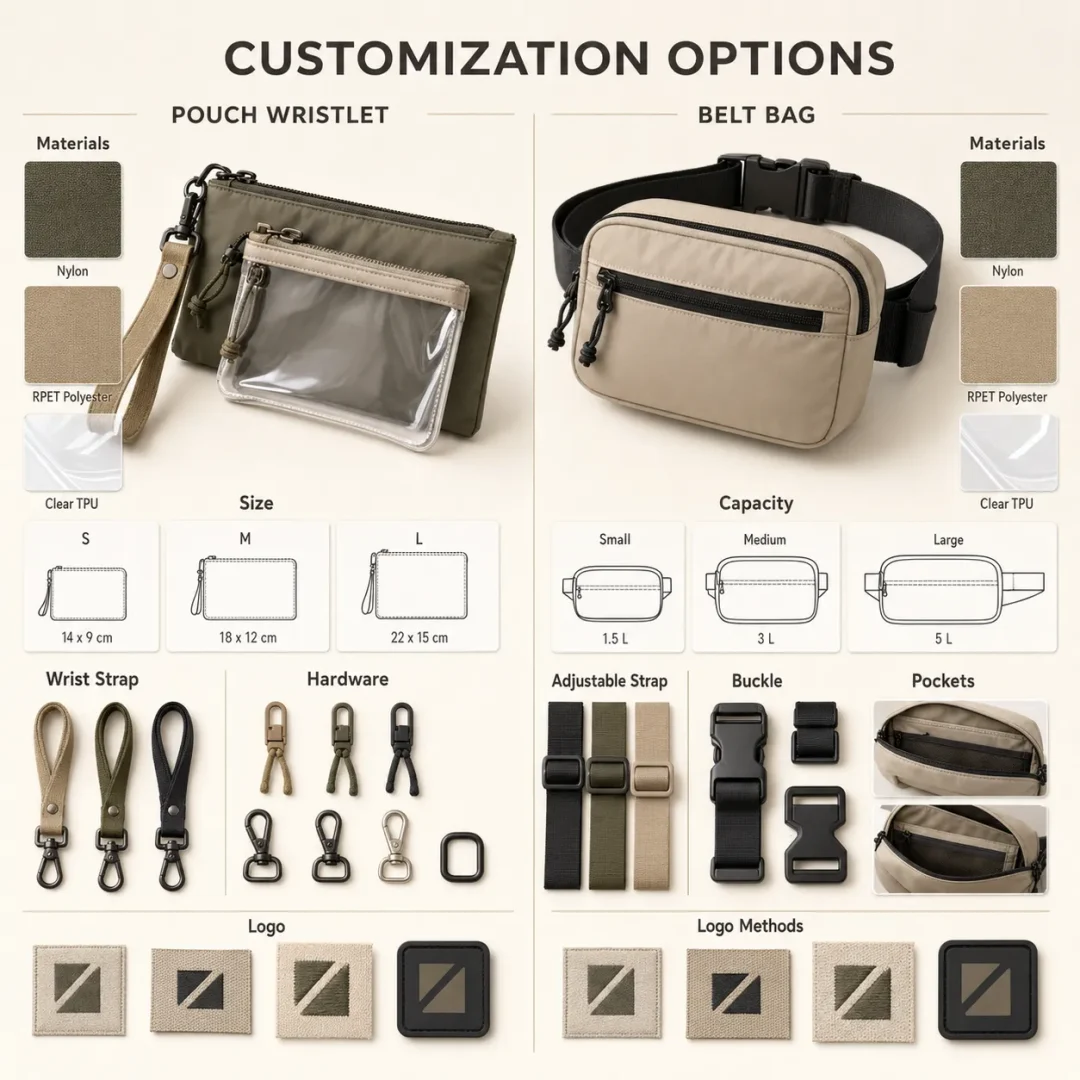
For brands developing a new accessory, the better product is the one that fits a clearly defined carrying routine. Start with what the end user needs to carry, where the product will be worn and how often items must be accessed. Materials and branding should follow those functional decisions.
Customization Options for Pouch Wristlets
- Single, dual or multi-pouch configurations
- Detachable cardholders or mini pouches
- Custom wrist-loop length and material
- Card slots, key rings and internal dividers
- Contrasting color combinations
- Screen printing, heat transfer, embroidery or woven labels
- Custom zipper pulls and hardware finishes
A dual pouch design benefits from careful component testing. The rings and hooks should allow easy removal without opening accidentally, and the combined set should not become too heavy or crowded around the wrist.
Customization Options for Belt Bags
- Custom body shape and capacity
- Strap length, width and adjustment range
- Waist-to-crossbody convertible construction
- Custom internal pocket layout
- Hidden back zipper pocket
- Branded buckles, zipper pulls or patches
- Water-resistant material options
- Screen printing, heat transfer, embroidery or rubber labels
Strap geometry deserves particular attention during sampling. Anchor position affects whether the bag lies flat against the body, while webbing width and buckle placement influence comfort and visual balance.
Developing a Coordinated Product Set
A pouch wristlet and belt bag can be designed as a matching retail collection, travel set or corporate gift package. Possible approaches include:
- Using the same material and color across both products
- Designing a detachable pouch that connects to the belt bag strap or interior
- Applying contrasting colors to identify different functions
- Repeating the same zipper pull, label and hardware finish
- Offering the wristlet separately as an entry-level accessory and the belt bag as the main item
This approach is particularly relevant to lifestyle, sports, travel and promotional collections because it gives customers several ways to use the same visual identity.
Frequently Asked Questions
Is a wristlet considered a bag or a wallet?
It can be either, depending on its size and internal structure. A small wristlet with card slots and cash compartments functions as a wallet, while a larger zippered wristlet without dedicated financial organization is closer to a small bag.
Can a pouch wristlet hold a phone?
Some larger pouch wristlets can hold a phone, but many compact or dual-pouch styles cannot. Check the internal dimensions and usable zipper opening against the exact phone size, including its protective case.
Is a belt bag the same as a fanny pack?
The terms are frequently used interchangeably. “Belt bag” often describes a modern, streamlined design intended for both waist and crossbody wear, while “fanny pack” is more strongly associated with traditional waist carrying. The distinction is based more on styling and marketing than on a universal technical definition.
Which is safer for travel?
A zippered belt bag worn close to the front of the body is usually more practical for travel because it remains visible and leaves both hands free. Actual security depends on pocket placement, closures, strap construction, wearing position and user behavior.
Can a belt bag be worn as a crossbody bag?
Many modern belt bags can be worn crossbody, but not every design fits comfortably that way. Check the total strap length, anchor angle and buckle position before purchasing or approving a sample.
Can a pouch wristlet be attached to a belt bag?
Yes, if the two products include compatible hardware such as a swivel hook, split ring or D-ring. A detachable pouch can connect to the belt bag’s strap or to an internal attachment point.
Which bag is better for promotional products?
A pouch wristlet uses less material and can suit compact, budget-conscious gift programs. A belt bag offers more perceived utility and a larger branding area, which may make it more appropriate for higher-value campaigns. The right choice depends on audience, budget, expected use and branding requirements.
Final Verdict: Pouch Wristlet or Belt Bag?
Choose a pouch wristlet when minimal carry, quick errands and organization inside another bag are the priorities. Choose a belt bag when you need space for a phone, longer-term comfort and genuine hands-free carrying.
For product developers, the decision does not have to be either-or. A coordinated set or convertible design can combine the wristlet’s modular organization with the capacity and wearable strap system of a belt bag.
Before developing a custom pouch wristlet, belt bag or matching accessory set, define the items it must carry and the way customers will wear it. Comparing dimensions, materials, pocket layouts and attachment systems before sampling helps ensure that the finished product performs as well as it looks.
 English
 French
 German
 Japanese
 Arabic
 Thai
 Vietnamese
 Russian
 Spanish
 Portuguese