
A lunch bag can look roomy and still be too narrow for your favorite lunch box. It can also hold your food perfectly until you add an ice pack or try to zip it closed around a water bottle.
The right lunch bag size starts with what you pack. Measure your lunch container, allow room for drinks and extras, and check the bag’s usable internal dimensions before choosing a size.
There is no single standard lunch bag size that applies across brands. Small, medium and large are useful starting points, but the same label can describe different shapes and capacities. This guide helps you compare those options and choose a bag that works for school, commuting, meal prep or a custom lunch bag project.
Lunch Bag Size Chart: Small, Medium, Large and XL
Use the following chart to get an initial sense of size. These are illustrative reference dimensions for rectangular lunch bags, not industry standards or verified specifications for particular products. The suggested packing combinations are things to check against each size, rather than guaranteed contents.
Dimensions below follow width × depth × height: width runs across the front, depth runs from front to back, and height runs from the base to the top. Inches are rounded.
| Reference size | Example outer dimensions | Approximate inches | Packing combination to check | Possible use |
|---|---|---|---|---|
| Small | 22 × 14 × 18 cm | 8.7 × 5.5 × 7.1 in | Compact food container, slim ice pack and a small snack | Light lunch or compact school setup |
| Medium | 26 × 18 × 22 cm | 10.2 × 7.1 × 8.7 in | Lunch box, ice pack, fruit and snacks | Everyday school or office lunch |
| Large | 30 × 22 × 25 cm | 11.8 × 8.7 × 9.8 in | Multiple containers, cooling packs and additional food | Meal prep or a longer workday |
| XL | 35 × 25 × 30 cm | 13.8 × 9.8 × 11.8 in | Several meal containers, drinks and cooling packs | Multi-meal days or shared food |
These are outer dimensions, so they do not describe the space available inside. Insulation, lining, seams and compartments reduce or divide the usable space. Handles and external pockets may also be measured differently between listings.
Start with the row closest to your needs, then check the dimensions of the actual product. A wide, shallow bento box might need a broader bag even for a small meal. A taller bag may suit stacked containers but offer no extra room across the base.
What Size Lunch Bag Do You Need for School, Work and Meal Prep?
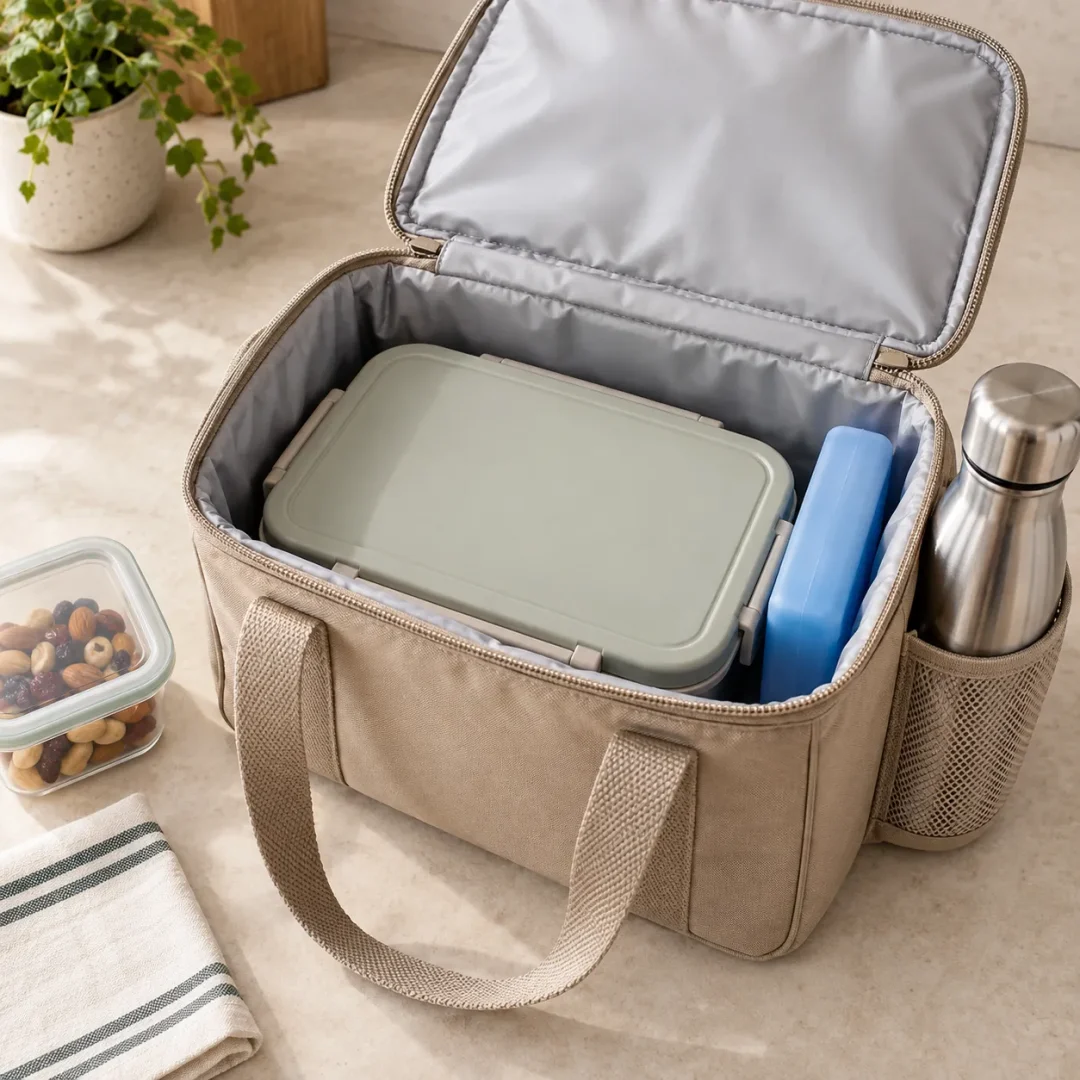
Your daily packing routine is more useful than a general “kids” or “adults” label. A child carrying a large compartmented lunch box may need a wider bag than an adult bringing one compact container.
School lunches
For school, begin with the lunch box and the backpack. The food container needs to pass through the opening and sit in the intended position; the packed lunch bag then needs to fit wherever the child will carry it.
Allow space for the ice pack and any snacks that travel with lunch. If the water bottle has its own backpack pocket, it does not need to take up space inside the lunch bag. This can make a compact bag practical without sacrificing room for food.
A bag that is difficult to open or tightly packed can also be awkward for a younger child. Check whether they can remove the container and close the bag independently.
Office lunches and commuting
For a single office meal, arrange your usual lunch box, fruit, snack and ice pack together before choosing a bag. Decide whether you want to carry a drink inside it or separately.
The journey matters, too. A bag carried inside a work tote needs to fit that tote’s opening. One carried separately needs a comfortable handle or strap and a stable base. A broad lunch bag might suit your container well but be inconvenient alongside a laptop bag on a crowded commute.
For an example of a compact rectangular format, see INITI’s insulated lunch bag with a shoulder strap. Its listed approximate size is 21 × 17 × 16 cm; confirm the usable interior against your containers before deciding on fit.
Meal prep and gym routines
For meal prep, container arrangement becomes especially important. Two boxes may fit stacked in a tall bag but require a much wider base when placed side by side.
Include lids and locking clips when checking the combined size. If one container must remain upright, do not count on tilting it to make everything fit. Add the shaker or water bottle to your trial arrangement if it will travel inside the bag.
Long shifts, multiple meals and shared food
Packing lunch, dinner and snacks requires a different setup from carrying one large lunch. Think about how you will access each meal, where the cooling packs will sit and whether separate compartments would help organize the contents.
For shared lunches or short picnics, a larger bag may be useful, but assess it when loaded. Several food containers and drinks can make a bag considerably heavier than it feels empty. Check its stated load limit and carrying design as well as its dimensions.
Understanding Lunch Bag Capacity: What Do Liters Tell You?
Some lunch bags are listed by dimensions, while others are labeled 9L, 12L or 20L. The liter rating gives you a way to compare stated volume, but it does not reveal the shape of that space.
For a rectangular space, the basic calculation is:
Volume in liters = length × width × height in centimeters ÷ 1,000
The examples below make those capacities easier to picture. They represent ideal rectangular spaces with the stated volume—not standard lunch bag dimensions, product recommendations or measured bag interiors.
| Capacity | One equivalent rectangular space | What the number leaves unanswered |
|---|---|---|
| 9L | 30 × 20 × 15 cm, or about 11.8 × 7.9 × 5.9 in | Whether the actual bag is wide enough for your container and deep enough for an ice pack |
| 12L | 30 × 20 × 20 cm, or about 11.8 × 7.9 × 7.9 in | Whether the additional volume comes from height, width or depth |
| 20L | 40 × 25 × 20 cm, or about 15.7 × 9.8 × 7.9 in | How that volume is divided and how practical the loaded bag is to carry |
A 9-liter lunch bag has a stated volume equivalent to 9,000 cubic centimeters. Whether it suits your daily lunch depends on the shape of your food containers and the space needed for everything else. The rating alone cannot establish how many lunch boxes it holds.
A 12L lunch bag has one-third more stated capacity than a 9L model. However, that extra space might sit above your lunch box instead of beside it. If your current bag is too narrow, choosing a taller 12L bag may not solve the problem.
A 20L lunch bag has more than twice the stated capacity of a 9L bag. That makes it worth considering when you need space for multiple meals or shared food, provided its dimensions and carrying arrangement suit the load. For a compact daily lunch, it may leave you carrying unnecessary bulk.
When comparing products, check whether the stated capacity refers to the main compartment or includes other sections. If a listing gives only external dimensions, multiplying them provides an outer bounding volume, not a verified usable capacity.
Equal capacity does not mean equal fit
Consider two ideal rectangular spaces: 30 × 20 × 10 cm and 20 × 15 × 20 cm. Both equal 6L, but their floor areas are different.
A rigid container with a 25 × 18 cm base could lie flat within the first space, assuming adequate clearance. It could not lie flat within the second. This is why measuring your lunch box is more reliable than choosing entirely by liters.
How to Measure Your Lunch Box and Check the Fit
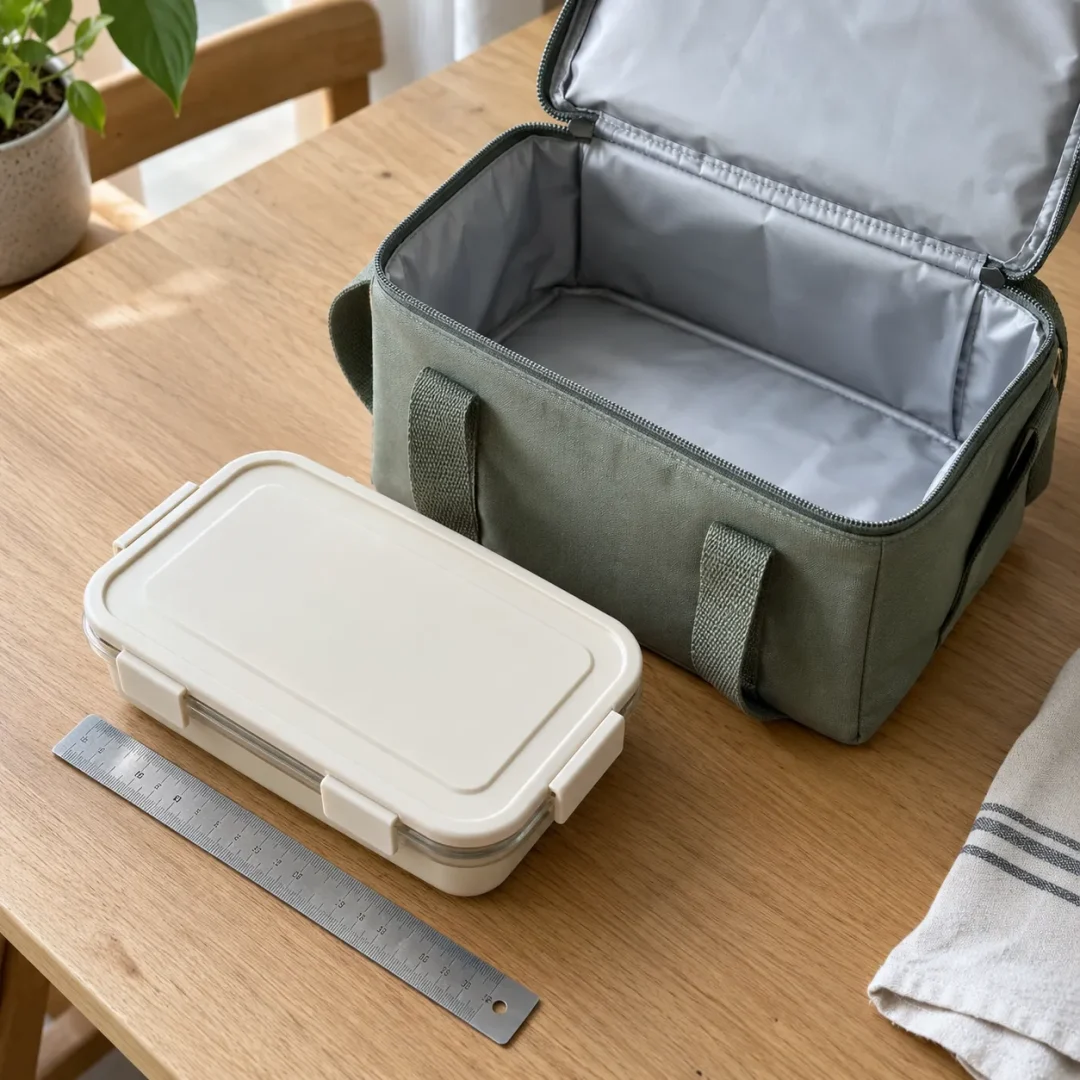
You do not need special equipment. A ruler or tape measure, your usual food containers and your everyday extras are enough to make a useful comparison.
1. Measure the closed container at its widest points
Measure the lunch box with its lid attached and clips closed. Include protruding tabs, handles and anything else that adds to its overall width, depth or height.
Do not use the food capacity printed on the container as a substitute. A 1L lunch box holds that volume of food internally; its walls, lid and closing hardware make its external footprint larger.
2. Arrange a complete lunch as you intend to carry it
Place everything on a table: lunch box, ice pack, fruit, snacks, cutlery and any drink that belongs inside the bag. Stack or arrange the items in the intended carrying position, then measure the overall space they occupy.
This reveals problems that individual measurements miss. A bottle may be taller than the container stack, or a piece of fruit may require more space than the remaining corner allows.
3. Compare with the bag’s usable interior and opening
Check the internal base dimensions and closed internal height. For a tapered bag, the narrowest relevant section matters more than the widest exterior measurement.
Also check the opening. A bag can have enough room inside while its zipper opening is too narrow to admit a rigid lunch box easily. A wide lid or three-sided zipper can make packing simpler, but the opening still needs to be checked against the container.
If a listing gives only outer dimensions, ask for interior measurements or a fit photo using a container of known size. Do not assume a fixed amount can be subtracted to account for every bag’s insulation.
4. Check closure and access
The bag should close without forcing the zipper, bending the container or crushing soft food. You should also be able to remove the lunch box without emptying every pocket first.
Allow handling clearance rather than choosing dimensions that match your container exactly. The necessary allowance depends on the bag’s structure and flexibility, so a physical fit check is preferable to a universal margin.
Space for Ice Packs, Bottles and Other Extras
The main lunch box is only part of the load. Where you put the remaining items can change which bag size works best.
| Item or feature | Space to check | Easy detail to overlook |
|---|---|---|
| Ice pack above or below the lunch box | Remaining internal height | The lid may no longer close comfortably |
| Ice pack beside the lunch box | Remaining base width or depth | A container that previously fit may be squeezed sideways |
| Upright water bottle | Closed internal height and base space | The cap may push into a curved top |
| External bottle pocket | Pocket opening, depth and grip | A full bottle can increase overall width or affect balance |
| Fruit and soft snacks | Uncompressed space around containers | Spare volume may be split into unusable gaps |
| Separate upper compartment | That compartment’s own dimensions | Total bag capacity does not describe either section individually |
A dedicated ice-pack sleeve still needs room when filled. Likewise, a roll-top closure uses some of the bag’s upper section when folded closed; its fully extended height is not necessarily its usable packing height.
For double-compartment lunch bags, check each compartment separately. A divider may help organize food, but it can prevent you from using the full height for one tall item.
Leave enough access to reach the lining and corners after use. Removable containers and an opening that folds back can make routine cleaning easier. Follow the product’s care instructions; our guide to how to wash a lunch bag covers cleaning considerations.
Choosing Custom Lunch Bag Sizes for Bulk Orders
For a custom order, the same fit questions become part of the product specification. “Medium lunch bag” leaves too much open to interpretation. A defined packing setup gives the buyer and manufacturer something concrete to assess.
Start with the intended contents
A school lunch program may need a bag that fits an existing lunch box. An employee gift may need to accommodate several container shapes. A meal-prep brand may require an exact fit for its own set of containers.
Where possible, provide the actual containers or their outer measurements, along with the intended ice packs and bottles. Explain whether items will sit side by side, stack or occupy separate compartments. Photos help communicate the arrangement, but they should accompany measurements rather than replace them.
Define how the finished bag will be measured
Agree on the dimension order and whether each measurement refers to the exterior, interior or opening. For soft bags, also state whether the measurement is taken flat, expanded or filled.
A useful specification records:
- Finished outer width, depth and height, with an agreed measurement method and tolerance.
- Required usable space for the intended container arrangement.
- Opening dimensions and closure position.
- Insulation, lining and compartment construction.
- Expected load, handle or strap arrangement, and pocket requirements.
If capacity in liters will appear on packaging or a product listing, agree on how it will be measured and which compartments it includes. Do not derive a usable-capacity claim solely from exterior dimensions.
Review a packed sample before confirming production
Pack the sample with the intended items and close it fully. Check whether the containers remain in position, whether the zipper operates without strain and whether the bag is comfortable to lift and carry.
Review branding on the filled bag as well. A print area that appears flat on an empty sample may curve, crease or sit under a handle once packed. Confirm artwork placement after the bag’s structure and dimensions have been established.
Finally, confirm the packing method and carton details. Folded and structured bags can occupy different shipping volumes even when their expanded dimensions are similar. Compare the actual carton quantity and measurements before approving a size increase.
INITI offers custom lunch bags with size, material, color and branding options. Begin with the intended packing arrangement so the dimensions and construction can be discussed around how the bag will be used.
Frequently Asked Questions
What is the standard size of a lunch bag?
There is no universal standard lunch bag size. Brands use different dimensions for small, medium and large models. Use the size chart above as a starting point, then check the bag’s internal width, depth and height against your lunch container, ice pack and other items.
Is a 5L lunch bag big enough?
A 5L lunch bag may be enough for a compact lunch container, a slim ice pack and a small snack, depending on their dimensions. It may feel restrictive if you also carry a bottle or multiple containers. Check the internal base measurements first—a tall 5L bag may still be too narrow for a wide bento box.
What size lunch bag fits two meal-prep containers?
Measure both containers in the arrangement you plan to use. For stacking, check their combined height, including lids, and allow space for cooling packs. For side-by-side packing, check the combined footprint. There is no single liter capacity that guarantees a fit for two containers because their shapes and sizes vary.
Should a lunch bag be bigger than the lunch box?
Yes. The bag needs enough clearance to insert and remove the closed lunch box comfortably, plus room for any ice packs or extras. Avoid choosing internal dimensions that exactly match the container’s outer dimensions. The opening and zipper should work without forcing, stretching or tilting a container that needs to stay upright.
Does a bigger lunch bag keep food cold longer?
A larger size alone does not mean better cooling performance. Insulation, closure design, cooling packs, starting food temperature and conditions during use all matter. Choose enough space for your food and the cooling packs you intend to use, and assess temperature performance separately from capacity.
How do I check lunch bag size when shopping online?
Look for internal dimensions, the measurement order and whether the listed size describes the bag expanded or folded. Compare those measurements with your closed lunch box, including clips and protruding parts. If only exterior dimensions are listed, ask the seller for usable interior measurements or a fit demonstration with a container of known size.
Can I use a cooler bag as a lunch bag?
Yes, provided its size and layout suit your lunch routine. Check whether your containers can sit securely, whether there is room for cooling packs, and whether the loaded bag is convenient to carry. A large cooler bag may suit multiple meals or shared food, while a compact model may be easier for everyday commuting.
 English
 French
 German
 Japanese
 Arabic
 Thai
 Vietnamese
 Russian
 Spanish
 Portuguese