
濡れたバッグは、湿った水着、汗をかいたジムの服、布おむつ、濡れたタオル、その他の持ち物に触れさせたくないアイテムを入れるように設計されています。ただし、一度湿気や有機物の残留物が閉じたバッグの中に閉じ込められると、不快な臭いが驚くほど早く発生することがあります。.
良いニュースは、ほとんどの濡れたバッグの臭いは、適切な洗濯、徹底的なすすぎ、完全な乾燥によって取り除くことができるということです。頑固な臭いの場合、希釈した白酢、重曹、または適合する酵素洗剤が役立つかもしれませんが、方法はバッグの素材と防水ライニングに適している必要があります。.
短く答えると:
濡れたバッグを空にし、裏返して、ケアラベルに従ってマイルドな洗剤で洗います。徹底的にすすいで、完全に開いた状態で自然乾燥させてください。臭いが残る場合は、希釈した白酢または重曹を別の処置として使用し、防水コーティングを傷めないよう注意してください。.
濡れたバッグはなぜ臭くなるのか?
バッグ自体が臭いの元であるとは限りません。臭いは通常、湿気、バイ菌、残留物が裏地に閉じ込められたときに発生します。.
濡れたアイテムが長時間内部に放置された
閉じられたウェットバッグは、温かく湿った通気の悪い環境を作ります。これは一時的に湿ったアイテムを保持するためには便利ですが、臭いを発生させるバイ菌が増殖するための条件も提供します。.
Common causes include:
- Wet swimwear left inside after returning from the pool;
- Cloth diapers stored for several days;
- Sweaty sportswear forgotten after exercise;
- Damp towels packed away during travel;
- Food, milk or toiletries leaking inside the bag.
A wet bag is intended for temporary separation and transport—not long-term storage of damp contents.
ライニングに残留物が残る
Even when a wet bag looks clean, urine, perspiration, body oils, pool chemicals or detergent can remain around its seams, zipper tape and bottom corners. A quick rinse may not remove this residue completely.
This is one reason a bag can smell fresh immediately after washing but develop an odor again as soon as it becomes warm or damp.
洗剤を使いすぎた
More detergent does not always mean better cleaning. Using too much can leave a film on the waterproof lining, especially if the bag is washed in a small load or without sufficient rinsing.
That residue can trap dirt and produce a stale or perfumed smell.
完全に乾燥する前にバッグを収納した
The flat surfaces of a wet bag may feel dry while the zipper, binding and folded seams are still damp. Closing and storing it in this condition can cause musty odors and, in more serious cases, visible mildew.
防水層が劣化している
Not every unpleasant odor is caused by dirt. If the inside of the bag smells strongly chemical, feels sticky or shows bubbling, cracking or peeling, its waterproof coating may be deteriorating.
Repeated washing will not reverse material breakdown. A damaged lining may also begin to leak, making replacement more practical than further deodorizing.
まず素材とケアラベルを確認してください
Before washing a wet bag, check its care label. Wet bags do not all use the same construction, even when they look similar from the outside.
Many fabric wet bags combine a polyester or nylon shell with a polyurethane-based waterproof layer. Others may use TPU, PUL, PEVA or a separate waterproof lining. The outer fabric, coating, printing process, zipper and seam construction can all affect how the product should be cleaned.
| Wet bag construction | General cleaning approach | Main precaution |
|---|---|---|
| Polyester with PUL or TPU layer | Hand wash or gentle machine wash if permitted | Avoid excessive heat |
| Nylon with waterproof coating | Mild detergent and gentle cleaning | Avoid hard brushes and strong chemicals |
| PEVA-lined bag | Wipe clean or hand wash unless stated otherwise | Avoid high heat and aggressive scrubbing |
| Cotton outer with waterproof lining | Follow the requirements of the inner lining | Do not treat it like an ordinary cotton bag |
| Fully welded plastic wet bag | Wipe or rinse thoroughly | Check whether the closure and seams have special care requirements |
If you are unsure whether your bag is a wet bag or a more protective outdoor dry bag, read our guide to what a dry bag is. The two products manage water differently and may require different cleaning methods.
The manufacturer’s care instructions should always take priority over general household advice.
濡れたバッグの臭いを取り除く方法:ステップバイステップ
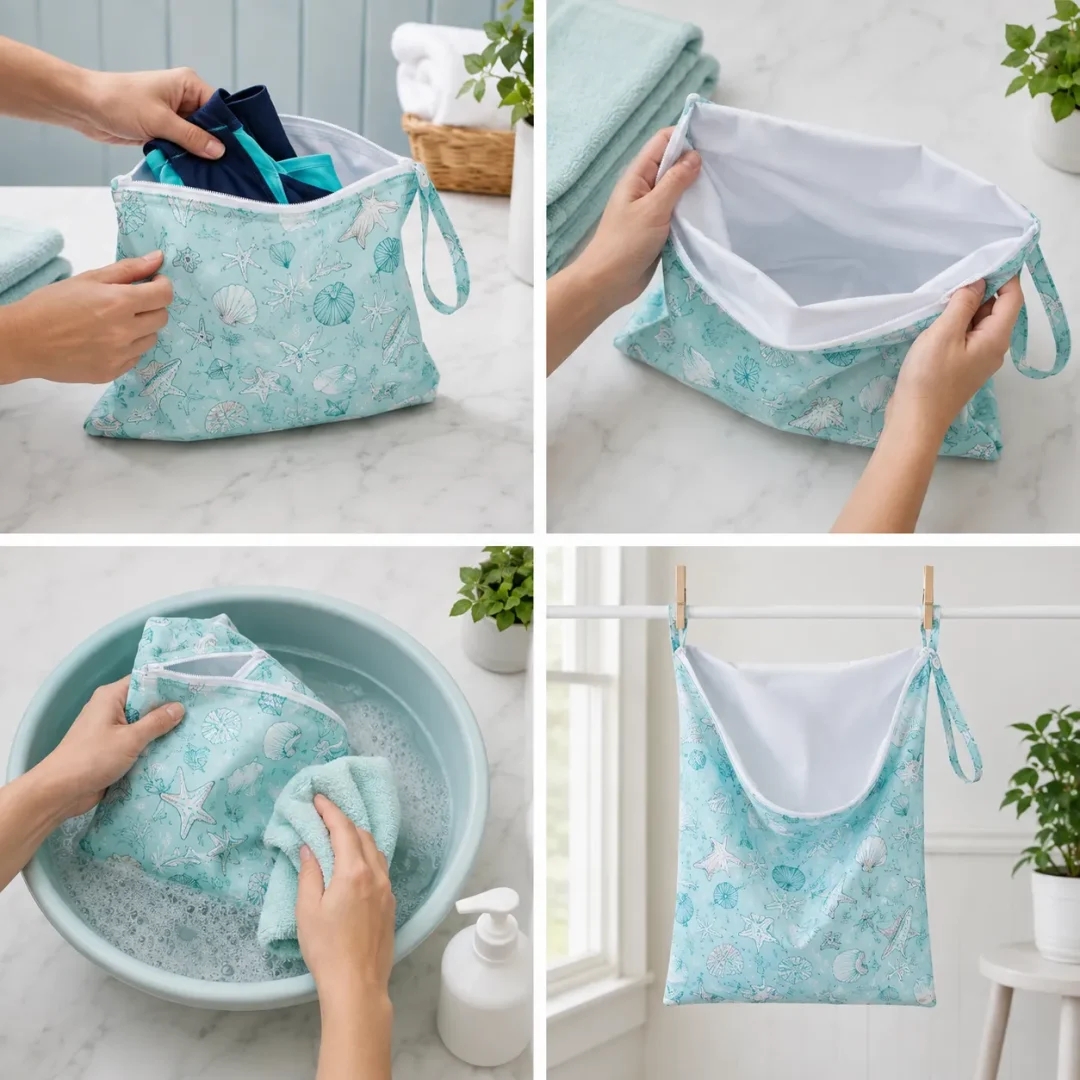
For most everyday odors, begin with a normal but thorough cleaning routine before trying a stronger treatment.
1. すぐにバッグを空にする
Remove the wet contents as soon as possible. Shake out sand, lint, hair and other loose debris. If the bag held diapers or heavily soiled items, remove any solids before washing it.
Do not allow wet clothes or towels to remain sealed inside for several days if it can be avoided.
2. 新しい残留物をすすぎ落とす
Rinse the interior with cool or lukewarm water. This is particularly useful after carrying:
- Chlorinated pool water;
- Saltwater;
- Urine;
- Spilled drinks;
- Shampoo or liquid toiletries;
- Mud or sand.
Prompt rinsing prevents residue from drying onto the lining and becoming harder to remove.
3. 濡れたバッグを裏返す
If the bag’s construction allows it, turn it inside out before washing. This exposes the surface that has been in direct contact with wet or soiled items.
Pay particular attention to:
- Bottom corners;
- Zipper tape;
- Binding;
- Stitched seams;
- Pocket divisions;
- Areas where the lining folds.
Do not pull aggressively against the zipper or seams while reversing the bag.
4. マイルドな洗剤で洗う
Follow the care label to decide between hand washing and machine washing.
For hand washing, add a small amount of mild detergent to cool or lukewarm water. Use a soft cloth or sponge to clean the lining. Avoid scraping it with a stiff brush.
If machine washing is permitted:
- Leave the zipper open;
- Turn the bag inside out;
- Use a gentle or appropriate regular cycle;
- Select the temperature shown on the label;
- Avoid overloading the machine;
- Use only the recommended amount of detergent.
Some wet bags can be washed with similar laundry, such as cloth diapers or sportswear. However, the hottest diaper-sanitizing cycle may not be suitable for the bag’s waterproof layer.
5. 徹底的にすすぐ
Rinsing is an important but often overlooked part of odor removal. Detergent residue can collect around the seams and contribute to recurring smells.
If the bag still feels slippery, heavily scented or soapy after washing, rinse it again with clean water.
6. 完全に自然乾燥させる
Leave the wet bag open and hang it in a well-ventilated area. Keeping it inside out can help the lining dry faster.
Make sure the following areas are completely dry before storing it:
- Interior corners;
- Zipper tape;
- Stitching;
- Binding;
- Handles or hanging loops;
- The space between separate compartments.
Moderate airflow is usually more useful than intense heat. Avoid radiators, irons and high-temperature drying unless the care label specifically allows machine drying.
濡れたバッグから頑固な臭いを取り除く方法
If ordinary washing does not remove the smell, choose one additional treatment based on the likely cause. Do not combine several household chemicals in the hope of producing a stronger cleaner.
軽い臭いの場合は風通しを良くする
A slightly stale bag may simply need more ventilation.
Turn the clean bag inside out and leave it fully open in a dry, shaded and well-ventilated location. Several hours of airflow may be enough for a light storage or moisture odor.
Limited indirect sunlight may help the bag dry, but prolonged exposure to strong sunlight can fade printed fabric or accelerate the aging of some coatings.
希釈した白酢のリンスを試してみてください
Diluted white vinegar is commonly used for lingering urine, sweat and stale laundry odors. However, it should not be poured undiluted onto an unfamiliar coating.
A cautious process is to:
- Check the care label;
- Test the diluted solution on a small, inconspicuous area;
- Apply or rinse briefly rather than soaking the bag overnight;
- Rinse again with clean water;
- Air-dry the bag completely.
A commonly used starting dilution is approximately one part white vinegar to three or four parts water, but this should not override the bag manufacturer’s instructions.
Never mix vinegar with chlorine bleach. The combination can release dangerous fumes.
ベーキングソーダを別の処置として使用してください
Baking soda can help absorb mild musty or storage odors.
For a dry treatment, place an open container or breathable sachet of baking soda inside the clean, dry bag. Close the bag loosely and leave it for approximately 24 hours. Remove the container afterward and air out the bag.
If the care label permits a wet treatment, a small amount of baking soda can be dissolved in water and applied gently. Avoid rubbing dry, gritty powder aggressively against the waterproof layer because repeated abrasion may affect the surface.
Do not pour vinegar and baking soda into the bag at the same time. The visible fizz is mainly an acid-base reaction: the two ingredients neutralize one another, so combining them does not automatically create a more effective deodorizer.
有機的な臭いには酵素洗剤を検討してください
Urine, sweat, milk and food smells are caused by organic residue. A compatible enzyme detergent may break down this residue more effectively than a fragrance-heavy cleaner.
Before using one:
- Confirm that the product is suitable for the bag’s fabric and coating;
- Follow the cleaner’s dilution and contact-time instructions;
- Test a small area first;
- Rinse thoroughly after treatment if directed.
Avoid assuming that every diaper, sportswear or household enzyme cleaner is safe for every waterproof lining.
臭いの種類に応じた処置を行いましょう
Identifying the odor can prevent unnecessary or overly aggressive cleaning.
| Type of smell | Likely cause | Best first response |
|---|---|---|
| Urine or diaper odor | Organic residue or extended storage | Wash promptly with detergent and rinse thoroughly |
| Sweat or gym-clothes odor | Perspiration, body oils and bacteria | Turn inside out, wash and fully air-dry |
| Musty smell | Damp storage or incomplete drying | Inspect for mildew, clean and improve airflow |
| Food or milk smell | Protein, sugar or grease residue | Wash promptly; use a compatible enzyme cleaner if necessary |
| Pool smell | Chlorine remaining on the lining | Rinse with fresh water immediately after use |
| Seawater smell | Salt and organic residue | Rinse thoroughly with fresh water |
| Strong chemical smell | New-material odor or coating degradation | Ventilate and inspect the lining |
| Perfumed but stale smell | Detergent or softener buildup | Rewash with less detergent and add an extra rinse |
If the bag is mainly used for swimming, it also helps to clean the main beach or pool bag regularly. Our guide to choosing and caring for beach bags explains how wet gear, sand and outdoor exposure affect different bag materials.
湿ったバッグの消臭時に避けるべきことは何ですか?
A strong smell can tempt you to use the hottest cycle or most powerful household cleaner available. That approach may remove the odor but shorten the life of the bag.
高温洗浄
Excessive heat may affect polyurethane coatings, laminated layers, seam tape and printed surfaces. Unless the label clearly permits it, do not use a washing machine’s sanitize cycle.
塩素系漂白剤
Bleach can discolor fabric and may weaken coatings, elastic components or other parts of the bag. Only use it when the wet bag manufacturer explicitly provides compatible instructions and a safe dilution.
柔軟剤
Fabric softener is not a true odor-removal solution. It can coat the material with fragrance and residue, temporarily masking a smell while leaving the underlying contamination in place.
強力な溶剤および消毒スプレー
Alcohol, concentrated acids, solvents and general-purpose disinfectants may react with coatings, printing inks or adhesives. A product that is safe for a countertop is not automatically safe for a waterproof textile.
硬いブラシや研磨パッド
Scrubbing aggressively can scratch a smooth lining or wear down a thin coating. Use a soft cloth, sponge or soft-bristled brush only where appropriate.
長時間の不必要な浸漬
Extended soaking may stress laminated materials and allow water to remain around seams and zipper components. Use short treatments unless the manufacturer recommends otherwise.
湿った状態でバッグを保管すること
Even a perfectly cleaned wet bag can begin smelling again if it is folded and stored before the seams have dried.
湿ったバッグの臭いを防ぐ方法
Prevention is easier on the waterproof lining than repeated deep cleaning.
使用後に湿ったアイテムを取り出す
Take out swimsuits, towels, diapers and gym clothes when you arrive home. Do not leave the wet bag in a car, locker or suitcase overnight if you can avoid it.
使用間に開けておく
If you cannot wash the bag immediately, empty it and leave the zipper open. Air circulation slows the development of musty smells.
プールやビーチの後にすすぐ
Fresh water helps remove chlorine, salt and sand before they dry onto the lining.
定期的に洗う
Cleaning frequency depends on the contents:
- A diaper wet bag generally needs frequent washing;
- A bag holding sweaty sportswear should be washed after heavy use;
- A bag used briefly for a clean swimsuit may only need rinsing and drying;
- A bag exposed to food, milk or bodily fluids should be cleaned promptly.
2つの湿ったバッグを交互に使用する
Keeping more than one bag allows each one enough time to wash and dry completely. This is particularly useful for cloth diapers, daycare, swimming lessons and daily gym routines.
開けた状態で乾かして保管する
Do not fold the bag tightly while it is still warm or damp. Keep it in a dry storage area rather than a sealed plastic container.
臭う湿ったバッグはいつ交換すべきですか?
Persistent odor does not always mean the bag is dirty. It may indicate that the material or construction has reached the end of its useful life.
Consider replacing the bag if:
- The smell returns immediately after proper washing and drying;
- The inner surface has become sticky;
- The coating is peeling, bubbling or cracking;
- Dark mildew marks remain around the seams;
- Water leaks through damaged areas;
- The zipper or binding traps residue that cannot be cleaned;
- A chemical odor becomes stronger over time.
Once a waterproof coating has separated from its base fabric, household treatments are unlikely to restore its original performance.
ウェットバッグを清潔に保つために容易にする要素は何ですか?
For consumers, cleaning performance is partly determined by product design. A smooth interior, wide opening and simple pocket structure generally make a bag easier to turn, rinse and dry.
For retailers and brands developing custom wet bags, several specifications can improve everyday care:
- A lining that can be wiped clean;
- A zipper opening wide enough to expose the interior;
- Limited inaccessible folds and narrow corners;
- A hanging loop for open-air drying;
- Separate wet and dry compartments;
- Durable zipper tape and reinforced stress points;
- Waterproof materials tested after repeated washing;
- Care instructions matched to the actual coating and printing process.
A double-pocket design can also keep clean items away from wet or soiled contents. See this custom double-pocket wet bag for an example of how separate compartments can be incorporated into a reusable design.
No fabric or lining can guarantee an odor-free bag if wet contents are stored indefinitely. Good material selection and construction make cleaning easier, but daily care remains important.
よくある質問
ウェットバッグを洗濯機に入れてもいいですか?
Many polyester wet bags with PUL or TPU layers are machine washable, but not all are. Check the care label before washing. If machine washing is allowed, leave the zipper open, turn the bag inside out and avoid excessive heat.
ウェットバッグを一晩酢に浸してもいいですか?
It is generally safer to avoid overnight soaking unless the manufacturer specifically recommends it. Prolonged exposure may affect certain coatings, printed surfaces, adhesives or hardware. A short, diluted treatment followed by a thorough rinse is more cautious.
重曹と酢を一緒に使ってもいいですか?
They should be used separately. Mixing them produces bubbles but also causes them to neutralize each other. Use one method, rinse the bag and evaluate the result before trying another treatment.
洗濯後もウェットバッグがまだ臭うのはなぜですか?
Possible causes include residue in the seams, too much detergent, insufficient rinsing, incomplete drying, mildew or a deteriorating waterproof layer. Recheck the corners and zipper area before repeating the cleaning process.
ウェットバッグはカビが生えることがありますか?
Yes. Any damp bag stored in a closed environment can develop mildew or mold. Emptying the contents promptly and drying the bag completely are the most important preventive steps.
ウェットバッグを乾燥機に入れてもいいですか?
Only if the care label allows it. Some wet bags permit low-temperature tumble drying, while others should be air-dried. High heat can damage waterproof coatings and laminated layers.
ウェットバッグはどのくらいの頻度で洗うべきですか?
Wash it according to what it carries and how frequently it is used. Bags holding diapers, sweaty clothing, food spills or bodily fluids require more frequent cleaning than bags used briefly for lightly damp swimwear.
最終的な感想
The safest way to remove odor from a wet bag is to begin with the basics: empty it, turn it inside out, wash it with a suitable amount of mild detergent, rinse it thoroughly and let every part dry completely.
For lingering odors, diluted white vinegar, baking soda or a compatible enzyme detergent can be used as separate treatments. Always check the care label first, avoid mixing household cleaners and do not use high heat simply to speed up the process.
Most importantly, do not treat a wet bag as permanent storage for wet items. Prompt emptying, regular cleaning and complete drying will prevent most odor problems before they start.

 Japanese
 English
 French
 German
 Arabic
 Thai
 Vietnamese
 Russian
 Spanish
 Portuguese