
A quart-size bag is a bag designed to hold approximately one US liquid quart, equal to 32 US fluid ounces or about 946 milliliters. The term describes the bag’s approximate capacity rather than one fixed shape or set of dimensions.
In everyday use, “quart bag” can refer to a disposable zip-top food storage bag. In travel contexts, however, it usually means the small, clear, resealable bag used to organize liquids when passing through airport security.
Although common quart bags often measure around 6 × 9 inches or 7 × 8 inches, not every quart bag has exactly the same dimensions. Its shape, depth, gusset and closure position can all affect how much it actually holds.
Table des matières
ToggleWhat Does “Quart-Size” Mean?
A quart is a unit of volume used mainly in the United States. When a product is described as “quart-size,” it is intended to hold roughly one US liquid quart.
According to the National Institute of Standards and Technology, one US liquid quart equals approximately 946 milliliters or 0.946 liters.
| Measurement | One US liquid quart |
|---|---|
| US fluid ounces | 32 fl oz |
| Milliliters | Approximately 946 ml |
| Liters | Approximately 0.95 L |
| US gallons | 0.25 gallon |
This is why a quart bag and a one-liter bag are often treated as roughly equivalent in travel discussions. They are close in capacity, although they are not mathematically identical: one liter is about 5.7% larger than one US quart.
It is also important to distinguish a US liquid quart from other quart measurements. A US dry quart and an imperial quart have different volumes. When people talk about quart-size storage bags or airport liquid bags in the United States, they are generally referring to the US liquid quart.
Does Quart-Size Describe Capacity or Dimensions?
Quart-size primarily describes capacity, not a universal length and width.
That distinction matters because flexible bags can hold the same approximate volume while having noticeably different shapes. For example:
- A flat polyethylene storage bag may be relatively wide and shallow.
- A long, narrow travel bag may provide a similar usable volume.
- A structured PVC pouch may be shorter but include a side or bottom gusset.
- A rigid zipper and thick binding may reduce the usable space inside a bag.
Two products can therefore both be marketed as quart-size without having identical external dimensions.
This is also why multiplying a bag’s maximum length, height and depth does not always provide an accurate usable capacity. Flexible corners, curved seams, zipper placement and material thickness all change the amount of space available inside.
How Big Is a Quart-Size Bag?
Many flat quart storage bags measure approximately 7 inches across and between 7 and 8 inches high. Travel liquid bags are also commonly found in dimensions around 6 × 9 inches or 7 × 8 inches.
These dimensions should be treated as common market references rather than one universal standard.
| Common format | Approximate dimensions | Typical construction |
|---|---|---|
| Flat storage bag | Around 7 × 7–8 inches | Thin polyethylene with press seal |
| Long travel liquid bag | Around 6 × 9 inches | Clear, flat and resealable |
| Wide travel liquid bag | Around 7 × 8 inches | Clear zip-top pouch |
| Structured quart pouch | Varies by design | PVC, TPU, EVA or PEVA with depth |
In metric measurements, the two frequently referenced travel sizes are approximately:
- 6 × 9 inches: 15 × 23 cm
- 7 × 8 inches: 18 × 20 cm
The actual dimensions of commercial storage bags vary by brand. A gusseted or structured bag may also use smaller front-panel dimensions while providing extra depth.
What does a quart-size bag look like?
A typical quart-size travel bag is:
- Small enough to hold comfortably in one hand;
- Large enough for several travel-size bottles;
- Clear or substantially transparent;
- Closed with a press seal, slider or zipper;
- Smaller than a gallon storage bag;
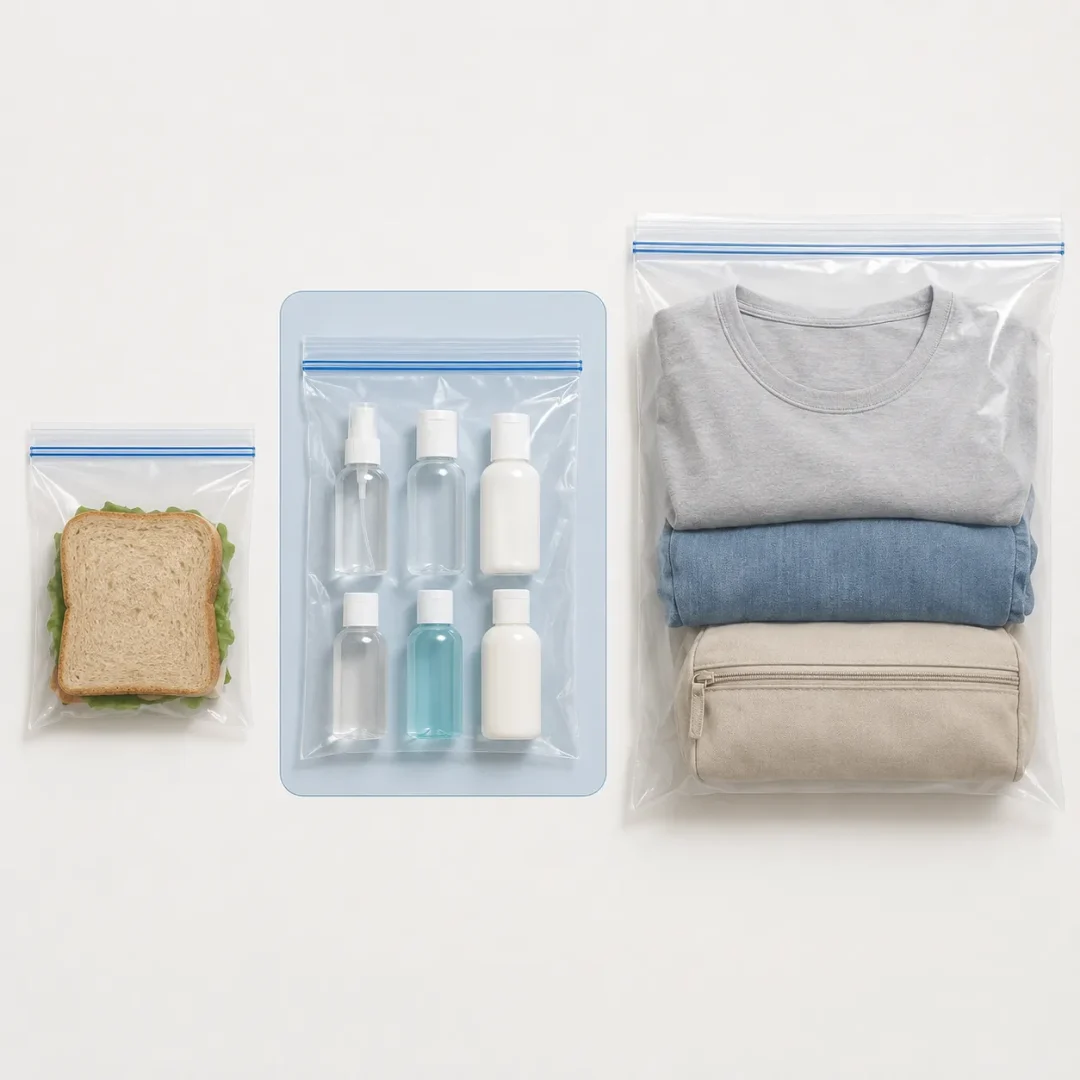
- Similar in general appearance to a large sandwich bag.
A reusable version may include reinforced seams, colored binding, a thicker zipper and a small carrying loop. These features improve durability, but they can also make its external dimensions different from those of a disposable quart bag.
What Is a Quart-Size Bag Used For?
The phrase has two main meanings: a travel liquid bag and a household storage bag.
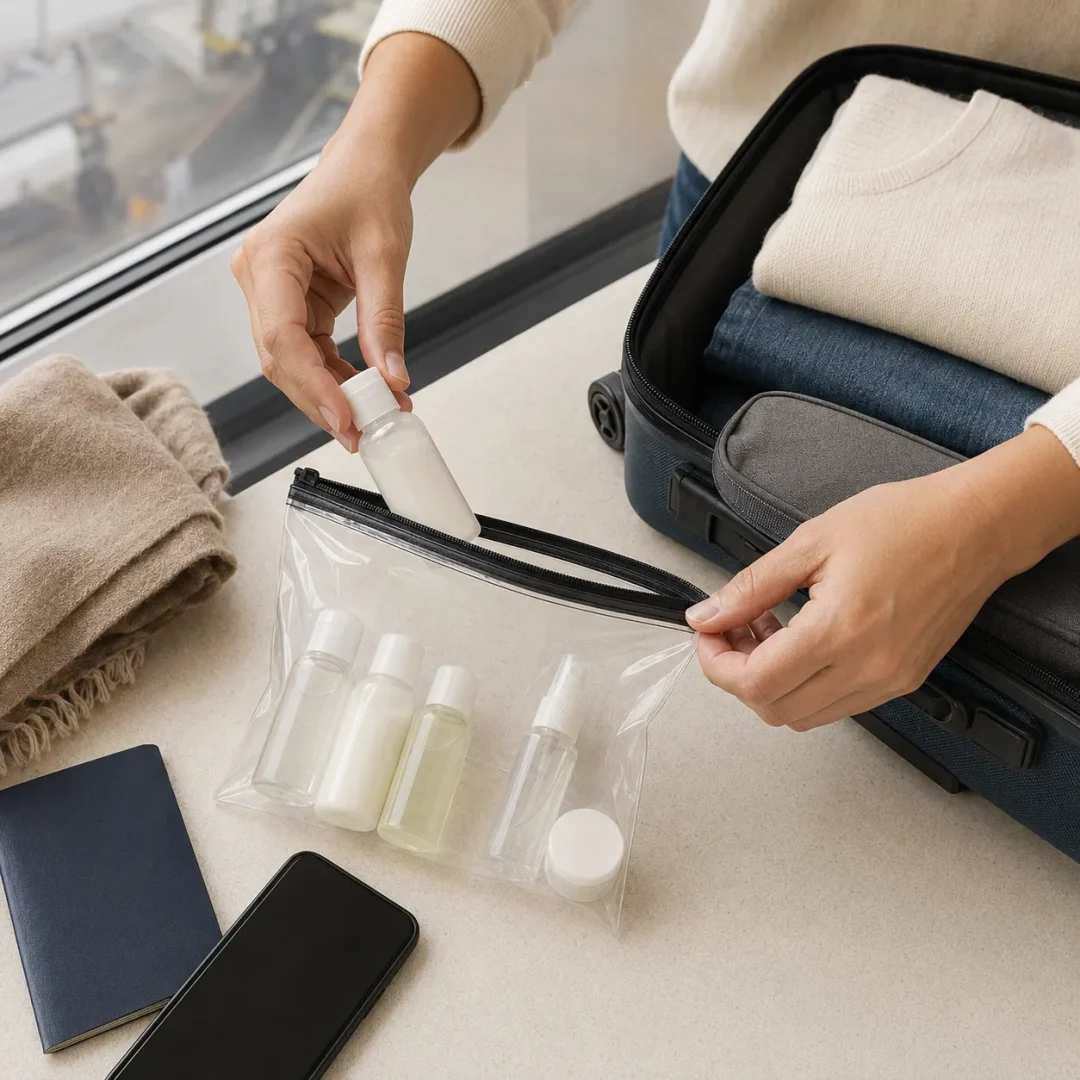
Airport liquid screening
In travel contexts, a quart-size bag is used to organize small containers of:
- Shampoo and conditioner;
- Lotion and moisturizer;
- Toothpaste;
- Sunscreen;
- Perfume;
- Liquid foundation and mascara;
- Gels, creams, aerosols and pastes.
Its clear construction makes the contents visible during security screening, while the resealable closure helps contain leaks.
A quart liquid bag is not necessarily a complete toiletry bag. It is usually reserved for regulated liquids during screening. Solid toiletries, brushes, razors and other permitted dry items can be organized separately.
Food storage
A quart storage bag can also refer to a common kitchen zip bag used for:
- Fruit and vegetables;
- Snacks;
- Small leftovers;
- Individual freezer portions;
- Marinating small quantities of food;
- Organizing ingredients.
A food storage bag and a travel liquids pouch may have similar capacities, but they are not automatically interchangeable for every application. A clear PVC travel pouch, for example, should not be used for food unless the material and finished product are specifically intended and tested for food contact.
Household organization
Quart bags are also a convenient size for small items such as:
- Charging cables;
- Craft supplies;
- First-aid items;
- Small toys;
- Travel documents;
- Hardware and spare parts.
For these applications, transparency can make the contents easier to identify without opening every bag.
What Is a TSA Quart-Size Bag?
A TSA quart-size bag is the clear, resealable bag used to carry limited quantities of liquids through a US airport security checkpoint.
Under the current TSA liquids, aerosols and gels rule, passengers may carry containers of liquids, aerosols, gels, creams and pastes through the checkpoint when:
- Each container holds no more than 3.4 ounces or 100 milliliters;
- The containers fit inside one quart-size bag;
- Each passenger carries only one such liquids bag.
This is commonly called the 3-1-1 rule.
| Part of the rule | Meaning |
|---|---|
| 3 | Containers must be 3.4 oz/100 ml or smaller |
| First 1 | The containers fit into one quart-size bag |
| Second 1 | One liquids bag is allowed per passenger |
The size of the container matters, not the amount remaining inside it. A half-empty 6-ounce bottle is still a 6-ounce container and does not become compliant simply because it contains less than 3.4 ounces.
The TSA travel checklist describes the liquids bag as a one-quart, clear, plastic, zip-top bag in which all applicable liquids must fit. Travelers should review the latest official TSA travel checklist before departure.
Does TSA specify exact quart bag dimensions?
TSA’s main published guidance defines the bag by approximate capacity and functional characteristics rather than prescribing one universal length, width and depth for every possible construction.
Dimensions such as 6 × 9 inches and 7 × 8 inches are widely used as practical references, but they should not be presented as the only officially accepted dimensions for every bag style.
The safest option for a traveler is a clearly labeled quart-capacity bag that is:
- Transparent;
- Resealable;
- Able to close without bulging;
- Easy to remove and present if requested;
- Not enlarged by an excessive gusset or multiple compartments.
A structured clear toiletry pouch may look approximately the right size but hold more than a flat quart bag because of its depth. Conversely, thick binding and reinforced seams may reduce its usable internal capacity.
Is a “TSA-approved” quart bag officially certified?
“TSA approved quart bag” is a widely used retail phrase, but it should not be interpreted as evidence that TSA has individually tested and certified every bag carrying that wording.
In most product descriptions, it means the bag is designed around the published TSA liquid-bag requirements. More precise wording includes:
- TSA-compliant quart-size bag;
- TSA-friendly clear liquids bag;
- Designed for the TSA 3-1-1 liquids rule.
Manufacturers and retailers should avoid implying a formal product certification unless they can document one.
For more detailed information about traveling with makeup, skincare and other beauty products, see our guide to TSA-Approved Cosmetic Bags.
Quart Bag vs Other Common Bag Sizes
A quart bag can be confused with sandwich bags, one-liter bags, gallon bags and general toiletry bags. The key difference is that some names describe capacity, while others describe purpose.
| Bag type | Approximate capacity | Common use | Appropriate for TSA liquids? |
|---|---|---|---|
| Sandwich bag | Varies by brand | Sandwiches and snacks | Not the clearest standard choice |
| Quart bag | About 0.95 L | Travel liquids or food storage | Yes, when clear and resealable |
| One-liter bag | 1 L | International travel liquids | Common outside the US |
| Gallon bag | About 3.78 L | Larger food portions and storage | Too large for the TSA allowance |
| Trousse de toilette | Varies widely | General personal-care organization | Only if it meets the applicable requirements |
Is a quart bag the same as a sandwich bag?
No. The two terms do not describe exactly the same thing.
“Quart” describes approximate capacity, while “sandwich” describes an intended use. Sandwich bags are generally designed around the dimensions of a sandwich and may be smaller than quart storage bags, but sizes differ among manufacturers.
A sandwich bag may look similar to a quart bag, particularly when both are empty and flat. That does not guarantee that it has the same capacity or that it is the best choice for airport liquids.
For airport travel, using a bag clearly identified as quart-size removes unnecessary uncertainty.
Is a quart bag the same as a one-liter bag?
They are close, but not identical.
- One US liquid quart is approximately 946 ml.
- One liter is 1,000 ml.
- One liter is approximately 1.057 US liquid quarts.
US airport guidance typically uses “quart-size,” while many countries describe a similar liquids bag as a one-liter bag. Because airport screening requirements can vary by country, airport and available scanning equipment, travelers should check the rules at every departure point, including the airport used for the return journey.
Do not assume that a rule encountered at one airport will apply throughout an international itinerary.
Is a quart bag the same as a gallon bag?
No. One gallon equals four quarts, so a gallon bag provides roughly four times the nominal capacity of a quart bag.
Even if only one corner of a gallon bag contains liquid bottles, it is not the bag size specified by TSA’s 3-1-1 guidance. Use a quart-size bag for applicable carry-on liquids and reserve gallon bags for general storage.
Is a toiletry bag automatically quart-size?
No. Toiletry bags range from compact flat pouches to large hanging organizers with several liters of capacity.
A bag may be transparent without being quart-size, and it may be described as travel-friendly without being intended for airport liquid screening. A large clear wash bag can still be useful inside a suitcase, but that does not make it a compliant quart liquid bag.
If you are choosing a bag for an entire trip rather than only for the security checkpoint, our travel toiletry bag size guide compares small, medium and large formats.
Disposable vs Reusable Quart-Size Bags
Both disposable zip-top bags and reusable clear pouches can organize travel liquids. The better choice depends on travel frequency, durability expectations and how accurately the product maintains a one-quart capacity.
Disposable zip-top bags
A standard disposable quart storage bag is:
- Lightweight;
- Inexpensive;
- Flat when empty;
- Easy to replace;
- Widely recognized;
- Usually closed with a press-to-seal strip or slider.
Its simple shape makes the capacity relatively easy to understand. However, thin film can puncture, stretch or lose sealing strength after repeated use.
Reusable clear quart bags
Reusable versions are commonly made from thicker PVC, TPU, EVA, PEVA or polyethylene. They may include:
- Reinforced seams;
- Zipper closures;
- Colored trim;
- Carrying loops;
- Wipe-clean surfaces;
- Printed or attached branding.
They generally provide better structure and longer use than thin disposable bags. However, a reusable bag should not be assumed to meet airport requirements only because it is clear. Its usable volume and ability to close comfortably still matter.
| Factor | Disposable bag | Reusable bag |
|---|---|---|
| Construction | Thin and flat | Flat or structured |
| Durabilité | Limitée | Designed for repeated use |
| Fermeture | Press seal or slider | Press seal or zipper |
| Nettoyage | Usually limited | Often wipe-clean |
| Branding area | Limitée | More customization options |
| Capacity check | Usually straightforward | Must consider gussets and binding |
Reusable does not automatically mean environmentally preferable in every situation. Material choice, production method, number of uses and disposal all affect environmental impact. A durable bag provides the most value when it is genuinely used repeatedly.
How to Choose the Right Quart-Size Bag
For airport liquids, start with capacity and screening suitability rather than appearance alone.
1. Confirm the approximate capacity
Check whether the product is genuinely designed to hold about one quart. External length and width are useful reference points, but they do not tell the full story when the bag has a gusset or structured sides.
2. Choose a clear construction
A clear body allows the contents to be inspected quickly. Large opaque panels, heavy printing or multiple hidden compartments may reduce visibility.
3. Check the closure
The bag should close completely after the containers are packed. A zipper that remains partly open or is placed under excessive tension indicates overpacking.
4. Consider leak resistance
A liquids bag is not the same as a fully waterproof dry bag, but secure seams and a reliable closure can help contain small leaks. For reusable bags, examine the seam construction, binding and zipper attachment.
5. Avoid unnecessary internal compartments
Dividers can improve organization, but they may also reduce usable capacity and make a small travel pouch more complicated during inspection. A simple single compartment is often the easiest format for an airport liquids bag.
6. Keep the bag accessible
Place it near the top of the carry-on rather than underneath clothing and electronics. Screening procedures vary, so the bag should be easy to remove if requested.
7. Check current airport rules
Security technology and liquids procedures are not identical at every airport. Review the official guidance for both outbound and return airports, especially on international trips.
What Brands and Buyers Should Know About Custom Quart Bags
For beauty brands, travel retailers, hotels and promotional-product buyers, a custom quart bag involves more than selecting a standard width and height. The final product needs to balance capacity, visibility, durability and brand presentation.
Define the finished capacity
A specification sheet should include:
- Finished external dimensions;
- Usable internal dimensions;
- Target capacity;
- Flat or gusseted construction;
- Position of the zipper and seam allowance;
- Material thickness;
- Acceptable dimensional tolerance.
A prototype should be tested with representative travel bottles rather than approved from a drawing alone. This helps identify capacity loss caused by binding, rounded corners or a low zipper position.
Choose the appropriate clear material
Common options include:
PVC: Clear, structured and cost-effective, with numerous thickness options. Buyers should specify applicable chemical and market requirements.
TPU: Flexible, durable and often chosen for higher-value reusable products, although it generally costs more than conventional PVC.
EVA or PEVA: Frequently used where buyers want a soft, flexible clear or semi-clear construction. Transparency and feel vary by formulation.
Polyethylene film: Lightweight and suitable for simpler press-seal storage bags or economical travel kits.
Material selection should be based on the desired transparency, flexibility, temperature performance, seam method, price point and applicable market requirements—not on the material name alone.
Protect the clear viewing area
Branding should not interfere with the bag’s practical transparency. Suitable logo placements include:
- A narrow top band;
- Zipper trim;
- Side binding;
- A lower corner;
- A small woven label;
- A removable packaging card.
Large-area printing across both clear panels may make the contents harder to inspect and can undermine the reason for choosing a transparent travel pouch.
Match the closure to the application
A basic press seal may suit economical promotional kits, while a reinforced zipper can add perceived value for retail and repeated use. Buyers should evaluate:
- Zipper smoothness;
- Puller size;
- Opening width;
- Seam strength;
- Resistance to repeated opening;
- Leakage around the zipper ends.
Consider the complete program
Custom quart-size pouches can be used for:
- Beauty and skincare gift sets;
- Travel-size product launches;
- Airline and hospitality kits;
- Promotional travel accessories;
- Subscription boxes;
- Retail multipacks;
- Corporate travel gifts.
For related product formats and customization options, explore INITI’s clear toiletry bag et custom toiletry bag manufacturing pages.
Questions fréquemment posées
How many milliliters are in a quart-size bag?
One US liquid quart equals approximately 946 milliliters, or 0.946 liters. A quart-size bag is intended to provide roughly this capacity, although the usable volume of an individual product can vary with its construction.
Is a quart-size bag exactly one liter?
No. One liter equals 1,000 milliliters, while one US liquid quart is approximately 946 milliliters. A one-liter bag is therefore slightly larger, although the two are often discussed together in international travel guidance.
What are the standard quart bag dimensions?
There is no single universal dimension for every quart bag. Common flat and travel formats are around 6 × 9 inches or 7 × 8 inches, but brand specifications and structured designs vary.
Can I use any clear bag for TSA liquids?
Not necessarily. For the standard TSA 3-1-1 rule, the bag should be quart-size, clear and resealable. A clear bag can still be too large, difficult to close or unsuitable because of its construction.
Can a TSA quart bag have a zipper?
Yes. A reusable clear pouch may have a zipper, provided the bag maintains an appropriate capacity and can close fully. “Clear with a zipper” alone does not prove that a larger toiletry bag is quart-size.
Can I use a gallon bag if my liquids only fill part of it?
A gallon bag is not the size specified in TSA’s standard liquids guidance. Use a quart-size bag instead, even when the actual liquid containers occupy only a small portion of a larger bag.
Is a quart bag required in checked luggage?
The TSA 3-1-1 quart-bag rule applies to liquids carried through the security checkpoint in carry-on luggage. Checked baggage is not subject to the same quart-bag arrangement, although other restrictions concerning hazardous, flammable or regulated products still apply.
Is every quart storage bag food-safe?
No. Food suitability depends on the material, manufacturing process and intended use of the finished product. Do not use a cosmetic or travel pouch for direct food contact unless the supplier confirms that it is designed and compliant for that purpose.
Réflexions finales
A quart-size bag is a bag with an approximate capacity of one US liquid quart—about 32 fluid ounces, 946 milliliters or 0.95 liters. It does not have one universally fixed shape, which is why common quart bags can have different dimensions.
For airport travel, the term normally refers to the small, clear, resealable bag used under the TSA 3-1-1 liquids rule. For household use, it can also describe a zip-top food or organization bag.
The simplest way to choose correctly is to check four things: approximate capacity, transparency, closure and intended use. For air travel, travelers should also verify the current rules at every departure airport rather than relying solely on a product’s “TSA approved” label.

 French
 English
 German
 Japanese
 Arabic
 Thai
 Vietnamese
 Russian
 Spanish
 Portuguese