
“Safe” is a loaded word in materials science. Nothing is unconditionally safe — water is safe until you inhale it, and cotton is safe until you set it on fire. The question isn’t “is PEVA safe?” but rather “safe for what, under what conditions, compared to what alternatives?”
This guide gives you the answer in those terms — and it won’t sugarcoat the uncertainties.
You’ll walk away understanding:
- What PEVA does NOT contain (and why that matters most)
- What concerns do exist — backed by actual studies, not speculation
- How PEVA’s safety profile changes by application (shower curtains, baby products, food contact, garment bags)
- What certifications to look for and what they actually verify
- How PEVA compares to PVC, EVA, silicone, and fabric alternatives
The Short Answer
For the vast majority of consumer applications — shower curtains, garment bags, cosmetic pouches, tablecloths, storage covers — PEVA is a demonstrably safer material than PVC and presents low health risk in normal use.
It is not “completely non-toxic” (few synthetic materials are), and long-term environmental health data is thinner than anyone would like. But on the dimensions that drive real-world safety — chlorine content, phthalate plasticizers, heavy metal stabilizers, and VOC emissions — PEVA is a meaningful improvement over the materials it typically replaces.

What PEVA Does NOT Contain: The Safety Foundation
PEVA’s safety reputation is built primarily on what’s absent, not what’s present. Understanding these omissions is essential to understanding why the material is considered safe.
No Chlorine
PVC (polyvinyl chloride) is approximately 57% chlorine by weight. This chlorine content is the root cause of PVC’s most serious health and environmental problems:
- Dioxin formation: When chlorine-containing materials are manufactured or incinerated, they can form dioxins and furans — persistent organic pollutants classified as Group 1 carcinogens (known human carcinogens) by the International Agency for Research on Cancer (IARC).
- Hydrogen chloride gas: Burning PVC releases HCl gas, which is corrosive, toxic when inhaled, and contributes to acid rain.
- Production hazards: Vinyl chloride monomer, the building block of PVC, is itself a known human carcinogen (IARC Group 1). Workers in PVC production facilities face elevated exposure risks that simply don’t exist in PEVA manufacturing.
PEVA eliminates chlorine entirely from its molecular structure. No chlorine means no dioxin formation pathway, no HCl off-gassing, and no vinyl chloride monomer exposure risk in production.
This is not a marginal improvement. This is the single most consequential safety difference between PEVA and PVC.
No Phthalate Plasticizers Required
PVC in its pure form is rigid and brittle. To make it flexible enough for shower curtains, bags, and films, manufacturers add plasticizers — chemicals that soften the material. Phthalates are the most common class of plasticizers used in flexible PVC, typically comprising 30–50% of the final product by weight.
Phthalates are not chemically bonded to PVC. They can leach out over time, especially when exposed to:
- Heat (hot showers, warm storage)
- Oils and fats (skin contact, food contact)
- Abrasion and mechanical stress
Once released, phthalates are classified as endocrine-disrupting chemicals (EDCs) . They interfere with hormone systems, and multiple studies have linked phthalate exposure to:
- Reproductive and developmental toxicity
- Reduced testosterone levels in males
- Increased risk of asthma and allergies in children
- Metabolic disorders
The regulatory response has been swift and global:
- EU REACH: DEHP, DBP, BBP, and DIBP restricted to ≤0.1% in consumer articles. DINP, DIDP, and DNOP restricted in toys and childcare items.
- US CPSIA: Certain phthalates banned in children’s toys and childcare articles at concentrations >0.1%.
- California Proposition 65: Requires warning labels for products containing listed phthalates.
- Japan, South Korea, Taiwan: All have phthalate restrictions in various consumer product categories.
PEVA’s molecular structure provides inherent flexibility without plasticizers. The vinyl acetate component (10–50% of the copolymer) creates the soft, pliable characteristics that PVC can only achieve through additive chemicals. No plasticizer means no plasticizer leaching.
No BPA (Usually)
Bisphenol-A (BPA) is primarily associated with polycarbonate plastics and epoxy resins, not with PEVA or PVC. However, some lower-quality PEVA formulations or recycled feedstocks may theoretically introduce trace BPA as a contaminant.
Standard PEVA formulations do not contain BPA. If BPA-free claims matter for your product or brand, request BPA testing documentation from your supplier — it’s a straightforward test and reputable manufacturers can provide it.
No Heavy Metal Stabilizers
PVC requires heat stabilizers to prevent degradation during processing and use. Historically, lead-based stabilizers were the industry standard, and they remain in use in some regions (particularly parts of Asia and Africa) despite phase-outs in Europe (completed 2015) and North America.
PEVA does not require heavy metal stabilizers. Standard PEVA formulations use organic or calcium-zinc stabilizer systems that carry none of the neurotoxic risks associated with lead or cadmium exposure.
What Concerns Do Exist? The Honest Assessment
No responsible analysis stops at “safer than PVC.” PEVA is a synthetic material, and synthetic materials carry inherent uncertainties. Here’s what the evidence actually says — including where the data is thin.
Limited Long-Term Human Health Studies
This is the most valid criticism of PEVA safety claims. PVC has been studied for decades because its problems were obvious and severe. PEVA is newer as a mainstream consumer material, and the body of independent, long-term toxicological research on PEVA specifically — as opposed to its individual components — is limited.
A 2014 study by Meng et al. published in the Journal of Toxicological Sciences found that volatile organic compounds from PEVA plastic showed toxic effects on simple-celled living organisms. The researchers concluded that PEVA “may not be 100% non-toxic” and called for further study.
This is important context, but it needs to be weighed appropriately:
- The study tested VOC extracts in laboratory conditions, not real-world consumer exposure levels
- The findings don’t indicate acute toxicity at normal-use concentrations
- The researchers’ own conclusion was a call for more research, not a declaration of established harm
What this means in practice: PEVA’s safety profile is based on the known safety of its components and the absence of known harmful additives, not on decades of longitudinal human exposure data. This is a gap worth acknowledging — and it’s why no responsible manufacturer or researcher claims PEVA is “proven safe in all contexts.”
VOC Emissions: Low, But Not Zero
All synthetic materials emit some volatile organic compounds, especially when new. PEVA’s VOC emissions are substantially lower than PVC’s, but they’re not zero.
A PEVA shower curtain fresh out of its packaging may have a faint odor. This is not the acrid “new shower curtain smell” associated with PVC (which can persist for weeks), but it exists. Properly formulated PEVA should be virtually odorless within hours of unpacking.
For most consumers, PEVA’s VOC profile presents negligible risk. For individuals with chemical sensitivities (MCS), compromised immune systems, or respiratory conditions, even low-level VOCs may be a concern — and natural fiber alternatives (organic cotton, hemp, linen) may be preferable regardless.
Microplastic Shedding
Like all plastics, PEVA can shed microplastic particles through wear, washing, and environmental degradation. A 2021 study by Jin & Chen in the Journal of Hazardous Materials demonstrated that even “biodegradable” plastics release microplastics during degradation, and PEVA is no exception.
Microplastic pollution is an environmental and potential health concern — microplastics have been detected in human blood, lungs, and placentas. However, this concern applies broadly to all synthetic materials (polyester, nylon, acrylic) and is not specific to PEVA.
Not Food-Safe by Default
Standard PEVA is not certified for direct food contact. While the base material is widely considered safe, food-grade applications require:
- Specific FDA-compliant formulations (US market)
- EU Framework Regulation (EC) No 1935/2004 compliance (European market)
- Migration testing to confirm no substance transfer to food
PEVA products marketed for food contact (lunch bags, food storage, cooler liners) should carry explicit food-safe certification. Do not assume that “PEVA = food-safe” without documentation.
Potential Additives in Low-Quality Formulations
PEVA’s safety depends partly on what’s NOT added. Reputable manufacturers use clean formulations with minimal, well-characterized additives. Low-cost suppliers may introduce:
- Processing aids that haven’t been fully evaluated for consumer safety
- Recycled content of uncertain origin and composition
- Colorants or UV stabilizers that don’t meet regulatory standards for the intended use
This is a supplier quality issue, not a PEVA issue — but it’s a real-world risk that makes supplier verification essential.
Safety by Application: Risk Assessment for Specific Uses
Safety isn’t absolute. It depends entirely on how, where, and by whom a material is used.
Rideaux de douche et produits de salle de bain
Verdict: PEVA is the clearly safer choice for shower curtains and bathroom products. The enclosed, hot, humid bathroom environment amplifies PVC’s off-gassing problems. PEVA’s low-VOC profile makes it suitable for the application.
Baby Products and Children’s Items
Verdict: PEVA is widely used in waterproof baby bibs, changing pads, and teething products. However, for products that go directly into a baby’s mouth (teethers, pacifiers), medical-grade silicone is the preferred material — it has a longer safety track record, more extensive testing, and higher heat resistance for sterilization. PEVA is acceptable for non-mouthing baby products when properly certified.
Garment Bags and Clothing Contact
Verdict: PEVA is safe for garment contact. It won’t stain, transfer chemicals, or leave odors on clothing. The main risk with PEVA garment bags is moisture trapping during long-term storage — this is a breathability problem, not a toxicity problem.
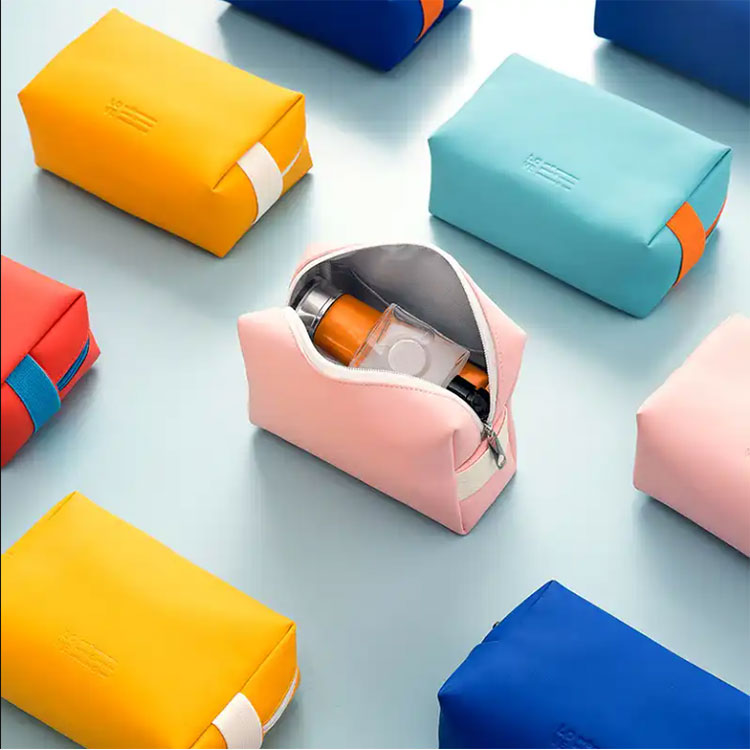
Cosmetic and Toiletry Bags
Verdict: PEVA is well-suited for cosmetic and toiletry bags. Its easy-to-clean surface and lack of odor make it practical and safe for products stored near personal care items.
Food Contact (Lunch Bags, Cooler Liners)
Verdict: PEVA is used in food-contact applications including insulated lunch bags and cooler liners, but only when specifically formulated and certified for that purpose. Never assume standard PEVA is food-safe. Request and verify food-contact certification.
Medical Applications
Medical-grade PEVA is used in some applications (IV bags, blood bags, tubing) as a phthalate-free alternative to PVC. However, medical materials are subject to entirely different regulatory frameworks (FDA 510(k) in the US, Medical Device Regulation in the EU) and should not be compared to consumer-grade PEVA.
Certifications: What to Look For and What They Mean
When evaluating PEVA products for safety, certifications are your primary verification tools. Here’s what the major certifications cover — and what they don’t.
The Certification Reality
A product carrying OEKO-TEX, REACH compliance documentation, and phthalate-free certification from the manufacturer is operating at a high standard of verified safety. A PEVA product with no certifications and no transparency about its formulation is not necessarily unsafe — but you have no way to verify the claim.
For businesses: Your liability exposure is directly proportional to how thoroughly you verify your materials. The cost of testing is a fraction of the cost of a recall or lawsuit.
PEVA Safety vs. Alternative Materials
Safety always exists on a spectrum. Here’s how PEVA compares to the most common alternatives:
How to Verify PEVA Safety Claims from Suppliers
Whether you’re a brand sourcing PEVA products or a consumer evaluating a purchase, these verification steps separate real safety from marketing claims:
For Businesses and Professional Buyers
Request a full material safety data sheet (MSDS/SDS) — this should list all hazardous components and their concentrations. A properly formulated PEVA SDS will show no chlorine, no phthalates, and minimal hazardous components.
Ask for third-party lab test reports — specifically:
- Phthalate content (target: non-detect or <0.1%)
- Heavy metals (lead, cadmium, mercury, hexavalent chromium)
- Chlorine content (should be absent)
- Formaldehyde (should be non-detect for textile-like products)
Request regulatory compliance certificates for your target market:
- EU: REACH SVHC compliance statement
- US: CPSIA Children’s Product Certificate (if applicable)
- California: Proposition 65 compliance documentation
Conduct an odor evaluation on pre-production samples:
- Open the package in a well-ventilated area
- A properly formulated PEVA product should have virtually no odor
- Any sharp, acrid, or persistent chemical smell warrants investigation
- If the product smells strongly of plastic, ask about the exact formulation
Request a material composition disclosure:
- What percentage is PEVA vs. other materials?
- What additives are used (UV stabilizers, colorants, anti-static agents)?
- Is any recycled content included, and if so, from what source?
Perform a chlorine content screening (simple field test) :
- Heat a copper wire until red-hot, touch it to the PEVA sample, then return it to the flame
- A green flame indicates chlorine presence (PVC contamination)
- No green flame suggests chlorine-free (consistent with PEVA)
- Note: this is a screening tool, not a definitive laboratory test
For Consumers
- Look for OEKO-TEX or similar certifications on the product label or packaging
- Check for “PVC-free,” “chlorine-free,” and “phthalate-free” claims — these are the key differentiators
- Smell the product — PEVA should have little to no odor. If you detect a strong chemical smell, it may not be pure PEVA or may contain problematic additives
- Check the brand’s website for material transparency and safety documentation
- Research the manufacturer — well-established brands with public safety commitments are generally more reliable than unknown generic products on marketplace platforms
Questions fréquemment posées
Is PEVA toxic? PEVA is classified as low-toxicity. It does not contain chlorine (eliminating dioxin risk), does not require phthalate plasticizers, and produces minimal VOCs compared to PVC. Some studies suggest PEVA may not be 100% non-toxic, but the evidence does not indicate acute health risks at normal consumer exposure levels. The scientific consensus is that PEVA is substantially less toxic than PVC and presents low risk for general consumer use.
Is PEVA BPA-free? Standard PEVA formulations do not contain BPA (bisphenol-A). BPA is primarily associated with polycarbonate plastics and epoxy resins, not with PEVA. If BPA-free certification is important for your product, request testing documentation — reputable suppliers can provide it.
Is PEVA safe for babies? For waterproof baby products that don’t go in the mouth (bibs, changing pads, mattress covers), PEVA with proper certifications (OEKO-TEX, CPSIA compliance) is generally considered safe. For products that babies mouth directly (teethers, pacifiers), medical-grade silicone is the preferred material with a longer and more robust safety track record.
Can PEVA be used with food? Only food-grade PEVA with explicit FDA or EU food-contact certification should be used for food-contact applications. Standard consumer-grade PEVA is not food-safe by default. Always verify certification before using PEVA products for food storage or contact.
Does PEVA off-gas? PEVA emits significantly fewer volatile organic compounds than PVC. Most PEVA products have little to no noticeable odor after initial unpackaging. However, like all synthetic materials, PEVA is not completely emission-free. The level of off-gassing from properly formulated PEVA is generally considered too low to pose health risks in normal use conditions.
Is PEVA safe for shower curtains? Yes, PEVA is widely considered the safest plastic option for shower curtains. Unlike PVC shower curtains (which can release phthalates and chlorine-based compounds, especially in hot, humid bathrooms), PEVA shower curtains present minimal off-gassing risk and are recommended by organizations including the Environmental Working Group (EWG) and multiple non-toxic living advocates as the preferred plastic option.
How does PEVA compare to silicone for safety? Medical-grade silicone has a longer and more extensive safety track record than PEVA, with decades of use in implantable medical devices, food-contact products, and baby products. Silicone also tolerates much higher temperatures for sterilization. For the highest-safety applications (baby mouthing products, medical devices, high-temperature food contact), silicone is the superior choice. For general waterproof consumer products (shower curtains, bags, covers), PEVA offers excellent safety at a significantly lower cost.
Is PEVA safe for pets? PEVA is generally safe for pet products (waterproof pet mats, travel bags, toy storage) when properly formulated. As with baby products, avoid PEVA for chew toys or items pets will mouth extensively — silicone or natural rubber are better choices for those applications.
Conclusion: Safe Enough, With Honest Caveats
PEVA occupies a specific and defensible position on the material safety spectrum:
- Dramatically safer than PVC on every meaningful metric — chlorine, phthalates, heavy metals, VOCs
- Comparable to EVA, its chemical cousin, with both sharing the same study gaps
- Less extensively studied than silicone for the highest-sensitivity applications
- More practical and affordable than natural fiber alternatives for waterproof applications
The honest answer to “is PEVA safe?” is: for its intended consumer applications, with proper formulation and certification, yes — it is a low-risk material that represents a genuine safety improvement over the PVC products it typically replaces.
The honest caveat is: long-term epidemiological data on PEVA specifically, as opposed to its component chemicals individually, is thinner than the scientific ideal. This does not mean PEVA is dangerous — the available evidence and chemical logic both point toward a favorable safety profile — but it means absolute certainty is unavailable.
For brands: this is a manageable risk. Source from reputable manufacturers, insist on third-party testing, maintain certification documentation, and be transparent with your customers about what your products contain (and don’t contain).
For consumers: PEVA products from established brands with safety certifications are a reasonable and practical choice — especially if the alternative is PVC. If you have chemical sensitivities, are buying for a baby who mouths objects, or simply prefer to minimize synthetic materials in your home, natural fiber or medical-grade silicone alternatives are available.
This article was last updated in July 2026. Safety assessments are based on available scientific literature and regulatory standards as of this date. Material safety is a developing field — new research may change the assessment over time. For medical, food-contact, or children’s product applications, consult with qualified regulatory and safety professionals specific to your product category and target market.

 French
 English
 German
 Japanese
 Arabic
 Thai
 Vietnamese
 Russian
 Spanish
 Portuguese