
Réponse courte : neoprene as a material is water-resistant, not waterproof — and whether a finished neoprene bag keeps water out has far less to do with the material than with four things you can see, touch and ask a supplier about: the seams, the zipper, the closure, and the lining. A plain stitched neoprene tote shrugs off a light drizzle and a spilled coffee. It is not a dry bag, it is not built for a downpour, and no amount of “waterproof neoprene” marketing changes what happens at a needle hole.
Points clés
- Material and finished product are two different questions. Neoprene resists water; a finished bag may not, because water usually enters through construction, not through the sheet.
- Water takes four paths in: stitched seams, zipper teeth and gaps, the opening itself, and any deliberate perforation.
- “Waterproof”, “water-resistant” and “water-repellent” are three different claims with three different test burdens. Most bags marketed as waterproof are genuinely only in the second and third tiers.
- There is no IP or IPX rating for a neoprene bag. The IP code system describes enclosures for electrical equipment, not fabric bags.
- Real waterproofing is a four-part specification, not a material choice: seam type, zipper type, closure type, and lining.
1. The short answer: it depends on which part of the bag you mean
A neoprene bag is not one material. It is a thin chloroprene foam sheet, usually laminated to a knit face fabric for colour and hand-feel, then cut into panels and joined into a shape that has an opening. Water can be stopped at any of those stages — or let straight through.
Material layer: why “water-resistant” is the accurate word
Neoprene does not wick water the way cotton or canvas does, and that is the property people actually notice: a wet neoprene bag does not become heavy and sodden the way a wet canvas bag does. But it also does not shed water the way a coated synthetic shell does. It absorbs, then releases.
That is not marketing language — it is what hands-on testing has found. In an independent comparative test of laptop sleeves published in March 2023, the neoprene sleeve’s only listed shortcoming was, verbatim:
“Absorbs water rather than sheds it” — independent hands-on testing of laptop sleeves, updated 29 March 2023
The same reviewer, using the same spray method on the other sleeves in the same test, described a polyurethane sleeve as shedding water “like a duck” and a polyester case as shedding water “with ease”. That contrast is the entire story of the material layer in one line: neoprene takes water on rather than throwing it off.
The same test also set a limit that most marketing copy leaves out: when sprayed, the neoprene case absorbed the water but the lining kept the interior dry — “unless you put the case in a puddle of water.”
Construction layer: where water actually gets in
If neoprene absorbed like a sponge, a neoprene bag would always leak. It doesn’t, which tells you the leak path is elsewhere. In practice, water reaches the inside of a neoprene bag through four routes:
- Stitched seams — the needle holes themselves
- Fermetures à glissière — the gaps between teeth, and the fabric tape either side of them
- Openings — an open top, a drawstring, or a wide mouth that catches rain directly
- Deliberate perforations — laser-cut holes used for breathability and looks
Section 3 covers each one, and what it costs to close it.
Finished bag layer: the only honest answer
Manufacturer guides on this question converge on the same conditional answer, and it is worth stating plainly:
“A finished neoprene bag is almost never 100% waterproof unless it’s specifically designed and constructed to be so.” — manufacturer-published guide, accessed October 2026
“Neoprene bags should never be assumed waterproof by default.” — manufacturer-published guide, accessed October 2026
So the honest answer to are neoprene bags waterproof? is: as delivered, usually not — but they can be made genuinely watertight on request, and once you know which four parts matter, you can specify it. If a supplier promises waterproofing without telling you how the seams and zipper are built, you are being sold a category label, not a property.
Table 1 — The three layers, and what each one can honestly be called
2. Waterproof, water-resistant, water-repellent: the three words that get mixed up
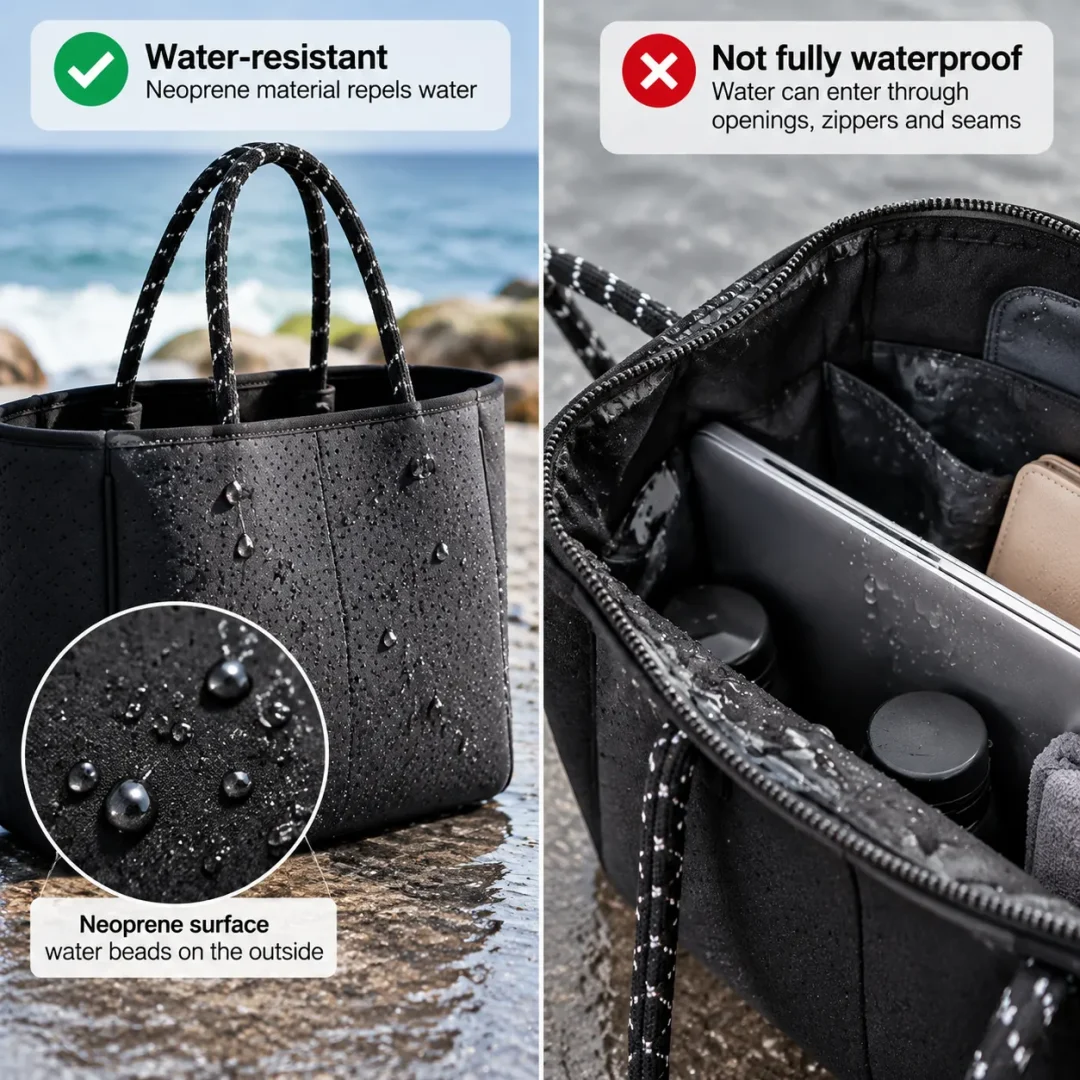
Most arguments about neoprene bags are really arguments about vocabulary. Three words get used interchangeably in product copy, and they carry three very different obligations.
What each word actually requires
Table 2 — Three terms, three obligations
The important part is the last row. Waterproof is the only one of the three that requires a test under pressure and across a duration — which is exactly why a bag can pass a “we sprayed it and nothing happened” demo and still fail the moment you set it on wet ground or leave it in real rain. A manufacturer-published rating scale frames the tiers this way, from weakest to strongest:
under 1,000 mm H₂O — water-resistant only · 1,000–5,000 mm — waterproof in light rain · 5,000–10,000 mm — heavy rain protection · over 10,000 mm — full submersion capable
Note what that scale implies: “water-resistant only” and “waterproof” can describe the same bag at different points on the same measurement. The word is a slot on a scale, not a property that either exists or doesn’t.
Why two pages can both say “water-resistant” and still disagree
Because “water-resistant” is a category, not a number — and published numbers for the same property diverge sharply. Across the sources reviewed for this guide, the water absorption figure for closed-cell neoprene was given as:
- less than 5% (materials supplier guidance)
- less than 2% (manufacturer-published comparison table)
- less than 1.5% (same manufacturer’s separate 24-hour immersion table)
One manufacturer’s page even carried two different ceilings for the same property in two different tables. None of the three stated a test standard alongside the figure.
That is not a reason to distrust neoprene. It is a reason to change what you ask for. When a supplier says “water-resistant”, ask which test, at what pressure, for how long. A number without a method is a mood, not a specification. (If you want the underlying material science rather than the buying advice, see what a neoprene bag is made of, and how its foam core is structured.)
3. Four paths water actually takes into a bag
This is the part of the question that decides real-world performance, and it is the part most product pages skip.
Path 1 — Seams: every stitch is a hole
A stitched seam is a series of punctures. Manufacturer’s material guides state it without decoration:
“Every stitch creates a tiny hole… The neoprene itself remains a waterproof barrier, but the construction method can create potential leak points.” — manufacturer-published guide, accessed October 2026
There are four seam types used on neoprene bags, and they sit in a clear order of water resistance:
Table 3 — Seam types, ranked by water resistance
Two practical notes. First, glued and blindstitched is the seam most people are actually looking for when they say “waterproof neoprene” — it is the wet-suit seam, and it handles weather without looking industrial. Second, the only construction-layer measurement found in public sources during this review was a stitched, unsealed seam beginning to leak at 0.4 bar (roughly 4,000 mm H₂O), against 1.2 bar for the base foam it was sewn from — i.e. the seam failed at about a third of the pressure the material itself withstood. It was manufacturer-published test data with no standard or report number attached, so treat it as an illustration of the ratio rather than a certified figure. The ratio is the point: the material is rarely the weak link. The stitch line is.
Path 2 — Zippers: the weakest link
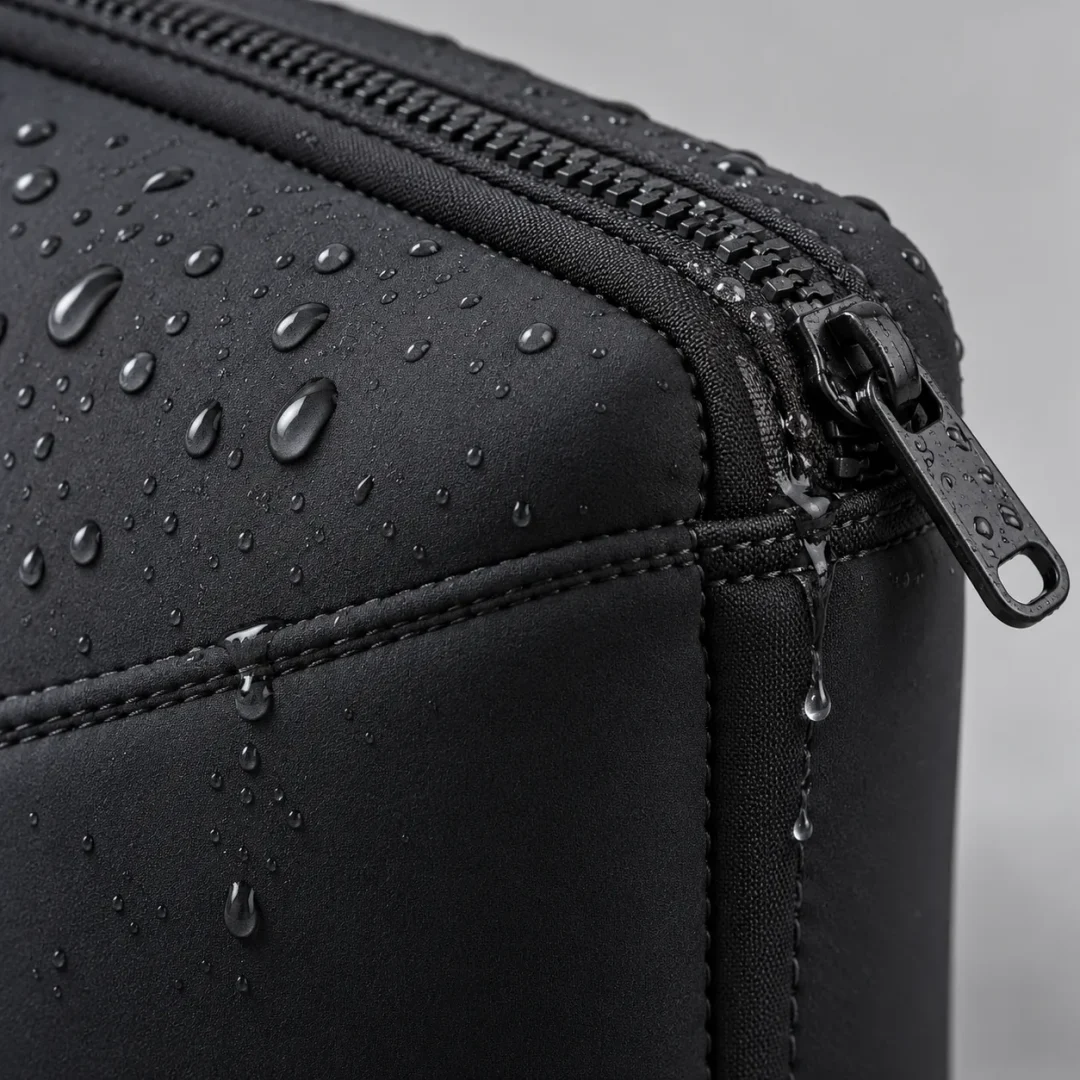
On a zippered neoprene bag, the zipper is usually the first thing to let water in, for the simple reason that the gap between two rows of teeth is a gap. Manufacturers describe three zipper tiers:
Table 4 — Zipper tiers on neoprene bags
Two details worth asking about, because they are cheap upgrades that are frequently omitted:
- Zipper garage or storm flap — a fold of fabric that covers the teeth, so wind-driven water is not pushed directly into the closure.
- Reverse coil — the coil faces inward, so the flat side presents to the weather.
There is a blunt confirmation of the zipper problem from the supply side itself: one retail neoprene lunch tote’s own product description instructs users to “keep it upright on flat surfaces to avoid liquid seeping through the zipper.” When a listing is titled waterproof and its own copy tells you to keep it upright so liquid doesn’t seep through, believe the second sentence, not the first.
Path 3 — Openings: the shape of the top matters more than the fabric
An open-topped bag is an open vessel. Neoprene’s water resistance does nothing for a bag that has a hole the size of your forearm facing the sky — and manufacturer guides say so directly:
“In contrast, drawstring bags, open totes, or wide-mouth designs allow water to enter easily, regardless of material quality.” — manufacturer-published guide, accessed October 2026
Ranked from most to least exposed, the closure types you will meet on neoprene bags are:
- Open top / wide mouth — the classic neoprene tote, wind and rain enter freely; fine for sand, not for rain
- Folded or overlapping flap — reduces splash entry, not rain driven sideways
- Fermeture éclair standard — closes the top, but leaves the zipper as the new weak point
- Zipper + storm flap or garage — closes the top and shields the closure
- Roll-top — folds over itself several times and buckles shut; no direct path in
- Hermetic / sealing closure — used on true dry bags, generally with welded seams rather than stitching
Path 4 — Deliberate holes
Neoprene totes are frequently sold with laser-cut perforations — the small dots across the panel that add breathability and texture. Manufacturers are refreshingly candid about the consequence:
“If there are literal holes in the bag, water will obviously get in.” — manufacturer-published guide, accessed October 2026
This is a genuine case of a design decision overriding material properties, and it is the one path a buyer can assess with no technical knowledge at all: hold the bag up to a light. If you can see the light through the panel, you can see the rain through it too.
4. The numbers behind “waterproof”: what exists, and what nobody publishes
If you want to buy on evidence rather than adjectives, this section is the one to read closely — including the part where the evidence runs out.
Hydrostatic head (mm H₂O): how to read the number
Water resistance in rain-facing gear is usually expressed as hydrostatic head, in millimetres of water column (mm H₂O): the height of water the material can hold back before it starts to pass through. Some suppliers quote it in bar instead. The two units are convertible — 1 bar is very roughly 10,000 mm H₂O — which is useful, because published figures for neoprene appear in both and look far apart until you put them on the same scale.
For reference, here is how one manufacturer’s published rating scale maps the number to a real-world promise:
Table 5 — Hydrostatic head, and what each band actually means
A specification note from the same published guidance: for a bag intended to be genuinely rain-proof, the lining should be rated over 10,000 mm H₂O. That is the number to ask for — not the word.
Now the gap. Across the industry pages, material guides and manufacturer comparisons reviewed for this guide, not one published a hydrostatic head figure for a finished neoprene bag. Not a tote, not a lunch carrier, not a sleeve. The only neoprene construction figures found anywhere in public sources were the two internal manufacturer test results mentioned in section 3, quoted in bar without a stated standard:
- base 4 mm closed-cell CR foam, unnotched: resisted to 1.2 bar (roughly 12,000 mm H₂O)
- the same foam with stitched, unsealed seams: began to leak at 0.4 bar (roughly 4,000 mm H₂O)
Read those two together and you have the single most useful number pair in this whole article: the material clears the >10,000 mm bracket; the ordinary stitched seam drops the assembly below the 5,000 mm line. If you are buying on data, the seam is where your money goes.
Water absorption: neoprene vs the fabrics it replaces
Absorption is the other published figure, and it is where sources disagree most.
Table 6 — Published water absorption figures (as published; no standard cited by any source)
Two cautions before you use these numbers in a conversation with a supplier.
First: immersion absorption and spray shedding are different tests. All of the figures above describe what happens when the material sits in water. They do not describe what happens in the 30 seconds after rain hits it — which is the situation your bag actually faces. And on that test, recall what independent spray testing found: neoprene absorbs rather than sheds. So a neoprene bag can score well on absorption and still behave like a wet sponge on the surface. Both things are true at once.
Second: the closed-cell figures disagree by a factor of more than three (under 1.5%, under 2%, under 5%), and one of the sources contradicts itself in two adjacent tables. Treat any single absorption number as indicative, and ask for the test method — immersion time, temperature, and whether the sample was laminated.
Thickness: 2 mm, 3 mm, 4–6 mm — what actually changes
Thickness is the specification buyers ask about most and understand least. Published manufacturer guidance across the sources reviewed is consistent:
- 2–3 mm — lighter, more flexible, still water-resistant; the common range for totes, sleeves and cosmetic cases
- 3–5 mm — a middle band frequently quoted for totes, giving structure as well as water resistance
- 4–6 mm — heavier, better structure, and described by manufacturers as slowing moisture penetration
Read that last phrase precisely. Thicker neoprene does not make a bag waterproof; it makes the panel stiffer, more protective, and slower to let moisture work through. Thickness buys you structure and time. Seam type and zipper type buy you water-tightness. If a supplier answers a waterproofing question with a thickness number, you have been given the wrong answer to your question.
Why an IPX rating doesn’t apply to a bag
You will occasionally see bags advertised with an IP or IPX rating — IPX4, IPX7 and so on. The IP code system describes ingress protection for enclosures of electrical equipment. It is not a textile or bag standard, and it does not have a defined test path for stitched foam panels.
In the 17 pages of competitor, material-supplier and manufacturer content reviewed for this guide, not one gave an IP or IPX figure for a neoprene bag — and the world’s dominant product listings still print them. That is a genuine red flag rather than a technicality: an IP rating on a fabric bag is usually a borrowed number with no test behind it.
The practical test: ask which standard the rating was tested to, and who tested it. A real waterproof specification will name a test, a pressure and a duration. A borrowed label will name none of the three.
5. What independent water testing actually shows
Everything above is published data supplied by manufacturers and materials sellers — people with an interest in the outcome. Here is what happens under someone else’s hose.
The most useful third-party evidence available on neoprene’s water behaviour comes from a comparative laptop-sleeve test published in March 2023, in which ten sleeves were purchased and tested by hand. Three findings matter for this article:
- The neoprene sleeve absorbed the spray. Its listed weakness was, verbatim, “Absorbs water rather than sheds it.”
- The lining still protected the contents. In the reviewer’s own words: “When sprayed with water, the case absorbed it, but this is how neoprene is supposed to behave, and the lining protects the inside from getting wet (unless you put the case in a puddle of water).”
- Materials that perform differently behave visibly differently. In the same test, on the same method, a polyurethane sleeve shed water “like a duck” and a polyester case shed water “with ease”.
Three conclusions follow directly, and they set the realistic expectation for any neoprene bag:
- Water-resistant, not water-repelling. The material’s behaviour under spray is absorption followed by release. It is not a coating that throws water off.
- The lining is doing real work. In that test, the interior stayed dry at spray level — which is a strong argument for buying a neoprene bag with a proper lining rather than a bare foam shell. See what neoprene bags do well and where they fall short if you are weighing up materials.
- Immersion is a different regime. The one condition the tester explicitly carved out was standing water. Spray-level resistance and puddle-level resistance are not the same property.
6. What brands’ own care pages reveal
If you want to know whether a brand believes its neoprene bag is waterproof, do not read its marketing page. Read its care page — and specifically, read what it says about water.
They submerge the whole bag — and they worry about water rings
A leading neoprene bag brand’s official care page gives cleaning instructions that would never appear on a genuinely waterproof product:
“To avoid water ring stains, don’t just spot treat. Instead, hand wash your neoprene bag by applying a mild soap directly onto the stain. Fully submerge the entire bag in cold water (yep, dunk it), then gently work the stain and soap out…” — brand care page, accessed October 2026
Two things follow from a single sentence. The material is immersed completely as a cleaning method — meaning the brand treats it as a washable fabric, not a sealed membrane. And the brand’s stated worry is water ring stains — a problem that only exists for materials that absorb water and then dry unevenly.
The same page adds: “Reshape when wet. Lay flat to dry on a clean, non-porous surface,” et “Don’t overexpose to light, heat, or water.”
That is the honest picture of neoprene in official hands: a material to be washed, shaped while wet, dried flat, and protected from prolonged water exposure.
“Machine washable” is not “waterproof”
Another brand’s care page labels a neoprene tote “machine washable in cold water” and advises hanging it on a coat hanger to dry after washing.
Machine-washable is a care claim. Waterproof is a performance claim. A product that survives the machine has demonstrated durability in water — not resistance to water from outside. These two ideas are routinely blurred in listing copy, sometimes within the same paragraph: a single product page can carry “waterproof” in the title, “100% waterproof” in the bullet points, and “water resistant” in the details, as one marketplace listing reviewed for this article does.
Rain and hardware: the limits brands admit
The third useful signal is subtler. A neoprene bag brand’s care page (published on its Japanese site; translated here) warns customers not to soak the bag for long periods in water or detergent, because it can damage the press snap — and notes that dark-coloured models can transfer colour onto other items through sweat, friction or rain.
Both warnings are quietly informative. The brand is treating water as a hazard to the hardware and to the dye, not as something the bag defeats. When a manufacturer’s own instructions tell you that rain is a colour-transfer risk, the “waterproof” claim on the product card is doing a lot of work that the engineering does not support.
7. “100% waterproof” claims vs what buyers actually report
This is the part of the picture that marketing copy cannot reach: what happens after people have owned the bag for a month.
A neoprene lunch tote reviewed for this article illustrates the pattern precisely. Its marketplace listing is titled “Waterproof Cooler Bag”, its bullet points promise a lining that is “leak-proof, 100% waterproof”, and its specification field lists “waterproof”. Its own product description then adds the qualifier:
“For best results, keep it upright on flat surfaces to avoid liquid seeping through the zipper.”
Table 7 — What the label says vs what owners report
Notice where every single complaint lands: seams, zippers, linings. Not one review of the material itself described the neoprene absorbing through and soaking the contents. The material is doing its job; the assembly is not. That is exactly the picture the independent spray test and the care pages painted, arrived at from a completely different direction.
One further, cautious signal: that listing is flagged by the platform as a “frequently returned item.” That flag is a routing notice, not a statistic — it should be read as one more indication that the claims and the reality are misaligned, and nothing more precise than that.
If you take one habit away from this section, take this one: read the one-star reviews before the marketing page, and read them looking for the words “seam”, “zipper” and “lining”. Those three words tell you which specification to interrogate before you buy.
8. Does it keep water out — or keep water in?
There is a second half of this question that almost nobody separates out, and it causes most of the disappointment in both directions.
Neoprene bags are asked to do two opposite jobs:
- Keeping water out — rain, spray, a wet bench, a splash from the side. This is an outer shell and closure problem, solved by seam type, zipper tier and closure design.
- Keeping water in — a leaky lunch container, a sweating drinks bottle, wet swimwear after a session, a broken bottle of wine. This is a lining and interior seam problem, solved by the lining material, whether the interior seams are sealed, and whether the interior is wipe-clean.
These two jobs need different parts of the bag to work, and a design that is excellent at one can be mediocre at the other. A roll-top dry bag with welded seams keeps rain out brilliantly and is miserable to get in and out of at a picnic. A soft-lined lunch tote with a wipe-clean interior handles a spilled soup beautifully and has no defence against a downpour.
Before you buy, decide which of the two you actually need — then check the specification for that half only. If a supplier answers your rain question with interior lining details, or your leak question with seam-taping details, they are selling you the other half of the problem.
9. Real-world scenarios: what to expect
The same bag can be the right choice on a beach and the wrong choice on a rainy platform. Here is what neoprene realistically delivers, scenario by scenario, and what has to be true of the construction for each to hold.
Table 8 — Neoprene bags by scenario
If you are choosing between neoprene and another material for a specific use, the honest comparison is on the seam and closure spec, not on the fibre name. For the adjacent product decision — keeping food and drinks cool and keeping spills contained — the build is a different one again: see our insulated cooler bag range.
10. If you need real waterproofing: the five specs to ask for
If your requirement is genuinely water-tight — ocean-facing retail, cooler and wine carriers, tech travel bags, marine accessories — you will not get there by choosing a fabric. You get there by writing a five-part specification.
Table 9 — The five-part waterproofing specification
The most important habit in this whole guide sits in row five. Ask for the test, not the word. A specification you can verify looks like this: seam type named, zipper grade named, lining rated in mm H₂O, and a seam leak test at a stated pressure for a stated duration.
There is a second habit that saves arguments later, and it applies to how you write the enquiry itself: state the material claim and the finished-product claim separately. “4 mm closed-cell CR neoprene” and “finished bag resists 5,000 mm H₂O at seams” are two different requests, and suppliers who can answer both are the ones worth talking to. If you are sourcing custom neoprene bags at volume, the same five-part spec is the fastest way to get comparable quotes — you can see our own range and enquiry route at custom neoprene bags.
11. Keeping water resistance from fading
Water resistance on a neoprene bag is not a coating that wears off the way a DWR finish does. What degrades is structure: seams loosen, linings tear, hardware corrodes, and the panel surface scuffs. Care is therefore mostly about not damaging the assembly.
Drying. Expect it to take real time. Published manufacturer guidance puts neoprene drying at “a few hours to even a full day to dry depending on thickness and moisture levels in the air” — the opposite of the “quick-drying” claim that appears in most retail copy, and consistent with the material’s absorb-then-release behaviour described in section 5. Air-dry, open, away from direct heat. Do not use a dryer, a radiator, or a hairdryer; heat is the one thing that genuinely damages chloroprene.
Reshaping while wet. Brand care pages are consistent on this: reshape the bag while it is still damp and lay it flat to dry on a clean, non-porous surface. Skip this step and a wet neoprene bag can dry with creases and a distorted silhouette.
Rinsing after salt and sand. Fresh water, quick rinse, air dry. Sand trapped in a seam works at the thread like an abrasive.
Avoiding prolonged soaking. This is about the metalwork, not the foam. Press snaps, zipper pulls and rivets are the components most likely to suffer from a long soak, and at least one brand’s care page warns specifically against it.
No machine washing unless the maker allows it. Some brands explicitly allow a cold machine wash on neoprene totes; others explicitly warn against putting their neoprene bags in a washing machine or dryer. There is no industry-wide answer — follow the care label for your specific bag, because a drum cycle works on seams and coatings in ways that hand washing does not.
No ironing or steam. High heat can melt the synthetic rubber component, causing the material to harden or warp. Wrinkles on neoprene are best handled by hanging the bag and letting it relax.
12. Buying checklist
Take this list to any product page or supplier conversation, and ask the eight questions in order:
- Ask the seam type.Flatlock, glued-and-blindstitched, taped, or welded? (If the answer is “sewn”, ask whether the needle holes are sealed.)
- Ask the zipper tier.Standard coil, coated water-resistant, or dry zipper — and is there a garage or storm flap over it?
- Ask about the closure.Open top, flap, zipper, or roll-top? An open tote is an open vessel.
- Hold it up to the light.If you can see through laser-cut perforations, rain will find them too.
- Ask for the lining.Bare foam, or a laminated waterproof lining with a wipe-clean finish?
- Ask for one number.A hydrostatic head figure in mm H₂O, with the pressure and duration it was tested at.
- Decide which half you need.Keeping rain out, or keeping spills in? Specify the half that matters.
- Read the one-star reviews first.Look specifically for “seam”, “zipper” and “lining”.
13. Frequently asked questions
Are neoprene bags 100% waterproof? No. Neoprene as a material is water-resistant, and a finished neoprene bag is only waterproof if its seams, zipper and closure are specifically built for it. Manufacturer-published guides state that a finished neoprene bag is “almost never 100% waterproof” unless it is designed and constructed to be so.
Can water get inside a neoprene bag? Yes, and it will almost never come through the neoprene sheet. Water enters through four routes: the needle holes in stitched seams, the gaps in a zipper, the opening itself, and any deliberate laser-cut perforation.
Will my things stay dry in the rain? In light rain and short exposure, yes — with any closure at all. In heavy or prolonged rain, no, unless the bag has taped or welded seams et a waterproof zipper. Independent spray testing found neoprene absorbs water rather than shedding it, and that a lined sleeve kept its contents dry at spray level but not in standing water.
Do neoprene bags absorb water? The material absorbs and then releases, rather than repelling. Published absorption figures for closed-cell neoprene range from under 1.5% to under 5% by weight in immersion testing — and the sources disagree with each other, so ask for the test method. For comparison, published figures for cotton and canvas sit at 20–50%+.
Are neoprene lunch bags waterproof inside? That is a different property from rain resistance, and it depends on the lining and its seams rather than on the neoprene. Buyer complaints about neoprene lunch bags cluster on torn interior linings and liquid seeping through the zipper — not on moisture passing through the foam.
Do neoprene bags dry quickly? Slower than the marketing suggests. Published guidance puts it at a few hours to a full day depending on thickness and humidity. Reshape the bag while damp and dry it flat, away from heat.
What thickness is best for rain? Thickness changes structure and how quickly moisture works through, not whether the bag is waterproof. Two to three millimetres is lighter and still water-resistant; four to six millimetres gives more structure and slows penetration. Seam and zipper type decide water-tightness.
Can a neoprene bag be submerged? An ordinary one, no. A dry-bag construction with welded seams and a roll-top or sealing closure can, and that is a different product from a fashion neoprene tote even when both use neoprene.
Does machine washing ruin the water resistance? Machine washing works on seams and coatings in ways hand washing does not, and brands differ: some allow a cold machine cycle on neoprene totes, others explicitly warn against the washing machine and dryer. Follow the care label for your specific bag, and never use heat to dry it.
Is there an IP or IPX rating for neoprene bags? No. The IP code system describes ingress protection for electrical enclosures, not fabric bags, and no neoprene bag reviewed for this guide carried a tested IP figure despite the ratings appearing in listings. If you see one, ask which standard it was tested to and who tested it.
14. Conclusion
Neoprene is a water-resistant material — genuinely so, and better than cotton or canvas in the ways that matter on a wet day. It is not a waterproof material, and a bag made from it is not a waterproof bag unless somebody deliberately built it that way.
The useful version of the answer is therefore not a yes or a no, but a short list: check the seam, the zipper, the closure and the lining, and ask for one number in millimetres of water column. Everything else about neoprene bags — how long they last, how they dry, whether they survive a downpour — follows from those four components and that one measurement.
If you are specifying neoprene bags for retail and need a water-tight build rather than a water-resistant one, the five-part specification in section 10 is the fastest way to get comparable answers from suppliers — and it is the version of the question our own team prefers to receive.

 French
 English
 German
 Japanese
 Arabic
 Thai
 Vietnamese
 Russian
 Spanish
 Portuguese