
Wet bags and dry bags both deal with water, but they are designed to solve opposite problems.
A wet bag isolates damp, sweaty or soiled items from everything around them. A dry bag protects its contents from rain, splashes and other external water exposure.
That distinction sounds simple, but it does not mean a wet bag can only hold wet items or that every dry bag is safe to submerge. A dry bag can also be used to transport wet clothing, while a wet bag may provide limited protection for dry belongings. The real difference lies in the product’s intended use, closure, seams and expected level of water exposure.
This guide compares wet bags and dry bags by function, construction, materials and practical use so you can choose the right option for swimming, travel, gym visits or outdoor activities.
Wet Bag vs Dry Bag at a Glance
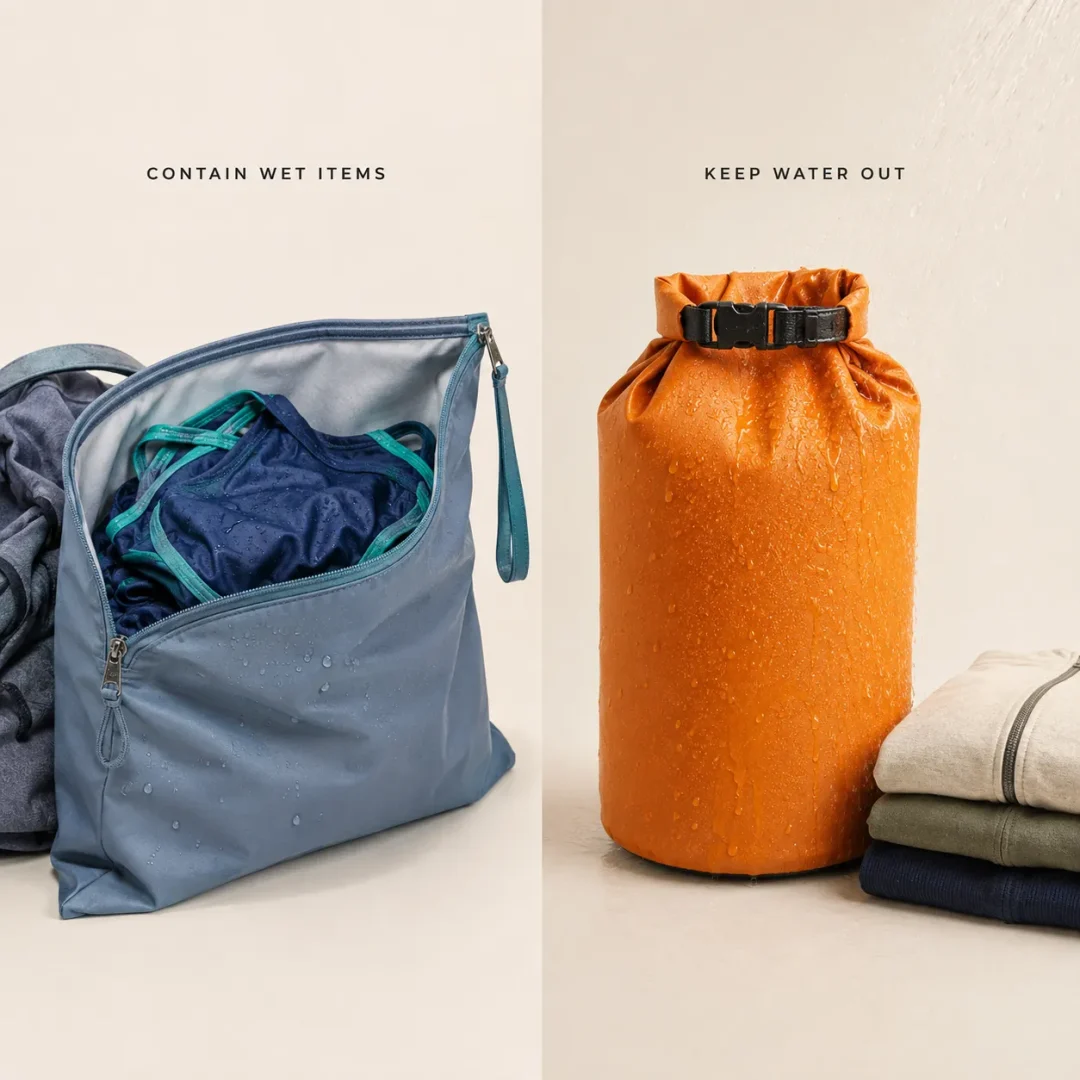
| ميزة | Wet Bag | Dry Bag |
|---|---|---|
| Primary purpose | Isolate damp, dirty or sweaty items | Protect contents from outside water |
| Typical contents | Swimwear, towels, diapers, gym clothes | Electronics, dry clothing, food, outdoor gear |
| Common environment | Pool, gym, daycare, suitcase | Kayaking, boating, camping, heavy rain |
| Typical closure | Zipper, snap or drawstring | Roll-top buckle or waterproof zipper |
| Seam construction | Usually sewn; sometimes taped or welded | Commonly welded, taped or otherwise sealed |
| Typical shape | Flat or lightly gusseted pouch | Cylindrical sack or structured waterproof bag |
| Main design priority | Lightweight separation and easy cleaning | External water protection |
| Usual water exposure | Damp contents and minor leakage | Rain, splashing and, for suitable models, temporary immersion |
| Common materials | PUL, TPU-laminated polyester, coated fabric | PVC-coated fabric, TPU-coated nylon or polyester |
| Cleaning needs | Frequent washing or wiping | Rinsing after exposure to salt, mud or outdoor conditions |
The easiest way to remember the difference is:
A wet bag manages items that are already wet. A dry bag protects items that need to remain dry.
What Is a Wet Bag?
A wet bag is a reusable pouch designed to temporarily separate damp, sweaty or soiled items from clean belongings.
It is commonly used for:
- Wet swimsuits
- Swim caps and goggles
- Damp towels
- Cloth diapers and soiled baby clothing
- Sweaty workout clothes
- Reusable hygiene products
- Dirty laundry during travel
- Toiletry bottles that may leak
Most wet bags are lightweight and flexible enough to fit inside a backpack, diaper bag, beach tote or suitcase. A basic version may have one zippered compartment, while a wet-dry bag normally includes a second section for clean or dry items.
Because wet bags frequently come into contact with moisture, they are usually made with coated or laminated materials that can be wiped or washed. Common options include PUL, TPU-laminated polyester and coated nylon.
However, the term “wet bag” does not guarantee that the finished product is completely leakproof.
A sewn wet bag may use waterproof fabric, but water can still escape through the zipper, needle holes or attachment points. For that reason, many everyday wet bags are better suited to damp or wrung-out items than clothing that is still dripping heavily.
What Is a Dry Bag?
A dry bag is designed to prevent outside water from reaching its contents. It is commonly used during:
- Kayaking and canoeing
- Boating and fishing
- Camping and hiking
- Beach and water-sports activities
- Heavy rain
- River crossings
- Outdoor equipment transport
Dry bags frequently carry clothing, food, sleeping gear, phones, cameras and other items that need protection from water.
Unlike a typical zippered wet bag, a traditional dry bag commonly uses a roll-top closure. The user presses the opening flat, rolls it down several times according to the product instructions and fastens the ends with a buckle.
Rolling the opening creates multiple folded layers that make it more difficult for water to enter. The bag body is also commonly joined using welded or sealed seams rather than exposed ordinary stitching.
If you want a broader explanation of its formats and applications, read our guide on what a dry bag is and how it works.
Does Every Dry Bag Withstand Submersion?
لا.
“Dry bag” describes a product category, not a universal waterproof rating. Some lightweight dry sacks are designed mainly to protect gear inside a backpack from rain and moisture. More technical models may withstand heavy splashing or temporary immersion when properly closed.
Performance depends on:
- The body material
- Seam construction
- Closure design
- Correct closing procedure
- Condition of the bag
- Depth and duration of water exposure
- The manufacturer’s tested protection level
Unless a product has been specifically tested and rated for submersion, it should not automatically be trusted to protect electronics underwater.
The Main Differences Between Wet Bags and Dry Bags
1. They Manage Water in Opposite Directions
The defining difference is where the water is expected to come from.
A wet bag expects moisture to come from its contents. Its purpose is to isolate a wet swimsuit, damp towel, sweaty shirt or soiled diaper from the rest of the user’s belongings.
A dry bag expects moisture to come from outside. Its purpose is to prevent rain, spray or surface water from reaching clean clothing and equipment.
This does not create a strict rule about what can be placed inside each bag. A dry bag can hold a wet wetsuit, and a wet bag can carry dry accessories on an ordinary day. The difference is the performance goal around which the product was designed.
2. Their Closures Work Differently
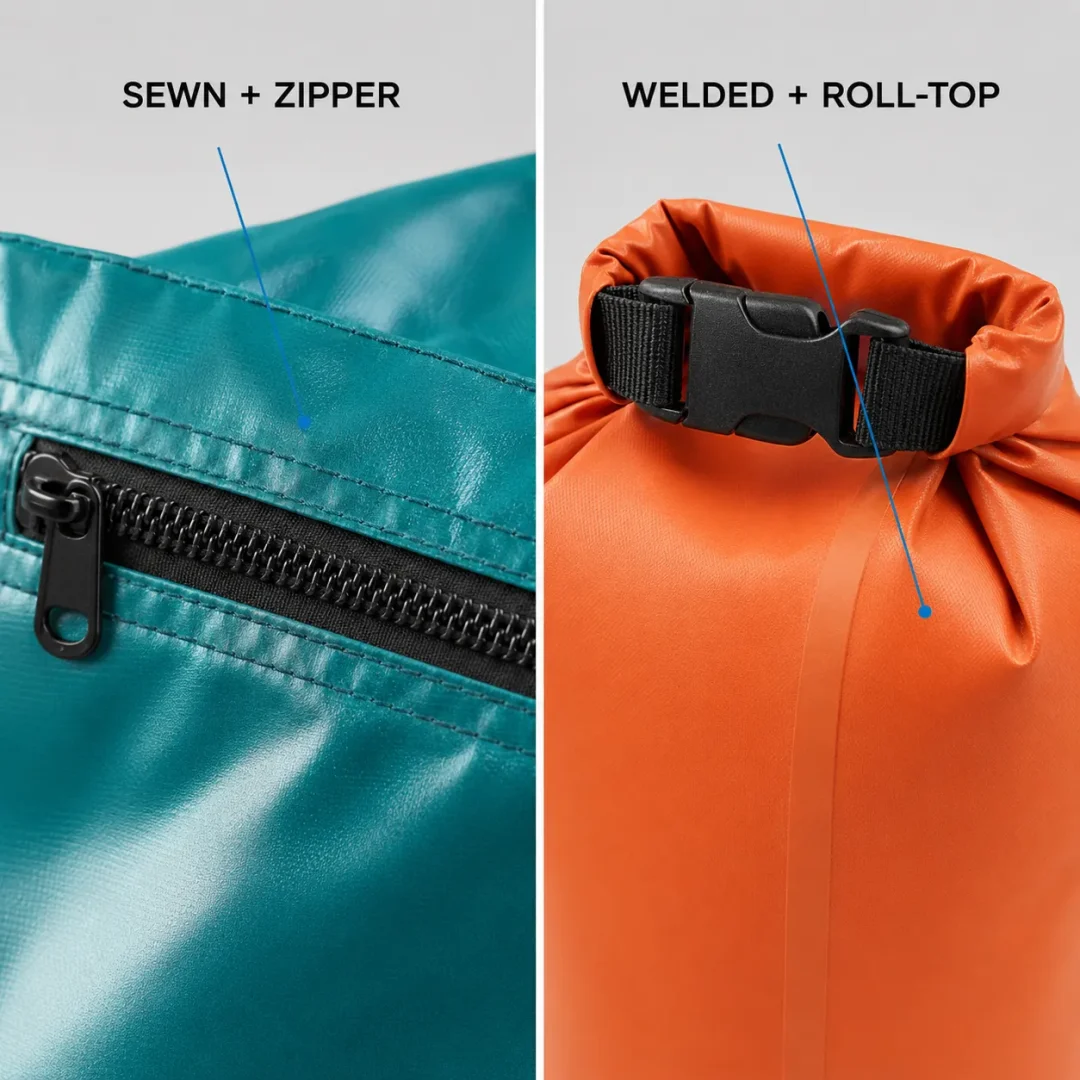
Most everyday wet bags use zippers because they provide quick access and allow the pouch to remain compact.
The zipper may be:
- A standard coil zipper
- A reverse-coil zipper
- A water-resistant coated zipper
- A specialized waterproof zipper
A standard zipper is convenient, but spaces around the teeth and slider can allow moisture to pass. A coated zipper offers better splash resistance but should not automatically be described as watertight.
Most traditional dry bags use roll-top closures. When properly folded and buckled, the opening provides a longer and more complicated path for water to enter.
Roll-top closures also adapt to different load sizes. However, they require enough unused material at the top to form the necessary folds. An overfilled dry bag may not close correctly, which reduces its ability to protect the contents.
3. Their Seams Have Different Performance Expectations
Conventional sewing joins fabric with a needle and thread. Even when the main material is waterproof, the needle creates small holes.
These holes may not matter when carrying a swimsuit that has been wrung out. They become more important when the bag is exposed to standing water, pressure or prolonged heavy rain.
Manufacturers may improve seam protection through:
- Seam tape
- Liquid seam sealant
- Hot-air seam sealing
- High-frequency welding
- Heat welding
- Ultrasonic welding
Welded construction joins compatible coated materials without creating a continuous line of needle holes. This is one reason it is commonly used for dry bags and other products requiring stronger water protection.
Welding does not automatically make every finished bag submersible. The closure, corners, valves, handles and attachment points still need to match the required performance.
4. Wet Bags Prioritize Flexibility and Cleaning
A wet bag is often carried inside another bag rather than used as the main piece of luggage. It therefore benefits from being:
- خفيف الوزن
- Foldable
- Easy to open
- Easy to rinse or wipe
- Quick to air-dry
- Compact when empty
Excessive padding, cardboard reinforcement and complicated internal pockets can trap moisture and make a wet bag more difficult to clean.
A wrist loop or snap handle is also common because it allows the wet bag to hang from a stroller, locker hook, changing table or bathroom rail.
5. Dry Bags Prioritize External Protection
A dry bag may be exposed to rain, rough ground, boat decks, sand and outdoor equipment. Its design is therefore more likely to prioritize:
- Waterproof seam construction
- Abrasion and puncture resistance
- Reliable closure
- Reinforced attachment points
- Carrying straps
- Visibility in outdoor environments
- Stable performance under repeated folding
Some lightweight dry sacks are intended to organize equipment inside a larger backpack. Heavier dry bags may function as standalone gear carriers with shoulder straps or handles.
6. They Use Capacity Differently
Wet bag sizes are commonly understood according to their contents:
- A small pouch for swimwear or reusable hygiene products
- A medium bag for several diapers or a gym outfit
- A larger bag for towels, family swimwear or travel laundry
Dry bags are more frequently sold by volume in liters. Capacity may range from a compact pouch for a phone and wallet to a large bag for clothing, camping equipment or boating gear.
A stated volume does not tell the whole story. A roll-top dry bag loses some usable height because space must remain available for closing. Wet bags may also become difficult to zip if bulky towels press against the opening.
Are Wet Bags and Dry Bags Completely Waterproof?
Some can provide strong waterproof performance, but the product name alone is not sufficient evidence.
The performance of either bag depends on the complete construction:
| Component | What to Check |
|---|---|
| Main material | Whether water can pass through the bag body |
| Seams | Whether they are sewn, taped, sealed or welded |
| الإغلاق | Standard zipper, resistant zipper, waterproof zipper or roll-top |
| Corners | Whether folds and joins create potential leakage points |
| Attachments | Whether handles, straps, labels or pockets penetrate the main body |
| Testing | Whether the finished bag has been tested for its intended exposure |
Water-Resistant
The bag can resist light splashes or brief moisture exposure but is not necessarily suitable for heavy rain or standing water.
Waterproof
The materials and construction are designed to prevent water penetration under defined conditions. Those conditions still need to be specified.
Leak-Resistant
The bag can reduce the escape of moisture from inside, but small amounts may still pass through the seams or closure.
Submersible
The product has been designed and tested for underwater exposure within stated limits.
These terms should not be treated as interchangeable. A bag made from waterproof PVC sheet, for example, may still leak if it has an ordinary sewn zipper. You can learn more about material construction in our guide to حقائب PVC.
Waterproof fabric does not automatically create a waterproof finished bag.
Can You Use a Dry Bag for Wet Clothes?
Yes. A dry bag can be used to carry wet clothing, and it may provide stronger containment than an ordinary wet bag.
This can be useful for:
- Dripping wetsuits
- Wet swimwear that cannot be wrung out immediately
- Large damp towels
- Muddy outdoor clothing
- Canyoning or paddling equipment
- Wet gear transported inside a vehicle
The roll-top closure and sealed seams can reduce the chance of moisture reaching the surrounding luggage.
However, a dry bag also has disadvantages for everyday wet clothing.
It is usually heavier and bulkier than a simple wet bag. The roll-top takes longer to open and close, and the low airflow traps moisture and odors inside. Wet items should therefore be removed as soon as practical.
A dry bag is a transport solution, not a suitable place to store wet clothes overnight or for several days.
After use:
- Remove all wet contents.
- Rinse away chlorine, salt, dirt or detergent residue if necessary.
- Wipe or drain the interior.
- Leave the bag fully open to air-dry.
- Store it only after both sides are dry.
Can You Use a Wet Bag to Keep Things Dry?
A wet bag may provide limited protection for dry belongings, but it should not automatically replace a dry bag.
Whether it works depends on the structure and the level of exposure.
| Situation | Is a Standard Wet Bag Suitable? |
|---|---|
| Bathroom splashes | Often sufficient |
| Toiletry bottle leaks inside luggage | Useful as secondary containment |
| Light rain while carried inside another bag | May be sufficient |
| Prolonged heavy rain | Not reliable without appropriate construction and testing |
| Kayaking or boating spray | Use a dry bag designed for the activity |
| Full or repeated immersion | Use a product specifically rated for submersion |
A simple wet bag may be convenient for carrying a dry change of underwear from a locker to a shower. It should not be relied upon to protect a phone during kayaking merely because its lining feels waterproof.
Which Bag Is Better for Swimming?
The better option depends on what you need to carry and how wet it will be.
For a Wrung-Out Swimsuit
A wet bag is normally the more convenient option. It is lightweight, easy to place inside a larger swim bag and suitable for the short journey home.
For a Dripping Wetsuit or Large Wet Towel
A small or medium dry bag may offer stronger containment. This is particularly useful when the bag will be carried inside a work backpack, suitcase or car where leakage would cause a significant problem.
For Clean Clothing, a Phone and a Wallet
Use a dry bag if these items may be exposed to rain, poolside splashes or outdoor water.
For Both Wet and Dry Items
Use two separate bags or a properly designed wet-dry bag. A waterproof compartment can hold the swimsuit, while another section carries goggles, toiletries or clean accessories.
Do not assume that the dry compartment is protected from external water in the same way as a technical dry bag. A wet-dry organizer is primarily designed to separate its own contents.
What About a Mesh Swim Bag?
A mesh bag solves a different problem.
It allows airflow and drainage, which can help swimming equipment begin to dry. However, water can easily pass through it and reach everything around the bag.
Choose:
- A mesh bag when ventilation and drainage are the priority;
- A wet bag when internal separation is the priority;
- A dry bag when stronger water containment or external protection is the priority.
أي واحدة يجب أن تختار؟
| Situation | Better Choice | Why |
|---|---|---|
| Wet swimsuit after a pool session | Wet bag | Lightweight and easy to carry |
| Dripping wetsuit | Dry bag | Stronger seam and closure construction |
| Cloth diapers or soiled baby clothes | Wet bag | Flexible, washable and convenient |
| Sweaty gym clothing | Wet bag | Separates used clothing from clean gear |
| Phone and camera during kayaking | Tested dry bag | Designed for external water protection |
| Dry clothing during heavy rain | Dry bag | Stronger closure and seam protection |
| Wet and clean items in one organizer | Wet-dry bag | Provides separate internal zones |
| Swim equipment that needs airflow | Mesh bag | Supports ventilation but not containment |
| Leak-prone toiletries in a suitcase | Small wet bag | Provides secondary spill containment |
| Large outdoor equipment | Dry bag | Available in larger, more durable formats |
If you are still unsure, ask five questions:
- Are you trying to contain wet items or protect dry items?
- Will the contents be damp, dripping or sitting in free liquid?
- Will the outside of the bag face rain, splashing or immersion?
- Is compact convenience or stronger protection more important?
- How soon can the contents be removed and dried?
Materials Used for Wet Bags and Dry Bags
The same material family can appear in both products. Its use and construction may differ.
| المادة | Wet Bag Application | Dry Bag Application |
|---|---|---|
| PUL | Flexible, washable body or lining | Less common in technical outdoor dry bags |
| TPU-laminated polyester or nylon | Soft wet bag, lining or wet compartment | Lightweight welded dry bag |
| PVC-coated fabric | Wipe-clean wet-item pouch | Heavy-duty outdoor dry bag |
| Coated polyester | Everyday swimming or gym wet bag | Lightweight dry sack when seams are appropriately sealed |
| PEVA or EVA | Soft lining or simple moisture-resistant pouch | Limited use in technical dry bags |
| Ripstop nylon with coating | Lightweight wet-item organizer | Pack liner or ultralight dry sack |
PUL
PUL is commonly associated with diaper wet bags, swim pouches and reusable hygiene products. It can offer a useful balance of flexibility, low weight and moisture resistance.
Its finished performance still depends on whether the coating or membrane faces inward or outward, how the seams are constructed and how the closure is attached.
TPU-Laminated Fabric
TPU can be laminated to polyester or nylon to create a flexible waterproof barrier. Depending on the textile and laminate system, it may support sewing, seam taping or welded construction.
It is used in both lightweight wet bags and more technical dry bags.
PVC-Coated Fabric
PVC-coated fabric is commonly used when durability, wipe-clean performance and weldability are priorities. It can be heavier and stiffer than lightweight PUL, making it more suitable for robust dry bags than compact everyday wet pouches.
Material selection should follow the actual use case rather than the product name.
What Is a Wet-Dry Bag?
A wet-dry bag is usually an organizer with separate compartments for wet and dry contents.
For example, it may include:
- One laminated compartment for swimwear or used clothing
- One separate pocket for clean accessories
- Independent zipper openings
- A carrying handle or hanging loop
This is not the same as a dry bag.
The “dry” section in a wet-dry bag means that it is separated from the internal wet section. It does not necessarily mean that the whole bag can protect its contents from heavy rain or immersion.
The quality of separation depends on:
- The material used between the compartments
- Whether the divider seams are sealed
- How the zippers are positioned
- Whether the wet section shares seam lines with the dry section
- How much water the wet items release
A mesh divider improves organization but does not contain moisture. A laminated divider provides better separation, although its stitched edges may remain possible leakage points.
For a comparison with another closely related travel product, see Wet Bag vs Toiletry Bag.
Design Considerations for Custom Wet Bags and Dry Bags
For brands and bulk buyers, “waterproof bag” is not a sufficiently precise product specification.
The bag should be developed around the actual contents, exposure and acceptable level of leakage.
For a Custom Wet Bag
Define:
- Whether the contents will be damp or dripping
- The type and quantity of items carried
- Single or wet-dry compartment construction
- Washing frequency
- Required drying speed
- PUL, TPU, PVC or coated-fabric preference
- Zipper type
- Handle, wrist strap or hanging loop
- Expected level of leak resistance
- Printing and logo requirements
A bag for one wrung-out swimsuit does not need the same construction as a bag intended to hold multiple soiled diapers or heavily wet fitness equipment.
For a Custom Dry Bag
Define:
- Expected rain, splash or immersion exposure
- Required capacity
- Roll-top or waterproof zipper closure
- Material thickness and abrasion requirements
- Welded or sealed seam construction
- Carrying handles, shoulder straps or backpack straps
- Attachment points
- Required test method
- Target product weight
- Branding and packaging
Adding conventional stitched pockets or strap anchors directly through the waterproof body can create leakage points. These features need to be considered during product development rather than added after the main bag has been designed.
Specify Performance, Not Just Terminology
Instead of requesting “a completely waterproof bag,” describe the real conditions:
- It must contain a wrung-out swimsuit for two hours inside a backpack.
- It must protect dry clothing from heavy rain.
- It will be exposed to continuous boat spray.
- It must tolerate brief accidental immersion.
- It will carry damp towels but no standing water.
These descriptions give the manufacturer a clearer basis for recommending materials, closures, seams and testing.
Final Verdict
Wet bags and dry bags both manage moisture, but they are optimized for different directions of water exposure.
Choose a wet bag when you need a lightweight, washable way to isolate damp swimwear, diapers, towels, toiletries or gym clothing.
Choose a dry bag when you need stronger protection against rain, spray or other water coming from outside the bag. It is generally the more appropriate option for boating, kayaking, camping and protecting sensitive equipment.
A dry bag can also carry wet clothing, especially when the contents are dripping or leakage would cause a serious problem. A wet bag may protect dry belongings from minor splashes, but it should not replace a tested dry bag in demanding outdoor conditions.
If you need both wet and dry storage in one product, choose a wet-dry bag with genuinely separate compartments. Always evaluate the complete construction—not just the material name or the word “waterproof” in the product description.
INITI develops custom wet bags, wet-dry organizers and waterproof storage bags for swim, fitness, baby-care, travel and outdoor collections. Materials, compartments, closures, carrying details and branding can be adapted to the product’s actual moisture and performance requirements.
Frequently Asked Questions
Is a wet bag the same as a dry bag?
No. A wet bag is primarily designed to isolate damp or soiled items, while a dry bag is designed to protect its contents from external water. They may use similar materials, but their closures, seams and expected performance are different.
Can I put wet clothes in a dry bag?
Yes. A dry bag can contain wet clothes and may offer stronger leak protection than a standard wet bag. Remove the contents promptly because a sealed dry bag traps moisture and odors.
Will a wet bag leak inside my backpack?
It may. Many wet bags resist moisture but use sewn seams and ordinary zippers that can allow water to escape. Wrung-out clothing is less likely to cause leakage than heavily dripping items.
Can a dry bag be fully submerged?
Only if the specific product has been designed and tested for submersion. A roll-top shape or waterproof fabric alone does not prove that the bag is safe underwater.
Is a wet bag or dry bag better for swimming?
A wet bag is normally sufficient for wrung-out swimwear and a short journey home. A dry bag may be better for dripping items, large wetsuits or situations where even minor leakage would damage other belongings.
What is the difference between a wet-dry bag and a dry bag?
A wet-dry bag separates wet and dry contents inside the same organizer. A dry bag protects its contents from water outside the bag. The dry compartment of a wet-dry bag is not necessarily suitable for heavy rain or immersion.
 Arabic
 English
 French
 German
 Japanese
 Thai
 Vietnamese
 Russian
 Spanish
 Portuguese