
Choosing a travel backpack involves three different measurements: how much it holds, how large it becomes when packed, and how much it weighs. A capacity label answers only the first question—and even that depends on how the manufacturer measures the bag.
For a starting comparison, consider roughly 20–30L for light packing and compact travel, or 30–40L when you need more clothing and equipment. A 40–45L backpack offers additional space but requires closer attention to packed dimensions and weight. None of these capacity ranges guarantees airline acceptance.
A carry-on backpack must meet the applicable airline’s size, weight, and baggage-entitlement rules when packed. Liters alone cannot establish whether it qualifies.
A common carry-on size published by several US airlines is 22 × 14 × 9 inches. Multiplying those dimensions produces a theoretical rectangular volume of approximately 45.4L. That calculation does not mean every 45L backpack fits, or that the permitted box provides 45.4L of usable packing space.
For travelers, the practical task is to match a packed bag to the itinerary. For brands, retailers, and wholesale buyers, it is to define capacity, finished dimensions, and loading conditions clearly before approving a sample.
How Backpack Volume Is Measured
Backpack capacity is normally expressed in liters or cubic inches. External dimensions are usually expressed in centimeters or inches. These figures describe related but different characteristics.
Liters, Cubic Inches, and Centimeters
One liter equals 1,000 cubic centimeters, or approximately 61.02 cubic inches.
| Nominal capacity | Approximate cubic inches | Cubic centimeters |
|---|---|---|
| 20L | 1,220 | 20,000 |
| 25L | 1,526 | 25,000 |
| 30L | 1,831 | 30,000 |
| 35L | 2,136 | 35,000 |
| 40L | 2,441 | 40,000 |
| 45L | 2,746 | 45,000 |
| 50L | 3,051 | 50,000 |
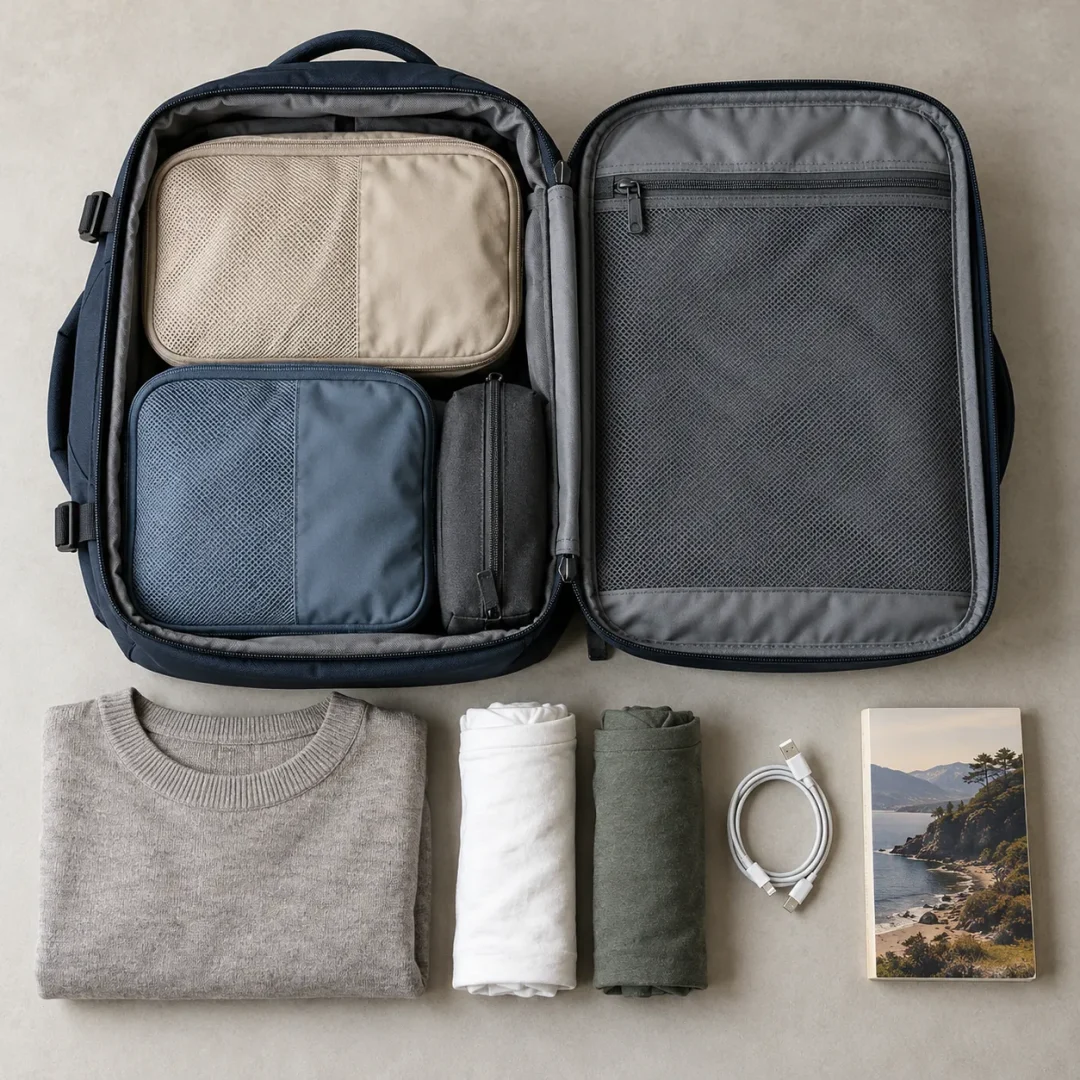
For a rectangular box, volume in liters can be calculated as:
Height × width × depth in centimeters ÷ 1,000
For example, 50 × 30 × 20cm gives 30L of rectangular volume. A backpack with these external measurements will not necessarily hold 30L of belongings. Curved corners, padding, lining, dividers, and the shape of the base all affect the space available inside.
Why Two 40L Backpacks Can Hold Different Amounts
Capacity figures are more useful when their measurement methods are known. Some manufacturers use a physical fill method; others calculate or estimate volume from compartment dimensions. Brands may also differ in which pockets they include.
ASTM publishes F2153, Standard Test Method for Measurement of Backpack Capacity. Its existence provides a reference for discussing measurement methods, but it does not establish that every backpack on the market has been tested to that standard.
When comparing products, ask whether the stated capacity includes the main compartment only, enclosed accessory pockets, expandable sections, or other storage areas. Also ask whether the number refers to the compressed or expanded configuration.
| المواصفات | What it helps describe | What it does not establish |
|---|---|---|
| Measured internal capacity | Packing space under the stated method | Whether the bag meets airline dimensions |
| External dimensions | The bag’s outside size in a stated condition | Usable internal capacity |
| External dimensions multiplied together | Volume of the surrounding rectangular box | Actual space inside a curved, padded backpack |
| Expanded capacity and dimensions | Additional space with the expansion section open | Compliance in the expanded configuration |
For custom orders, record the method alongside the result. A specification such as “capacity measured with the expansion zipper closed, including enclosed front pocket” is more useful than an unexplained liter figure.
Empty Dimensions Versus Packed Dimensions
A soft backpack can change shape when loaded. Clothing may push the main panel outward, a laptop can flatten and stiffen the back, and a filled front organizer can increase overall depth.
There is no universal allowance for this growth. It depends on the pattern, fabric, reinforcement, pocket construction, and contents. A fixed claim that all soft bags gain a particular number of centimeters would be misleading.
The important comparison is between the published measurement condition and the condition in which the bag will travel. An empty bag measured flat and a packed bag standing upright can produce different results without either measurement being fabricated.
Carry-On Backpack Dimensions: Why There Is No Universal Size
Airline cabin-baggage rules combine several requirements. These may include individual side limits, a combined-dimension limit, weight, the number of bags, and whether overhead baggage is included in the fare.
Passing one requirement does not cancel the others. A bag can fit the sizer but exceed the weight limit. It can also meet both size and weight requirements while requiring an additional baggage purchase.
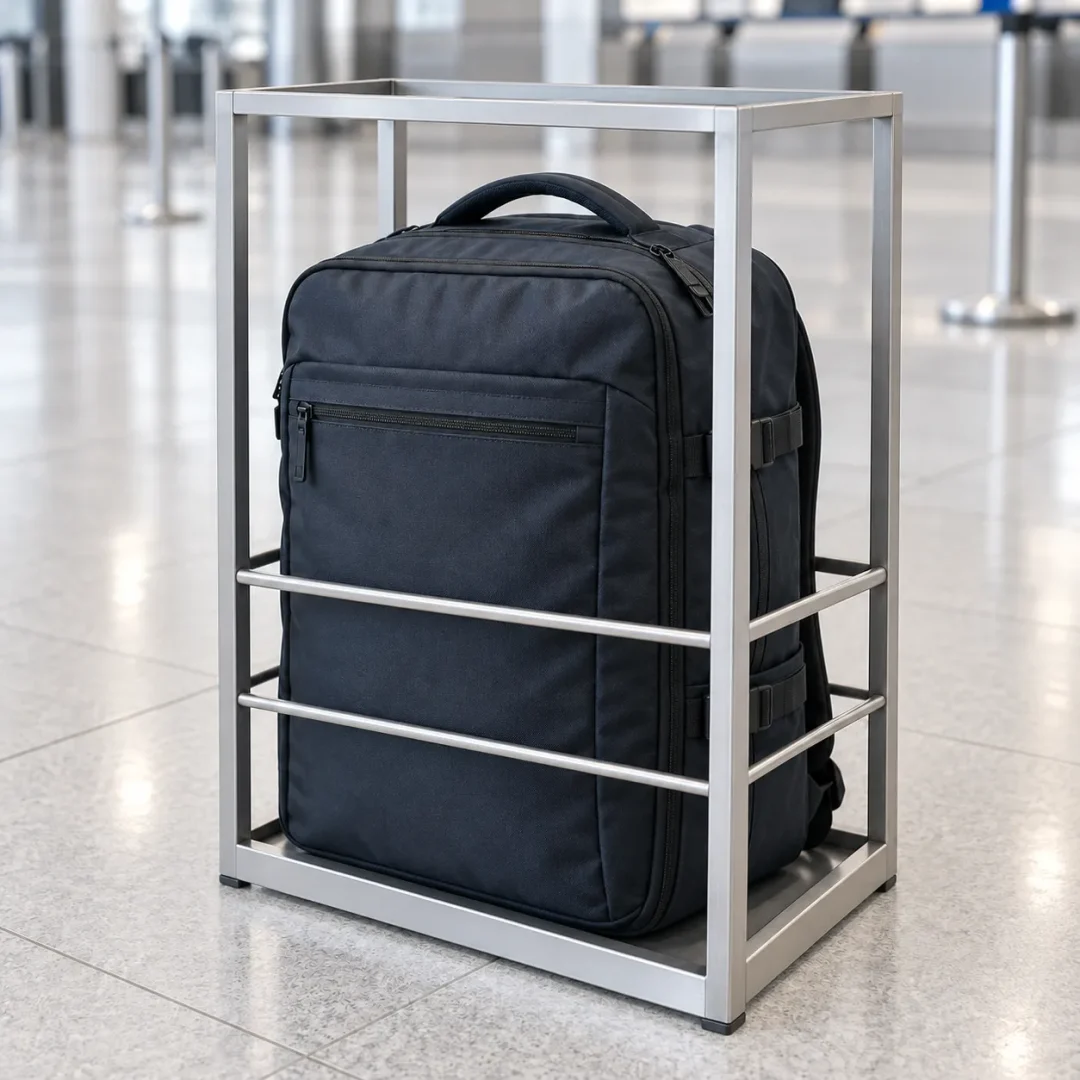
What 22 × 14 × 9 Inches Actually Means
A 22 × 14 × 9-inch box has a volume of 2,772 cubic inches, approximately 45.4L. Its three sides also add up to 45 linear inches.
These are different measurements. A 45-inch linear total does not define one unique box. If an airline publishes individual side limits as well as a linear total, both requirements matter.
The same distinction applies to nominal backpack capacity. Consider two illustrative external shapes:
| External dimensions | Calculated rectangular volume | Compared with a 40 × 30 × 20cm limit |
|---|---|---|
| 40 × 30 × 20cm | 24L | Meets the individual side limits |
| 48 × 25 × 20cm | 24L | Exceeds the 40cm side limit |
Both boxes have the same volume. Only one has the required proportions. A 24L label therefore cannot guarantee personal-item compliance.
Airline Carry-On Examples
The following table summarizes selected official policies reviewed on October 19, 2026. It is a comparison of specified bag categories, not a promise that every fare includes an overhead bag. Dimensions retain each airline’s published units; equivalent metric and imperial figures may be rounded differently.
| Airline or bag category | Published maximum size | Weight or booking consideration |
|---|---|---|
| Delta carry-on | 22 × 14 × 9in; also 45 linear inches | Aircraft and available cabin storage can affect acceptance |
| American Airlines carry-on | 22 × 14 × 9in, including handles and wheels | Must fit the sizer; some aircraft have additional restrictions |
| Ryanair free personal bag | 40 × 30 × 20cm | Included in all fares; stows under the seat |
| Ryanair Priority & 2 Cabin Bags: additional overhead bag | 55 × 40 × 20cm | Up to 10kg; requires the applicable baggage entitlement |
| easyJet free small cabin bag | 45 × 36 × 20cm | Up to 15kg; must fit under the seat |
| easyJet large cabin bag | 56 × 45 × 25cm | Up to 15kg; requires an eligible booking, benefit, or added bag |
| British Airways cabin bag | 56 × 45 × 25cm | Must be liftable into the overhead compartment without assistance; check booking details |
| Lufthansa carry-on | 55 × 40 × 23cm | Up to 8kg per permitted piece; number of pieces and inclusion depend on travel conditions |
| Air France hand baggage | 55 × 35 × 25cm | Economy total with small bag: 12kg; overhead entitlement depends on fare |
| Emirates Economy carry-on | 55 × 38 × 22cm | Up to 7kg under the general Economy rule; route exceptions apply |
| Qatar Airways Economy carry-on | 50 × 37 × 25cm | One piece up to 7kg under the general Economy rule; route exceptions apply |
| ANA carry-on | 55 × 40 × 25cm; combined dimensions within 115cm | Carry-on and personal item together: up to 10kg |
| Cathay Pacific Economy example | 56 × 36 × 23cm | Official route guidance lists one 7kg carry-on plus a small personal item; confirm the applicable allowance for the booking |
Several differences are easy to miss. A bag that measures 55 × 40 × 23cm is deeper than Ryanair’s 55 × 40 × 20cm overhead limit. A bag that is 55cm tall exceeds Qatar Airways’ published 50cm length limit, even if its other dimensions are smaller.
This is why a larger theoretical box volume does not necessarily mean a particular backpack will fit. Compare the relevant sides directly.
IATA Guidance Is a Reference, Not a Universal Allowance
IATA’s passenger baggage guidance explains that baggage allowances remain airline specific. It gives 56 × 45 × 25cm as a general carry-on reference used by many airlines, while noting variation by airline, cabin class, and aircraft.
Do not treat “IATA size” as an approval applicable to every flight. The airline’s published conditions and the baggage entitlement attached to the booking remain the relevant checks.
For an itinerary involving several airlines, compare every flight. Choose a bag whose packed dimensions satisfy all applicable limits, rather than choosing to the most generous allowance and assuming the other airlines will accept it.
What 20L- 50L Travel Backpacks Are Useful For
Trip length helps frame the choice, but it does not determine capacity on its own. A spare pair of shoes, a large laptop, camera equipment, or winter clothing can change the packing requirement more than several extra travel days.
The following ranges are practical planning examples, not measured packing guarantees or airline approvals.
| السعة | Useful starting point | Main consideration |
|---|---|---|
| 20L | Day trips, overnight travel, or a compact companion to checked luggage | Limited room once a laptop and accessories are added |
| 25–30L | Light weekend packing or longer trips with a small wardrobe and regular laundry | Verify dimensions before treating it as a personal item |
| 35L | Clothing, toiletries, and everyday electronics for travelers packing selectively | Separate shoe and laptop compartments can reduce clothing space |
| 40L | One-bag trips needing more clothing or equipment | Check loaded depth and weight before filling all available space |
| 45L | Travelers who need extra storage and have a compatible overhead allowance | Less room for dimensional error; external shape still decides fit |
| 50L | Bulkier equipment, outdoor use, or trips where checking the bag is acceptable | Do not assume it qualifies as cabin baggage |
20L: Compact Packing and Everyday Use
A 20L backpack can suit an overnight stay with a change of clothes, a compact toiletry kit, and small electronics. It also works as an everyday bag at the destination when the main luggage stays at the hotel.
The limitation becomes clearer when the bag includes a heavily padded laptop compartment or several organizers. Those features may be useful, but the main compartment can feel considerably smaller than the overall capacity suggests.
For personal-item travel, check the bag’s height and depth carefully. A slim commuter backpack can be too tall for a particular airline even when its capacity is modest.
25–30L: Light Travel With a Defined Packing List
This range offers more flexibility for a weekend or a longer trip built around regular laundry. It can be attractive when you want a backpack that remains useful for work or daily use after the trip.
The packing list matters. Compact clothing and one pair of shoes worn throughout the journey leave more room than a second pair packed inside. A camera insert, thick charger, or large water bottle can noticeably change the remaining space.
A 30L backpack can work for extended travel, including cooler destinations, if the packing system suits the trip. It is not limited to warm climates, but bulky clothing and specialist equipment make the compromise more demanding.
35L: More Flexibility Without Automatically Moving to the Largest Bag
A 35L pack is a useful size to compare when you need clothing storage alongside a laptop, toiletries, and smaller accessories. Whether it suits a few days or a week depends on wardrobe choices, laundry access, and equipment.
Look beyond the capacity number. A broad, shallow main compartment may accept folded clothes and packing cubes differently from a tall, narrow compartment. A separate shoe tunnel may be convenient while reducing the uninterrupted space available for other items.
40L: Room for a Broader Travel Load
A 40L backpack provides additional packing room, but the extra capacity is useful only if the bag remains manageable and meets the intended transport rules.
Check the main compartment with the front organizer loaded. A backpack that fits an airline’s depth limit with an empty front pocket may exceed it once chargers, toiletries, or a jacket are added.
This is also a useful point to assess carrying comfort. A bag with room for more belongings should have a harness suited to the expected load, rather than relying on capacity alone as its main selling point.
45L: Extra Capacity With More Careful Checking
A nominal 45L backpack is not automatically too large, and it is not automatically a carry-on. The outcome depends on its actual shape, the capacity measurement method, and its packed dimensions.
When comparing a 40L and 45L model, examine whether the additional space comes from a deeper body, a taller frame, expansion, or external pockets. These changes have different consequences at the airport.
A larger soft bag can sometimes be packed below its maximum size. However, a fixed frame, stiff base, or rigid back panel may prevent meaningful reduction. Check the actual structure before assuming partial packing solves the problem.
50L: Plan for the Possibility of Checked Baggage
A fully loaded 50L travel backpack warrants careful checking against cabin rules. Outdoor models may also have tall frames, projecting lids, or attached equipment that complicates the comparison.
If cabin travel is the priority, compare its packed measurements with a smaller model before buying or developing it. If checking the bag is acceptable, additional capacity may be useful, but external straps and the carrying system should be prepared for handling.
Weight Limits: A Backpack Can Fit and Still Be Overweight
Size and weight must be checked independently. There is no reliable universal conversion from liters to kilograms: a bag filled with lightweight clothing weighs differently from one carrying books, camera equipment, and electronics.
Airline rules also use different counting methods. Some specify weight per piece; others combine the cabin bag and personal item. Higher-cabin allowances may involve more pieces rather than a heavier individual bag.
Start With the Empty Bag’s Weight
Suppose your allowance is 7kg and the backpack weighs 1.5kg empty. That leaves 5.5kg for everything packed inside. A 1kg backpack would leave 6kg under the same limit.
This is an arithmetic example, not a suggested universal backpack weight. It shows why the empty bag’s weight belongs beside capacity and dimensions in a useful product specification.
Features such as padded dividers, a rigid frame, numerous organizers, and heavy hardware can improve protection or convenience while adding weight. The right balance depends on how the bag will be used.
Separate Per-Piece and Combined Allowances
ANA’s published 10kg allowance covers the carry-on and personal item together. Air France’s Economy 12kg allowance also applies to the combined permitted cabin baggage. Moving belongings into the smaller bag does not reduce the combined total.
Emirates distinguishes between Economy, Premium Economy, and Business or First Class. Qatar Airways also distinguishes a single Economy piece from the combined allowance for two higher-cabin pieces. Read those conditions as separate baggage products, not as interchangeable numbers.
For a multi-airline journey, check both the strictest applicable dimensions and the relevant weight calculation. Do not assume all European low-cost airlines, or all airlines in any other region, share one weight rule.
Personal Item Versus Overhead Carry-On
A personal item normally travels under the seat in front of you. A larger carry-on normally travels in the overhead compartment. Airlines use different names for these categories, so check the actual storage location and allowance rather than relying on the label.
| Official policy example | Personal item or small underseat bag size |
|---|---|
| American Airlines | 18 × 14 × 8in |
| British Airways | 40 × 30 × 15cm |
| Air France | 40 × 30 × 15cm |
| Ryanair | 40 × 30 × 20cm |
| easyJet | 45 × 36 × 20cm |
| ANA | 40 × 30 × 20cm |
Sources are linked in the airline comparison above. Special seating positions and aircraft arrangements may change where a bag must be stowed.
There is no single “safe personal-item capacity.” A bag fitting a 40 × 30 × 20cm allowance may still be too deep for a 40 × 30 × 15cm allowance. The capacity printed on either bag does not resolve that difference.
Can You Travel With Only a Personal Item?
Personal-item-only travel is possible when the packing list fits the permitted bag. Plan around the items with the least flexibility: laptop size, medical necessities, work equipment, required clothing, and footwear.
Then decide how often you can wash clothes and whether you need to carry additional layers. A compact wardrobe can support a long trip, while a short business trip with formal shoes and equipment may need more space.
If using two bags, verify that the booking permits both. A second backpack is not automatically an additional free item simply because it is small.
Opening Systems: Clamshell, Panel-Load, and Top-Load
Opening style affects packing and access. It does not independently determine whether the backpack passes an airline sizer.
| Opening system | Main advantage | What to check when loaded |
|---|---|---|
| Clamshell | Wide access for arranging clothing and organizers | Bulging panels, zipper tension, and overall depth |
| Panel-load | Front access with a U-shaped or similar opening | Whether the access opening accommodates the intended contents |
| Top-load or roll-top | Flexible access from above; some designs adjust in height | Tall frames, overfilled upper sections, and the closed height |
These terms can overlap. A front-opening panel-load backpack may also be described as clamshell-style if it opens sufficiently wide. For a custom specification, an opening drawing or reference sample is clearer than the name alone.
Compression Helps Within Structural Limits
Compression straps can control some outward movement, particularly when the contents are soft and there is unused space. Adjustable closures or expansion sections can also change the bag’s external size.
They cannot shorten a rigid frame or compress a laptop. Straps also need to act on the area that is expanding: a side strap may do little to restrain a separate front pocket.
For development, load the intended compartments and compare measurements before and after normal adjustment. This provides a more useful result than assuming that adding straps guarantees cabin compliance.
Materials, Weight, and Carrying Structure
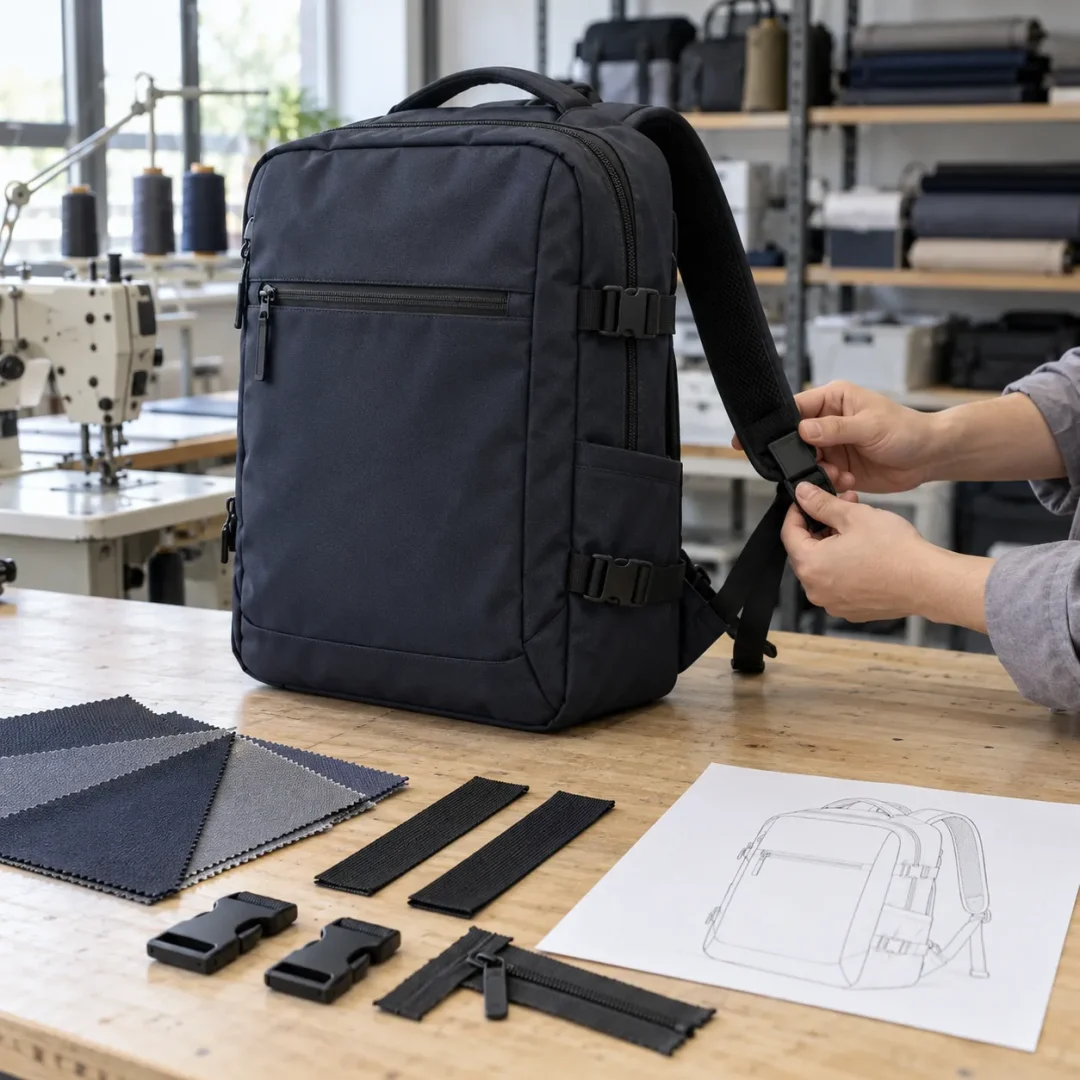
Material selection affects weight, shape retention, abrasion performance, and appearance. It should be evaluated as part of the complete backpack, including lining, foam, reinforcement, zippers, webbing, and hardware.
Denier Is One Specification, Not a Durability Rating
Denier describes yarn linear density. It does not provide a complete ranking of finished-fabric durability. Fiber type, weave, yarn construction, fabric weight, coatings, and test conditions also matter.
Comparing two otherwise similar fabrics by denier can be useful. Comparing unrelated materials solely by their D number can be misleading. For bulk sourcing, request the complete material specification and relevant performance results rather than relying on a single number.
Padding and Back Panels Use Space but Provide Function
A padded laptop sleeve and structured back panel reduce some available room while helping organize and protect equipment. A softer body may compress more easily, but its carrying comfort depends on the harness and load distribution.
Water-resistant face fabric also does not make the entire backpack waterproof. Seams, zipper construction, openings, and assembly determine how the completed bag handles water exposure.
| Construction choice | Potential benefit | Trade-off to evaluate |
|---|---|---|
| Lightweight outer fabric | Can reduce empty weight | Suitability for abrasion, tear, and intended use |
| Reinforced base | Supports wear resistance in a high-contact area | Added weight and reduced compressibility |
| Padded laptop compartment | Equipment separation and cushioning | Less flexible packing space |
| Rigid or semi-rigid back panel | Shape retention and load support | A minimum size that may resist compression |
| Multiple organizers | Easier separation of small items | Extra material, seams, and divided storage space |
| Coating or laminate | Can improve water resistance or structure | Added weight, flexibility, and aging behavior |
Fit the Harness to the Intended Load
Capacity does not describe torso fit or carrying comfort. Check strap spacing, padding, adjustment range, back-panel shape, and where the loaded bag sits on the wearer.
A properly designed load-bearing hip belt can be helpful for heavier loads and longer walks. A simple webbing waist strap mainly provides stability and should not be presented as equivalent. Smaller bags and short transfers may not require the same harness complexity.
For product-range planning, separate daily business travel, short leisure trips, and equipment-heavy travel before selecting one harness for every model. INITI’s custom backpack range provides examples of different applications and compartment layouts that can inform that discussion.
How to Measure a Packed Travel Backpack
Measure the configuration you actually intend to carry. Include belongings in the laptop sleeve, organizer, side pockets, and any separate lower compartment—not just the main cavity.
1. Pack the Intended Contents
Use the real packing list, or an agreed representative load for product development. Decide whether the expansion section is open or closed and keep that condition consistent throughout the check.
If a pocket shares space with the main compartment, filling both may change the bag’s shape. The measurement should reflect how the design is intended to be used.
2. Measure Height, Width, and Depth
Place the loaded bag on a level surface without pressing it flat. Use straightedges or two flat boards to identify the outermost points, then measure the distance between them.
Measure all three sides. Include filled external pockets and fixed protrusions that contribute to the outside size. Secure loose straps as they will be secured for travel, and include handles or wheels wherever the airline requires them.
The goal is to measure the outside of the loaded bag, not the distance between stitching lines. Repeat with the bag repositioned if the contents shift significantly.
3. Test the Relevant Rectangular Space
A rigid box or frame with the correct internal dimensions can help check fit. A rectangle marked on the floor checks only two dimensions and cannot reveal excess depth.
Apply the airline’s fitting requirements. Do not rely on unusual force or on temporarily crushing contents to make the bag appear smaller. If normal compression is part of the design, measure after adjusting it in the way the traveler will use it.
4. Weigh the Complete Load
Use a luggage scale and apply the airline’s per-piece or combined-weight rule. Include accessories attached to the bag and account for items added after the initial packing check.
5. Record the Result for Samples
For custom backpacks, keep the load list, photographs, empty weight, packed dimensions, and expansion state with the approved sample. Agree a measurement procedure and production tolerances before bulk production.
There is no universal tolerance that ensures airline acceptance. A sample designed exactly at a published limit has little allowance for changes in loading or production variation.
Backpack or Rolling Suitcase?
A backpack can be useful on stairs, uneven surfaces, and journeys involving frequent walking. A rolling suitcase reduces the need to carry the main load on the shoulders when the route is suitable for wheels.
Compare actual products. Wheels, handles, frames, and padded harnesses all occupy space and add weight, but their practical value depends on the trip.
Soft-sided backpacks can sometimes be compressed, whereas rigid cases retain their outer size. That flexibility is useful only when the packed backpack still meets the rules. A backpack does not receive a different dimensional allowance simply because it is worn on the back.
Cabin storage can also be unavailable even when the bag meets the published limits. Keep essentials accessible and follow the airline’s instructions if an overhead bag needs to travel in the hold. Spare batteries and power banks require separate attention under the applicable airline safety rules.
Common Travel Backpack Size Mistakes
Choosing by liters alone. Capacity describes storage, while airline acceptance depends on packed dimensions, weight, entitlement, and operating conditions.
Assuming a familiar US size works worldwide. Similar-looking airline limits may differ in height, width, or depth. A few centimeters can matter when a bag is already near the maximum.
Measuring only the main body. A loaded organizer, water bottle, stiff handle, or expanded section may change the outer measurements.
Treating a larger half-empty bag as automatically compliant. Underpacking helps only if the structure can reduce to the required dimensions.
Moving weight between bags without checking the counting rule. Where a combined limit applies, redistributing the contents does not reduce total weight.
Assuming an overhead bag is included. Read the fare conditions and added-baggage details separately from the size chart.
Confusing security screening with baggage allowance. Security requirements govern what can pass screening; the airline determines the applicable cabin-baggage allowance. Passing security does not establish that a bag qualifies for the flight.
Frequently Asked Questions
What Size Backpack Do I Need for a Week?
Compare approximately 30–40L first if you pack selectively and have access to laundry. You may need less space for a compact wardrobe or more for spare footwear, equipment, and bulky clothing. Confirm the packed dimensions and weight against your flights before choosing the final size.
Is a 40L Backpack Carry-On Size?
It can be, but 40L is not a carry-on certification. Check the loaded bag’s height, width, depth, and weight, plus whether your ticket includes the relevant bag category.
Is a 45L Backpack Too Large for Cabin Travel?
Not necessarily. Some nominal 45L designs may meet a particular airline’s limits, while others will not. A capacity label cannot replace a packed-dimension check.
Is a 50L Backpack Too Big for Carry-On?
A fully loaded 50L bag may exceed the permitted dimensions, especially if it has a tall frame or projecting pockets. Check the specific model and airline. If you need dependable cabin-only travel, compare a smaller design before committing to the larger capacity.
How Many Liters Is a 22 × 14 × 9-Inch Carry-On?
Those dimensions define a rectangular volume of approximately 45.4L. That is the volume of the surrounding box, not a measurement of usable storage inside a backpack.
Can a 24L Backpack Be a Personal Item?
Possibly, if its packed dimensions and other conditions meet the airline’s allowance. Two 24L backpacks can have different proportions, and some personal-item limits are shallower than others.
Is a 30L Backpack Enough for Two Weeks?
It can be if your clothing, equipment, and laundry arrangements fit that space. Length of stay alone is not decisive. Check the volume and weight of the items you need, particularly footwear, electronics, and cold-weather layers.
Should I Choose a Full 40L Bag or a Partly Filled 50L Bag?
Compare their actual packed measurements and comfort under the intended load. The 50L bag may remain too tall because of a fixed frame, while a flexible design may compress. The smaller bag may also become too deep when overfilled. Neither label settles the decision.
Are 45L Backpacks Allowed on Ryanair?
Ryanair’s additional overhead cabin bag under Priority & 2 Cabin Bags must meet 55 × 40 × 20cm and the 10kg limit. Its free personal bag is smaller. Check your backpack in its packed configuration and confirm which baggage product is included in your booking.
Do Airlines Weigh Carry-On Backpacks?
Airlines may check cabin-baggage weight. The applicable limit and whether bags are weighed separately or together depend on the policy. Weigh your bags before travel rather than predicting whether a particular airport will check them.
Do Compression Straps Make a Backpack Carry-On Compliant?
They may reduce bulging, but they cannot overcome a rigid frame or non-compressible contents. Measure the adjusted, packed bag; do not assume the feature guarantees fit.
Can a Backpack Be Called Airline Approved?
Avoid treating that phrase as a universal guarantee. A clearer description states the bag’s dimensions, measurement condition, and intended baggage category, then directs travelers to the requirements for their actual booking.
Specifying Custom and Wholesale Travel Backpacks
For brands, importers, retailers, and promotional suppliers, a travel backpack specification should connect the intended customer use with measurable product requirements. Starting with a liter target alone leaves important questions unanswered.
Define the Target Baggage Category First
Decide whether the product is intended as an underseat personal item, an overhead travel backpack, a business-travel bag, or a larger backpack that may be checked.
Identify the target market and relevant dimension limits, then develop the pattern and compartment arrangement around that brief. If the product is aimed at several airlines, compare their individual side limits rather than selecting the largest theoretical volume.
Some projects may need two sizes instead of one product advertised for every use. A compact underseat model and a larger overhead model can serve different packing needs more clearly than an oversized expandable design with an ambiguous claim.
Agree the Product Specification and Verification Method
| Specification item | What to agree before sample approval |
|---|---|
| Intended use | Customer profile, trip type, and baggage category |
| External dimensions | Height, width, and depth; identify the measurement state |
| السعة | Measurement method and which compartments are included |
| Expansion | Dimensions and capacity with expansion open and closed |
| Empty weight | Target finished weight and agreed production tolerance |
| الحجرة الرئيسية | Packing layout, opening style, and organizer compatibility |
| Laptop storage | Usable internal dimensions, padding, and access |
| External pockets | Loading conditions and their effect on overall depth |
| Harness | Strap design, adjustment, reinforcement, and intended load |
| المواد | Face fabric, lining, foam, reinforcement, coating, and trims |
| Branding | Logo method, placement, size, and effect on construction |
| Sample verification | Representative load, measurement procedure, photographs, and approval record |
A separate wet compartment, shoe section, or insulated lower pocket can add useful functionality, but it also changes the packing layout. INITI’s multi-compartment travel backpack example illustrates this type of compartment planning; it should not be treated as proof of compatibility with every airline.
Validate Capacity, Fit, and Construction Separately
A sample may reach the intended capacity but become too deep when loaded. Another may meet the external dimensions while offering less practical clothing space because of internal dividers. These are separate outcomes and need separate checks.
An agreed sample-review process can examine empty dimensions and weight, capacity under the chosen method, packed measurements under a representative load, zipper access, and carrying comfort. Relevant seam, attachment, and material performance should also be assessed against the intended use and buyer requirements.
Describe these as checks to agree with the supplier, rather than implying a specific test program has already been completed. Actual test results should identify the sample, method, loading conditions, and outcome.
For retail specifications, favor measurable statements such as “external dimensions with expansion closed” and “empty weight” over an unqualified “fits all airlines” claim. This gives buyers and travelers information they can compare with their own requirements.
INITI works with bulk buyers on backpack size, materials, compartments, harness details, and logo application. To discuss a custom travel backpack, send INITI your target dimensions and design requirements, including the intended baggage category, capacity measurement expectations, packing scenario, and reference details.


 Arabic
 English
 French
 German
 Japanese
 Thai
 Vietnamese
 Russian
 Spanish
 Portuguese